






A collector's guide to Denton Mine, USA: its geology, mining history and notable minerals, illustrated with the 573 specimens documented from this locality on EarthWonders.
Key facts
Denton Mine is one of the great late chapters of the Illinois-Kentucky Fluorspar District: an underground bedding-replacement fluorspar mine in the Harris Creek Subdistrict of Hardin County, southern Illinois, roughly north of Cave-in-Rock and northwest of the Rock Creek Graben. To collectors, its importance is not just that it was productive, but that it was productive at the right time and in the right ground. Ozark-Mahoning’s mining in the 1980s and early 1990s opened Rosiclare and sub-Rosiclare horizons that yielded fluorite in some of the most coveted American styles: lustrous cubes with purple skins, blue and yellow interiors, sharp phantoms, stepped growth, and dramatic associations with honey calcite, ruby-brown sphalerite, bright galena, chalcopyrite, and bladed barite.
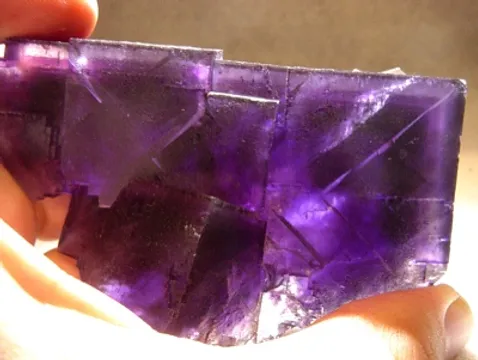
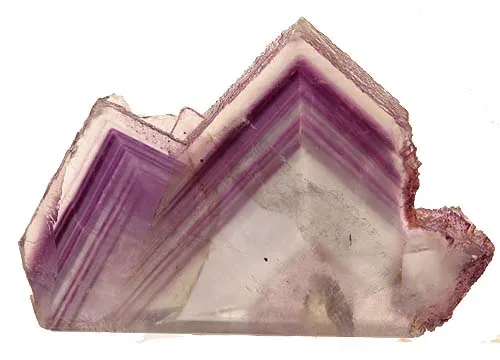
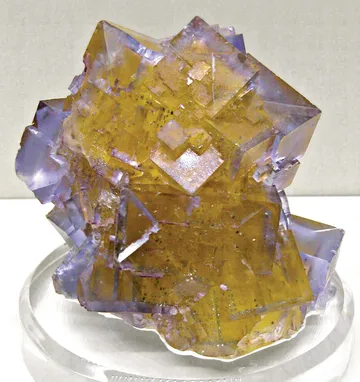
The deposit was a Mississippi Valley-type fluorspar system, but Denton’s specimen character is more nuanced than that phrase suggests. Ore replaced limestone in tabular, lenticular bodies guided by northeast-southwest fractures; in places the replacement ore formed banded “coontail” textures of yellow fluorite, purple spar, calcite, and remnant limestone. In the collector’s cabinet, that geological layering reappears as color zoning and phantom architecture: cubes that can look dark grape-purple in reflected light, then flare into blue, yellow, lavender, or smoky internal geometry when backlit.
Regional View
Country View
Denton also matters historically because it belongs to the final modern producing period of southern Illinois fluorspar mining. Along with Annabel Lee and Minerva No. 1, it was one of the mines that kept the district alive after many older Cave-in-Rock and Rosiclare operations had become history. Its specimens consequently bridge two worlds: they are classic Illinois fluorites, yet many have unusually precise mine-level, pod, and collector provenance from working miners, mine geologists, and contemporary field collectors.

Photo: Wikimedia Commons
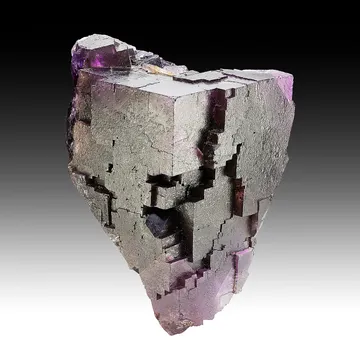
The best Denton pieces are instantly recognizable. Fluorite cubes may sit as isolated architectural blocks, stepped stacks, mounded clusters, or cabinet-size plates. The elite examples combine large size with transparency, crisp edge definition, undisturbed faces, and internally legible zoning. Calcite can be equally important here: the Bahama Ore Body produced glassy golden to orange crystals that are counted among the district’s most desirable calcites. Barite adds a different texture altogether, typically as pale bladed or diamond-shaped crystals on purple fluorite. Sphalerite and galena, when well-crystallized, make Denton combinations feel heavier, darker, and more MVT in character than the purely gemmy fluorite clusters.

Photo: Wikimedia Commons
Search for specimens: View all specimens from Denton Mine, USA
Denton Mine is in the Harris Creek Mining Subdistrict, Hardin County, Illinois, within the Illinois-Kentucky Fluorspar District. Its main shaft was in the SW¼ of Section 9, T11S, R9E, and the mine lies roughly 6.5 miles north of Cave-in-Rock. The locality is commonly seen on specimen labels as “Denton Mine, Harris Creek Subdistrict,” but older and dealer labels may also fold it into the Goose Creek Mine Group or the broader Cave-in-Rock/Illinois-Kentucky Fluorspar District. Those labels reflect district usage more than exact geology: the Harris Creek mines are generally bedding-replacement deposits, whereas the neighboring Goose Creek subdistrict is more characteristically vein-type.
The Denton ore was a tabular bedding-replacement or stratiform fluorspar deposit hosted in Mississippian carbonate strata, especially around the Rosiclare and sub-Rosiclare levels, with some mineralization also recorded at the Bethel level. The local rock section includes Lower Chesterian units in the Glen Dean-Renault interval. Ore-bearing fluids moved along subtle northeast-southwest fractures, replacing receptive limestone beds and producing fluorite-rich bodies with calcite, barite, galena, sphalerite, chalcopyrite, and quartz. In mine descriptions, the replacement ore is described as banded, lenticular, and locally collapsed into V-shaped high-grade zones; the resulting coarsely crystalline ore is exactly the environment that gave collectors large, separated crystals rather than only massive spar.
Mining was by underground room-and-pillar methods. A 1982 underground visit by Illinois State Geological Survey geologists documented ore-grade replacement beneath the Rosiclare, in the uppermost Ste. Genevieve Limestone, following a northeast-trending fracture belt about 75 to 150 feet wide. The main production shaft is reported in later mine summaries as approximately 688 feet deep, with additional shafts for ventilation and escape. Production began around the start of the 1980s under Ozark-Mahoning; published summaries list strong output in the mid-1980s, including tens of thousands of metric tons per year, and a later Illinois State Geological Survey circular records 967,503 raw tons of ore extracted from the mine before closure.
The mine’s specimen output is closely tied to named ore zones and pods. The Rosiclare Level and Sub-Rosiclare Level produced most of the collectible fluorite, calcite, sphalerite, galena, chalcopyrite, and barite combinations. The “Lillie Pod” at the North End is associated with early- to mid-1980s fluorites, often purple to lilac with yellow/orange internal color and chalcopyrite or barite accents. The “Butterknife Pod,” mined in the later 1980s, is associated with fluorite on sphalerite and with fine calcite-on-fluorite combinations. The Bahama Ore Body, discovered by drilling cross sections at near right angles to the main Denton trend, became legendary for golden calcite and purple fluorite from the Rosiclare and sub-Rosiclare horizons. It was narrow and comparatively small, but rich enough to justify driving a drift; the nickname came from its position south of the main trend, “on its way to the Bahamas.”
Today Denton is a closed underground mine. The significant specimen supply is not from casual field collecting but from old mine-run material, former miner and collector holdings, dealer archives, and estate dispersals. Access should be treated as closed and unsafe unless a landowner or lawful operator has explicitly granted permission; underground fluorspar workings are not recreational collecting sites. For collectors, provenance is therefore a major part of value. A Denton specimen with a mine-level, pod, date, miner, or Ross C. Lillie collection number carries information that cannot be recreated once separated from the piece.
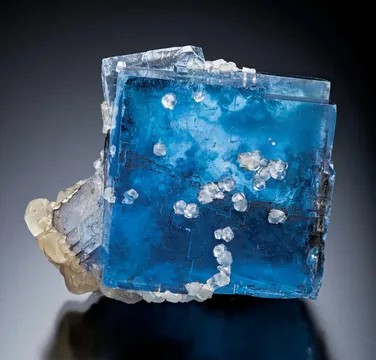
Fluorite is the signature Denton mineral, and the finest pieces show why southern Illinois remains a benchmark for American CaF2. Typical collector specimens are cubic, lustrous, and purple to lavender in reflected light, but the best examples reveal yellow, blue, gray-blue, or pale violet internal zoning when backlit; some have sharply defined phantoms, stepped or mounded faces, secondary overgrowths, and occasional modified edges. Crystal sizes range from thumbnail cubes to cabinet crystals several centimeters across, with exceptional single cubes documented above 8 cm and large matrix specimens still appearing from old collections. Associations are central to Denton’s appeal: fluorite occurs with calcite, sphalerite, galena, chalcopyrite, barite/baryte, and quartz, and the strongest specimens combine transparency, intact edges, high luster, sculptural arrangement, and a color display that changes dramatically between reflected and transmitted light.
Denton calcite ranges from colorless rhombs and small accents on fluorite to major golden, amber, honey, and orange crystals that can dominate a specimen. The Bahama Ore Body is the great calcite source here: pockets along the Rosiclare and sub-Rosiclare horizons produced glassy deep golden crystals, including reported singles to about 30 cm in cavities up to 8 m long. Smaller collector pieces commonly show scalenohedral, rhombohedral, twinned, or doubly terminated habits perched on purple zoned fluorite, sphalerite, limestone, or brecciated Rosiclare sandstone. Good Denton calcite is judged by luster, warm color, transparency, sharpness, freedom from bruising, and how naturally it composes with fluorite; a glassy amber calcite isolated over purple fluorite is far more desirable than ordinary late white calcite coating a damaged spar plate.
Sphalerite from Denton is usually the dark, lustrous zinc sulfide partner to fluorite rather than the headline species, but on better pieces it becomes a rich visual foundation: reddish-brown, honey-brown, resinous, or nearly black crystals forming druses and matrices beneath purple to blue-zoned cubes. Dealer and collection records tie fine sphalerite-fluorite combinations to the Rosiclare Level, including material attributed to the Butterknife Pod, where early pale fluorite could be coated by sphalerite and then followed by later purple fluorite perched on top. Quality depends on crystal luster and visibility; the most attractive specimens show clean sphalerite faces with red-brown flashes, contrasting fluorite cubes, and minimal bruising, while lesser examples reduce sphalerite to a dark granular base hidden under fluorite.
Galena at Denton occurs as silvery lead-gray crystals with fluorite, sphalerite, chalcopyrite, calcite, and barite, and it is part of the lead by-product suite of the mine’s fluorspar ore. Collector specimens show cubes and modified cuboctahedral crystals, sometimes as small bright accents on sphalerite or as a more massive crystallized base beneath purple fluorite. The best Denton galena combinations have clean metallic luster, distinct crystal form, and good placement relative to the fluorite—small sharp galenas tucked among color-zoned cubes can be more desirable than larger but dull or abraded masses. Because Denton fluorite on reddish sphalerite with galena can superficially recall Elmwood, Tennessee combinations, locality confidence rests on the Illinois-style color zoning, associated calcite or chalcopyrite, and reliable provenance.
Chalcopyrite is a classic Denton accent mineral, most often seen as small brassy crystals sprinkled on fluorite faces or enclosed within the fluorite itself. On Lillie Pod and North End material, tiny metallic yellow chalcopyrites can sharpen the color contrast against lilac, purple, or yellow-zoned cubes, and some pieces are valued specifically for the way the chalcopyrite appears suspended in transparent fluorite. Large standalone chalcopyrite crystals are not the locality’s main draw; the best specimens are balanced fluorite-chalcopyrite combinations with bright, undulled sulfide crystals, strong zoning, and no distracting edge wear. When chalcopyrite is sparse but well placed, it can turn an otherwise attractive Denton fluorite into a distinctly Illinois specimen.
Barite, the American trade spelling for BaSO4, is an important secondary aesthetic mineral at Denton and appears on many older U.S. labels for the mine. The notable Denton style is pale yellow-cream, white, colorless, bluish-gray, or translucent bladed to diamond-shaped barite sitting on purple fluorite, sometimes with chalcopyrite or calcite. A widely noted find produced several flats of attractive barite crystals on purple fluorite, with well-formed crystals reported to about 2 inches; these pieces stand out because the Illinois-Kentucky district is far better known for fluorite than for elite barite display specimens. Fine Denton barite is judged by translucency, luster, clean bladed form, attractive contrast on fluorite, and absence of the chalky whiteness or dullness that makes ordinary district barite less compelling.
Baryte is the same BaSO4 species as barite, but the spelling is common in European mineralogical usage and on international labels, auction records, and museum catalogues. Denton baryte specimens are particularly desirable when platy, translucent crystals sit clearly on dark purple fluorite cubes rather than merging into pale crusts. Miniatures and small-cabinet pieces from Denton can show baryte blades or rosettes crossing fluorite faces, with crystals a few centimeters across and, in the better examples, a delicate glassy to pearly luster that contrasts with the saturated fluorite beneath. For a Denton suite, a baryte-on-fluorite specimen fills a different visual niche from the more common fluorite-calcite and fluorite-sphalerite combinations, and competition-level examples are much scarcer than ordinary fluorite plates from the mine.
Other documented Denton minerals include quartz, and collector/photo records also note accessory sulfides and hydrocarbon-related inclusions or coatings in some fluorite. Denton is not a type locality famous for new species; its stature rests instead on specimen quality, pocket provenance, and the unusually fine expression of a limited MVT assemblage. That limitation is part of its identity: a Denton cabinet is built less by accumulating rare species than by choosing the right combinations of fluorite, calcite, sphalerite, galena, chalcopyrite, and barite from the mine’s named levels and pods.
Denton specimens reward close lighting. Many pieces that appear merely dark purple on a shelf become exceptional when backlit, revealing yellow cores, blue centers, lavender rims, phantom cubes, and growth episodes that are nearly invisible in reflected light. When evaluating a piece online, ask for both reflected-light and transmitted-light images if transparency is claimed. A strong Denton fluorite should hold its color without becoming muddy, but it should also show internal zoning rather than simple opaque purple mass.
Condition is the main grading issue. Fluorite has perfect cleavage and Denton cubes are prone to edge bruises, corner nicks, cleaved contacts, and chatter along raised steps. Large crystals with only minor peripheral wear are acceptable, especially on old mine-run specimens, but damage to the main display edge sharply reduces value. Calcite bruises and cleaves easily as well; amber scalenohedra from Bahama Pod should be inspected for repaired tips, rehealed breaks, and contact points. Sphalerite and galena are tougher visually but can be dull, scuffed, or oxidized, and galena-heavy specimens are dense enough that old matrix repairs or reattachments deserve scrutiny.
Restoration is documented in the market for Denton fluorite. At least one sold dealer specimen was explicitly described as having two small restored areas visible under UV light. That does not make Denton uniquely suspect—restoration is common in large fluorite specimens worldwide—but it does mean collectors should use ultraviolet inspection, magnification, and strong side-lighting on high-value pieces. Look for filled cleaves, mismatched luster along corners, unnatural fluorescence in repair resin, and seams where fluorite cubes meet matrix.
Mislabelling is a subtler concern. Denton material can be confused with other southern Illinois localities, especially Annabel Lee, Minerva No. 1, and broader Cave-in-Rock district material, because all share the same regional fluorite tradition. Some labels also use “Goose Creek Mine Group” for Denton, even though Harris Creek is a distinct bedding-replacement subdistrict in modern geological usage. More unusually, fluorite on reddish-brown sphalerite with galena can be mistaken at a glance for Elmwood Mine, Tennessee; Denton pieces tend to show Illinois-style blue-yellow-purple zoning and different galena-fluorite relationships, but provenance is essential.
Fluorescence is variable and should not be oversold. Dark purple to black Illinois fluorite is commonly weak to non-fluorescent, while some lighter material and hydrocarbon-bearing fluorite may show blue or yellow responses under UV. Petroleum or bitumen inclusions are of interest, but they are not present in every Denton specimen and should be described only when visible or tested. Avoid prolonged intense sunlight on sensitive fluorite displays; color stability varies across fluorite localities and conservative display practice is warranted.
Market availability is steady but finite. Denton closed decades ago, so new supply is essentially old stock, collection dispersals, and archived dealer material rather than active mine production. Modest miniatures, damaged cabinet plates, and dark fluorite clusters still appear regularly. Fine pieces with major backlit zoning, documented Lillie Pod or Bahama Pod provenance, glassy golden calcite, or unusual barite on fluorite are much scarcer and can command strong prices. The premium rises quickly for specimens that combine size, transparency, sharp zoning, intact edges, and old provenance.
In 1982, John Nelson and Donald K. Lumm of the Illinois State Geological Survey made a brief underground visit to Denton. The working level they saw lay in uppermost Ste. Genevieve Limestone beneath the Rosiclare Sandstone, reached from a deep skip shaft while mining advanced by room and pillar. What Nelson recorded was not a simple vein, but a replacement belt: ore-grade material following a northeast-trending fracture zone 75 to 150 feet wide. The ore replaced limestone in nearly horizontal, lens-shaped bodies, with crinkled bands of yellow fluorspar, purple spar, white to yellow-brown calcite, and unaltered limestone. That banded material—known to miners as “coontail”—is the underground texture behind the cabinet specimens collectors now prize for phantom zoning.
The same underground observations describe places where the limestone had collapsed into V-shaped zones parallel to the orebody. These zones could be 40 feet wide and 30 feet deep, and they carried exceptionally high-grade, coarsely crystalline ore. That detail is worth dwelling on: the spectacular crystals were not random ornaments in the mine, but part of a structural and chemical system where inconspicuous fractures, little or no displacement, carbonate replacement, and local collapse concentrated the spar. In a collector’s hand, a transparent purple cube with a yellow core is the polished remnant of that hidden architecture.
The Bahama Ore Body has the best Denton story because it sounds almost too casual for such important mineral specimens. It was found not by following the obvious main trend, but by drilling cross sections of diamond-drill holes nearly at right angles to it. The body was narrow and relatively small, but rich enough that a drift was driven from existing mine workings. It lay to the south, and Ross Lillie’s explanation for the name has become part of Denton folklore: it was “on the way to the Bahamas.” The name stuck, and so did the specimens.
The Bahama Ore Body repaid the effort with some of the finest calcite ever recovered in the district. On the sub-Rosiclare level, pockets linked by fractures along strike yielded hundreds of superb glassy orange to golden calcites. Single crystals reached 30 cm, and some cavities were up to 8 m long. The producing years, 1991 to 1993, came at the twilight of the Illinois fluorspar industry, making the find feel like a final bright flare before the district went quiet. For collectors, a Bahama Pod label carries more than locality information; it places the specimen in a named episode of discovery, development, and late-stage mine history.
The Lillie Pod is another name that turns a Denton label into a story. Specimens from the early development of the orebody in the 1980s are repeatedly tied to Ross C. Lillie, whose labels and database numbers now function almost like field notes preserved with the minerals. One documented November 1983 specimen from the Sub-Rosiclare Level carried large, sharp, gemmy multicolor fluorite cubes to 5.3 cm, studded with small chalcopyrite crystals. Another July 1984 specimen from the Lillie Pod showed purple fluorite on “ruby jack” sphalerite with small modified galenas. These are not anonymous district pieces; they are fragments of a mine being opened, mapped, collected, and remembered in real time.
The Butterknife Pod adds still another Denton style. Specimens attributed to it show fluorite and sphalerite relationships that can be unusually layered: an early pale, nearly colorless to light-purple fluorite stage, sphalerite druse overgrowth, and later isolated rich purple fluorite crystals perched above. Other Butterknife pieces carry amber calcite crystals on zoned purple fluorite, with enough balance that the calcite is not merely an accessory but the sculptural center of the specimen. Good Denton collecting means learning these pod personalities—not as rigid rules, but as clues that help a piece speak in the dialect of the mine.
.jpg)

