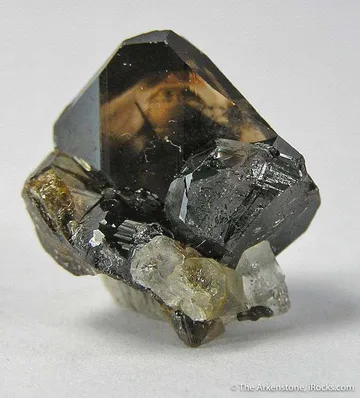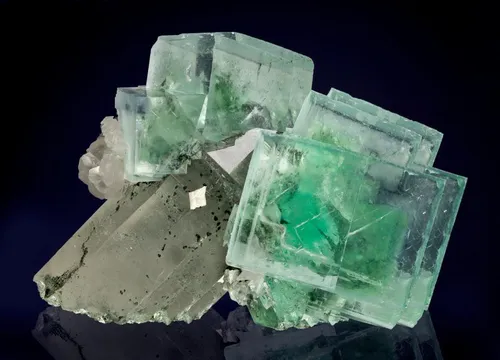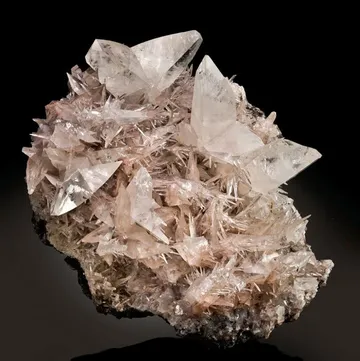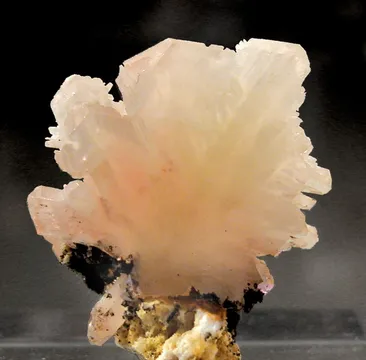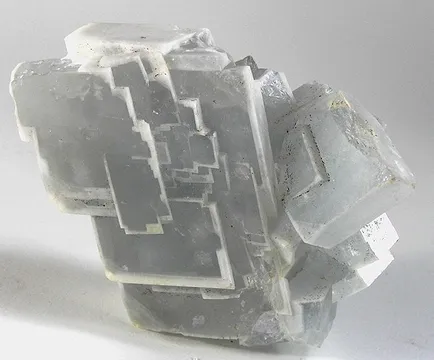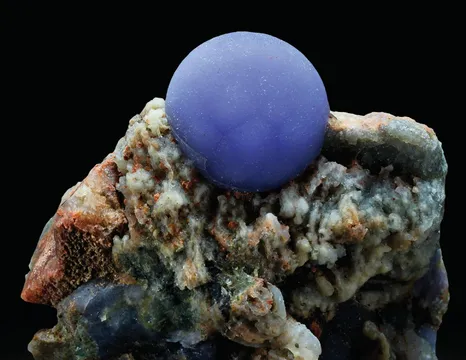
Henan, China — Minggang fluorite (violet/blue botryoidal forms) makes it notable, with type-localities like tongbaite and weishanite, a strong draw for collect…
Key facts
Henan is not a single-mine locality in the way that Yaogangxian or Huanggang are. For collectors, it is a province whose identity is built around a handful of very different mineralizing systems: the Minggang–Tongbai fluorite occurrences that produced China’s unforgettable purple and blue botryoidal fluorite; the Luanchuan molybdenum belt with giant porphyry–skarn Mo-W-Fe systems; the Weishancheng gold-silver belt in Tongbai County; the Taipingzhen rare-earth deposit at Xixia; and the rare-metal pegmatites of Guanpo and Nanyangshan in Lushi County. The result is a locality name that appears on cabinet fluorites, modest quartz-and-calcite association pieces, analytical rarities, and type-mineral literature rather than one tightly defined pocket or mine series.
The best-known collectible material is fluorite from the Minggang fluorite mine area near Xinyang and related Henan labels often sold as Minggang, Guxian, or Tongbai. These pieces are unlike the sharp cubic Chinese fluorites most collectors expect: instead, the finest are spherical to botryoidal aggregates, internally violet, lavender, blue, or rarer green, with surfaces made of tiny intergrown fluorite faces that can read as satin, sugary, or sparkling depending on the generation of growth. Good examples have a sculptural, almost organic silhouette—single rounded “bubbles,” turtle-shell mounds, or linked globes—often perched on quartz-rich matrix, occasionally with calcite.
Regional View
Country View
Henan’s broader mineralogical importance goes well beyond the specimen market. Tongbai County is a type-locality district for several species, including tongbaite, the chromium carbide Cr3C2, and weishanite, an Au-Ag-Hg amalgam from the Poshan Mine in the Weishancheng ore field. Farther west, the Guanpo pegmatite field and Nanyangshan pegmatites have produced lithium-, tantalum-, cesium-, and beryllium-bearing assemblages and type-locality mica and microlite-group minerals. Taipingzhen, in Xixia County, adds a rare-earth chapter: the type locality of taipingite-(CeCa), associated in the type material with calcite, fluorite, fluocerite-(Ce), allanite-(Ce), parisite-(Ce), gatelite-(Ce), and törnebohmite-(Ce).

Photo: Wikimedia Commons
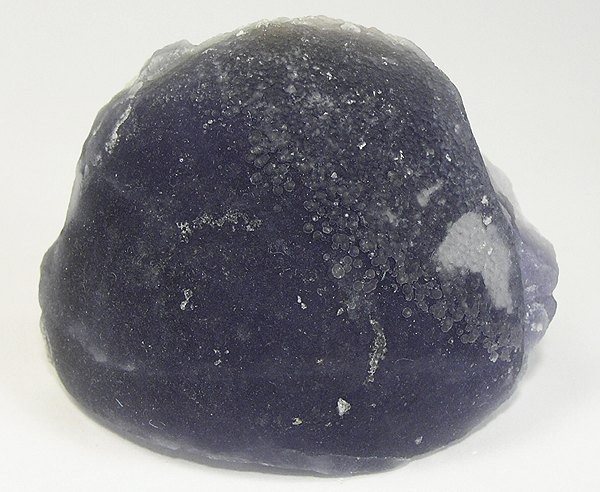
Photo: Wikimedia Commons
Search for specimens: View all specimens from Henan, China
Henan occupies a geologically busy position in central China, where the Qinling–Dabie orogenic system, the southern margin of the North China Block, and older metamorphic and sedimentary packages have been cut by repeated magmatic and hydrothermal events. That setting matters to collectors because “Henan” labels can refer to several unrelated deposit types. A Minggang fluorite specimen is a low-temperature fluorite piece. A Luanchuan specimen belongs to a porphyry–skarn polymetallic environment. A Guanpo piece is pegmatitic. A Weishancheng reference specimen is tied to gold-silver mineralization in metamorphic rocks. Treating the province as one mineral style leads quickly to bad labels.
The collector-class fluorite comes principally from the Minggang fluorite mine, Shihe District, Xinyang, and from related market labels using Guxian, Tongbai, or “Guxian (Minggang).” Published locality records for Minggang list fluorite with quartz and chalcedony, and describe the mine as a fluorite locality rather than a complex polymetallic suite. Geological notes on the Tongbai fluorite mine describe fluorine-rich hydrothermal solutions moving through porous sandstone along a major fault and precipitating fluorite in a thick, fluorite-impregnated sandstone body. Another locality record for Minggang describes fluorite as replacement of carbonate wallrock and fracture filling. These descriptions are not mutually surprising in a fault-guided hydrothermal fluorite district: specimen cavities, replaced carbonate zones, silica-rich matrix, and fluorite-cemented sedimentary rock can all appear in the commercial material.
The industrial history of the Tongbai fluorite deposit begins before its mineral-specimen fame. The deposit was reportedly discovered in the 1950s, when purple fluorite was noticed in brown sandstone ridges, and the mine was developed in the early 1980s to produce fluorspar for metallurgical use. Mining focused on extracting and crushing fluorite-bearing ore and concentrating it by flotation. A French BRGM fluorspar report lists Henan Xinyang Minggang Fluorspar (Group) Corp. among Chinese fluorspar producers, confirming that this was not a boutique specimen dig but part of China’s industrial fluorspar sector.
The most famous specimen production appears to have come in waves. Purple botryoidal Minggang fluorites entered the international market in the 2000s and were immediately noticed because botryoidal fluorite of this quality is rare worldwide. Dealer and auction records from the mid-2000s through the 2010s show cabinet and miniature pieces in lavender to rich purple, often rounded and translucent, with quartz-rich matrix. Later records document rarer yellow and green styles, including 2021 Guxian/Tongbai pieces shown by Fabre Minerals as spheroidal growths of small translucent octahedral fluorite crystals, fluorescent under both longwave and shortwave ultraviolet light. Current market records still show Henan fluorites appearing sporadically, but much of the best classic material is older collection stock rather than fresh, abundant production.
Calcite and quartz at Henan’s fluorite localities are mostly association minerals in the specimen sense. Quartz is common as matrix, crusts, and small crystals beneath or around botryoidal fluorite; chalcedony is also recorded from Minggang. Calcite appears with fluorite in dealer and auction records and is an important gangue mineral in many of Henan’s broader hydrothermal systems, but the province is not known internationally for freestanding calcite specimens in the way it is known for botryoidal fluorite. Good Henan calcite-bearing pieces are valued because the calcite supports or contrasts the fluorite rather than because the calcite itself dominates the specimen.
Western Henan adds a very different mining picture. The Luanchuan district in Luoyang is part of the East Qinling molybdenum belt and includes the Nannihu, Sandaozhuang, and Shangfanggou deposits. Shangfanggou is described in the literature as a giant porphyry–skarn Mo-Fe deposit hosted by Neoproterozoic Luanchuan Group rocks, with mineralization stages that include quartz-molybdenite stockworks, pyrite-quartz-sulfide assemblages, and late carbonate-quartz-fluorite. The Sandaozhuang deposit is a skarn-type W-Mo system within the same world-renowned Luanchuan molybdenum mining field. These deposits are scientifically and economically important, but they are large industrial operations; specimen access should not be assumed.
The Guanpo and Nanyangshan pegmatites of Lushi County are another chapter again. These are rare-metal granitic pegmatites carrying quartz, albite or cleavelandite, muscovite, lepidolite-series micas, spodumene, beryl, elbaite, pollucite, amblygonite-montebrasite, columbite-tantalite minerals, cassiterite, and microlite-group minerals. They are important to mineralogists because of species such as luanshiweiite and oxynatromicrolite from the No. 309 pegmatite vein, and fluorluanshiweiite from Nanyangshan 703. For collectors, however, most material is better understood as rare-mineral and pegmatite reference material than as abundant aesthetic cabinet specimens.
Collecting access today should be treated as closed unless one has explicit permission from the mine owner, landholder, or operating company. Henan’s famous localities include active or formerly active industrial mines, open pits, underground operations, and worked ore fields. The safe collector’s route is through established dealers, old collection labels, auction histories, and specimens with enough locality detail to separate Minggang, Guxian/Tongbai, Yindongpo, Poshan, Luanchuan, Guanpo, Nanyangshan, and Taipingzhen material from the vague label “Henan, China.”
Fluorite is the Henan mineral that serious collectors most often recognize on sight: rounded, botryoidal to spheroidal aggregates from the Minggang–Guxian/Tongbai commercial stream, typically lavender-purple to blue-purple, with rarer grass-green, dark green, and yellow layers or surface generations. The surfaces may look smooth from a distance but are built from tiny fluorite crystals; some described 2021 Guxian pieces are spheroidal clusters of small translucent octahedral crystals, while classic Minggang specimens show single “bubble” forms or multi-lobed mounds on quartz-rich matrix. Miniatures around 5 to 6 cm are common in the trade, but important cabinet pieces exceed 10 cm and documented large examples reach roughly 14 cm across; the best pieces combine saturated color, translucency when backlit, undamaged rounded surfaces, and a natural matrix contact rather than a sawn or broken base. Ordinary pieces are duller, heavily contacted, too massive, or lack the internal glow that makes the locality special; elite pieces show the impossible-looking combination of botryoidal form, purple-to-blue color, sparkling microcrystalline skin, and, in the rarer green examples, strong contrast against pale quartz.
Calcite from Henan is best approached as an association and paragenetic mineral rather than as a province-defining display species. In the Minggang and Yindongpo fluorite material, calcite can appear as matrix, small supporting crystals, or a contrasting carbonate base for purple fluorite; a documented Yindongpo miniature, for example, is fluorite on calcite from the Weishancheng ore field in Tongbai County. In the broader Henan mineral systems, calcite is significant in late carbonate-quartz-fluorite stages at Shangfanggou, in the Taipingzhen rare-earth assemblage associated with taipingite-(CeCa), and in hydrothermal ore zones where carbonate gangue accompanies sulfides. The best collector pieces are those in which calcite provides clean architecture or color contrast without overwhelming the fluorite—sharp pale carbonate beneath rich purple fluorite, or matrix that gives the rounded fluorite an elevated display; ordinary pieces tend to be bruised, etched, iron-stained without pattern, or so massive that the calcite reads only as broken gangue.
Quartz is one of the quiet keys to reading Henan specimens. At Minggang it is recorded with fluorite, and in the specimen trade quartz-rich matrix is the usual stage on which the botryoidal fluorite sits; chalcedony is also recorded from the same mine. Rather than producing famous standalone quartz crystals, Henan’s fluorite localities use quartz as contrast: white to gray granular matrix, drusy crusts, or small colorless crystals that make the purple, blue, green, or yellow fluorite seem brighter. In western Henan, quartz is also fundamental in the Guanpo and Nanyangshan pegmatites and in the quartz-molybdenite and pyrite-quartz stages of Luanchuan mineralization, but those occurrences are more important geologically than aesthetically for the quartz itself. Good Henan quartz-bearing specimens show matrix that is natural, proportional, and cleanly integrated with the fluorite; less desirable pieces have quartz merely as a broken lump, a distracting white scar, or an unattractive cemented mass beneath otherwise interesting fluorite.
Other documented Henan minerals make the province far more mineralogically interesting than the fluorite market alone suggests. Tongbaite, Cr3C2, was described from Liu village in Tongbai County and occurs in an ultramafic association with magnesiochromite, pyrrhotite, pentlandite, pyrite, chalcopyrite, cubanite, magnetite, ilmenite, altaite, violarite, awaruite, native metals, forsterite, phlogopite, apatite, diopside, enstatite, and hydrogrossular. Weishanite, an Au-Ag-Hg amalgam, was described from the Poshan Mine in the Weishancheng ore field, associated with gold-silver sulfide mineralization including acanthite, galena, native gold, native silver, pyrite, pyrrhotite, scheelite, and sphalerite. Taipingite-(CeCa) is a rare-earth silicate from the Taipingzhen REE deposit, where the type material occurs as microscopic grains intergrown with REE minerals. Guanpo and Nanyangshan add pegmatite species such as luanshiweiite, oxynatromicrolite, and fluorluanshiweiite, alongside spodumene, beryl, elbaite, pollucite, amblygonite-montebrasite, tantalites, cassiterite, cleavelandite, and lithium micas.
The main authenticity issue with Henan specimens is not an epidemic of artificial material; it is locality precision. “Henan, China” is often too broad to be useful. For fluorite, ask whether the piece is specifically Minggang Mine, Shihe District, Xinyang; Guxian, Tongbai, Nanyang; Yindongpo, Tongbai; or simply a dealer’s province-level label. Some dealers and older labels have used Minggang, Guxian, and Tongbai in ways that are not administratively clean, so provenance should be judged from the whole label history, dealer notes, matrix style, and comparison with documented examples.
Minggang-type fluorite is visually distinctive but still easy to misdescribe. The rounded purple aggregates are fluorite, not chalcedony, grape agate, dyed quartz, or amethyst; close inspection should reveal the fine fluorite crystal texture and, where exposed, fluorite cleavage or stepped crystalline surfaces. Conversely, some generic “botryoidal purple Chinese fluorite” should not automatically be upgraded to Minggang without a credible label. The best documented pieces show purple to blue-purple botryoidal fluorite, rarer green or yellow generations, quartz-rich matrix, and sometimes calcite. A label that says only “China” or “Henan” may be marketable, but it is less desirable than a mine-level label.
Condition matters enormously. Fluorite has perfect octahedral cleavage and these rounded aggregates commonly have natural contacts, flattened growth faces, or small bruises hidden along the underside. A specimen can still be excellent with one natural contact point, but broad saw cuts, polished bases, badly bruised high points, and chalky abraded surfaces reduce value sharply. The microcrystalline skin is part of the appeal; aggressive cleaning can turn a lively satin surface into a dull, scuffed one. Calcite associations require extra care because calcite is softer and reacts readily with acids. Quartz matrix is tougher, but quartz points and drusy crusts can chip around the fluorite contact.
Fluorescence is a useful bonus but should not be generalized. Specific Guxian/Tongbai green fluorites have been documented as fluorescent under longwave and shortwave ultraviolet light, while other Minggang pieces may respond differently or weakly. Test gently, record the wavelength, and do not buy purely on a seller’s fluorescence claim unless the visible-light specimen is already strong.
Rarity is style-dependent. Small purple botryoidal Minggang fluorites remain available, but truly fine cabinet pieces with saturated color, translucency, undamaged rounded form, and attractive matrix are much scarcer. Green and yellow Henan fluorite styles are less common than the classic purple and can be desirable when natural, lustrous, and well documented. Calcite- and quartz-dominant Henan specimens are much less established in the market unless they are tied to fluorite, rare pegmatite minerals, or a specific published locality.
The Henan fluorite story begins in a distinctly practical way: not with a collector’s pocket, but with purple mineralization showing in ridges of brown sandstone. In the 1950s, prospectors reportedly noticed the purple fluorite and recognized an industrial fluorspar resource. By the early 1980s the Tongbai operation had been developed for metallurgical fluorspar, the kind of fluorite used as flux in steelmaking. The same geological fact that made it mineable—the movement of fluorine-rich hydrothermal fluids through a porous, fault-guided body—also gave collectors something strange enough to stand apart from ordinary cubic fluorite.
When the purple botryoidal Minggang material reached collectors, it caused a reaction out of proportion to the mineral’s familiarity. Fluorite is common; this fluorite was not. A specimen note preserved with a large Rob Lavinsky example calls the find “shocking” and says the pieces looked like “big purple turtles.” Another Wikimedia-hosted specimen note captures the mood more quietly: botryoidal fluorites were already rare from anywhere, so there was real excitement when purple examples came out of China. That reaction is still easy to understand in hand. The pieces do not present themselves as textbook fluorite cubes; they sit like violet bubbles, rounded and translucent, their surfaces only revealing the fluorite structure when the light catches thousands of tiny faces.
A later chapter came with the greener Guxian/Tongbai material shown internationally around 2021. Fabre Minerals described dark green spheroidal fluorites from Guxian as unusual because most pieces from the mining district had been lilac-purple rather than strongly green. One 8.8 cm specimen was described as a growth of small fluorite crystals forming a large sphere; another 10 cm piece carried a globular deep green fluorite crystal on crystalline quartz matrix. For collectors who had mentally filed Henan under “purple botryoidal fluorite,” these green spheres complicated the picture in the best possible way.