A collector's guide to Minggang Mine, China: its geology, mining history and notable minerals, illustrated with the 33 specimens documented from this locality on EarthWonders.
Key facts
Minggang Mine is a fluorite locality of unusual importance to collectors because it produced one of the most recognizable Chinese fluorite styles of the early twenty-first century: purple to bluish-lilac botryoidal, spheroidal, and locally stalactitic fluorite on pale quartz-rich matrix. The mine lies in the Xinyang fluorite district of southern Henan, within the broader South Henan fluorite metallogenic belt, a belt of structurally controlled, hydrothermal fluorite deposits associated with Proterozoic metamorphic rocks, carbonate-bearing units, and Yanshanian granitic intrusions. Unlike the sharply cubical and octahedral fluorites that made many Chinese polymetallic mines famous, Minggang’s best pieces are rounded, bubbly, almost organic forms—hemispheres, grape-like clusters, “mushroom” caps, ribs, and plates whose edges glow grape-purple when backlit.
Regional View
Country View
The collector history is compact but memorable. Around 2007–2008, a limited production of purple botryoidal fluorite reached the international market and surprised dealers because fine botryoidal fluorite is uncommon anywhere, and strong purple botryoidal fluorite was especially unexpected. The best specimens from that production are not simply “bubbly” fluorite; they show controlled, repeated growth over quartz-chalcedony crusts, with rounded domes of different diameters, satiny to matte surfaces, internal translucency, and in some pieces a radial internal structure exposed along natural contacts or bruised edges. Later labels and dealer descriptions sometimes use Minggang, Guxian-Minggang, Xinyang, Shihe District, or Henan; careful collectors should treat those label variants as part of the locality’s trade history and compare each specimen against the known Minggang habit, matrix, and color range.
Search for specimens: View all specimens from Minggang Mine, China
Minggang Mine is recorded in collector databases as a mine in Xinyang, Henan, China, with the familiar mineral-label wording “Minggang Mine, Shihe District, Xinyang, Henan, China.” Chinese mining-right and safety listings, however, place the active Minggang fluorite mining-right record in Pingqiao District, Xinyang, under the Chinese project name 信阳市明港萤石矿一采矿区中矿段萤石矿, literally the middle ore section of the first mining area of the Xinyang Minggang fluorite mine. That difference is not unusual for Chinese specimen localities, where older specimen labels, Mindat administrative hierarchy, town names, mine-field names, and current licensing districts do not always map cleanly onto one another.
Geologically, Minggang belongs with the Xinyang–Jianshan–Minggang fluorite field of southern Henan. Regional descriptions of the Xinyang Jianshan fluorite deposit place the district near the eastern end of the Qinling east-west tectonic belt, north of the Maoji fracture zone. The bedrock framework includes Paleoproterozoic amphibole schist and quartz-mica schist with intercalated quartzite and marble, cut or bordered by Yanshanian granitic rocks. Fluorite mineralization in this district is controlled mainly by faults and fracture belts, especially east-northeast to nearly east-west structures, and occurs as hydrothermal filling veins and lenticular, pod-like, or wavy ore bodies. The ore mineralogy is simple by specimen-collecting standards: fluorite dominates, with quartz and chalcedony as the principal gangue; deeper ore assemblages in the district may include calcite.
The ore bodies are typical of post-magmatic, low- to medium-temperature hydrothermal fluorite systems: open fractures, brecciated zones, and vugs allowed fluorine-bearing fluids to react with calcium-bearing wall rocks and precipitate CaF2. The specimen pockets that matter to collectors were not ordinary massive ore. They were open spaces or partly open seams where silica crusts, chalcedony, or quartz provided a substrate for later fluorite growth. In the best material, the fluorite did not build as free-standing cubes but as rounded crusts composed of compact, fine crystalline growth, sometimes with skeletal or radial interiors. Some specimens show stalactitic ribs or interrupted stalactites, and a few expose a pale internal framework beneath a purple outer fluorite layer.
Commercially, Minggang is a fluorite mine, not a classic open collecting locality. Official provincial records list the Minggang fluorite mine under a mining license number, and a 2025 Henan mining-right management list records it as an ordinary fluorite mining right in Pingqiao District. A 2025 mine-environment and land-reclamation inspection summary also lists the same license among valid mining rights and records no problem for that inspection item. These documents confirm continuing administrative reality for the mine field, but they do not imply collecting access. Any modern visit would require permission from the mining-right holder and compliance with mine-safety rules; collectors should assume underground workings, dumps, and processing areas are closed industrial sites unless explicit permission has been granted.
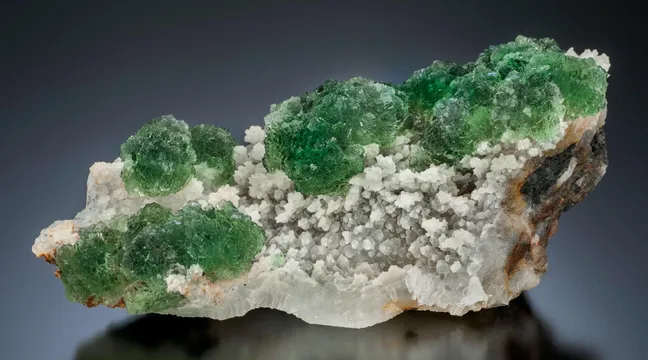
The important specimen production was the 2007–2008 purple botryoidal find. Dealer and gallery records describe cabinet pieces from that find with lavender to deep grape-purple rounded fluorite on blocky or layered matrix, individual domes commonly around 2–3 cm, and specimens ranging from thumbnails and miniatures to large cabinet plates. A handful of later market records document unusual variants: two-generation pieces with a lighter pinkish-orange botryoidal layer beneath a purple layer; specimens with white frosting or white late-stage overgrowths; stalactitic examples showing internal structure; and rare green spheroidal fluorite reported in 2021 from the Guxian-Minggang trade locality.
Fluorite from Minggang is prized for rounded botryoidal, spheroidal, and locally stalactitic aggregates rather than conventional cubes. The classic color is translucent lavender to rich purple or bluish violet, with some pieces showing pale lilac, white late-stage frosting, yellow iron-oxide staining on matrix, or rare green spheroidal material in later trade. Fine pieces range from small cabinet specimens with one or two complete domes to large plates and sculptural cabinet examples; documented individual botryoids reach about 3 cm across, while exceptional plates and merged masses can be far larger. Associations are simple but distinctive: purple fluorite on pale, quartzose or chalcedonic matrix, sometimes with silica-rich crusts visible beneath the fluorite. The best Minggang pieces have separated, complete, undamaged rounded forms, strong internal glow when backlit, pleasing contrast with matrix, and surface quality that is satiny or gently lustrous rather than chalky, abraded, oiled, or overly dense.
The documented mineral list from Minggang is short: fluorite, quartz, chalcedony, and albite. That simplicity is part of the locality’s character. It is not a polymetallic Chinese locality celebrated for dozens of rarities; it is a fluorite locality whose collector significance rests on a single exceptional habit. No type-locality minerals are documented from Minggang in the standard locality record, and the “rarity” here is morphological rather than species-based: purple botryoidal fluorite with the Minggang look.
The main authenticity issue with Minggang fluorite is enhancement and mislabelling rather than outright synthetic material. Purple botryoidal fluorite from China has appeared under broad or uncertain labels such as Henan, Tongbai, Guxian-Minggang, Xinyang, or simply China. Some of those may reflect legitimate trade-path or district naming, but some are vague labels applied to attractive rounded fluorites whose exact mine was not documented at export. Compare suspected Minggang pieces with established examples: the classic material has purple to bluish-purple rounded fluorite on pale quartz/chalcedony-rich matrix, commonly in domes, ribs, or stalactitic crusts rather than loose polished “bubbles.”
Surface enhancement is a real concern. Collectors have specifically noted heavily oiled examples and photographs with boosted color. Oil can make a matte or bruised botryoidal surface look deeper and more translucent than it is, and it can exaggerate the “grape jelly” effect that honest Minggang specimens show naturally only under strong light or backlighting. Look for unnatural greasy shine in recesses, dust stuck to surfaces, oil film on the base or matrix, and a color that collapses under neutral daylight. Photographs should be judged cautiously: strongly saturated purple images, black-background studio lighting, and backlighting can all make ordinary pieces appear exceptional.
Condition is critical. Botryoidal fluorite does not give the collector sharp crystal edges to judge; instead, value rides on the continuity of rounded surfaces. Bruising, flat contact scars, sawed bases visible from the front, scuffed high points, and chalky abraded domes all matter. Some edge contacts are natural where a dome grew against a pocket wall, and good dealers will distinguish those from damage. Natural contacts may show radial internal growth, silica cores, or a clean transition into matrix; fresh damage often appears lighter, granular, and visually disruptive.
Fluorite is relatively soft and should be handled accordingly. Avoid rubbing the botryoidal surface with cloth, as satiny skins can be dulled. Keep pieces away from acids, ultrasonic cleaners, and long exposure to strong sunlight or heat. Some Minggang fluorites are reported as fluorescent under long- and short-wave ultraviolet light, and at least one retail listing records light purple-white short-wave fluorescence; UV response is a bonus rather than a primary value driver. For display, backlighting or a narrow beam from the side often brings out the internal purple glow better than broad overhead light.
Market availability is moderate but uneven. Small and lower-grade pieces continue to appear, especially on general mineral and crystal retail platforms, but top examples from the classic 2007–2008 production are not common. Auction records show that strong cabinet pieces can command serious prices, while small or damaged pieces may sell for much less. The highest-value examples are large, sculptural, deep purple, translucent at the edges, and clean across the display face; two-generation pieces and convincing stalactitic forms are especially desirable when intact.
When the Minggang fluorites first circulated internationally, they had the odd power of looking both familiar and impossible. Fluorite collectors knew botryoidal fluorite from scattered localities, and they knew China for brilliant cubes, octahedra, and complex combinations from mines such as Yaogangxian and Huanggang. What they did not expect was a Chinese fluorite that looked like a cluster of purple grapes or a colony of smooth violet bubbles, built over pale stone rather than flashing with textbook cubic faces. Dealer accounts from the 2007–2008 find repeatedly describe the reaction in show terms: a small Chinese find that made a splash, caused a stir, or even “shocked” the collecting world because purple botryoidal fluorite of that quality had rarely been seen.
Some individual specimens from the find became little geological sculptures. One documented cabinet specimen measured 10.3 x 9.9 x 4.8 cm and carried a central compound botryoid 3.2 cm across, the rounded forms spaced openly enough that each dome could be read as an individual growth rather than as a crowded crust. Another piece, 14.4 x 9.1 x 5.4 cm, was described as lavender, translucent, matte-finished, and colored further by yellow oxide staining on the matrix; at the edges, wear revealed the radial growth of the botryoids, turning a condition issue into a lesson in how the piece grew.
The oversized examples are the ones collectors repeat from memory. One large Minggang specimen was recorded at 29.2 x 23.0 x 15.0 cm and 31 pounds—a merged pair of thick purple fluorite masses, too thick to be truly transparent but still showing grape-juice color along the edges. Another major specimen was noted at 16.8 x 12.2 x 9.5 cm and 5.7 pounds, a reminder that the Minggang find was not limited to delicate miniatures; some pockets produced massive, rounded purple forms large enough to dominate a cabinet shelf.
The most educational Minggang pieces are the stalactitic ones. Several descriptions note fluorite ribs and stalactites, and one gallery record describes interrupted stalactites exposing an inner “skeleton” of quartz that likely served as the guide for fluorite growth. That detail is central to understanding the locality. The form is not random bubbling: silica surfaces and internal frameworks appear to have directed later CaF2 deposition, letting fluorite wrap around curves and build rounded purple skins over earlier mineral architecture.
A small number of pieces complicate the usual purple story. A two-generation specimen from the Kurt Hefendehl collection showed a lighter pinkish-orange botryoidal fluorite layer underneath a later purple layer, the purple “balls” partly enveloping the earlier growth. Later Fabre Minerals media presented an emerald-green spheroidal fluorite from the Guxian-Minggang trade locality, dated 2021, noting how unusual the intense green color was compared with the more familiar lilac-purple production. Such pieces are not the normal Minggang look, but they prove that the locality’s growth habit was more stable than its color chemistry: the same tendency toward rounded, spheroidal fluorite could express itself in more than one color episode.