A collector's guide to Goble, USA: its geology, mining history and notable minerals, illustrated with the 30 specimens documented from this locality on EarthWonders.
Key facts
Goble, on the Oregon side of the Columbia River in Columbia County, is one of the classic Pacific Northwest zeolite localities: not a metal mine in the usual sense, but a cluster of roadcuts, quarry faces, breccia zones, and small excavations in late Eocene basalt of the Goble Volcanics. The appeal to collectors is the contrast between ordinary-looking gray to red volcanic rock and the remarkably intricate secondary mineralization in its vesicles, fractures, and breccia cavities. Here, low-temperature hydrothermal fluids moved through porous flow tops, brecciated flow bases, and jointed dense basalt, depositing a layered assemblage dominated by heulandite, stilbite, thomsonite, mesolite, chabazite, calcite, and a suite of rarer zeolites and silica minerals.
What elevates Goble above many regional amygdaloidal-basalt occurrences is its scientific record. Neer Road is the type locality for boggsite and tschernichite, and Goble material was central to the recognition of cowlesite. Cavansite, better known to most collectors from India today, was also first characterized from Oregon material that included the Goble area. For a locality of modest physical extent, Goble has had an outsized role in zeolite mineralogy.
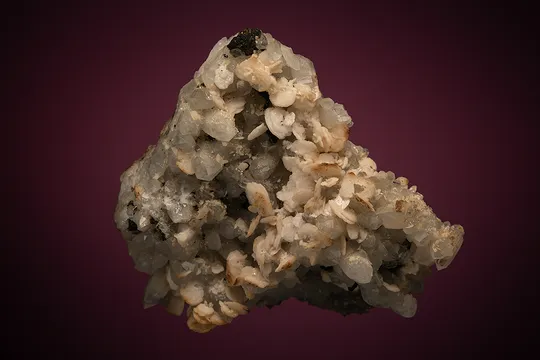
The best Goble specimens have a distinctive Pacific Northwest look: white to colorless rhombohedra of chabazite perched on drusy heulandite; compact, smooth or curly balls of thomsonite; pearly stilbite blades tucked into basalt vugs; mesolite needles rising out of thomsonite-lined cavities; and, in the more specialized micromount realm, glassy or ghostly tschernichite crystals and tiny hemispheres of boggsite in clay-lined vesicles. Good specimens are often small, but the texture, sequencing, and mineral associations reward close viewing.
Regional View
Country View

Photo: Wikimedia Commons
The locality is best understood as a group of related occurrences rather than a single pit. Neer Road supplied many of the classic common-zeolite pieces and the rare silica-rich assemblage of the Neer Road pit. The Jaquish roadcut along Highway 30, south of Goble, produced attractive thomsonite-mesolite-heulandite-chabazite combinations from red breccia and gray olivine basalt. The Goble Quarry, also known for a time as the Nicolai Quarry, exposed zeolite-bearing breccia at its east end, while the active quarrying history of the property makes collecting access a separate, modern issue from the historic specimen record.
Search for specimens: View all specimens from Goble, USA
Goble’s zeolites occur in basaltic volcanic rocks of the Goble Volcanics, a late Eocene volcanic sequence named for exposures near the town of Goble and along the lower Columbia River. In the specimen-producing zones, the host is chiefly olivine-bearing basalt, red volcanic breccia, tuff breccia, and vesicular to dense flow rock. The “deposit” is a low-temperature hydrothermal amygdule-and-fracture system: cavities in the basalt acted as miniature reaction vessels, and solutions moving through joints, breccia spaces, and vesicular horizons supplied water and redistributed Ca, Na, K, Al, Si, and other components from the altered host rock.
At Neer Road, the most important mineralogical distinction is between the common zeolite-bearing porous zones and a very restricted silica-rich zone in denser basalt. Common zeolites including thomsonite, mesolite, chabazite, cowlesite, garronite, and heulandite are recorded from the vesicular upper parts and brecciated bases of the flows. The rarest material—tschernichite, boggsite, mordenite, chalcedony, erionite-group minerals, and okenite—came from the poorly vesicular center of a single flow at the Neer Road pit, in a zone reported as no larger than about 2 × 3 × 9 meters. That tiny volume of rock is the reason Goble is known internationally among zeolite specialists.
The classic paragenesis at Neer Road is unusually well documented. In the more widespread zeolite rock, smectite and drusy heulandite are early, followed by stilbite, analcime-cowlesite, garronite-phillipsite, levyne-thomsonite, mesolite, another thomsonite generation, chabazite, and finally calcite. Away from Goble Creek the assemblage simplifies to drusy heulandite, stilbite, chabazite, and calcite, or to drusy heulandite alone. In the dense, silica-rich rock, tschernichite was the first zeolite to crystallize in many cavities, followed locally by boggsite and then, more rarely, by chalcedony, heulandite, apophyllite, levyne, chabazite, calcite, aragonite, or opal. This is not merely an attractive collecting locality; it is a small but remarkably legible hydrothermal system.
The Jaquish roadcut, about half a mile south of Goble along Highway 30, is a separate but closely related occurrence. Its mineralization is in angular cavities in red volcanic breccia between gray Eocene olivine basalt. The red breccia cavities produced thomsonite, heulandite, stilbite, chabazite, mesolite, and calcite, while tubular cavities and vesicles in the gray basalt—some reported up to 60 cm long—yielded mordenite, heulandite, apophyllite, and okenite. Jaquish material is especially attractive where white or cream thomsonite balls and mesolite needles sit on colorless drusy heulandite and are dusted with small chabazite rhombohedra.
The Goble Quarry has a different collecting history. It has been operated for crushed rock and landscape rock since the 1940s and was briefly known around 2000 as the Nicolai Quarry before the Goble Quarry name returned. Historically, the active west end produced few collector specimens, mostly copper with calcite on heulandite. In 1989, Gloria Cook, leading a school field trip, found zeolites in the neglected east end; collecting was allowed at that time, and the owner even blasted zeolite-bearing rock so that more specimens could be recovered. The productive rock there was basalt breccia in a single flow, with white zeolite veins lining and filling angular cavities, some of them large enough to make small-cabinet specimens when the roof material preserved scattered crystals rather than massive cavity fill.
There is no meaningful “ore body” in the economic-mining sense for the collector minerals. Goble Quarry is an aggregate operation, not a zeolite mine. The specimen-producing bodies are discontinuous flow-top, flow-base, breccia, vesicle, joint, and fault-related hydrothermal pockets. The productive zones are highly localized: a meter-scale silica-rich zone for the rare Neer Road minerals, scattered roadcut pockets for thomsonite and chabazite, and specific brecciated horizons for quarry zeolites.
Collecting access today should be treated as restricted unless explicit permission is obtained. The Goble Quarry is an operating industrial site and collecting has been reported as no longer allowed. The Neer Road pit that yielded the rarest material was largely depleted by the early 1990s and was later filled or obscured. Roadcuts along Neer Road and Highway 30 involve private land, traffic hazards, unstable rock, and maintenance activity; they should not be entered or worked without permission and a clear understanding of safety and legal constraints. Most serious collectors today obtain Goble specimens from older collections, micromount suites, museum duplicates, and the occasional dealer or auction offering.
Chabazite is the public face of Goble collecting: colorless to milky-white rhombohedra, commonly on drusy heulandite and with thomsonite, mesolite, stilbite, apophyllite, calcite, or okenite depending on the pocket. Neer Road material is recorded as rhombohedra up to 25 mm across, while Jaquish roadcut chabazite is documented to about 10 mm; the best pieces show isolated, sharp, glassy rhombs with enough contrast from white thomsonite balls or pearly heulandite lining to read clearly under a hand lens. Ordinary Goble chabazite is drusy or crowded and can be hard to separate visually from other pale zeolites; fine pieces have well-spaced crystals, intact rhombohedral faces, and classic associations from Neer Road, Jaquish, or the east end of Goble Quarry.
Heulandite at Goble is usually the architectural base layer of the specimens rather than the showiest species: colorless to pale, drusy linings and small prismatic crystals coating vesicle walls before later stilbite, chabazite, thomsonite, mesolite, calcite, mordenite, okenite, and copper arrived. At Neer Road, drusy heulandite is central to the widespread paragenesis and may be the only zeolite left in less richly mineralized areas away from Goble Creek; at Jaquish, it lines red-breccia cavities beneath thomsonite balls and mesolite needles. The better collector pieces are those where heulandite forms a sparkling, continuous, undamaged carpet with later minerals perched cleanly on top, while plain grayish crusts or massive, stained cavity linings are more common.
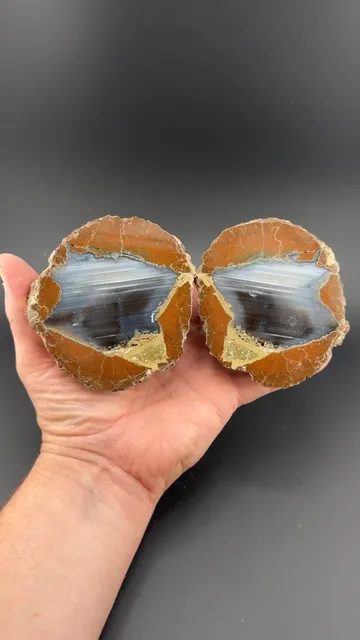
Goble thomsonite is prized as smooth, compact balls; white, cream, gray, or bluish-gray radial aggregates; curly or arborescent growths; and zoned balls that can be cross-sectioned to show internal structure. Neer Road produced compact balls on stilbite or heulandite and a famous 1972 pocket with thomsonite-Ca balls around 4 cm across, while Jaquish supplied white to cream balls commonly 8 mm to 3 cm across on drusy heulandite, with mesolite needles and tiny chabazite rhombohedra over the surface. Fine pieces have complete rounded aggregates, crisp radial texture, strong contrast with basalt or heulandite, and minimal bruising to the soft outer fibers; poorer pieces are worn, chalky, or broken across the spheres.
Stilbite from Goble is usually pearly white to colorless and occurs as blades, small sheaves, and drusy plates associated with heulandite, chabazite, thomsonite, mesolite, and calcite. In the Neer Road sequence it follows drusy heulandite and precedes much of the later low-silica zeolite growth; collectible examples include thomsonite spheres sitting on stilbite plates and chabazite perched with stilbite in breccia cavities. The best Goble stilbite specimens are not necessarily large but show individual lustrous blades or sheaf-like sprays standing free in a cavity, preferably with a contrasting later zeolite; ordinary material tends to be pale, crowded, and difficult to distinguish from heulandite without magnification.
Calcite at Goble is both an early and late participant in the cavity history, but the collector material is mainly late, pale to colorless calcite associated with zeolites and, in some specimens, native copper. In the Neer Road paragenesis calcite closes the common sequence after chabazite, while at Jaquish it appears with heulandite, thomsonite, chabazite, mesolite, and copper-bearing assemblages; auctioned and collection specimens also record calcite on thomsonite and calcite with aragonite from the broader Goble suite. Good Goble calcite is valued less for size than for placement—clean rhombs or scalenohedral crystals on zeolite-lined basalt, especially with thomsonite or copper staining—whereas massive white carbonate or bruised crystals are routine.
Other documented Goble minerals are what make the locality essential for advanced zeolite collectors. Neer Road is the type locality for boggsite, a very rare high-silica zeolite forming colorless to white radial hemispheres, and for tschernichite, the natural zeolite-beta analogue occurring as colorless to white tetragonal dipyramids and drusy aggregates. Cowlesite, recognized from Goble-area material and named for Oregon collector John Cowles of Rainier, occurs as extremely thin, delicate white to gray blades and cavity linings that are easily confused with thomsonite. The broader Goble list also includes analcime, aragonite, celadonite, epistilbite, erionite-group minerals, fluorapophyllite-(K), garronite-Ca, levyne, mesolite, mordenite, native copper, offretite, okenite, opal, phillipsite-group minerals, pyrolusite, quartz var. chalcedony, smectite-group minerals, and wairakite. Cavansite from the Charles W. Chapman quarry on Neer Road is historically important as part of the early Oregon record for that blue vanadium silicate.
Goble specimens are commonly small, pale, and visually complex, so misidentification is the main authenticity issue. Chabazite, heulandite, stilbite, thomsonite, cowlesite, and garronite can all appear as white to colorless cavity minerals in basalt. Without a reliable old label, a specific sublocality may be hard to reconstruct. “Goble” is sometimes used broadly for Neer Road, Jaquish roadcut, the Goble Quarry/Nicolai Quarry, railroad cuts, and nearby roadcuts; that broad label is acceptable for many older collection pieces, but it is less informative than a sublocality label. For rare species such as boggsite, tschernichite, cowlesite, erionite-group minerals, offretite, levyne, and garronite, visual identification alone is not enough for high-confidence sales unless the specimen comes from a well-documented collection or has analytical support.
No widely documented fake-manufacturing tradition is associated with Goble, but “wishful labeling” is a real risk. Common chabazite-thomsonite-heulandite pieces may be upgraded on labels to rare species, and cowlesite has historically been confused with thomsonite because both can form pale radial or bladed aggregates. Boggsite is especially vulnerable to optimistic identification: genuine pieces are tiny, rare, and often require magnification and X-ray confirmation. Tschernichite is also a micromount mineral at Goble; cabinet-sized “tschernichite” claims from the locality should be viewed skeptically unless the claim refers to the matrix size rather than crystal size.
Condition matters. Goble zeolites are often soft, brittle, and attached to crumbly altered basalt or red breccia. Thomsonite balls bruise and flatten on exposed high points; mesolite needles bend, shed, and mat; stilbite blades cleave; chabazite can be edge-chipped; and thin cowlesite is mechanically fragile. Many pieces are best kept in perky boxes or lidded micromount cells rather than open trays. Cleaning should be conservative: avoid acids unless you are certain of the assemblage, avoid ultrasonic cleaning, and do not scrub fibrous or needle-like zones. A soft air bulb, careful trimming, and dry handling are usually safer than wet cleaning.
Fluorescence is not the main attraction at Goble, but it is worth checking rare material. Tschernichite may show pale yellow fluorescence under shortwave and longwave ultraviolet light, and altered boggsite has been reported to fluoresce weak bluish under both shortwave and longwave UV. Because erionite-group minerals are recorded from the Neer Road assemblage, collectors should avoid grinding, sawing, or deliberately abrading unknown fibrous zeolite material from Goble. Keep dusty fragments sealed, and handle friable specimens with the same caution you would use for any potentially hazardous fibrous mineral.
Market availability is uneven. Common chabazite, thomsonite, stilbite, heulandite, and calcite combinations still appear from old Pacific Northwest collections, usually as thumbnails, miniatures, and micromounts. Attractive Jaquish thomsonite-mesolite pieces are less common and can be surprisingly good display specimens. Tschernichite and boggsite are specialist material: they are rarely available, often microscopic, and strongest when accompanied by older Rudy Tschernich, Rice Museum, Bob Boggs, John Cowles, or other well-established provenance. For serious collectors, labels and sublocality history are part of the specimen.
Goble’s modern mineral story is inseparable from Rudy Tschernich. His first day collecting zeolites at the Neer Road roadcut was in 1968, along the cliff side above Goble. That first day produced only the “common” material—thomsonite-Ca, chabazite, stilbite, and heulandite—but those common minerals were enough to set the hook. In retrospect, it was the beginning of a chain of collecting and study that would eventually make Neer Road a type locality known to zeolite specialists far beyond Oregon.
One of the memorable Neer Road pockets came in 1972, when collectors worked in the rain on a 90 cm long pocket that yielded 4 cm thomsonite-Ca balls. The image is easy to picture: wet basalt, a narrow roadcut, white radial spheres emerging from a pocket long enough to work but small enough that every intact ball mattered. Today those old thomsonite pieces have a different kind of value from the rare-species micromounts; they are physical reminders of the locality when new pockets still appeared in roadside basalt.
The decisive rare-mineral episode came in the 1980s at the Neer Road pit. Collectors found that the silica-rich minerals were not spread through the hillside but confined to a tiny, hard, dense part of the flow. In 1987 the Northwest Micro Mineral Study Group worked the pit, with Rudy Tschernich drilling hard basalt and Bob Boggs present during the search. The hole yielded tschernichite and boggsite, while the surrounding rock held the familiar common zeolites. The scale was almost absurd: two new zeolite species and a major scientific result from a pocket system small enough to be described in meters.
The boggsite paper preserves one of the great collector-mineralogical facts of Goble: after the site appeared depleted, only about 200 boggsite hemispheres had been found, and many of those were consumed during characterization of the mineral. That is a sobering number. It explains why boggsite specimens are so coveted and why old, verified examples are treated as research objects as much as collectibles. A collector looking at a 1 mm white hemisphere from Neer Road is looking at material from a finite and largely exhausted discovery.
By 1992, the Neer Road pit had changed character. Photographs from that period show the remains of the pit after most of the collecting had been done; sand used on winter roads had been dumped into the excavation by the road department. For a locality whose best minerals came from a tiny zone in very hard basalt, that sort of practical road maintenance mattered. It did not merely make collecting inconvenient; it helped erase the physical context of the rare-species pocket.
Goble Quarry had its own unexpected chapter in 1989. The quarry had worked for decades as a source of crushed rock, and the active west end was not especially generous to collectors. Then Gloria Cook, leading a field trip with students from the school across from the quarry, found zeolites in the far east end. The timing and human detail are wonderful: the owner’s son was one of the students, collecting was allowed, and the owner even blasted the zeolite-bearing rock so that more specimens could be collected. For a short window, an industrial rock quarry became a productive zeolite locality.
Another brief collecting moment occurred beside Highway 30 in October 1992, when a small landslide at the Goble Creek roadcut made zeolites easy to collect. Dan Rokosz was photographed there working the fresh material, and the assemblage included chabazite, stilbite, and thomsonite. The opportunity did not last. Road crews hauled away the remainder. That is typical of Goble: discoveries appeared in unstable roadside and quarry settings, sometimes suddenly, and then vanished just as quickly under maintenance, ownership changes, or the normal demands of road and quarry work.
Howard, D.G., Tschernich, R.W., Smith, J.V., and Klein, G.L. (1990), “Boggsite, a new high-silica zeolite from Goble, Columbia County, Oregon,” American Mineralogist, 75, 1200–1204. The primary description of boggsite from Goble, including occurrence, paragenesis, rarity, and type-material information.
Pluth, J.J., and Smith, J.V. (1990), “Crystal structure of boggsite, a new high-silica zeolite with the first three-dimensional channel system bounded by both 12- and 10-rings,” American Mineralogist, 75, 501–507. Structural paper explaining why boggsite became important beyond locality mineralogy.
Boggs, R.C., Howard, D.G., Smith, J.V., and Klein, G.L. (1993), “Tschernichite, a new zeolite from Goble, Columbia County, Oregon,” American Mineralogist, 78, 822–826. The type-species record for tschernichite, summarized in the Handbook of Mineralogy with crystallography, composition, association, and type-material details.
Wise, W.S., and Tschernich, R.W. (1975), “Cowlesite, a new Ca-zeolite,” American Mineralogist, 60, 951–956. The original cowlesite description, with Goble material as the type-area composition and occurrence.
Staples, L.W., Evans, H.T., Jr., and Lindsay, J.R. (1973), “Cavansite and Pentagonite, New Dimorphous Calcium Vanadium Silicate Minerals From Oregon,” American Mineralogist, 58, 405–411. The classic cavansite-pentagonite paper; it documents Goble cavansite from the Charles W. Chapman quarry on Neer Road.
Coombs, D.S., Alberti, A., Armbruster, T., Artioli, G., Colella, C., Galli, E., Grice, J.D., Liebau, F., Mandarino, J.A., Minato, H., Nickel, E.H., Passaglia, E., Peacor, D.R., Quartieri, S., Rinaldi, R., Ross, M., Sheppard, R.A., Tillmanns, E., and Vezzalini, G. (1998), “Recommended nomenclature for zeolite minerals,” Canadian Mineralogist, 35, 1571–1606. Important nomenclature reference for zeolite names and framework usage, including Goble-related species.
Staples, L.W., and others, Oregon Department of Geology and Mineral Industries publications on Oregon zeolite occurrences. Useful regional comparison for Oregon basalt-hosted zeolite deposits and their mineral assemblages.
Rudy Tschernich Zeolite Collection, Rice Northwest Museum of Rocks and Minerals, Hillsboro, Oregon. The key institutional collection connected with many Goble specimens, photographs, and labels, especially Neer Road and Jaquish material.
Mindat: Goble, Columbia County, Oregon, USA — The broad locality page tying together Goble’s sublocalities, species list, and type-locality records.
Mindat: Neer Road, Goble, Columbia County, Oregon, USA — Essential locality page for the Neer Road zeolites, including boggsite, tschernichite, cowlesite, and the silica-rich pit assemblage.
Mindat: Jaquish roadcut, Goble, Columbia County, Oregon, USA — Best summary for the Highway 30 red-breccia and gray-basalt occurrence famous for thomsonite, mesolite, heulandite, and chabazite combinations.
Mindat: Goble Quarry / Nicolai Quarry — Locality history for the quarry occurrence, including the 1989 zeolite discovery and later access restrictions.
Wikimedia Commons: Mesolite–Thomsonite-Ca from Jaquish Road Cut — Freely licensed photograph of a cabinet-quality Goble specimen from the Jaquish roadcut.
American Mineralogist: Boggsite, a new high-silica zeolite from Goble — Primary scientific source for boggsite and the Neer Road hydrothermal paragenesis.
Handbook of Mineralogy: Boggsite — Concise mineral data sheet with type locality, crystal habit, fluorescence, association, and references.
Handbook of Mineralogy: Tschernichite — Concise mineral data sheet for tschernichite from the Neer Road pit.
American Mineralogist: Cowlesite, a new Ca-zeolite — Original cowlesite description, including Goble occurrence and diagnostic distinction from thomsonite.
American Mineralogist: Cavansite and Pentagonite, new dimorphous calcium vanadium silicate minerals from Oregon — Documents Goble’s role in the early recognition of cavansite.
USGS Geolex: Goble publications — Stratigraphic background for the Goble Volcanics and their regional geologic usage.
Western Rock Resources: Goble Rock — Current operator-facing page for the Goble Quarry as an aggregate source, useful for understanding why historic collecting access differs from modern site status.