






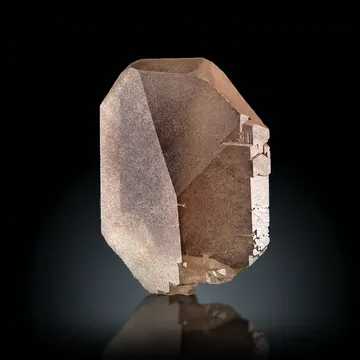
Fontainebleau, France — renowned for sand-calcite crystals in quartz sand, unique poikilitic textures, and a storied history treasured by collectors.
Key facts
Fontainebleau is one of the great paradoxes of classic mineral collecting: a locality famous not for metallic ores, pegmatites, alpine clefts, or hydrothermal veins, but for calcite crystals that grew inside loose quartz sand. The celebrated “Fontainebleau calcites” are sand-calcite: CaCO3 crystals so heavily charged with pale quartz grains that they look and feel like sculpted sandstone, yet retain the unmistakable geometry of calcite. Their home is the Sables et Grès de Fontainebleau of the southern Paris Basin, an Oligocene sand formation later transformed in places by groundwater, silicification, carbonate precipitation, and Pleistocene periglacial processes.
The best specimens are instantly recognizable. They are beige to grayish, sometimes warm buff, built of sharp inverse rhombohedra whose faces may be frosted by included sand. Fine pieces form intergrown “cristallarias”—radiating sheaves, cock’s-comb ridges, compact rosettes, or tangled clusters of rhombs—rather than single transparent crystals. The sand is not a superficial coating: thin-section work shows rounded Fontainebleau quartz grains enclosed within single-crystal calcite areas, a poikilitic texture that gives these specimens their strange double identity as both mineral crystal and sedimentary object.
Historically, Fontainebleau matters because the Belle-Croix crystals entered mineralogical literature astonishingly early. They were discussed in the 1770s, studied in relation to crystallography and the nature of sandstone, and later dispersed into major museum collections. Long before the locality became a reference point for Quaternary paleohydrology, it was already a French mineral classic: the kind of specimen that old collections labeled with pride as “grès cristallisé” or “calcite de Belle-Croix.”
Regional View
Country View
Modern geological work has added a second layer of importance. The Fontainebleau sand-calcites are no longer treated merely as curiosities. They are now read as records of ancient groundwater positions and cold-climate infiltration systems. Carbonate-bearing surface waters moved down through the sand; near the water table, changing temperature, CO2 conditions, and saturation state caused calcite to precipitate, trapping the quartz grains through which it grew. Dating and isotope work tie these bodies to Pleistocene glacial and periglacial episodes, turning cabinet specimens into paleoclimate evidence.

Photo: Koreller/Wikimedia Commons
Search for specimens: View all specimens from Fontainebleau, France
Fontainebleau lies in Seine-et-Marne, Île-de-France, within the southern Paris Basin. The mineral locality as used by collectors is broader than the town itself: old labels may refer simply to Fontainebleau, Belle-Croix, the Rocher-Saint-Germain sector, the Grotte aux Cristaux, Nemours, Puiselet, Larchant, Bonnevault, Darvault, or other points in the Fontainebleau massif and its surrounding sand and sandstone exposures. The essential host is the Sables de Fontainebleau, a very pure quartz sand of Oligocene age, classically called Stampian in the Paris Basin literature and now generally placed in the Rupelian. In the massif these sands are locally indurated into the famous Grès de Fontainebleau, the hard quartz-cemented sandstone that forms the platières, boulder fields, and sculptural rock chaos beloved by climbers.
This is not an ore locality in the mining sense. There are no ore shoots, veins, or metallic production zones attached to the classic mineral specimens. The “mineralization” is diagenetic to epigenetic carbonate cementation within porous sand, expressed as discrete crystal groups, spheroidal concretions, carbonate-cemented sandstone, and related sandy calcite bodies. The calcium carbonate source is tied to overlying carbonate-bearing beds and circulating waters; the quartz component is the clean, rounded sand of the Fontainebleau Formation itself. In the crystalline variety, calcite grew as inverse rhombohedra while engulfing sand grains, producing aggregates whose external form is calcite but whose mass may be dominated visually and tactilely by quartz sand.
The best-known specimen zone is Belle-Croix, especially the Grotte aux Cristaux near the Rocher-Saint-Germain. Early accounts place the first discovery in 1774 by a quarryman named Laroche during sandstone working. The locality became famous because the crystals were not mere nodules: they showed sharply organized rhombohedral form, in places lining or projecting from sandstone cavities and overhangs. Later observations at the Grotte aux Cristaux showed crystal groups attached to the underside of a sloping layer and growing downward, an arrangement compared in modern work to vadose-zone speleothem growth, though developed in sand and sandstone rather than a conventional limestone cave.
The old quarries are central to the story. Fontainebleau sandstone was exploited for centuries for building stone and, especially, paving blocks. The same quarrying that scarred the forest also opened the sand and sandstone levels in which the calcites occurred. Paris consumed enormous numbers of Fontainebleau paving stones in the nineteenth century, and the working faces, spoil, sand pits, and partly buried cavities created opportunities for both discovery and damage. The carriers were not mineral collectors in the modern sense; they exposed the pockets incidentally while extracting grès. Some of the great museum specimens almost certainly came from those phases of quarry activity and from later rediscoveries of already-known cavities.
Belle-Croix and Rocher-Saint-Germain supplied the classic sharp cabinet pieces, prized for size, clarity of crystal arrangement, and sharply pointed rhombohedra. Puiselet and the Nemours area are also important names on labels, especially for rhombohedral sand-calcite aggregates and smaller collected pieces from quarry settings. Bonnevault and the Gondonnières quarries near Larchant are significant in modern descriptions because they preserve calcite-bearing levels, spheroidal sandy calcites, “gogotte”-like carbonate forms, and in some cases specimens with unusually precise locality pedigrees. Les Courtins at Nemours is described as an old digging area for sand-calcite crystals, with levels of crystallarias related to former groundwater positions.
Today the classic Fontainebleau collecting ground is a heavily visited, protected cultural and natural landscape rather than an open collecting district. The forest is managed for conservation, recreation, heritage, climbing, and forestry concerns, and the famous Grotte aux Cristaux has a long history of protective closure, vandalism, and restricted observation. Loose old specimens circulate through collections and the mineral trade, but active digging in protected forest or at closed historic sites is not an acceptable route to material. Modern collectors should treat precise old provenance—Belle-Croix, Puiselet, Bonnevault, Nemours, Larchant, Darvault—as part of the value of a specimen, because much trade material is still labeled only “Fontainebleau.”
Fontainebleau calcite is the locality’s signature mineral and its reason for inclusion in serious classic collections: sand-included CaCO3 in inverse rhombohedra, beige to grayish rather than glassy, commonly in intergrown crystallarias that range from small hand specimens to decimetric groups. The finest examples show crisp, pointed rhombohedra arranged in radiating sheaves, cock’s-comb ridges, rosettes, or open clusters; ordinary pieces are more rounded, dull, sandy, broken, or shapelessly concretionary. Belle-Croix and the Rocher-Saint-Germain/Grotte aux Cristaux area supplied the most celebrated old specimens, while Puiselet, Nemours, Bonnevault, Larchant, and Darvault appear in modern and trade records. Associations are essentially geological rather than mineral-suite associations: rounded quartz sand grains are engulfed in the calcite, and the bodies occur with Fontainebleau sand, siliceous sandstone, carbonate-cemented sandstone, and related “gogotte” or poupée-like concretions.
The documented mineral list for Fontainebleau is deliberately sparse: calcite, its sand-calcite variety, and quartz. Quartz is not a showy druse mineral here in the usual collector’s sense; it is the constituent sand and sandstone framework, locally cemented by silica into the famous grès. Limestone is recorded as a rock type in the wider locality framework, and carbonate beds are crucial to the calcite story, but Fontainebleau is not a multi-species rarity locality and has no verified type-mineral status comparable to a formal mineral type locality. Its rarity lies instead in the exceptional size, perfection, and historical fame of calcite crystals grown in sand.
For collectors, Fontainebleau is a locality where authenticity is usually a matter of texture, morphology, and provenance rather than laboratory identification. Genuine sand-calcite has calcite form but a sandy, granular body; quartz grains are integral to the crystals, not glued-on sand. Good pieces show coherent rhombohedral architecture, preferably with several sharp individuals rather than an amorphous lump. The surface should look naturally sandy and slightly matte; overly cleaned, coated, dyed, or suspiciously sharpened pieces should be treated cautiously, although widely documented systematic fakery is not the main issue with this locality.
The commoner problem is loose or vague labeling. “Fontainebleau” on an old label may mean the town, the forest, Belle-Croix, Puiselet, Nemours, Larchant, or the broader arrondissement. A specimen with a credible old label naming Belle-Croix, Grotte aux Cristaux, Puiselet, Bonnevault, or another precise quarry or sector deserves more attention than one with only a modern generic label. Conversely, not every sculptural “gogotte” from the Fontainebleau region is calcite: many gogottes are siliceous sandstone concretions dominated by quartz cement, whereas the collectible Fontainebleau calcites are carbonate and will react to acid where fresh calcite is exposed.
Condition is central. Calcite dissolves in rainwater and weak acid, and the old field literature repeatedly notes that exposed pieces become dulled, rounded, or partly destroyed by weathering. Many specimens have bruised points, abraded edges, missing attachment areas, or broken backs from quarry extraction. Because the crystals are sand-rich and may be porous or friable at exposed surfaces, they should not be soaked, acid-cleaned, ultrasonically cleaned, or aggressively brushed. Keep them dry, dust with a soft brush or air bulb, and avoid prolonged handling that sheds sand grains from weathered surfaces.
Fluorescence is not the primary collecting reason for Fontainebleau calcite, but some trade-described specimens show minor response under both long-wave and short-wave ultraviolet light. Treat that as a bonus, not a diagnostic feature. The diagnostic suite is sharper: inverse rhombohedral calcite habit, sandy inclusions throughout, buff to gray coloration, locality-typical aggregate form, and credible provenance.
Market availability is intermittent but real. Fontainebleau calcites are classic European minerals and appear in old collections, dealer inventories, and auctions more often than newly collected field material. Small to medium cabinet specimens with damaged points remain obtainable; sharp, aesthetic, well-provenanced Belle-Croix-style groups are much less common and command a premium. Museum-scale crystallarias and historically labeled nineteenth-century pieces are in a different category altogether.
The Fontainebleau calcite story begins in the working world of the grès carriers. In 1774, at Belle-Croix, a quarryman named Laroche reportedly encountered the first crystals while the sandstone was being exploited. The discovery was strange enough to travel quickly beyond the quarry face. These were not ordinary loose stones: they were sandy blocks shaped into true rhombohedral crystals, a thing that seemed to sit uneasily between mineral and rock. Louis XVI is said to have come in person to admire the marvels, and the learned world followed. De Lassone, physician to Marie-Antoinette and Louis XVI and a figure close to the scientific circles of his day, brought the Belle-Croix material into the Académie Royale des Sciences with early memoirs on the grès cristallisés.
The locality then passed through the rough hands of quarry history. Édouard-Alfred Martel, the pioneer of speleology, later retold the sequence: the carriers of the First Empire ravaged the crystals; in September 1850, a worker named Benoit uncovered the vault of a cave buried under debris; Élie de Beaumont reported on it to the Académie des Sciences; then the cave was filled again. On 2 January 1891, Colinet found it once more. That place, the Grotte aux Cristaux, became the emblematic Fontainebleau occurrence—the mineralogical chamber behind the old label “Belle-Croix.”
Its survival was never secure. Protective grilles and barriers appear again and again in the site’s history because the very fame of the crystals made them vulnerable. The cave’s exposed blocks were carried away, the heads of large ceiling crystallizations were broken, and iron bars had to be rewelded after vandalism. Early twentieth-century postcards already show wire and metalwork around the site, a reminder that conservation conflict at Fontainebleau is not modern. The crystals that now sit quietly in museum drawers and display cases are survivors of quarrying, curiosity, collecting, and repeated attempts at protection.
One of the most charming modern museum stories belongs to “Mickey,” a Fontainebleau sand-calcite in the Muséum National d’Histoire Naturelle in Paris. Curator Cristiano Ferraris selected the specimen as a curator’s pick and described it as an “amazing result of nature,” born when calcite crystallized in the presence of pure white quartz sand grains trapped during growth. The specimen entered the national collection catalog in 1806. Its exact discovery circumstances are no longer known, but its public life is vigorous: displayed in the “Trésors de la Terre” gallery, it became a favorite of visitors’ cameras, a sandy calcite celebrity from Belle-Croix.
There is also a quieter, more scientific field story embedded in the modern work. The old collector’s object became a clock. Calcite bodies enclosed in sandstone can be older than the silica cement that surrounds them, giving researchers a rare handle on the timing of Fontainebleau sandstone formation. Dissolved-out calcites leave holes in sandstone faces, sometimes aligned in superposed levels that mark successive water-table positions. What a nineteenth-century carrier saw as a curiosity and a collector saw as a cabinet classic, a Quaternary geologist now reads as the trace of cold surface waters, warmer groundwater, permafrost landscapes, and ancient hydrologic gradients.
.jpg)