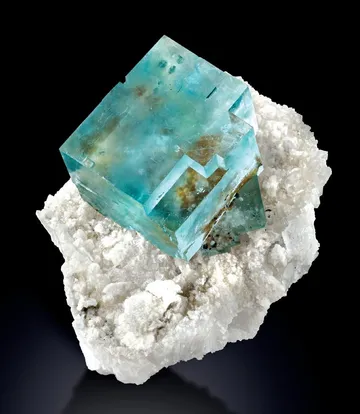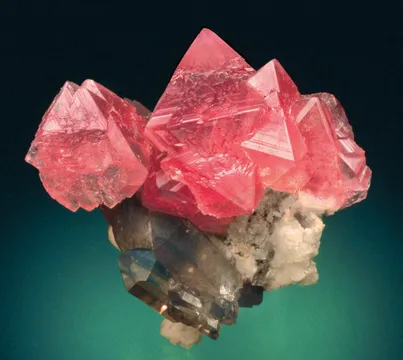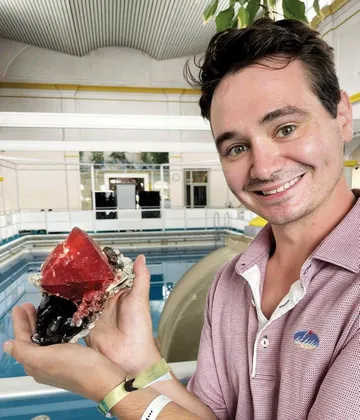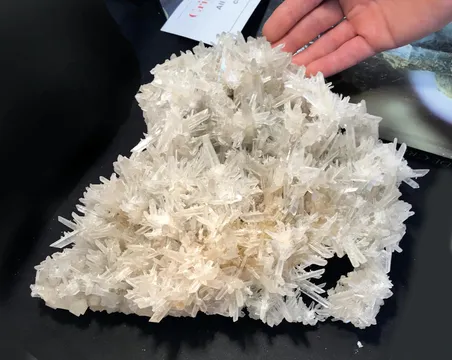
La Barre Mine, France — a classic fluorite locality in Massif Central, celebrated for blue cubes with yellow cores and phantom bands, prized by collectors.
Key facts
La Barre Mine, also known historically as La Martinèche, is one of the signature fluorite localities of the Puy-de-Dôme and a compact classic of the French Massif Central: not a vast modern industrial district, but a vein mine whose specimens carry a look that serious collectors recognize at once. The deposit lies near Saint-Jacques-d’Ambur, in the Combrailles country west of Clermont-Ferrand, where hydrothermal fluids moved through fractures in the old gneissic to migmatitic basement and deposited a fluorite-quartz vein of unusual specimen quality. Its fame rests above all on fluorite: sharp cubic crystals, yellow to amber cores, blue or violet edge zoning, occasional colorless outer growth, and the prized “floating” phantom bands that can make a small cabinet piece look optically deep far beyond its size.
The locality matters because it joins three kinds of interest rarely balanced so well: industrial fluorspar history, Massif Central vein geology, and a distinctive collector aesthetic. La Barre was worked intermittently through the twentieth century for metallurgical-grade fluorite, yet the same vein produced cabinet minerals with crisp crystallography: cubes, cuboctahedral forms, octahedra, curved-face octahedra, and rare forms noted in older French mineralogical literature. The most desirable specimens are not merely blue fluorite from France; they are La Barre fluorites with a particular architecture—transparent to translucent crystals perched on pale quartz or chalcedony, with blue-violet zoning set just inside the cube edges and a yellow, honey, or greenish heart visible through the crystal.
Regional View
Country View
In collection cabinets La Barre is often compared with Le Beix, Puy-Saint-Gulmier, Le Burg, and the better-known French fluorite mines of Haute-Loire and Tarn, but it remains visually separate. Le Beix can be intensely blue, Le Burg can be superbly glassy, and Haute-Loire material can be grand in scale; La Barre’s strength is the geometry of its color. The best pieces reward backlighting, which reveals their internal growth history: a yellow or pale core, a blue to violet growth zone parallel to the cube edges, and in some specimens a nearly colorless skin that makes the colored band seem suspended just beneath the surface.
Search for specimens: View all specimens from La Barre Mine, France
La Barre Mine is situated at Saint-Jacques-d’Ambur, in the Riom arrondissement of the Puy-de-Dôme, Auvergne-Rhône-Alpes. The workings are associated with the hamlets of La Barre and Martinèche, near the Sioule drainage and within the broader Pontgibaud mineralized region. Older accounts treat La Barre and Martinèche together because the vein continues across the small stream and was worked on both sides; modern collector labels may read “La Barre,” “La Martinèche,” or “La Barre Mine (La Martinèche Mine),” and all refer to this same classic fluorspar occurrence when properly used.
Geologically, the deposit is a hydrothermal fluorite-quartz vein hosted by gneissic to migmatitic basement of the Massif Central. The vein is generally described as trending roughly north-south and dipping steeply eastward, with published figures placing the worked or followed portion at roughly 350 to 400 meters in length and around 40 meters in explored depth. The average vein width is commonly given near 2 meters, but the mineralization swells and pinches over short distances; older technical descriptions note local enlargements substantially wider than the norm. The filling was not a simple open-space crystal vein throughout. Much of the mined material was massive to banded fluorite, accompanied by quartz, clayey material, and local silica-rich breccias, with pockets or open cavities providing the conditions for well-formed crystals.
The ore mineral was fluorite, mined as fluorspar for metallurgical use. Published summaries differ on total output, but the credible range is approximately 80,000 to 100,000 tonnes of fluorspar. That is modest compared with the giant French fluorspar fields, yet substantial for a relatively narrow vein deposit. The crude fluorite from Martinèche was valued because it could be used for metallurgy, and older reporting notes that simple washing could improve selected material to high CaF2 contents for other industrial uses.
The mining history is discontinuous, which is typical of small French vein fluorspar operations tied to price, access, and ore regularity. Work began at the opening of the twentieth century; one local history records M. Lassale extracting about 800 tonnes from 1901 to 1903. Later phases involved M. Gouttenoire, the company Alais, Froges et Camargue, and Ugine in the 1940s. In 1961-1962 the Société Minière et Métallurgique du Châtelet carried out renewed exploration, and in 1966 SECME—the Société d’Entreprises, Carrières et Mines de l’Esterel—also investigated the deposit. Those later efforts did not revive long-term mining, the vein being too narrow, irregular, and silica-rich in the explored ground.
The underground workings followed the vein by adits, galleries, and local stopes. A 1931 description of Martinèche mentions a 225-meter gallery and a 40-meter vertical shaft in fluorite within the explored portion, an arresting detail that explains why the deposit impressed early technical observers even though later industrial prospects were limited. The field reality today is very different. The mine is closed, secured, and treated as a protected bat habitat; the CEN Auvergne manages Martinèche-La Barre among underground roost sites fitted with gates and other measures to protect both people and chiropteran colonies. A municipal prohibition on prospecting was reported for the abandoned site in the late 1990s, and modern collecting access should be considered closed unless explicit permission has been obtained from the relevant landowner and managing authorities.
Specimen production came from both historical underground work and later recovery from old workings or dumps before closure and restriction. Older material includes green, blue-green, mauve, violet, yellow, and multicolored fluorite, often on chalcedony or quartz. More recent collector-market appearances include very localized 2019 and 2020 finds of sharp yellow fluorites with violet to blue-violet edge zoning, as well as rarer blue-dominant pieces of unusual size for the mine. These modern pieces are important because they refreshed the market with La Barre specimens that were not merely old, chipped stock; several had high luster, good transparency, and the diagnostic geometric zoning that collectors prize.
Fluorite is the defining mineral of La Barre, occurring as massive and banded ore but also as collector-quality crystals in cubes, cuboctahedra, octahedra, curved-face octahedra, and rarer forms historically noted from Martinèche. Cubes may reach the decimeter scale, though the most attractive collector pieces are often smaller, with individual crystals from under a centimeter to 3 cm being especially sharp and transparent; octahedra around 5 cm are recorded, and Spathfluor notes octahedral material with edges to about 6 cm. The color range includes green and blue-green, violet and mauve, pinkish tones, honey to amber yellow, and deep blue; yellow is less common, while multicolored zoning is frequent enough to be a hallmark of the mine. The classic association is fluorite on white quartz or chalcedony, sometimes with baryte and traces of galena or chalcopyrite. The finest La Barre specimens show sharp cube edges, glassy to high luster faces, strong internal zoning—especially a yellow core with a blue-violet edge band and a colorless outer layer—and little edge bruising; ordinary pieces are more massive, more opaque, contacted, or reduced to cleaved fragments without matrix or optical depth.
Other documented minerals from La Barre include quartz, chalcedony, baryte, galena, chalcopyrite, and opal. Quartz is abundant enough to be part of the vein architecture rather than a mere accessory, and chalcedony forms the pale, microcrystalline silica substrate so characteristic of many aesthetic fluorite specimens. Baryte is less important than fluorite but occurs as lamellar crystals and white to yellowish groups, including collectible specimens in its own right. Galena and chalcopyrite are minor sulfides; chalcopyrite may appear as small golden inclusions or altered grains in the fluorite-bearing gangue, while galena is a label-worthy but subordinate association. Verified mineral lists for La Barre do not indicate any type-locality species; its importance lies instead in a narrow but highly distinctive fluorite paragenesis.
La Barre fluorites should be judged first by zoning, then by form, then by condition. The locality’s best-known look is yellow to amber cubic fluorite with a blue or blue-violet band close to the cube edges; in superior examples the outermost growth zone is nearly colorless, so the band seems to float inside the crystal. Backlighting is often essential. A specimen that appears pleasant but subdued in cabinet lighting can become unmistakably La Barre when light passes through the crystal and reveals the phantom structure.
Condition is a central issue. Fluorite cleaves easily, and La Barre cubes commonly show corner bruises, edge nicks, or cleaved terminations; these are especially visible on transparent blue pieces and on larger cubes. Some faces are naturally matte, finely pitted, or slightly corroded, so do not mistake every uneven surface for post-collecting damage. Conversely, sharply glassy faces beside dull broken areas usually indicate trimming or breakage. Matrix pieces on chalcedony or quartz are preferable to isolated fragments when aesthetics are comparable, because loose cleaved crystals and massive chunks are more difficult to distinguish from attractive but less locality-diagnostic French fluorites.
No well-established pattern of manufactured fakes is associated with La Barre, but mislabeling is a real concern because France has several blue fluorite localities and many old labels are imprecise. Specimens may be loosely labeled “Auvergne,” “Puy-de-Dôme,” “Pontgibaud,” “La Barre,” or “Martinèche,” and adjacent Saint-Jacques-d’Ambur occurrences such as Les Isserts and La Chazotte can confuse provenance. Compare the gangue and crystal style: classic La Barre material often shows fluorite on chalcedony or fine quartz, and the blue-violet edge zoning in yellow cubes is a strong clue. Blue fluorite without the characteristic zoning may still be La Barre, but it requires stronger provenance.
Cleaning must be conservative. Baryte is brittle, chalcedony can hold iron staining in pores, and fluorite can be etched or dulled by inappropriate chemical treatment. Avoid aggressive acids unless the treatment history is already known and the specimen is expendable; what looks like dirt may be part of the contrasting matrix that proves the piece. Many La Barre fluorites fluoresce under long-wave and short-wave ultraviolet light, with dealers recording UV response on several 2019-2020 pieces. Use UV examination as an aesthetic and diagnostic aid, not as proof of provenance; many fluorites fluoresce, and the response is not unique to this mine.
Market availability is limited but not extinct. Older material surfaces from French and European collections, and the 2019-2020 limited finds placed sharp yellow-zoned and blue pieces into the trade. Miniatures with excellent zoning can bring strong four-figure prices when condition and provenance are good; large cabinet groups with transparent deep blue crystals have reached much higher asking prices at major shows. More modest thumbnails and small cabinet pieces remain obtainable, especially if they have small crystals, minor bruising, or less dramatic zoning. For advanced collectors, the sweet spot is not necessarily size: a small, undamaged, strongly backlit yellow-blue phantom cube on chalcedony is more representative of La Barre than a larger but opaque massive plate.
The earliest technical descriptions of Martinèche read less like a collector story than a mining engineer’s walk into a vein that refused to behave small. Louis Duparc placed the occurrence about 12 km from Ancize-Saint-Georges station and 15 km from Pontgibaud, west of the great volcanic chain of Auvergne, in country occupied by gneiss. He followed the vein by surface exposure for more than 400 meters near a small tributary of the Sioule. In the southern part, it had first been worked in open cut, then driven underground by a gallery 225 meters long; from the entrance to the working face, the vein held mostly between 1.5 and 2 meters thick, swelling locally to about 4 meters. For a miner, that meant ore. For a later collector, it explains why so many La Barre specimens are fragments of a serious fluorspar operation rather than the casual debris of a tiny prospect.
One detail from Duparc’s account is worth lingering over: north of the gallery end, in the Pechiney workings, a crosscut met the vein about 12 meters below the north and south gallery entrances, and a 40-meter vertical shaft was then sunk. Duparc recorded that the shaft remained entirely in fluorite, stopping in a swelling of the vein. This is the kind of sentence that makes a locality memorable. It does not describe a single pocket of crystals; it describes a mineable body of fluorite with enough continuity and thickness to carry a shaft down through the ore. Yet that same abundance is also why fine crystals are relatively scarce compared with the tonnage. La Barre was an ore mine first. The collector pieces are the lucky open-space episodes within a vein otherwise filled by massive fluorspar and silica.
The working history has the rhythm of many French fluorspar mines: promising beginnings, pauses, new operators, and eventual abandonment. M. Lassale’s 800 tonnes from 1901 to 1903 gave the locality its first industrial chapter. M. Gouttenoire followed in the post-World War I years; Alais, Froges et Camargue and later Ugine also worked the ground. Then came the last investigative pushes of the 1960s. The Société Minière et Métallurgique du Châtelet explored in 1961-1962, and SECME returned in 1966, but neither effort transformed the mine into a long-lived modern producer. The reasons were practical and unforgiving: narrow zones, silica, irregularity. For collectors this history gives La Barre specimens a particular romance. They come from a vein big enough to have mattered, but not big enough to be mined into anonymity.
A modern show-floor episode brought La Barre back into sharp view. At the 2023 Denver Hardrock Summit, Jonathan Feigin of Minerals of the World by Jonathan displayed two loose single crystals and two cabinet-size clusters of transparent, inky-blue cubic fluorite from the long-dormant mine. The single crystals measured 3.2 and 4 cm on edge and were priced at $2,000 and $5,000; the cabinet-size groups were around $9,000. The report praised their high luster, near-total transparency, and “broodingly beautiful” deep blue color. What made the story more striking was the provenance tension: the mine had stopped commercial work decades earlier, the underground adits had been closed in 2000, and collecting on the dumps was reported as prohibited. Feigin stated that the specimens came from a “small pocket” recently opened—just the sort of late, tightly localized event that can briefly revive a classic locality and then vanish again into collections.