Le Beix Mine, France: renowned for blue fluorite crystals, sharp cubes and rare octahedra on quartz, historic mine significance, prized by collectors.
Key facts
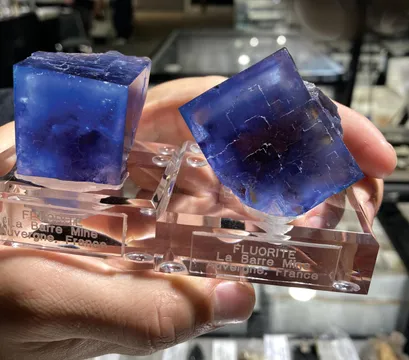
Le Beix is one of the classic names in French fluorite: a closed fluorspar mine in the western Puy-de-Dôme, near Lastic and Saint-Germain-près-Herment, whose best specimens gave collectors the phrase “Beix blue.” The deposit is a high-purity hydrothermal fluorite vein in the crystalline basement along the great faulted coal-bearing corridor of the Massif Central. It was mined for industrial spath fluor, but its enduring importance is specimen-mineralogical: sharp cubes, less common octahedra and modified forms, and large, clean crystals in pale sky blue, turquoise, blue-green, violet, yellow, and color-zoned combinations, most famously on a matrix of thin quartz blades or crusts.
Regional View
Country View
The best Le Beix pieces have an immediately recognizable architecture: transparent to translucent fluorite cubes stacked or stepped across quartz, often with violet zoning deep inside the blue, and sometimes with a later silica skin that gives the surface a frosted, antique look. Unlike many mines celebrated for broad species diversity, Le Beix is prized for the depth and refinement of a comparatively simple assemblage. Fluorite dominates; quartz frames and interrupts it; baryte, galena, pyrite, chalcopyrite, and rare pyromorphite add the accessory story.

Photo: Wikimedia Commons
Le Beix also matters because it sits at the intersection of French industrial history and collector culture. It was not a casual prospect hole that happened to yield a few fine crystals; it was a long-lived underground fluorspar mine, worked through several phases of modernization, remembered in French mining literature, represented in public collections, and famous enough that a Le Beix-style blue fluorite appeared on a French postage stamp issued in 1986. Today, with the mine closed, the main shaft collapsed and access impossible on private agricultural land, every authentic specimen is an old-production piece.
Search for specimens: View all specimens from Le Beix Mine, France
The mine lies in the south-western part of the Puy-de-Dôme department, close to the hamlet of Rozet and near Lastic, with Herment and Bourg-Lastic both appearing historically on labels. “Le Beix,” “Bourg-Lastic,” “Herment,” and “Saint-Germain-près-Herment” can all occur on older specimen tags; this variety reflects shipping points, nearby settlements, and later administrative wording rather than separate specimen localities.
Geologically, Le Beix is a hydrothermal fluorite vein in the crystalline rocks of the Massif Central. The vein belongs to the family of fluorite-bearing structures developed along the great coal-bearing fault corridor that crosses the region and is accompanied by other fluorite occurrences such as Boisset, La Rochette, Le Four, and Saint-Jacques-d’Ambur. The Bourg-Lastic geological sheet describes the Beix mineralization as the filling of a fracture oriented around 110°, remarkable for its regularity and purity. Older analyses reported extremely high CaF2 values, with very little silica and baryte, which explains why the deposit was economically attractive for fluorspar rather than merely collectible fluorite.
Published accounts differ slightly in detail because they summarize different stages and datasets, but the broad geometry is consistent: a steep, nearly vertical vein, generally a few metres thick, followed for roughly 250 m in length and to about 235 m in depth. The vein was notably regular for a French fluorite lode, commonly described as about 4 m average thickness, locally narrower and locally broadening to several metres. The internal structure was banded and symmetrical, with fluorite deposited along the walls toward the centre of the fracture and a central baryte-rich zone that could carry small galena blebs. Quartz commonly borders or cuts the fluorite and is particularly important in specimen pockets.
The mineralization was simple but highly expressive. Massive fluorite formed the ore, while open spaces in the central portions of the structure allowed cubes and octahedra to develop. The most prized pockets produced blue, blue-green, or yellow fluorite crystals in geodes, commonly associated with quartz and locally with baryte. Some accounts distinguish an early, duller or massive fluorite generation from later, more transparent and sharply crystallized fluorite, and many specimens show zoning that records repeated changes in the hydrothermal system.
Mining is generally said to have begun in the late nineteenth century, with more organized exploitation in the early twentieth century. Early work was modest and partly open to the surface before operations moved underground. A first underground gallery was driven from the quarry floor, and by the 1920s a vertical shaft had been sunk into the vein. The mine was worked for most of its productive life by Établissements Teisset-Kessler, then passed into the Péchiney-Ugine-Kulhmann orbit through SOGEREM in its final period. The mine closed definitively in 1977; some sources give the final stoppage of extraction as 22 April 1977, while broader summaries simply cite July 1977 as the final closure period.
The workings were served by shafts commonly named Saint-Jean, Saint-Jacques, and Saint-Louis. Over time, mining evolved from small timbered galleries and manual haulage to more systematic underground methods. In the post-war period, perforators, improved sorting and washing installations, and later cut-and-fill style stoping were introduced. By the 1950s and 1960s the mine was producing several thousand tonnes annually, and in the mid-1960s it still employed dozens of workers. Production figures vary by source depending on whether they refer to ore, fluorite, or marketable products, but the usual cited range is about 360,000 to 386,000 tonnes, making Le Beix a significant French fluorspar producer as well as a collector locality.
The most desirable specimen material appears to have come from mid-level workings exploited during the strongest production years, especially around the Saint-Jean shaft and levels identified in some accounts by letters such as S and T. The best geodes reportedly yielded vivid blue cubes measuring 10 to 15 cm across, with the largest cubes from the locality cited up to around 20 cm on edge. The roof side of the vein was considered more favourable for crystallized pockets than the footwall side. As the mine deepened, the vein became poorer in attractive pockets and richer in quartz, and the quality of specimen material declined.
Collecting today is not possible. The principal shaft was collapsed after closure, surface machinery was dismantled, and the site is private agricultural property. Any modern Le Beix specimen should therefore be treated as old stock, a specimen from a miner’s saved material, an old French collection, a dealer archive, or a museum duplicate lineage.
Fluorite is the signature mineral of Le Beix and occurs as massive ore, cubes, octahedra, cube-octahedron combinations, rhombododecahedral forms, stepped parallel-growth cubes, and rarer modified crystals with beveled or star-like terminations. The best-known crystals are blue to blue-green, from pale sky blue to vivid turquoise, but the mine also produced yellow, violet, green, colorless, and strongly zoned pieces, including blue-yellow, violet-clear, and blue crystals with darker phantom cores. Most collector crystals are centimetric, commonly in the 1–6 cm range, but major examples reach 10–15 cm and rare reported cubes approach 20 cm on edge. Associations are usually restrained: quartz is the classic matrix, with occasional pyrite, marcasite, baryte, galena, chalcedony, or very rare pyromorphite. The finest pieces combine transparency, saturated but natural “Beix blue,” sharp cubic geometry, visible internal zoning, good coverage on quartz, and minimal bruising to corners; ordinary examples are paler, more massive, edge-damaged, or dulled by late silica or exposure.
Quartz at Le Beix is the essential supporting actor rather than a showy stand-alone species. It occurs as thin blades, veinlets, crusts, small clear crystals, and microcrystalline silica that cuts, coats, or supports fluorite. Large isolated quartz crystals are not typical of the mine; most documented crystals are small, commonly under a couple of centimetres, but quartz is crucial because many of the most aesthetic fluorite specimens formed where later silica created a matrix or scaffolding for a subsequent generation of blue fluorite. Good quartz-bearing specimens are valued when the quartz gives contrast and architecture without obscuring the fluorite—especially thin, platy, white to translucent quartz beneath sharp blue cubes—while heavily silicified pieces can look frosted, etched, or visually muted unless the texture is especially sculptural.
Other documented minerals from Le Beix include baryte, galena, pyrite, chalcopyrite, and pyromorphite, with some sources also discussing marcasite, hematite, chalcedony, and jasper-like secondary silica. Baryte formed a thin central white vein in the lode and only rarely produced attractive honey-colored tabular crystals. Pyrite occurs as inclusions in fluorite and as small crystals on quartz or baryte; marcasite is more alteration-prone where present. Galena is generally minor, disseminated in baryte and fluorite or appearing as small cubic crystals in pockets. Pyromorphite is the most notable rarity, described as scarce yellow-green crystals on galena or directly on fluorite. Le Beix is not known as a type locality; its stature rests on classic fluorite specimens rather than new-species mineralogy.
The first authenticity issue with Le Beix is locality, not species. Blue fluorite from several European and French localities can be made to look superficially similar, and Le Beix has been valuable and famous long enough to attract optimistic or incorrect labels. A specifically discussed problem in French collector circles involved blue fluorites from La Collada being sold as Le Beix. Labels reading “Bourg-Lastic,” “Herment,” or “Saint-Germain-près-Herment” may still be legitimate for Le Beix material, but an unprovenanced “blue French fluorite” should not be upgraded to Le Beix without old labels, collection history, or strong stylistic support.
Condition matters greatly. Fluorite has perfect octahedral cleavage and Le Beix cubes often show chipped corners, bruised edges, internal cleavage, or contact damage along the margins of a plate. Many otherwise impressive cabinet specimens are best judged by the display face: small edge nicks may be acceptable on a large old piece, but repaired prominent cube corners, reattached crystals, or disguised cleavage should affect value. Some specimens show late chalcedony or quartz coatings; these are part of the locality’s natural paragenesis when genuine, but they can reduce brilliance and should not be mistaken automatically for damage or artificial frosting.
The blue color deserves special care. French sources repeatedly warn that the intense blue of Le Beix fluorite can fade with prolonged daylight exposure. For display, avoid direct sun and strong UV-rich lighting; storage in a cabinet away from window light is prudent. Short inspection under ultraviolet light is reasonable, and some Le Beix fluorites are reported as fluorescent under both longwave and shortwave UV, but UV response should be treated as an accessory observation rather than an authentication test.
Market supply is finite. Because the mine is closed, inaccessible, and on private land, pieces now come from old collections, dealer inventories, estate dispersals, and occasional miner-saved material. Small pale-blue or violet fragments still appear, but sharp, transparent blue cubes on quartz, large cabinet plates, strongly zoned crystals, and fine old-label specimens are increasingly competitive. The most desirable examples carry a premium for three things at once: unmistakable color, undamaged cubic form, and credible provenance.
The old story of Le Beix begins almost like a mineral-collector folktale. The vein is said to have been recognized by chance, with one version crediting a soldier from the Bourg-Lastic military camp who noticed the fluorite vein in the commune of Saint-Germain. Whether or not the tale is literally exact, it fits the character of the place: a deposit that began as an industrial fluorspar resource and ended as one of the reference names of French mineral collecting.
The mine’s industrial life was not romantic in the easy sense. Early underground work was small-scale, timbered, and manual. A 1919 description summarized a modest mine with only about fifteen workers, including six underground miners. The ore was handled by local labor, and women and men at surface sorting tables picked fluorspar by hand. One published photograph caption from 1930 records hand-sorting of spath fluor at Le Beix, a reminder that many crystals now admired under cabinet lighting survived because someone at the mine recognized that a pocket specimen was more than just feed for the crusher.
Le Beix also entered the modernization story of French fluorspar mining. Louis Sire, director from 1914, is credited in a historical account with introducing mechanical drilling at Le Beix for the first time in France. That single detail says much about the mine’s position: old enough to have begun in a quasi-artisanal era, important enough to justify modern methods, and productive enough to remain active long after many smaller prospects had vanished.
By the 1950s, another kind of mining was happening in parallel with the official extraction. Collectors and miners had learned which pockets mattered. Fine specimens were set aside, traded, or sold; a “chasse aux géodes,” a hunt for geodes, developed alongside industrial work. The prized pockets were not evenly distributed. Mid-level stopes, especially around the Saint-Jean shaft and the S and T galleries mentioned in later accounts, produced vivid blue cubes sometimes reaching 10 to 15 cm. Such pieces are the reason old French collectors still speak of Le Beix with the same instinctive respect given to La Gardette quartz or Les Farges pyromorphite.
The most charming sign of Le Beix’s status came not from a mining report but from the post office. On 13 September 1986, the French postal service issued a stamp depicting a specimen of the kind that made the locality famous. Few mineral localities achieve that level of public recognition. For collectors, the stamp confirmed what the cabinets had already shown: the pale luminous blue fluorite of Le Beix had become an emblem, not simply a product.
There is a quieter modern story as well: the mine is gone, but the specimens continue to move. One collector account describes a large Le Beix fluorite collected by a miner, left for years in a barn, later cleaned and partly restored at the tip of a cube before entering the collector market. The owner described waiting ten months to secure it, then covering it with cloths because these fluorites “fear the sun” and can lose color in daylight. That anecdote captures the present life of Le Beix material: no longer dug, often imperfect, sometimes restored, always judged under the shadow of its rarity, and protected as much for its color as for its history.