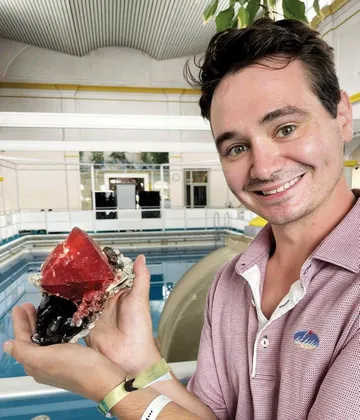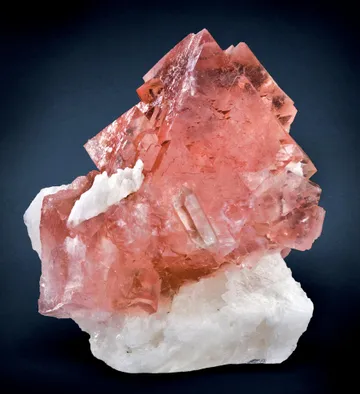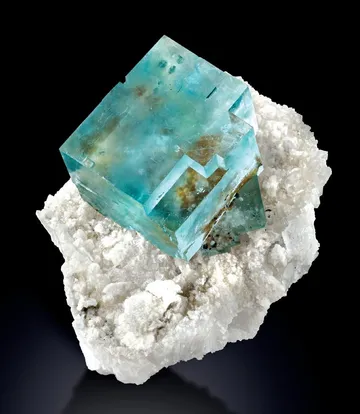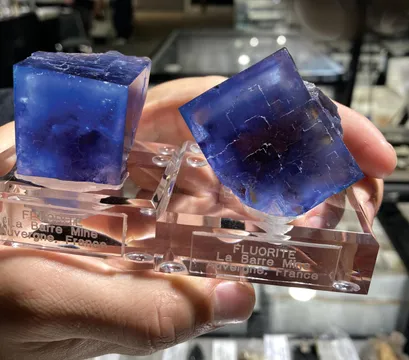
Argentière Glacier: Alpine locality in the Mont-Blanc massif known for smoky quartz and morion with pink fluorite octahedra; prized by collectors for its strik…
Key facts
Argentière Glacier is one of the great Alpine-cleft specimen localities of the Mont-Blanc massif: not a mine, not an ore deposit, but a high, glaciated granite basin where tectonic fissures and quartz veins have opened enough free space for crystals to grow. For collectors, its name carries a very specific image—smoky quartz and morion from the Mont-Blanc granite, locally accompanied by octahedral pink to raspberry-red fluorite, the combination that made the Chamonix–Argentière tradition famous far beyond France. The best specimens have a severe Alpine elegance: lustrous, glassy smoky quartz points or gwindels, sometimes almost black at their cores or terminations, carrying small but intensely colored fluorite octahedra that look as if they were placed deliberately for composition.
The setting matters as much as the minerals. The glacier occupies a classic Mont-Blanc landscape of granite, protogine, crystalline schists, knife-edge ridges, seracs, moraines, and steep walls above Chamonix. The productive ground is not a single pit but a basin and its flanking ridges and subsidiary sectors: the Aiguille d’Argentière and its Charlet-Straton ridge, the Tour Noir area, Pointe Kurz, Pointe des Améthystes, Les Droites, Les Courtes, and other pockets along the Argentière side of the massif. In specimen labels, “Argentière Glacier” often functions as both a precise locality and a collecting-basin name, so old labels deserve careful interpretation.
Regional View
Country View
Historically, Argentière belongs to the culture of the Chamonix cristalliers—mountain people, guides, and highly competent alpinists who search natural crystal cavities known locally as fours. The modern collecting reputation of the basin rests above all on quartz and fluorite finds made from the later twentieth century onward, as technical climbing equipment, glacier retreat, and persistent local prospecting opened ground that earlier collectors either could not reach or could not see.

Photo: Géry Parent / Wikimedia Commons
Search for specimens: View all specimens from Argentière Glacier, France
Argentière Glacier is best understood as an Alpine fissure locality developed in the Mont-Blanc crystalline massif. The collector’s “deposit” is a system of naturally opened clefts and quartz veins in granite and protogine, with local influence from adjacent crystalline schists and gneissic rocks. During Alpine deformation and uplift, extensional fractures opened in the rigid crystalline rocks; hydrothermal fluids moved through those spaces, dissolved and redistributed silica and other elements from the surrounding rock, and deposited quartz first, with later or accompanying assemblages that may include fluorite, feldspar, chlorite, epidote, carbonates, iron oxides, and rarer phosphates or accessory species. The mineralization is therefore not stratiform, not a lode mine in the economic sense, and not a pegmatite field; it is the classic Alpine-cleft environment, exposed and refreshed by frost, rockfall, and glacier retreat.
There are no ore bodies or historic mining operators at Argentière Glacier in the normal mining sense. The “operators” have been independent cristalliers, often guides or accomplished climbers, working natural crystal pockets by hand. Specimens come from openings in quartz veins, from pockets in altered granite, from moraines carrying blocks released by the glacier, and from steep walls or ridges overlooking the ice. In the Charlet-Straton ridge area near the Aiguille d’Argentière, the assemblage is documented with albite, chlorite, fluorite, epidote, and colorless to smoky quartz. In the Tour Noir granite, labels and records mention albite, aragonite, calcite, and quartz. At Pointe des Améthystes, the assemblage expands to amethyst, albite, ankerite, hematite, and smoky quartz. These named sublocalities are important because many old “Argentière Glacier” specimens actually came from one of the ridges or points that feed the collecting basin.
The famous production is specimen production, not metal production. Nineteenth-century Chamonix collecting brought amethyst and early fluorite from the Argentière basin into local circulation, but the great modern reputation developed later as serious high-mountain prospecting matured. Important fluorite finds are recorded in the basin and neighboring sectors in the late twentieth century: a 1968 find by Roger Fournier in the Argentière basin produced a plate with fluorite crystals to about 5 cm; the Tour Noir area yielded notable dark pink octahedral fluorites in 1997; and other Argentière-basin discoveries in the 1980s and 1990s added green fluorite, pink-cored green fluorite, and smoky-quartz combinations to the lore of the massif. More recent finds include colorless gwindels and smoky quartz from the Argentière side, including a 2009 discovery of unusually fine twisted colorless quartz that became the subject of a dedicated Le Règne Minéral article.
Collecting access today is formal and regulated. Since August 1, 2008, anyone wishing to search for crystals on the territory of Chamonix-Mont-Blanc has been required to make a declaration to the town hall and comply with the code of honor for cristalliers. The rules preserve the traditional character of the work: no explosives, no machines, no heavy equipment, no removal by helicopter, no motorized transport of finds, and the site must be restored when work ends. Significant discoveries must be reported, scientifically interesting pieces must be presented to the Chamonix Crystal Museum committee, and the municipality’s current convention framework treats mineral collecting on communal parcels as an annual, explicitly granted activity rather than open public collecting. For visiting collectors, this means that Argentière is not a casual hammer-and-backpack locality; it is a serious alpine environment with legal, safety, and cultural expectations.
The best pockets are typically small, awkward, and unforgiving. Large open cavities are rare; many fours are narrow seams, low chambers, or frost-collapsed pockets where crystals have detached into mud, ice, gravel, or shattered roof debris. Ice can preserve crystals beautifully, but it also makes extraction delicate. On the collector market, the finest Argentière pieces are those that preserve the pocket relationship: smoky or morion quartz in crisp Alpine habit with well-placed pink to red fluorite octahedra, or clean gwindels with undisturbed twisting and minimal edge bruising. Matrix pieces are prized when the granite or quartz base is natural, balanced, and not over-trimmed; loose fluorite octahedra are attractive, but locality confidence and undamaged faces become much more important.
Quartz from Argentière Glacier is the foundation of the locality: colorless, smoky, morion, amethystine, and locally gwindel forms occur in Alpine fissures of the Mont-Blanc granite and in the named sectors around the basin. Good pieces show sharp, lustrous prism faces, undamaged terminations, pleasing transparency, and a clean Alpine architecture rather than merely being large; the finest smoky specimens may carry pink to raspberry-red fluorite octahedra, while the 2009 Argentière gwindel discovery is especially noted for transparent, twisted colorless quartz of a form considered typical of the Mont-Blanc massif. Older records also note large quartz crystals in the Tour Noir area, where hyaline quartz, smoky quartz, amethyst, and pink fluorite occur in altered protogine and quartz veins, with some crystals historically reported as multi-kilogram pieces.
Fluorite is the prestige mineral of Argentière Glacier, classically appearing as octahedra rather than cubes, in pale pink, rose, raspberry-red, and locally green crystals perched on smoky quartz, morion, granite, or feldspar-rich matrix. Typical crystals are small to a few centimeters, but important Argentière-basin and adjacent Mont-Blanc finds include octahedra around 5 cm and exceptional larger crystals from the wider massif; collector-grade pieces are judged by saturated color, transparency, intact octahedral edges, absence of obvious oiling or repair, and the placement of fluorite on undamaged smoky quartz. The Tour Noir and Argentière-basin finds are especially valued because the best examples combine saturated red-pink fluorite with glassy, dark quartz in a way that is visually unmistakable as high Mont-Blanc material.
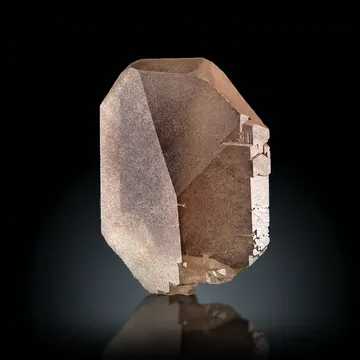
Smoky quartz from Argentière Glacier ranges from pale tea-colored crystals to dark morion, with the color developed in the radioactive granite environment of the Mont-Blanc massif. The most desirable specimens are not simply dark: they have glassy luster, crisp Alpine terminations, strong transparency when backlit, graceful proportions, and—at the top end—natural association with pink to red fluorite octahedra or unusual forms such as gwindels and faden-like, flattened groups. Ordinary pieces from collapsed pockets may be bruised, frosted, or incomplete, whereas the best Argentière smoky quartz keeps its termination faces, shows minimal edge wear from ice and rock movement, and has either a sculptural single-crystal presence or a balanced group that clearly belongs to the Alpine-cleft tradition.
Other documented minerals from the Argentière Glacier locality and its immediate collecting basin include apatite, dolomite, albite and adularia, chlorite, epidote, aragonite, calcite, ankerite, hematite, amethyst, heulandite, and laumontite. Violet apatite from the Mont-Blanc massif has been specifically reported in connection with Argentière Glacier, making it one of the more interesting recent rarities. The locality is not celebrated as a type locality for new species; its mineralogical importance rests instead on Alpine-cleft quality, on the quartz–fluorite association, and on the named high-mountain pockets that have produced specimens of exceptional aesthetic and historical weight.
Argentière specimens demand unusually careful locality scrutiny. Old labels may say “Glacier d’Argentière,” “Bassin d’Argentière,” “Aiguille d’Argentière,” “Tour Noir,” “Pointe Kurz,” “Pointe des Améthystes,” or simply “Mont-Blanc, Chamonix,” and those labels are not always interchangeable. Because the glacier basin, its moraines, and the surrounding ridges form a connected collecting landscape, many historic specimens were labeled broadly. A serious collector should preserve every original label and avoid “improving” the locality beyond what the label or provenance actually supports.
The principal authenticity concerns are repair, assembly, enhancement, and vague locality claims. Pink and red Mont-Blanc fluorite is valuable enough that repaired octahedra, reattached crystals, made-up quartz–fluorite combinations, oiled fluorite faces, and artificially glossy surfaces are all realistic concerns. The Chamonix code of honor explicitly forbids selling modified pieces such as assemblies or finished specimens and requires repairs to be disclosed. On the market, look for mismatched contact surfaces, unnatural glue menisci, suspiciously perfect placement of isolated fluorite octahedra on smoky quartz, oil trapped in cleavage cracks, and fluorite faces that appear unnaturally wet or saturated under strong light.
Condition is the great separator. Alpine pockets around Argentière are commonly affected by frost, ice, seismic movement, and collapse; many crystals are naturally detached, bruised, etched, or cleaved before they are ever found. Fluorite octahedra commonly show rounded or etched faces, and cleavage damage can be disguised by color and luster. Smoky quartz may have chipped terminations, bruised prism edges, healed breaks, chlorite coatings, clay residue, or contact marks where it grew against pocket walls. A small, undamaged, well-composed piece is generally preferable to a larger specimen with hidden repair or a poor fluorite–quartz relationship.
Fluorescence is not the collecting driver here. The locality’s fluorite is valued for daylight color, transparency, octahedral habit, and association with smoky quartz rather than for ultraviolet response. Handling should be conservative: fluorite cleaves easily, and many specimens combine hard quartz with much softer, more fragile fluorite perched on edges or terminations. Avoid ultrasonic cleaning, harsh acids, aggressive brushing, and heat. Iron or clay cleaning should be done slowly and with full awareness that a slight natural pocket patina can be part of the specimen’s identity.
Availability is limited but not impossible. Modest smoky quartz and occasional small pink fluorite specimens appear through French and Alpine dealers, Chamonix-related channels, and international shows. Fine red fluorite on smoky quartz from an old or well-documented Argentière-basin pocket is much scarcer, and museum-quality pieces are genuinely rare. Recent legal and cultural expectations around Chamonix collecting also mean that good provenance—named cristallier, year of find, pocket or ridge when legitimately disclosed, and repair status—is increasingly part of the specimen’s value.
In the modern Argentière story, the glacier is not a place where collectors stroll to a dump. It is a place reached by ladders, glacier crossings, bivouacs, and judgment. One Outside account follows Christophe Péray and Simón Elías as they move through the high Mont-Blanc basins, with the Mer de Glace running roughly parallel to the Argentière Glacier several miles away and the Aiguille Verte rising between them. Their equipment tells as much as their route: Péray in black jeans, a red shirt, and a scarf, carrying a long stave that had once been a ski-run marker rather than a conventional ice axe. Elías jokes that expensive mountaineering brands do not get much business from Péray; denim survives kneeling, crawling, and scraping inside granite pockets better than glossy alpine clothing.
At the Col des Cristaux, five hours from the hut and about 11,814 feet up, the scene becomes pure cristallier arithmetic. Péray had made small sleeping platforms in the scree, and dark angular crystals lay around—material already extracted but not worth the human cost of carrying down. A classic pointed quartz might bring only a modest sum; a gwindel or quartz with fluorite changes the calculation entirely. In this landscape, weight is value, but only if it is the right value. Everything must be carried by back and legs through exposed ground, so mediocre crystals remain on the mountain.
The pocket above the Argentière Glacier shows why the best pieces are rare. Once the tents were up, the party crossed onto the north face and traversed up to a ledge above the glacier. Péray and Elías first knocked loose boulders to make a stance, then squeezed into the pocket while blowtorches hissed. The crystals were trapped in ice, and Péray explained the rule every collector should remember: “You have to melt it very slowly.” A hammer blow into ice may save minutes and destroy the very edges that give the specimen its worth. For two hours, roped to the rock, they inspected each piece as it emerged; keepers were set aside or laid on the snow, rejects went downslope. The day’s haul—about 40 pieces—was wrapped in sheets of Libération for the carry out.
Another pocket, just beneath a ridge, was almost absurdly hidden. Péray pointed out that a classic climbing route passed only yards above it; thousands of climbers had gone by within a few meters and had never seen the opening. He had marked the cavity with a business card, the customary sign of discovery and the right to work it. Inside, the pocket was the size of a small cave, with crystals showing as silver-gray flashes in the mud and points protruding from the low roof. It is a useful lesson in Alpine collecting: the mountains may be crossed by famous routes, yet the productive cleft can remain invisible unless the eye has been trained to read rock, vein, shadow, thaw, and fracture.
The pursuit of red fluorite takes the story higher and darker. With Péray forced back by a bad back, Elías and the writer set out before 6 A.M. toward the Aiguille Verte, caching crampons and moving toward the Grande Rocheuse. The Whymper couloir, once a celebrated snow route on the first-ascent line of 1865, lay nearby, but in summer it had become a rockfall chute; the safer choice was another spur. At roughly 13,100 feet, six hours out, Elías built a diagonal rappel into a sunless gully, followed by two more rappels. The target was a horizontal crack only about eight inches wide, halfway up a cliff, with silver-gray-black crystals in its roof and a drop of about 1,500 feet toward the glacier below.
For 90 minutes, suspended in harnesses at about 12,795 feet, Elías pried out crystals, rejecting broken or ordinary pieces and wrapping better ones individually in toilet paper and Le Monde. He found smoky quartz covered with red fluorite, but the larger pieces were fractured. The sack still held around $2,500 worth of crystals by the end of the trip, yet there was no miracle piece. The descent supplied its own bill: shredded gloves, boot soles peeling away, a nearly sleepless exhaustion back at the hut, then a slip on scree the next day and an improvised sling made from a light down jacket. They returned toward Montenvers past tourists admiring the last accessible ice, while the real story of the crystals remained, as so often in Chamonix, almost invisible.
A different kind of story surrounds the great French red fluorite specimen known as “Laurent.” Found in the Mont-Blanc massif by Christophe Péray in 2006, it combines the two Chamonix signatures—red fluorite and smoky quartz—in a specimen of such importance that it was classified as a “bien culturel d’intérêt patrimonial majeur,” the first time a natural history object received that status in France. Péray named it for his climbing companion Laurent Chatel, who died in a fall in 2005. Offers reportedly reached extraordinary levels, but the piece remained in France through a deal involving Total and the national museum context. For collectors, Laurent is more than a trophy: it is the example that explains why Argentière-basin fluorite on smoky quartz is watched so closely, regulated so carefully, and spoken of in Chamonix with a mixture of pride, secrecy, and grief.