Margabal Mine, France: a small uranium phosphate locality famed for torbernite and metatorbernite on smoky quartz, prized for sculptural crystal forms.
Key facts
Margabal is one of those improbably small mines whose reputation is wildly out of proportion to its physical size. The workings are tucked into the wooded slopes above the Lot valley, south of Entraygues-sur-Truyère in Aveyron, on the flank of the Puy de Soulouze. Collectors know the name for superb green torbernite and metatorbernite—tabular, lustrous, often sheaf-like or stalactitic—and for the particularly beautiful way those crystals contrast with smoky quartz from the granite-hosted vein system.
Geologically, Margabal belongs to the small uranium occurrences of the Entraygues sector of the southern Massif Central. The mineralization is not a large pitchblende mine in the classic Limousin sense; it is a compact, fracture-controlled, supergene uranium phosphate occurrence developed in and around quartz veins cutting the Entraygues granite. The collectible minerals formed in open spaces and fractures where uranium-bearing solutions, phosphate, copper, calcium, and later oxidizing groundwater chemistry interacted over time. That chemistry produced the mine’s signature assemblage: torbernite/metatorbernite with autunite/meta-autunite on smoky quartz, with uranocircite historically reported but not always easy to separate from calcium-rich yellow autunite-family zones without analysis.
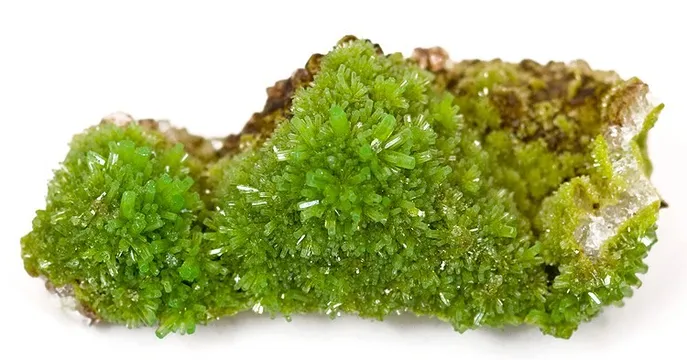
The best Margabal specimens have a look that is instantly recognizable: saturated emerald to pine-green books and stepped tetragonal plates, sometimes with darkened edges, built into free-standing sprays, combs, “fir-tree” clusters, and stalactitic aggregates. Some pieces are almost pure floating masses of uranium phosphate; others show the green crystals perched on smoky quartz points. At the top level, Margabal competes with the great torbernite localities of the world not by the tonnage it produced, but by form, color, luster, and sculptural architecture.
Regional View
Country View
Margabal’s importance also rests on a distinctly modern collecting history. The mine was investigated and worked only briefly for uranium, but it was rediscovered as a specimen locality decades later. Collectors in the 1990s and afterward reopened access with difficult hand work, and the resulting pockets supplied many of the pieces by which the locality is now judged. The classic date on many labels is 1997; later finds, including the 2009 and 2014 work, added further material but did not erase the aura of the original post-mining recoveries.
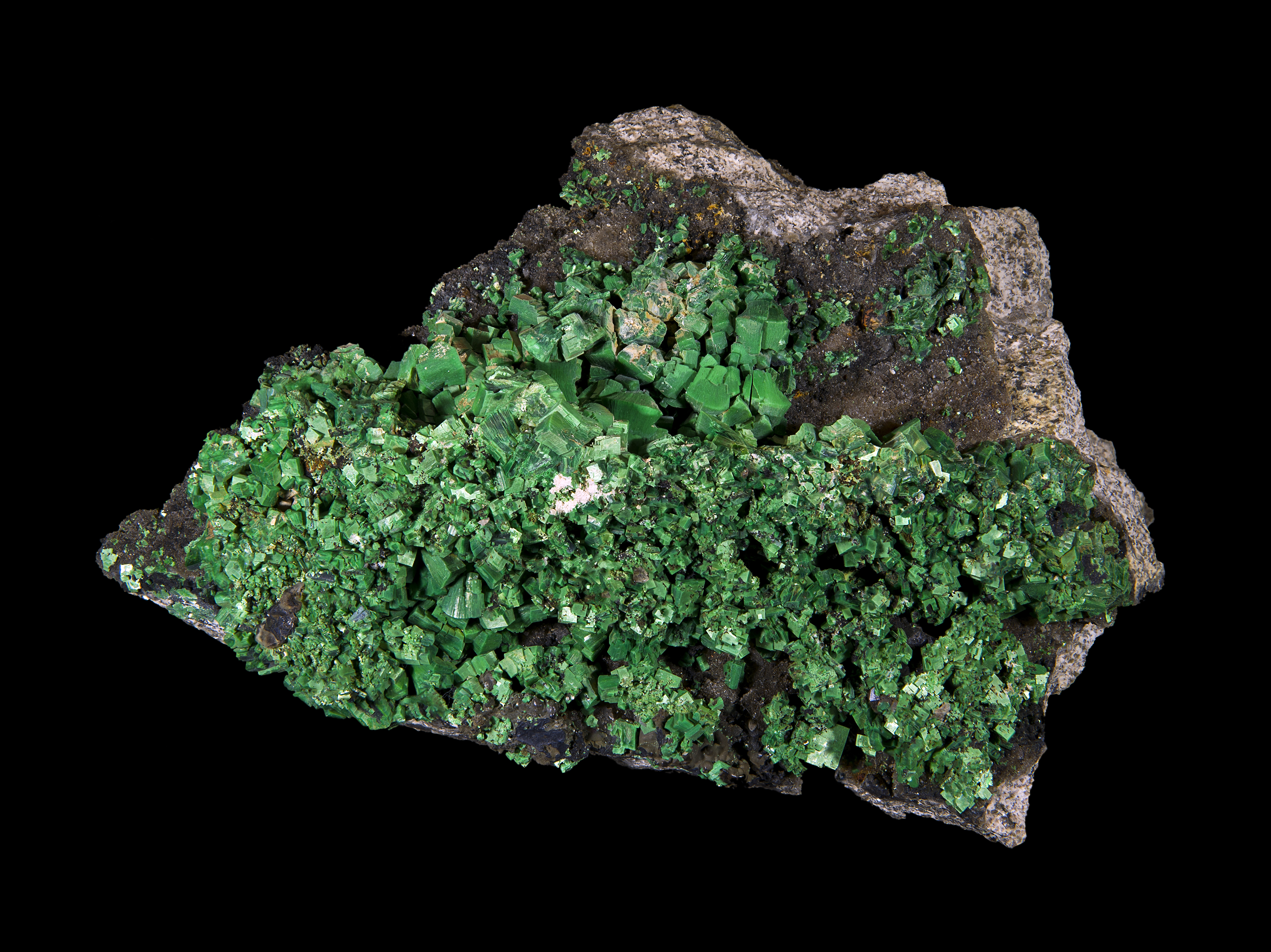
Photo: Wikimedia Commons
Search for specimens: View all specimens from Margabal Mine, France
Margabal lies near Entraygues-sur-Truyère, in the Aveyron department of Occitanie, within the granitic terrain of the southern Massif Central. The uranium occurrence is hosted by fractured granite cut by smoky quartz veins, within a structurally prepared zone described in modern accounts as a mylonitized fracture belt. The productive vein system was small: published locality summaries describe the mine as only about 100 meters in extent, and specimen accounts refer to a torbernite-bearing vein a little over 30 cm wide in the mine’s “uranium enrichment zone.” More broadly, quartz veins in the system are commonly described as narrow, often around 10–15 cm, but widening locally into more open cavities where the best specimens formed.
The mineralization is best understood as secondary uranium phosphate mineralization in an oxidized, low-temperature setting rather than a major primary uranium orebody. Uranium was mobilized through the fractured granitic host; phosphate could be supplied by alteration of accessory phosphate minerals such as apatite; copper was likely contributed by the breakdown of copper-bearing sulfides in the system or nearby source rocks. In open cavities, this chemistry produced hydrated uranyl phosphates. The green copper member is torbernite, Cu(UO2)2(PO4)2 · 12H2O, which commonly dehydrates to metatorbernite, Cu(UO2)2(PO4)2 · 8H2O. The yellow calcium member is autunite, Ca(UO2)2(PO4)2 · 10-12H2O, with meta-autunite also documented.
The old mine was developed as a small uranium prospect in the postwar period, during the wave of French uranium exploration linked to the Commissariat à l’énergie atomique. Accounts differ slightly in how they date the earliest opening of the mine: some collector and locality records give 1957–1960, while the national MIMAUSA uranium inventory records official work at Margabal from 1959 to 1960. In either case, the productive life was extremely short. MIMAUSA lists the operation as “Travaux de Reconnaissance par Petit Chantier”—recognition work by a small working—and records 1.5 tonnes of extracted uranium, with no ore treatment plant and no tailings storage on site.
The underground layout is described as a small horizontal working, often summarized as Y-shaped, with two shafts or raises associated with extraction. The project did not become a sustained uranium mine. After work ended, the entrance was blasted and backfilled, which cut off ordinary collecting access to the original workings and preserved, for a time, the mine’s specimen potential.
The collecting history is the heart of Margabal. Torbernite from the district was noticed long before the uranium rush: in the mid-19th century, Pierre Toussaint Marcel de Serres recorded “chalcolite,” an old name applied to torbernite-type material, from the Margabal area. After the mine closed, a few fine specimens survived and entered important hands, including material associated with Pierre Bariand of the Sorbonne. The locality then returned to prominence in the 1990s when collectors forced new access after the old mine entrance had long been blocked. The 1997 work is especially important: named collectors including Alain Pouget and Yvan Dissac are associated with the first major modern recoveries, and later that same collecting season other teams worked the vein and opened additional pockets.
Those pockets yielded the classic material: rich, free-standing groups of green torbernite/metatorbernite, books of tabular crystals, stalactitic masses, and specimens on smoky quartz. A celebrated 47 cm stalactitic group, found in 1997 by Jérôme Adani, is reported in multiple collector sources as having gone to the Muséum national d’Histoire naturelle in Paris. Further work in 2009 by Marc and Cyril Caverivière with Alain Deboth produced additional high-quality specimens, and later reports describe 2014 material from an argillaceous cavity lined with smoky quartz.
Current field access should not be treated as a normal collecting opportunity. The mine is a small, old uranium working; later locality notes report that by late May 2025 it had been sealed by a one-meter-thick wall with a bat access opening. Even apart from legal ownership and permission questions, the hazards are real: unstable underground ground, sealed or altered workings, poor ventilation, radon potential, radioactive dust, and fragile hydrated uranium minerals. For practical collecting purposes, Margabal is now a specimen-market locality, not a casual field-collecting destination.
Margabal torbernite is treasured for deep emerald to pine-green tabular crystals, commonly in stacked books, echeloned growths, fan-like sheaves, and stalactitic free-standing aggregates, with individual crystals reported from millimeter scale to more than 2 cm and exceptional 1997 pocket material cited with crystals reaching about 3.4 cm. Much material labeled “torbernite” has partially dehydrated to metatorbernite, but the visual character remains that of sharp green uranyl phosphate plates, often with a darker natural patina and occasional yellow autunite/meta-autunite zones. The finest pieces are not merely green coatings: they show three-dimensional architecture, crisp tetragonal faces, luster, depth of color, freedom from bruising, and, ideally, a dramatic setting on smoky quartz or a sculptural floating form from the vein cavities.
Autunite at Margabal is most important as the yellow to lemon-yellow calcium-rich phase intergrown with, underlying, or zoning into the green torbernite/metatorbernite aggregates, rather than as abundant isolated display crystals. SEM-EDS work on yellow zones in Margabal specimens found calcium-rich autunite-family material and no detectable barium in the analyzed areas, helping explain why some yellow “uranocircite” labels need caution. Under longwave ultraviolet light, these yellow autunite/meta-autunite portions can fluoresce intensely, and even apparently green groups may reveal small fluorescent areas where calcium-rich phases are present. The most desirable autunite-bearing Margabal pieces are those where the yellow component is visually legible—zoned, glowing under UV, and mineralogically interesting—while still preserving sharp green torbernite books and good smoky quartz association.
Other documented minerals from Margabal are few but significant. Quartz, especially smoky quartz, is the essential gangue and matrix mineral, forming the dark, glassy stage for many of the best green crystals. Metatorbernite is abundant and, in practice, much classic “torbernite” from Margabal is at least partly metatorbernite because of natural dehydration. Meta-autunite is also documented. Uranocircite is listed in major locality databases and older references, but the Margabal record is complicated by analyzed yellow zones that proved to be autunite/meta-autunite rather than barium uranocircite; collectors should therefore value confirmed analytical provenance where a specimen is specifically sold as uranocircite. No type-locality mineral is credited to Margabal itself in the principal locality records.
Margabal specimens are radioactive uranium minerals and should be handled and stored accordingly. The main practical issue is not just external radiation but fragility and dust: torbernite, metatorbernite, autunite, and meta-autunite are soft, cleavable, hydrated phosphates. Broken plates, loose powder, or crumbly matrix should be avoided or stabilized by a knowledgeable conservator. Handle pieces as little as possible, wash hands afterward, do not cut or abrade them, and store them in a ventilated but secure display or container away from living spaces, children, pets, food preparation areas, and prolonged close contact.
Condition is central to value. Margabal crystals commonly grow in stacked books and delicate sheaves, so edge bruising, crushed terminations, and rubbed high points are common. The best pieces retain sharp plate edges and open, three-dimensional form. Some specimens have been stabilized, and that is not automatically a defect if disclosed; for radioactive secondary minerals, stabilization may be prudent. Undisclosed coatings, glossy consolidants that change the surface, or repairs to broken stalactitic groups should be considered value factors.
The most persistent labeling issue is the torbernite/metatorbernite/autunite/meta-autunite/uranocircite problem. Many older labels use “torbernite” broadly for green material that has dehydrated partly or mostly to metatorbernite. Yellow zones on Margabal pieces have sometimes been called uranocircite, but analytical work on representative yellow areas showed calcium-rich autunite-family compositions and no barium in those analyzed spots. A precise label should ideally read something like “metatorbernite after torbernite with autunite/meta-autunite” when that is what the specimen actually is; traditional “torbernite” labels remain common in the market, but analytical precision matters for high-end pieces.
Fluorescence is a useful clue but not a complete identification. Pure torbernite is not expected to show strong fluorescence, while autunite and meta-autunite can fluoresce yellow-green under UV. Margabal specimens that glow strongly under longwave UV often owe that response to autunite-family admixture or zoning. A non-fluorescent specimen can still be excellent Margabal torbernite/metatorbernite; a fluorescent one may be more compositionally mixed and, to many collectors, more interesting.
Authentic Margabal specimens have a recognizable suite of traits: smoky quartz or dark quartz matrix, green tabular uranium phosphate plates in books and sheaves, occasional yellow autunite-rich areas, and a style ranging from small thumbnail clusters to cabinet-sized stalactitic masses. Mislabeled “Entraygues” or generic Aveyron uranium pieces can resemble Margabal, because smoky quartz and uranium phosphates occur in the wider district. Provenance to the 1997, 2009, or 2014 recoveries, old French collections, or reputable dealers is especially valuable.
Availability is better than the mine’s tiny size would suggest because the 1997 and later recoveries released thousands of specimens into the collector market. Small pieces still appear regularly. Fine cabinet specimens are far scarcer, and exceptional stalactitic or large sculptural examples have become expensive. Recent auction and dealer records show that top Margabal metatorbernite/torbernite remains a serious classic, with high-quality cabinet pieces selling into the thousands of dollars and the most dramatic pieces treated as museum-level French uranium classics.
The first chapter of Margabal’s story belongs not to the atomic age but to the old mineralogical vocabulary of the 19th century. Pierre Toussaint Marcel de Serres, a French geologist and naturalist, recorded “chalcolite” from the Margabal area in the 1840s. The word has the flavor of an earlier science, before uranium minerals had the ominous glamour they would later acquire. At that time, uranium salts were still more closely associated with colored glass and cabinet curiosities than with reactors, weapons, or radiation safety. Margabal’s green crystals had been noticed, but not yet transformed into a strategic resource.
That transformation came after the Second World War. The creation of France’s Commissariat à l’énergie atomique in 1945 changed the meaning of small radioactive anomalies in remote granite country. Field campaigns in the 1950s identified uranium prospects across Aveyron, and Margabal became one of many small targets in a region suddenly viewed through scintillometers and state-backed exploration programs. The mine itself was unimpressive as an ore producer: short-lived, small, and ultimately uneconomic. Yet the very features that made it modest as a mine—open cavities, narrow quartz veins, oxidized phosphate mineralization—made it extraordinary as a specimen locality.
After closure, the workings were not simply abandoned in a collector-friendly state. The old entrance was blasted and filled. For years the mine was more legend than source, known from old pieces and the occasional specimen that surfaced. Then came the 1990s, when collectors began the hard physical work of regaining access. In 1996 and 1997, Alain Pouget and Yvan Dissac are credited with reaching the productive heart of the mine and bringing out superb torbernite. Accounts of the period describe more than 6,000 specimens emerging from these efforts, spanning a wide range of size and quality. For a mine of only about 100 meters of development, that number is remarkable.
The summer of 1997 was the season that made Margabal a modern classic. More than 1,000 specimens were reportedly brought to the Sainte-Marie-aux-Mines show, which immediately put the locality before the European collecting world. Later that same year, further cavities yielded still better material: green crystals reaching several centimeters, pieces on smoky quartz, and the celebrated 47 cm stalactitic specimen found by Jérôme Adani. The great stalactite, now reported as preserved in the Paris natural history museum collection, became the locality’s trophy object—the piece by which every large Margabal specimen is inevitably measured.
The pocket work continued in waves rather than as a single clean episode. In 2009, Marc and Cyril Caverivière, working with Alain Deboth, reopened an old part of the quartz vein and recovered another suite of excellent pieces. Published descriptions of those labors emphasize how difficult the underground work had become: breathing equipment, ventilation tubes, and persistent hand effort rather than machinery and explosives. In 2014, another recovery associated with Jean-Guillaume Soulé reportedly produced hundreds of specimens from a clay-rich cavity lined with smoky quartz. These later finds kept Margabal alive in the market, but they also reinforced the sense that every good piece came at the cost of real labor in a cramped, unstable, radioactive old working.
There is also a quieter scientific story in the crystals themselves. Joan Rosell-Riba’s study of Margabal specimens focused on the yellow zones that collectors had been tempted to call uranocircite. Under longwave ultraviolet light, those yellow areas lit up strongly, unlike torbernite. SEM-EDS analyses showed a chemical transition: green zones rich in copper, yellow zones rich in calcium, and no barium detected in the analyzed yellow parts. The story became not merely “green torbernite with yellow mineral,” but a more subtle tale of cation exchange, dehydration, epitaxy, and possible pseudomorphosis between autunite and torbernite over millions of years. Cariou’s older lead-isotope dating—about 17 Ma for autunite and about 2 Ma for torbernite—gave that color zoning a geological timescale.