Flux Mine, USA — an Arizona locality famed for textured cerussite sprays and acicular crystals, with associated lead minerals; a collectible source.
Key facts
The Flux Mine is one of the great Arizona localities for secondary lead minerals, and among American collectors its name is almost inseparable from white “jackstraw” cerussite. The mine lies in Flux Gulch, a southwestern tributary system related to Alum Gulch in the Harshaw Mining District of the Patagonia Mountains, Santa Cruz County, Arizona. It was historically known also as the Goshen Mine and was worked as a zinc-lead-copper-silver-gold-manganese deposit on and near the south shoulder of Flux Ridge.
Geologically, the locality sits in a structurally busy part of the northern Patagonia Mountains, where the Flux lode and associated fissures cut a mixed package of Jurassic-Triassic volcanic rocks, Paleozoic limestone and shale-conglomerate units, Cretaceous shale, quartz monzonite, and granitic aplite. The best collector material came from the oxidized upper workings, above the deeper sulfide zone, where galena- and sphalerite-bearing ore was converted into cerussite, anglesite, lead oxides, iron oxides, manganese oxides, copper minerals, and occasional colorful sulfate species. The oxide zone was deep enough to matter underground: old descriptions place oxidation to around 250 feet, with sulfide ore encountered on the 260-foot level.
For specimens, Flux is not a locality of jewel-like isolated crystals on clean matrix. It is a locality of texture: pearly to silky white or champagne cerussite, acicular to pencil-like crystals thrown together in dense, tangled, three-dimensional sheaves; white crystal sprays protruding from red-brown gossan; small glassy anglesite in iron-oxide cavities; and, more rarely, sculptural pieces combining pyrite, calcite, galena, hematite, psilomelane, linarite, or serpierite. The best Flux cerussites have a fragile, airy architecture that looks almost more woven than crystallized.
Regional View
Country View
Historically, Flux was far more than a specimen source. It was one of the principal producers of the Harshaw district, a district built on argentiferous lead-zinc ores and later base-metal production. Early accounts describe the mine as an old Mexican working, later relocated and reopened, with ore treated in adobe and regional smelters before rail shipment became practical. By the 20th century the property had passed through a long succession of owners, lessees, and operators, including R. R. Richardson, Arizona Gold & Copper Co., Patagonia Mining Co., Flux Mining Co., and ASARCO-linked operations.

Photo: Wikimedia Commons
Search for specimens: View all specimens from Flux Mine, USA
The Flux Mine is in the SE¼SW¼ of section 30, T.22S., R.16E., roughly 4 miles south of Patagonia and about half a mile southwest of the Blue Eagle Mine, near the head of Flux Gulch. Published elevations range around 4,800 to 4,921 feet depending on the record and point referenced. The old mine lay on National Forest land, but that fact should not be confused with open collecting access; abandoned-mine hazards, mineral claims, reclamation work, gates, and current land-management restrictions make permission and up-to-date local verification essential.
The deposit has been described in mine databases as a skarn zinc-lead model and in broader Patagonia Mountains literature as part of the district’s polymetallic carbonate-replacement and vein systems. At the mine scale, the mineralization is best understood as intersecting quartz-lode veins and irregular ore shoots developed along a complex fault and shear zone. The main north-south Flux lode follows or roughly coincides with the axis of Flux Ridge, dipping westward and narrowing from a broad surface expression to a much tighter zone in the deeper workings. To the south, the lode is associated with limestone in reef-like form; to the north it lies mainly in rhyolite. Replacement of rhyolite created porous, cellular, honeycombed siliceous ore, and old descriptions emphasize the dissolved-out texture of altered feldspar in the gangue.
The ore minerals were classic for this part of Santa Cruz County: sphalerite, galena, pyrite, and chalcopyrite at depth, with oxide-zone lead, zinc, copper, manganese, and silver minerals nearer the surface. In the upper levels, argentiferous cerussite formed rich ore shoots with minor copper oxides and silicates; secondary silver minerals, especially acanthite, are reported in association with lead-carbonate-rich material. The oxidized ore was commonly stained yellow and reddish brown by limonite and hematite, and some was essentially a friable mass of gray-white crystalline cerussite, iron oxides, lead oxides, and sparse quartz. The surface expression included pyrite gossan, a useful clue to the sulfide body below and a reason the mine developed such a strong suite of secondary sulfate and carbonate minerals.
Development was substantial. Early 20th-century descriptions record more than 5,000 feet of workings concentrated on the Flux claim, including open cuts, tunnels, shafts, drifts, crosscuts, and stopes on four main levels: 70, 100, 125, and 260 feet below surface. The main shaft was about 260 feet deep, with long adit tunnels giving access to the hillside workings; Western Mining History’s MRDS-derived entry also records an open cut approximately 75 feet long, 22 feet wide, and 15 feet deep, plus 800- and 500-foot tunnels and crosscutting on multiple levels. Mining centered on a large deposit in the south shoulder of Flux Ridge, where several veins or lodes came together.
The history is unusually long for an Arizona collector locality. The mine was reportedly discovered or worked by Mexican miners in the early 1850s, and an 1858 episode places richer ore from Flux in an adobe furnace near Alum Gulch and Sonoita Creek. Schrader’s 1915 USGS account says the mine was relocated in 1878, worked about 1882, and shipped several thousand tons of ore to the Benson smelter. R. R. Richardson and partners of Patagonia took up the property under a January 1897 location title; that year it produced nearly 1,000 tons of ore. In 1896, the property and other Hardshell-area mines were bonded to Arizona Gold & Copper Co., which built the Patagonia smelter and took about 2,000 tons from Flux before giving up the property. In 1904, about ten carloads of high-grade galena ore averaging $60 to $100 per ton were shipped to El Paso. Benjamin Heney of Tucson bonded the mine in 1905, sank it from 110 to 260 feet, completed roughly 800 feet of tunneling and drifting, and encountered the sulfide zone near 250 feet before suspending work in 1909.
Later summaries extend the operating life to 1963 and estimate total production at around 850,000 tons of ore, averaging about 8% zinc, 5% lead, 2.5% copper, 5 ounces silver per ton, minor gold, and 2.5% manganese. In the larger Harshaw district picture, Flux and the nearby Trench Mine were the dominant tonnage contributors, and Flux alone accounted for more than half of the district’s ore output before mining became uneconomic.
The specimen-producing fame of Flux rests on the oxidized upper workings, especially the roof and crosscut areas of the inner south tunnel. Historic mineralogical descriptions speak of great masses of closely spaced, acicular to filiform silky white cerussite hanging from the roof, with crystals and crystal masses large enough that some were described in foot-scale terms. Later collector accounts and specimen labels add important details: David Shannon collected notable material around 1979–1980, before and during the period that brought Flux cerussite strongly into the specimen market; older specimens also occur in established collections with 20th-century provenance. The finest known pieces range from thumbnails and miniatures to large cabinet specimens, with individual cerussite crystals commonly in the 1–4 cm range on collected pieces and exceptional masses significantly larger.
Current access is not the old-timer’s open dump situation. The mine was reclaimed after ASARCO forfeited its claim, and 2011 notes record U.S. Forest Service work to gate or foam remaining adits, shafts, and concrete storage rooms. Later environmental-settlement records list Flux as a former zinc and silver mine with adits and waste-rock dumps on Coronado National Forest land administered by the Forest Service. Modern exploration activity in the surrounding Flux Canyon–Hermosa area has further complicated the practical landscape. For collectors, the responsible assumption is simple: do not enter underground workings or disturbed mine areas; do not collect without permission from the land and mineral-rights holders; and treat any old Flux specimen with strong locality provenance as more desirable than a self-collected modern piece.
Cerussite is the defining Flux Mine mineral: white to champagne, silky to pearly, and most prized as tangled “jackstraw” sheaves of acicular, filiform, needle-like, or pencil-like crystals. The classic occurrence was in the upper oxidized workings, especially the inner south tunnel and adjacent crosscuts, where masses of closely spaced cerussite reportedly hung from the roof; many collected pieces show white crystals protruding from limonite-goethite-hematite gossan or forming matrix-free clusters. Typical cabinet-quality specimens show individual crystals around 1–3 cm, with documented specimens to about 4.2 cm crystals and cabinet plates exceeding 10 cm overall; much smaller miniatures are commoner. Good pieces have intact terminations, open three-dimensional architecture, pearly luster, and clean contrast against iron-oxide matrix, while ordinary pieces tend to be crushed, stained, crumbly, or visually compact rather than airy.
Anglesite from Flux is much less abundant and usually more modest than the cerussite, but it is important as part of the mine’s galena-oxidation sequence. Documented material includes clear to yellow crystals in goethite vugs, commonly small and up to about 1 cm long, as well as small glassy blocky crystals coating matrix; one photographed specimen was collected by David Shannon in 1979, shortly before the famous Flux cerussite material became widely recognized. Associations include goethite, galena, hematite, and the broader lead-carbonate suite. The better examples are clean, transparent to glassy, and visibly crystallized rather than dull gray coatings, and they gain collector interest when accompanied by reliable Flux provenance because anglesite is overshadowed here by the locality’s much more famous cerussite.
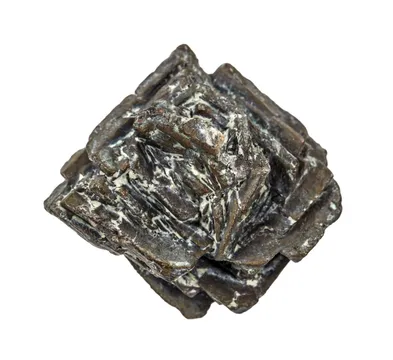
Pyrite at Flux is a primary sulfide and a driver of the mine’s gossanous oxidation chemistry rather than the locality’s main display mineral, so attractive specimens are genuinely scarcer than the lead-carbonate material. It occurs in the sulfide assemblage with galena, sphalerite, chalcopyrite, and quartz-altered wall rock, and surface pyrite gossan is specifically documented at the mine. Collectors know the species here from occasional well-crystallized pieces, including sharp brassy pyritohedra on calcite-rich matrix; a notable example measured 13.3 x 9.4 x 5.8 cm overall with a pyrite crystal about 3.5 x 2.8 x 2.3 cm on flattened sprays of small dogtooth calcite. Fine Flux pyrite is valued for sharp form, bright luster, and locality rarity, not for abundance.
Beyond these three collector staples, Flux has a broad secondary and primary suite: galena, sphalerite, chalcopyrite, acanthite, chrysocolla, hemimorphite, aurichalcite, pyromorphite, vanadinite, linarite, serpierite, massicot, minium, jarosite, halotrichite, goethite, hematite, psilomelane, pyrolusite, siderite, quartz, calcite, kaolinite, saponite, muscovite/sericite, chlorite-group minerals, epidote, and hornblende-group material are all documented or reported from the mine. For rarity-minded collectors, the lead oxides massicot and minium are especially interesting, historically noted with Flux cerussite, while blue linarite with light blue serpierite adds a scarce color accent to an otherwise white, brown, black, and metallic locality palette.
Flux Mine cerussite is easy to recognize in style but still deserves scrutiny. The classic pieces are delicate white jackstraw clusters, often on or partly included in crumbly gossan. Because similar white jackstraw cerussites occur at a few other localities, a vague “Arizona” or “old collection” label is not enough for top value; old Flux labels, collection history, dealer documentation, or consistency with well-photographed Flux matrix are important. Be cautious with unusually robust, bright, matrix-free white clusters that lack provenance: they may be Flux, but they may also be from another lead-zinc district.
The principal condition issue is fragility. Many Flux cerussites consist of slender, intergrown crystals perched on weak iron-oxide matrix, and broken tips, missing sprays, repaired matrix, and losses along the underside are common. Some specimens are naturally iron-stained or manganese-stained; staining is not automatically damage, but heavy brown coating can obscure crystal form and lower display quality. Cleaned specimens should be evaluated carefully, because aggressive washing can loosen gossan and detach crystal sprays. Repairs are not surprising on larger cabinet pieces, and a discreet, honest repair on a historic Flux cerussite is less troubling than concealed reconstruction.
Cerussite is a lead carbonate, anglesite is lead sulfate, and massicot and minium are lead oxides, so Flux specimens should be handled with ordinary lead-mineral caution: wash hands after handling, avoid dust, keep fragments away from children and pets, and do not use acidic cleaning. Cerussite from Flux is reported to show whitish fluorescence under shortwave ultraviolet light, but fluorescence is a supporting observation, not a decisive locality test. Store fine jackstraw specimens in a rigid box or mounted acrylic display; they do not tolerate being jostled in drawers with loose labels or other specimens.
Market availability is uneven. Small Flux cerussites appear regularly enough that the locality remains obtainable, but top examples—airy, undamaged, lustrous, and aesthetically perched on contrasting gossan—are much less common than the number of old specimens might suggest. Large, robust, old-time cabinet cerussites with strong provenance can command a premium because the underground access that produced the classic material is no longer a casual collecting option. Anglesite and pyrite are significantly scarcer as display specimens from Flux, while massicot, minium, linarite, serpierite, and other rarities are mostly of interest to systematic collectors.
The oldest Flux story has the hard, frontier-metal smell of 1858. The mine was said to have been an old Mexican working, and after relocation its richer ore was smelted in an adobe furnace near the mouth of Alum Gulch, close to Sonoita Creek. Later retellings preserve an even sharper detail: lead from the mine was reportedly used for ammunition during the Civil War. Whether one imagines the ore as argentiferous galena, lead carbonate, or mixed oxidized lead ore, the picture is unmistakably early Arizona—ore taken from a gulch in the Patagonias, reduced in a crude furnace, and valued not just for silver but for metal in hand.
By the 1880s and 1890s Flux was no longer just a rediscovered working; it had entered the industrial rhythm of southern Arizona mining. Several thousand tons went to the Benson smelter around 1882, then the property quieted until R. R. Richardson and partners took it up under a January 1897 title. That year alone, the mine produced nearly 1,000 tons. Arizona Gold & Copper Co. then entered the story, built the Patagonia smelter, took roughly 2,000 tons from Flux, paid $10,000 on the Flux and associated properties, and then walked away. In 1904, about ten carloads of high-grade galena ore were shipped to El Paso, valued at $60 to $100 per ton—a striking figure that explains why generations of lessees kept returning to the ridge even when the geology was complicated and the ore bodies irregular.
The specimen story has its own almost comic reversal. In the silver mine, the very mineral now prized by collectors was once easy to ignore. A later collector account says that in one stope rich in jackstraw cerussite, miners passed it by because it carried little or no silver value. The white needles and tangled sprays that collectors now wrap carefully and mount in acrylic were, in the working mine, simply low-value lead carbonate in the way of ore. That is one of the enduring lessons of classic mineral localities: the mining ledger and the collector’s eye often disagree.
One of the most vivid collecting accounts attached to Flux comes through Dick Jones, who reportedly recalled a trip in the 1960s that yielded about 400 flats of specimens. It is an astonishing number, but it fits the old descriptions of roof-hung masses in the oxidized workings and the later market presence of Flux cerussite in many established American collections. A later generation, including Stan Esbenshade and others, reworked the mine and recovered another “hoard” of good material. Those episodes explain why Flux cerussite can be both famous and still attainable: the mine was generous during the right windows, but the best pieces were always vulnerable to breakage, culling, and time.
The modern ending is less romantic but just as important for collectors. In 2011, reclamation notes record active claim concerns, ASARCO reclamation following forfeiture, and U.S. Forest Service work to gate or foam remaining adits, shafts, and concrete storage rooms. The same underground spaces that made the locality famous—south tunnel, crosscuts, stopes, and deeper levels—became hazards to be sealed rather than places to explore. Today, the finest Flux specimens carry not only mineralogical beauty but a closed-chapter quality: they are survivors from workings that serious collectors should not expect to enter again.