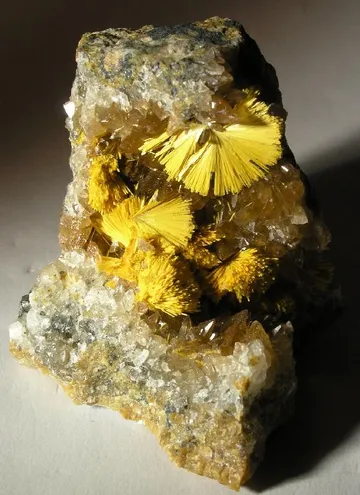
Erongo Region, Namibia - famed for cavity-formed pegmatite crystals, featuring aquamarine and smoky quartz, plus emerald fluorite; a premier site for collector…
Key facts
Erongo Region is one of the great modern names in African mineral collecting, but its importance is not tied to a single shaft or conventional ore mine. For collectors, “Erongo” usually means the rugged Erongo Mountains and their satellite pegmatite localities near Usakos, Karibib, Omaruru, Tubussis, Bergsig, Ameib, Davib, Brabant and related farm localities. The specimen-producing heart of the district is a deeply eroded Cretaceous volcano-plutonic complex: granite, granodiorite, volcanic rocks and pegmatitic miaroles exposed in a dry mountain massif that rises abruptly from the Namibian plains. Late, volatile-rich fluids concentrated beryllium, boron, fluorine, tin, tungsten and uranium-bearing accessory minerals, producing crystal-lined cavities rather than bulk ore. That cavity origin is the reason the best Erongo pieces are so three-dimensional: crystals stand free in open space, perched on pale feldspar, black tourmaline nests, smoky quartz, opal, topaz or late green fluorite.
The classic Erongo look is immediately recognizable across a bourse floor: icy to saturated blue aquamarine in sharp hexagonal prisms rising from glossy black schorl, with white to tan feldspar giving the composition contrast and architectural weight. Fluorite adds a second visual language—emerald-green cubes, cuboctahedra and modified crystals, commonly color-zoned with purple edges, corners or phantom zones. Smoky quartz, goshenite, topaz, muscovite, hyalite opal, cassiterite, goethite after siderite and rare borates and phosphates complete a mineral assemblage that made the district internationally famous after the late-1990s and early-2000s specimen rush.
Historically, the region had been known to geologists and miners long before it became a staple of high-end cabinet collections. Tin, tungsten, fluorite, beryllium, uranium, gold and base-metal mineralization occur across the wider Erongo Region, and older workings date back to German colonial and early twentieth-century exploration. The modern specimen era, however, began when small-scale miners opened miarolitic cavities in the Erongo Granite and found marketable aquamarine, schorl, fluorite and jeremejevite. From that point onward, Erongo became a locality where aesthetic mineral specimens—not ore tonnage—defined the district’s reputation.
Regional View
Country View
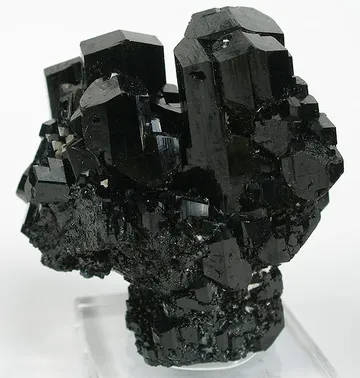
Erongo’s finest specimens reward close looking. Aquamarines may show pale bases, more saturated blue cores, clear terminations, complex color zoning or schorl inclusions. Schorl itself is not merely matrix here; it can form lustrous, ribbed, fluted or columnar clusters strong enough to carry a specimen visually. Fluorite may look simple at first glance, then reveal internal color zoning, etched faces, beveled corners, included schorl needles or associations with muscovite, quartz and feldspar. The best pieces preserve the original pocket geometry: freestanding crystals, clean contacts, natural luster and a convincing growth relationship among all species.

Photo: Wikimedia Commons

Photo: Wikimedia Commons
Search for specimens: View all specimens from Erongo Region, Namibia
The collector locality called Erongo sits within the larger Erongo Region of west-central Namibia, but most of the famous aquamarine–schorl–fluorite specimens come from the Erongo Mountains, a roughly circular volcano-plutonic massif southwest of Omaruru and north to northwest of Karibib and Usakos. The Geological Survey of Namibia describes the Erongo as one of the largest Cretaceous granitic complexes in northwestern Namibia, about 35 km in diameter, intruded into older Damara metasediments and granites. Its igneous activity belongs to the Damaraland Suite, related to the breakup of Gondwana and the opening of the South Atlantic between roughly 137 and 124 million years ago. Unlike the nearby Brandberg and Spitzkoppe complexes, Erongo preserves both intrusive and extrusive rocks, including darker silica-poor to lighter silica-rich volcanic units, granitic to granodioritic intrusions, and a prominent dolerite ring dyke.
From a collector’s standpoint the essential deposit type is a granite-hosted miarolitic pegmatite system. In simple field terms, the pockets formed where volatile-rich residual melt and fluid exsolved during crystallization of the Erongo Granite, leaving open cavities lined with quartz, feldspar, tourmaline, beryl, topaz, fluorite and late-stage accessory minerals. Modern geochemical work emphasizes that the Erongo Granite is not a simple, textbook A-type granite: it carries a mixed anorogenic–orogenic signature, likely influenced by contamination from the Damara metasedimentary rocks into which it was emplaced. That contamination is important mineralogically because it helped introduce boron into the melt, explaining the abundance of tourmaline-rich nests, orbicules and boron-bearing pocket minerals.
The productive pockets are not distributed as one tidy mine. They occur in named farms, claims, pegmatites, gorges and mountain slopes around the massif. The better-known names include Bergsig Farm 167, Tubussis 22, Ameib Farm 60, Brabant, Davib Ost, Erongurus, Hohenstein Gorge, Lion’s Head, Pietershill, the Van der Made pegmatite and associated farm localities. The surrounding Erongo Region is broader still, including important pegmatite districts near Karibib, the Neuschwaben tourmaline locality, the Spitzkoppe area, Namib Lead, Rössing, Navachab and other ore or gem occurrences. For the specimens shown most often in collector markets, however, the Erongo Mountains miaroles are the defining source.
Mining history here has two overlapping strands. The older strand is economic mining and prospecting for tin, tungsten, uranium, fluorite, gold and base metals in and around the Erongo Region. German settlers and later operators worked cassiterite-bearing pegmatites and other mineralized zones, but larger-scale operations in the Erongo Mountains themselves were eventually abandoned where they proved uneconomic. The younger strand is specimen mining: small-scale miners opening pockets for aquamarine, schorl, fluorite, jeremejevite, topaz and associated cabinet minerals. That specimen phase accelerated sharply from 1999 onward, after important miarolitic pockets yielded attractive schorl and topaz, followed by the major aquamarine finds that brought international buyers, dealers and collectors to the district.
The April 2000 Bergsig 167 aquamarine discovery stands as one of the modern turning points. It produced the first major aquamarine pocket of the new Erongo era, with gemmy blue crystals in association with schorl and feldspar. Later pockets yielded unusual habits: aquamarines grading from opaque bases to clearer terminations, blue-white “cotton-reel” forms with projecting rims, tapered etched crystals, interlocking jackstraw clusters, pale goshenite, heliodor-aquamarine zoning, and specimens where fluorite, smoky quartz or hyalite opal added a second phase of growth. Fluorite discoveries, including material from Bergsig and other Erongo pockets, introduced vivid green and purple color zoning on white feldspar and black schorl, giving the locality a second international signature beyond aquamarine.
Access today must be treated as controlled, not casual. Much of the mountain land is private farmland, and parts of the area lie within the Erongo Mountain Nature Sanctuary, a large private conservation landscape. Namibia regulates mineral rights, small-scale mining, high-value mineral trading and export permits through the Ministry responsible for mines and energy. Mindat and Namibian government guidance both stress permission from landowners and mineral-rights holders before visiting or collecting. In practice, most collectors obtain Erongo specimens through established Namibian miners, roadside or formalized mineral markets, local dealers, international shows, specialist dealers and auctions rather than by personal field collecting in the pockets.
Erongo aquamarine is famous for crisp hexagonal prisms in pale blue, blue-green and sometimes richly saturated blue, most characteristically perched on glossy black schorl with feldspar, quartz, muscovite, fluorite or cassiterite as accessories; crystals range from thumbnail-scale singles to cabinet pieces with upright crystals several centimeters long, and exceptional specimens show color zoning, gemmy terminations, included schorl needles or strong contrast against a black tourmaline nest. The Bergsig 167 finds of 2000 made the locality’s reputation, while later pockets supplied unusual habits including tapered crystals, “cotton-reel” forms, jackstraw clusters, heliodor-aquamarine zoning and trapiche-pattern material documented by GIA. Good pieces here are not just blue beryl: they have undamaged terminations, saturated but natural color, sharp prism faces, natural matrix contact and a balanced Erongo composition rather than a loose aquamarine crystal set decoratively on unrelated schorl.
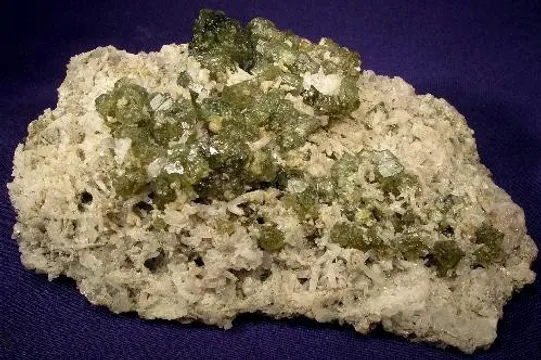
Erongo fluorite is best known as bright green to emerald-green cubes, cuboctahedra and modified crystals, often with purple edges, corners, outer zones or phantoms, on feldspar, schorl, smoky quartz, muscovite, opal or aquamarine-bearing matrix. Many specimens are thumbnails to small cabinets, with individual fluorites commonly in the millimeter to centimeter range, though larger cubes and compound crystals occur; some show beveled corners, etched faces, concave growth features, schorl inclusions or striking color response under transmitted light. The most desirable examples combine clean geometry, strong green-purple zoning, transparency, intact edges and the unmistakable contrast of fluorite against pale feldspar or black schorl; ordinary pieces tend to be crowded, chipped, cloudy or poorly balanced on matrix.
Schorl from Erongo is one of the few black tourmalines that serious collectors routinely buy for aesthetics rather than merely as matrix, forming lustrous striated prisms, parallel-growth columns, radial nests, fibrous aggregates and fluted clusters in the miarolitic cavities of the Erongo Granite. It is the principal visual partner of aquamarine and fluorite, but it also occurs with smoky quartz, feldspar, muscovite, opal, topaz, cassiterite, foitite and other late-stage minerals; some crystals show etched or stepped terminations, and smaller acicular material may be intergrown with related tourmaline species. Better pieces have deep luster, crisp terminations, sculptural shape and natural attachment to aquamarine or fluorite, while ordinary schorl is merely broken black ribbing without pocket freshness or compositional strength.
Beryl in Erongo Region is a family story rather than a single color: the Erongo Mountains have produced aquamarine, goshenite, heliodor and greenish beryl, generally as subhedral to euhedral prismatic crystals with strong hexagonal habit, while the broader Karibib–Erongo pegmatite belt also includes gem beryl occurrences in older rare-element pegmatites. Analytical work on Erongo beryls documents associations with schorl, quartz, muscovite, alkali feldspar, plagioclase, iron oxides, foitite, rossmanite and cassiterite, matching what collectors see in hand specimens. The strongest beryl specimens from Erongo show locality-specific color zoning, sharp terminations, natural pocket matrix and visible growth relationships; less desirable pieces are pale, abraded, heavily iron-stained or isolated from the assemblage that gives Erongo beryl its identity.
Feldspar is the quiet structural mineral of Erongo specimens, forming the creamy white, tan or pale blocky matrix on which aquamarine, fluorite, schorl, smoky quartz and muscovite are displayed. Orthoclase, microcline, albite and feldspar-group labels all appear in Erongo specimen descriptions, and well-formed feldspar crystals can show etched faces, cleavelandite-like plates, blocky twins or corroded pocket surfaces that record late fluid activity. A fine Erongo feldspar specimen is valued less for rarity than for architecture: it should lift the color contrast, stabilize the composition and preserve pocket texture, whereas bland massive feldspar or repaired matrix contributes little unless it carries exceptional aquamarine or fluorite.
Quartz from Erongo ranges from clear to smoky, with lesser amethyst, sceptre quartz and pocket quartz associations, most often serving as a transparent or smoky counterpoint to schorl, fluorite, beryl, opal, feldspar and muscovite. In the Erongo Mountains it commonly occurs in miarolitic cavities and quartz-tourmaline nests, where crystals may be glassy, etched, tapered, included or partially coated by later phases such as hyalite. The best quartz pieces from this locality are not generic clear points; they are specimens where quartz records the Erongo pocket paragenesis—smoky crystals with schorl penetration, fluorite on quartz, aquamarine beside quartz, or sculptural groups with feldspar and tourmaline—while ordinary quartz lacking association is comparatively less important.
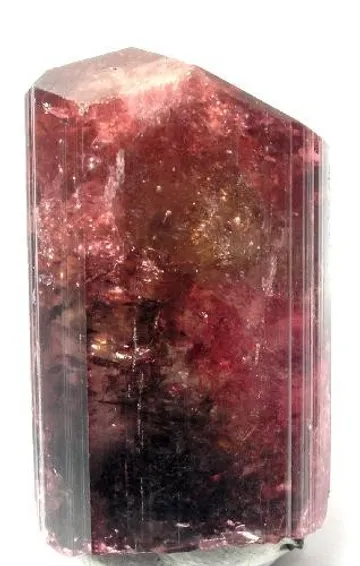
Elbaite belongs chiefly to the wider Erongo Region’s rare-element pegmatite story rather than the classic black-schorl Erongo Mountain assemblage, with notable gem tourmaline production from localities such as Neuschwaben Farm 73 near Karibib and other Karibib–Usakos pegmatites. Verified regional material includes green, blue indicolite and pink-to-red siberite-style elbaite, with older and modern sources describing Neuschwaben as one of Namibia’s best-known tourmaline localities and a long-worked source of gem tourmaline. Good Erongo Region elbaite is judged by color saturation, transparency, termination quality, zoning, freedom from cracks and credible locality specificity; it should not be confused with black Erongo schorl, nor should every Namibian tourmaline be casually assigned to “Erongo” without a more precise farm or mine name.
Muscovite at Erongo is usually an accessory species, but it can be important aesthetically where silvery, beige or greenish mica books and plates provide a sparkling platform for fluorite, schorl, feldspar or quartz. Documented Erongo combinations include fluorite with schorl, quartz and muscovite, as well as fluorite on tabular muscovite and specimens where mica adds texture between the harder, more colorful pocket minerals. Collectors should prize muscovite when it is fresh, sharply crystallized and compositionally useful; drab, bruised or exfoliating mica is common in pegmatites and only becomes special here when it participates in a true Erongo pocket assemblage.
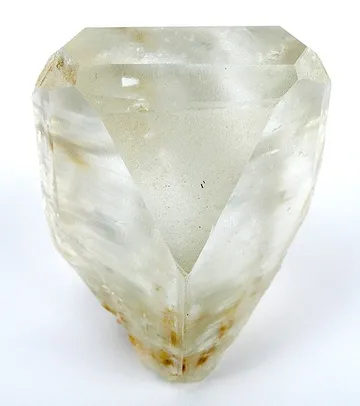
Goshenite from the Erongo Mountains is the colorless beryl counterpart to aquamarine, occurring as clear to milky hexagonal prisms in the same miarolitic pegmatite environment and sometimes associated with schorl, quartz, feldspar, fluorite or other beryl colors. Analytical work on Erongo beryl included a colorless, clear, transparent goshenite sample and confirmed that Erongo beryls share the prismatic habit and pocket associations familiar from the locality’s blue aquamarines. The best goshenite specimens here depend on sharpness, transparency, matrix contrast and association, because colorless beryl needs excellent form and setting to compete visually with Erongo’s blue aquamarine and vivid fluorite.
Smoky quartz is a major Erongo accessory and sometimes a display species in its own right, forming glassy brown to smoky gray prisms in pocket assemblages with schorl, aquamarine, fluorite, feldspar, opal, topaz and muscovite. Mindat photo data for Erongo Mountains smoky quartz strongly emphasizes schorl first, followed by opal, aquamarine-bearing beryl, fluorite and feldspar, which matches the specimens most often seen in the trade. Strong pieces show sharp, lustrous crystals with undamaged tips, interesting etching, inclusions or intergrowths, and natural balance with blue aquamarine or black tourmaline; weaker pieces are just brown quartz points without the locality’s distinctive multiphase pocket character.
Beyond the headline species, Erongo Region is exceptionally rich in documented rarities. The Erongo Mountains are a noted world source of jeremejevite, especially pale to saturated blue prismatic crystals that helped turn a once-obscure aluminum borate into a widely recognized collector species. The massif is also documented for topaz, foitite, fluor-schorl, cassiterite, hydroxylherderite, opal-AN and hyalite, goethite after siderite, siderite, ilmenite, uranium minerals and tungsten-related species. Across the wider Erongo Region, type-locality or historically important species include cheralite, formerly described as brabantite, from Erongo; ernstite, idaite and karibibite from regional localities; and joosteite from the Helikon II rare-metal pegmatite near Karibib. Other famous regional mineral stories include Namib Lead vanadates and sulfates, Klein Spitzkoppe minerals, Neuschwaben elbaite, Rössing uranium minerals and Navachab gold-mine assemblages, but the Erongo Mountains remain the collector flagship.
Erongo specimens are widely available in the market, but fine examples are selectively rare. Small aquamarine-on-schorl pieces, green fluorite on feldspar, smoky quartz with schorl and simple black tourmaline clusters appear regularly through Namibian dealers, European and American show dealers, online auctions and specimen marketplaces. Truly excellent pieces—undamaged, well-balanced, sharply terminated aquamarine on natural schorl, large zoned fluorite, unusual goshenite or heliodor associations, or specimens with documented pocket provenance—are much less common and command a premium.
Authenticity concerns center on matrix relationships and locality precision. Detached aquamarine crystals are sometimes glued or mounted onto schorl or feldspar to imitate the iconic Erongo look. Natural Erongo matrix pieces should show convincing growth contact: crystal bases seated into pocket feldspar or tourmaline, intergrowth rather than adhesive seams, consistent patina, matching clay or iron staining, and no suspicious gap-filling at the contact. Fluorite may be repaired, especially where cubes project from fragile feldspar or schorl. Quartz and schorl clusters can also be trimmed, stabilized or reassembled. Under magnification, check for glue gloss, bubbles, unnatural meniscus lines, mismatched dirt, fresh breaks at hidden junctions and colorless adhesive fluorescing along contacts.
Mislabelling is another persistent issue. “Erongo” may be used loosely for any Namibian pegmatite specimen, but serious labels should distinguish Erongo Mountains, Bergsig Farm 167, Tubussis, Ameib, Hohenstein, Karibib-area pegmatites, Neuschwaben, Spitzkoppe, Brandberg, Goboboseb and other localities where known. Black tourmaline from Erongo should not automatically be called schorl without analysis where foitite or fluor-schorl may be present; however, schorl remains the practical field label for most black tourmaline specimens in the trade. Likewise, feldspar labels can vary between orthoclase, microcline, albite and feldspar group depending on analysis and dealer caution.
Condition issues are locality-specific. Aquamarine terminations chip easily and may show natural cracking, iron-oxide-filled fractures or inclusions; some crystals are naturally etched or cloudy at the base, so not every internal feature is damage. Fluorite is soft and cleaves readily, so sharp edges, corners and high points deserve close inspection. Purple zoning at fluorite edges can make small bruises harder to see under show lighting. Schorl can appear robust but often breaks across fibrous bundles or ribbed terminations, and old pocket clay may hide bruises. Muscovite books are prone to edge fraying and exfoliation. Hyalite-bearing specimens should be handled carefully because thin opal coatings can be fragile and may be the fluorescent highlight of the piece.
Fluorescence varies. Some Erongo fluorite shows purple or other UV response, but GIA work on Namibian fluorite has also documented inert long-wave behavior in some material and weak short-wave yellow response in yellow to orange-yellow zones, so fluorescence should not be treated as a universal locality test. Hyalite opal from Erongo can show bright green fluorescence and even daylight fluorescence, making it desirable but also vulnerable to damage as a thin coating. Use filtered UV safely, avoid prolonged exposure for display, and do not rely on fluorescence alone to confirm locality.
For export and legality, buy from reputable sources and retain invoices and locality information. Namibia requires mineral collecting, purchasing and exporting to follow mineral-rights and export-permit rules; commercial export of mineral specimens and movement of purchased material should be documented through the proper Namibian authorities. For collectors outside Namibia, the most practical safeguard is a clear purchase record from a credible dealer, ideally with the most precise locality name available.
The modern Erongo story begins not with a corporation but with people following pocket signs in brutal granite country. By 1999, miners were reading the mountain for quartz-schorl nests: black tourmaline, quartz and feldspar concentrations that might open into a miarolitic cavity. Some cavities were disappointingly small—barely 10 cm across. Others opened into tubular hollows 50 to 80 cm wide and more than 2 m deep. Even then, a promising pocket could be clay-filled and barren. Because repeated climbs into the steep workings were punishing, miners made semi-permanent camps among the boulders, sleeping in rough shelters and tents near the diggings. Water was not an incidental convenience; it was a deciding factor. At one locality a rainwater-filled pocket was valuable enough that it could sustain work for months.
In April 2000, Bergsig Farm 167 produced the aquamarine find that collectors still treat as the opening chapter of the great Erongo era. The pocket became remembered as the first major aquamarine pocket of modern Erongo collecting, and it changed the market perception of the locality almost overnight. The crystals were not just blue; they had presence—hexagonal aquamarines on black schorl and feldspar, with a clean, high-contrast look that photographed well and displayed even better. From that point, Erongo was no longer merely a Namibian curiosity. It became a serious source for contemporary museum-quality aquamarine specimens.
The mountain then began producing variations that seemed almost designed to keep collectors arguing over “best pocket” status. Some aquamarines graded through several optical states in one crystal: opaque or milky blue at the base, stronger blue through the body, and transparent, potentially gemmy termination zones. In November 2000, one cavity produced an interlocking “jackstraw” cluster of opaque cornflower-blue aquamarine—more sculptural than gemmy, but unforgettable because the crystals crossed one another like a mineral bundle of thrown sticks. In May 2001, other aquamarines appeared in the so-called “cotton-reel” habit, with narrow blue-white rims projecting from both terminations beyond the prism edges. On some specimens later natural etching partly removed those rims, leaving tapered, cone-like terminations and adding to the strange vocabulary of Erongo beryl forms.
The field accounts from Tubussis 22 add the physical setting that labels cannot convey. After obtaining the farm-gate key, a visiting party examined a pipe-like pocket about 2 m deep and 60 to 70 cm wide, where miners had removed orthoclase crystals more than 10 cm across with schorl and yellow hyaline opal. Nearby, in the late-afternoon light, the same granite landscape revealed a much older human record: Bushman paintings on rock faces, with antelope—especially kudu and eland—together with giraffes and stylized human figures. It is one of the striking realities of Erongo collecting that pockets, private farm tracks, small-scale mining camps, wildlife country and ancient rock art occupy the same granite world.
Another Erongo surprise traveled through the gemological world rather than the cabinet market. In 2008, GIA reported a cluster of transparent to translucent greenish blue aquamarine crystals, reportedly from the Erongo Mountains, measuring 52.17 mm across and still partly coated with pocket clay. The remarkable feature was visible on several terminations: a trapiche structure in aquamarine, an effect far better known in emerald. GIA described it as the most obvious example of trapiche patterning in aquamarine they had encountered. A later 2012 GIA report examined additional Erongo trapiche aquamarine material supplied by Jo-Hannes Brunner, including a 43.60 mm crystal, a 6.13 ct cabochon, an 8.20 ct rectangular step cut and an 8.84 ct hexagonal tablet. Cut perpendicular to the c-axis, the tablets revealed hexagonal zoning and radial arms made mostly of clouds of minute inclusions—proof that Erongo’s value is not limited to cabinet minerals but extends into unusual gemological phenomena.
Fluorite added a different kind of drama. The July 2005 Bergsig fluorite finds brought vivid emerald-green crystals on white feldspar, commonly clean cubes with dark purple corners. Unlike aquamarine, which announced itself by form and color contrast, the best fluorites often reveal themselves by light: backlighting turns a modest green cube into a zoning diagram of teal cores, purple edges and transparent growth shells. Later collectors began informally naming specific fluorite pockets—“Lollipop Pocket” material, for example, became a recognizable market phrase for colorful fluorite perched on black tourmaline. Whether a pocket name becomes permanent or not, the appeal is obvious: Erongo fluorite often looks less like a simple cube than a small optical object grown inside a granite cavity.
Bruce Cairncross and Uli Bahmann, “Famous mineral localities: The Erongo Mountains, Namibia,” The Mineralogical Record, Vol. 37, No. 5, September 2006, pp. 361–370 — The core collector reference for the Erongo Mountains, including geology, collecting history, pocket accounts and species descriptions.
https://pure.uj.ac.za/en/publications/famous-mineral-localities-the-erongo-mountains-namibia/
Alexander U. Falster, William B. Simmons, Karen L. Webber and Andrew P. Boudreaux, “Mineralogy and Geochemistry of the Erongo Sub-Volcanic Granite-Miarolitic-Pegmatite Complex, Erongo, Namibia,” The Canadian Mineralogist, Vol. 56, No. 4, 2018, pp. 425–449 — The key modern technical study of Erongo Granite, miarolitic pegmatites, quartz-tourmaline orbicules and boron-rich mineralization.
https://doi.org/10.3749/canmin.1700090
Jullieta Enone Lum, Fanus Viljoen, Bruce Cairncross and Dirk Frei, “Mineralogical and geochemical characteristics of BERYL (AQUAMARINE) from the Erongo Volcanic Complex, Namibia,” Journal of African Earth Sciences, Vol. 124, 2016, pp. 104–125 — Detailed study of Erongo beryl color, zoning, inclusions and chemistry.
https://doi.org/10.1016/j.jafrearsci.2016.09.006
Franco Pirajno, “Geology, geochemistry and mineralisation of the Erongo Volcanic Complex, Namibia,” South African Journal of Geology, Vol. 93, 1990, pp. 485–504 — Foundational geological interpretation of the Erongo Volcanic Complex and associated mineralization.
https://journals.co.za/doi/abs/10.10520/AJA10120750_1905
Geological Survey of Namibia, “Erongo,” Roadside Geology of Namibia sheet — Concise official summary of Erongo geology, ring structure, mineralization styles, collectible minerals and rock-art landscape.
https://www.mme.gov.na/files/publications/c55_A4_Erongo_en.pdf
John I. Koivula, “Trapiche Aquamarine from Namibia,” Gems & Gemology, Fall 2008, Gem News International — Documents an Erongo aquamarine specimen with unusually obvious trapiche structure on several terminations.
https://www.gia.edu/doc/FA08.pdf
Riccardo Befi, “Trapiche Aquamarine from Namibia,” Gems & Gemology, Summer 2012, Gem News International — Follow-up report on Erongo trapiche aquamarine, including cut and rough samples supplied by Jo-Hannes Brunner and confirmed by Raman spectroscopy.
https://www.gia.edu/doc/SU12.pdf
The Mineralogical Record, Erongo issue, September–October 2006, Vol. 37, No. 5 — Back-issue page for the dedicated Erongo Mountains issue.
https://mineralogicalrecord.com/back_issues/erongo-sep-oct-2006-vol-37-no-5/
D. Rose, “Brabantite, a new mineral of the monazite group,” Neues Jahrbuch für Mineralogie, Monatshefte, 1980, pp. 247–257 — Original description of brabantite, now treated as cheralite, tied to the Erongo locality record.
https://www.mindat.org/min-1005.html
Oleg von Knorring, Th. G. Sahama and Pentti Rehtijärvi, “Karibibite, a new FeAs mineral from South West Africa,” Lithos, Vol. 6, No. 3, 1973, pp. 265–271 — Type-mineral publication for karibibite from the Erongo Region.
https://doi.org/10.1016/0024-4937(73)90087-X
E. Seeliger and A. Mücke, “Ernstit, ein neues Mn2+-Fe3+-Al-Phosphat und seine Beziehungen zum Eosphorit,” Neues Jahrbuch für Mineralogie, Monatshefte, 1970, pp. 289–298 — Type-mineral publication for ernstite from the Erongo Region.
https://www.mindat.org/min-1401.html
G. Frenzel, “Ein neues Mineral: Idait,” Neues Jahrbuch für Mineralogie, Monatshefte, 1958, p. 142 — Type-mineral publication for idaite, with Erongo Region locality records.
https://www.mindat.org/min-1988.html
“Schorl from Erongo Region, Namibia,” Fabre Minerals — Short rotating specimen video of a lustrous schorl group from Erongo Region, with dimensions and collection provenance.
https://vimeo.com/789712547
“JHG1454 Schorl on Feldspar Erongo Mountains Namibia,” The Arkenstone / iRocks-style specimen media on Vimeo — Close video view of an Erongo schorl-on-feldspar specimen.
https://vimeo.com/843025627
“Aquamarine with Schorl & Quartz,” Vimeo specimen video — Rotating specimen media showing the classic Erongo association of aquamarine, schorl and quartz.
https://vimeo.com/854377724
“Aquamarine on Siderite (ps. Ilmenite) on Orthoclase & Schorl,” Catawiki / Vimeo-linked specimen media — Auction-media example of a compact Erongo multi-mineral specimen with aquamarine, schorl, orthoclase and pseudomorph material.
https://www.catawiki.com/en/l/104759390-aquamarine-on-siderite-ps-ilmenite-on-orthoclase-schorl-erongo-mountains-karibib-namibia-height-2-5-cm-width-2-2-cm-9-g
Mindat: Erongo Region, Namibia — Broad locality database for the entire region, including commodities, mines, species lists and type-locality minerals.
Mindat: Erongo Mountains, Erongo Region, Namibia — Essential locality page for the collector-famous Erongo Mountains assemblage and sublocalities.
Mindat: Aquamarine from Bergsig Farm 167 — Useful occurrence page for the major Bergsig aquamarine locality and photo-based associations.
Mindat: Smoky Quartz from Erongo Mountains — Occurrence page showing smoky quartz associations and photo statistics for Erongo Mountains material.
University of Johannesburg: Cairncross and Bahmann, “Famous mineral localities: The Erongo Mountains, Namibia” — Bibliographic record for the principal collector article.
The Canadian Mineralogist: Erongo granite–miarolitic pegmatite complex — Technical geochemistry and mineralogy paper for the Erongo Granite, miaroles and tourmaline-rich systems.
University of Johannesburg: Lum et al. 2016 Erongo beryl study — Detailed abstract and publication data for the major Erongo aquamarine chemistry paper.
GIA: Fall 2008 Gems & Gemology — Includes the first GIA report of unusually obvious trapiche aquamarine from Erongo.
GIA: Summer 2012 Gems & Gemology — Includes the follow-up report on Erongo trapiche aquamarine slabs, cuts and rough.
GIA: Winter 2011 Gems & Gemology — Includes a Gem News International report on Namibian color-zoned fluorite and its gemological properties.
Geological Survey of Namibia: Erongo Roadside Geology sheet — Official illustrated summary of the geology, mineralization and landscape context of the Erongo Mountains.
Namibia Ministry of Industries, Mines and Energy: Mineral Rights & Resources Development — Current official information on mineral rights, mining claims, export permits and high-value mineral permits.
Namibia Trade Information Portal: Minerals Export Permit — Step-by-step official export-permit procedure for mineral consignments.
Erongo Mountain Nature Sanctuary — Conservation and land-access context for the modern Erongo Mountains landscape.
Wikimedia Commons: Beryl-Schorl-264171 — Freely licensed image and specimen description of an aquamarine-on-schorl Erongo piece.
Wikimedia Commons: Fluorite-Feldspar-Group-122788 — Freely licensed image of a zoned Erongo fluorite cube on feldspar.
Wikimedia Commons: Minerals of Erongo Mountain category — Image gallery of Erongo mineral specimens hosted on Wikimedia Commons.
Le Gemmologue: Tourmalines of Erongo, Namibia — Gem-oriented overview of Erongo Region tourmaline, especially Neuschwaben and related localities.