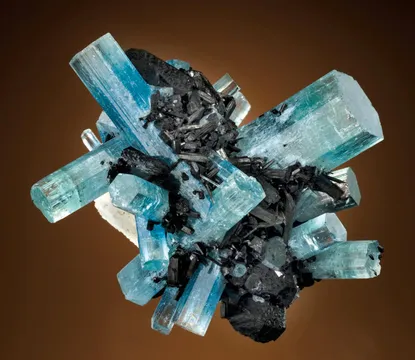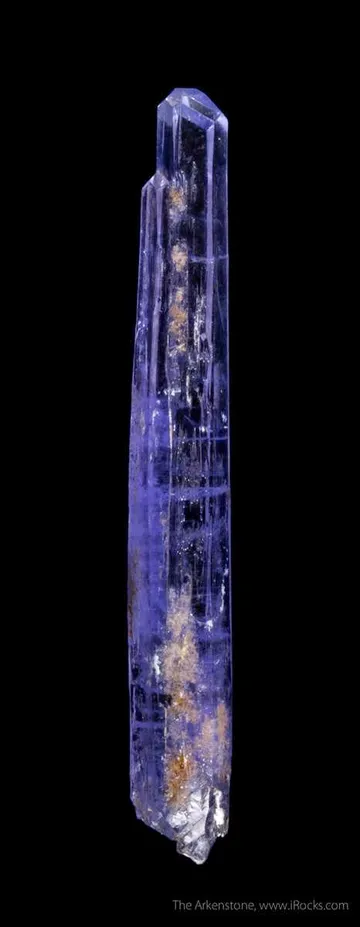
Arandis, Namibia — desert locality known for boltwoodite orange sprays on calcite and blue jeremejevite prisms, prized for rarity and collecting appeal.
Key facts
Arandis is not a single pocket in the collector’s imagination so much as a mineral province compressed into one famous Namibian name: the uranium country around Rössing and Goanikontes, the Cape Cross–Mile 72 pegmatites to the northwest, and the old tin occurrences that gave “Arandis” a foothold in mineralogical literature long before most modern collectors handled a Namibian boltwoodite. The setting is the arid western flank of the Damara Orogen, where granitic and pegmatitic bodies cut metamorphosed sedimentary rocks and where the desert has left veins, claims, old workings, and open pits sharply exposed.
For collectors, Arandis matters above all for two very different kinds of rarity. One is the brilliant uranyl-silicate suite represented by boltwoodite from the Goanikontes Claim: saffron-yellow to orange, silky acicular sprays and crusts in vugs, commonly on brown, smoky, or colorless calcite. The other is gem jeremejevite from Mile 72 in the Cape Cross area: thin hexagonal prisms, famously blue in the best early material, usually loose, glassy, and startlingly elegant. These two species could hardly look less alike, yet both are classic Namibian desert minerals—formed in specialized geochemical niches, collected in limited windows of access, and often burdened by imperfect old locality labels.
Regional View
Country View
The best Arandis-area specimens have a desert-mineral clarity to them. Fine boltwoodites are not just yellow stains; they are discrete sprays, tufts, globular aggregates, and prismatic needles with a live silky luster, standing out against dark calcite or pocket walls. Fine jeremejevites are small but aristocratic: pencil-thin, transparent to translucent prisms with clean hexagonal form, blue or pale straw color, and enough luster and sharpness to make a thumbnail feel like a major species specimen.

Photo: Wikimedia Commons

Photo: Wikimedia Commons
Search for specimens: View all specimens from Arandis, Namibia
The Arandis collecting name overlaps several geological environments in west-central Namibia. Around Rössing and Goanikontes the key context is uranium in leucogranite and pegmatitic granite—locally called alaskite—within high-grade Damaran metasedimentary rocks. Rössing itself is a major open-pit uranium mine near the Khan River, extracting uranium from hard, abrasive alaskite bodies. The ore is worked industrially for uranium oxide, not for specimen recovery, and the mine should not be imagined as the normal source of collector boltwoodite despite the frequency of old “Rössing” labels.
The celebrated boltwoodite specimens belong to the Goanikontes Claim area, near Goanikontes southeast of the settlement and well away from the operating Rössing pit. The claim is a small uranium occurrence in the Swakop River–Goanikontes district. Specimens entered the collector market for decades under broader “Arandis,” “Rössing,” or even “Langer Heinrich” labels, but the now-standard correction for the finest yellow-orange boltwoodite-on-calcite material is Goanikontes Claim, Goanikontes, Arandis Constituency, Erongo Region. Mineralogically, this is a secondary uranium environment: uraniferous rock weathered under desert conditions, and late uranyl silicates and related secondaries formed in cavities and fractures where silica, potassium, sodium, and uranium-bearing fluids could interact.
Mile 72, by contrast, lies in the Cape Cross coastal area north of Swakopmund. It is part of the Cape Cross–Uis pegmatite belt, a rare-element pegmatite province with late-stage Uis pegmatites exposed close to the Atlantic shore. The Mile 72 occurrence is famous for jeremejevite, with documented associations including feldspar, microcline, quartz, schorl, fluorapatite, grandidierite, gypsum, albite, muscovite, and related pegmatite minerals. The important collector feature is the pocket character: jeremejevite here was recovered mostly as loose single crystals, while true matrix specimens are rare and carry a premium when undamaged and honestly represented.
Mining history around Arandis has several layers. The older tin story centers on the Arandis tin mine, historically the Stiepelmann tin mine, where cassiterite and unusual tin minerals were recorded in a non-pegmatitic, hydrothermal setting associated with sulphides. Early geological work noted production in the late 1920s and 1930s, including recorded cassiterite output in 1929. The Rössing uranium story became the dominant industrial chapter: uranium occurrences in the broader Rössing area were known early in the twentieth century, systematic prospecting expanded in the mid-twentieth century, mine development began in the 1970s, and commercial production at Rössing began in 1976. Arandis grew in relation to that uranium industry.
The specimen history is more selective than the mining history. Goanikontes produced the boltwoodite pieces collectors prize: vugs and pocket surfaces lined with calcite, then lit by yellow to orange needles and radial groups of boltwoodite. The productive period represented in collections appears chiefly late twentieth century into the early 2000s, with many older labels later corrected. Mile 72 produced its legendary jeremejevite in the 1970s and was reworked in 1999 with modern equipment; that later work recovered mostly colorless to pale yellow crystals rather than repeating the finest cornflower-blue early material. The locality was subsequently backfilled under reclamation requirements, and modern collecting at the classic workings is not a casual field activity.
Access today should be treated conservatively. Rössing is an active industrial uranium mine and is not an open collecting locality. Goanikontes and Mile 72 involve claims, protected or regulated coastal-desert land, and minerals whose collection and export fall under Namibian mineral regulations. Namibia requires permits for mineral material collected or purchased by private collectors and researchers, and export permits are required for minerals leaving the country. For serious collectors, the practical route is documented provenance through reputable Namibian or international dealers, old collections, and museum-published specimens rather than field collecting without explicit authorization.
Arandis-area boltwoodite is the classic Goanikontes Claim material: vivid yellow, golden-yellow, orange-yellow to orange acicular crystals in silky radial sprays, crusts, globular aggregates, and short prismatic bundles, most attractively perched in calcite-lined vugs or over dark brown calcite and host rock. Individual crystals and sprays are generally small—millimetric, with good visible groups commonly several millimeters and exceptional sprays approaching the centimeter scale—but the best specimens are judged less by raw size than by saturation, separation, luster, and contrast. Ordinary pieces show yellow coatings or sparse needles; superior pieces show three-dimensional radial clusters, continuous “fields” of bright needles, or a strong yellow-orange band against smoky calcite, with undamaged crystal tips and enough open vug space to let the sprays read as crystals rather than powdery crust.
Arandis jeremejevite is best understood as Mile 72, Cape Cross-area material: slender hexagonal prisms, usually loose, ranging from colorless and pale straw-yellow to pale blue, blue-green, and the coveted cornflower-blue of the finest early crystals. Documented crystals reach several centimeters, with classic references noting blue examples around 4.5 to 5 cm and later pale yellow to colorless material to similar or greater lengths, though most collector specimens are far smaller and are valued as thumbnails or individual gem crystals. Associations include microcline, feldspar, quartz, schorl, fluorapatite, and grandidierite, but matrix pieces are exceptional; a good Mile 72 jeremejevite is sharply prismatic, lustrous, transparent to gemmy, lightly etched rather than battered, and preferably terminated or with minimal contacts, while the rare matrix examples are judged with special scrutiny because repairs and reattachments can strongly affect value.
Other minerals documented from the Arandis Constituency broaden the district beyond its two marketplace stars. The Ida Mine is the type locality for idaite, a copper-iron sulphide originally described from the Ida mine in what was then South West Africa and now placed within the Arandis Constituency locality framework. The Arandis tin mine, or Stiepelmann tin mine, is notable for cassiterite with arsenopyrite, pyrrhotite, chalcopyrite, stannite, nordenskiöldine, danburite, axinite-(Fe), calcite, siderite, quartz, tourmaline, and the historically reported “arandisite,” a name that persists in older literature but is not a modern approved showpiece species in the way collectors sometimes imagine from the locality name. Mile 72 has also yielded grandidierite in quartz and K-feldspar, while the broader Arandis uranium belt includes familiar secondary uranium species from Rössing and nearby deposits, including uranophane, beta-uranophane, uraninite, carnotite-group and related supergene phases.
Arandis-area specimens demand unusually careful locality reading. The most important trap is boltwoodite labeled simply “Rössing,” “Rössing Mine,” “Arandis,” or “Langer Heinrich.” Some old labels are historically understandable because Rössing was the best-known uranium name in the district, but the finest familiar yellow-orange boltwoodite-on-calcite specimens are now generally attributed to Goanikontes Claim rather than to the operating Rössing uranium mine. A serious label should preserve both pieces of information when known: the exact modern attribution and the old label text. For example, “Goanikontes Claim, ex old Rössing label” is much more useful than silently replacing or discarding the original label.
Condition is a major issue for boltwoodite. The crystals are slender, radiating, and exposed; pocket specimens often have rubs along high points, broken sprays, edge chipping, and vug-wall bruising. Strong color can make damage less obvious in photographs, so inspect under magnification for crushed silky patches, loose needles, and powdery surfaces. Because boltwoodite is a uranium mineral, specimens should be handled as mildly radioactive mineral specimens: avoid inhaling dust, wash hands after handling, keep them away from children, do not trim or saw them indoors, and store friable examples in a closed box with a label noting the uranium content. Their greatest display virtue—high surface area of fine needles—is also the reason one should avoid abrasion and casual open-air handling.
Jeremejevite from Mile 72 has a different authenticity profile. Most crystals are loose singles, so “matrix” must be judged carefully. Genuine matrix specimens exist and are among the locality’s great prizes, but repaired, glued, or reattached crystals should be expected in the marketplace and priced accordingly. Even a loose single can be excellent if it has color, luster, transparency, and good terminations; conversely, a larger pale or etched crystal with broken ends may be less desirable than a smaller blue, sharp, undamaged one. Be wary of vague “Namibia” labels for jeremejevite, because Mile 72 material, Erongo Mountains material, and later Namibian production differ in occurrence, appearance, and market value.
Treatments are not the central problem here in the way they are for some gem species; locality, repair, and completeness matter more. For jeremejevite gems, standard gemological documentation is useful because faceted stones can be confused by appearance with other pale blue or colorless gems, and fine Namibian stones are valuable enough to justify paperwork. For mineral specimens, provenance back to recognized dealers, published collections, or old Namibian collections carries real weight. The market still sees Goanikontes boltwoodite regularly in thumbnails and miniatures, with fine cabinet-quality vugs much less common. Mile 72 jeremejevite is far scarcer, especially blue crystals and matrix pieces; many offerings are old stock, recycled collection pieces, or single crystals whose value rests on color, condition, and confidence in the exact source.
The Mile 72 jeremejevite story has the improbable shape that collectors love because the locality name is almost comically plain: not a romantic mountain, not a deep mine, but a road marker in the coastal desert north of Swakopmund. The classic account begins in the early 1970s near the track to the Mile 72 fishing camp, where road work and casual looking turned up attractive blue crystals that were first mistaken for aquamarine. One retelling names Mrs. Tannie Klippie, wife of road-grader operator John Marais, as the person who picked up pretty crystals behind the grader as it turned the ground. What emerged from that wind-blown coastal pegmatite was not beryl at all but jeremejevite, a mineral then known essentially from the old Russian type occurrence and a handful of rarities.
The first Mile 72 production between 1973 and 1976 was small but legendary. Crystals ranged from colorless to the prized “cornflower” blue, and enough of the best pieces reached major collections that the locality became the reference standard for blue jeremejevite. Unlike many pegmatite finds where cabinets filled with matrix plates, Mile 72’s identity was built on loose, gemmy prisms—long, thin, glassy crystals that looked more like cuttable treasure than rugged field specimens. That is why the few matrix examples are so admired. One Council for Geoscience specimen collected in 1973 carries jeremejevite crystals on feldspar matrix, the largest crystal measuring 3.7 cm, and has been described as one of the finest known matrix specimens from the locality.
The 1999 reworking has the feel of a modern mining gamble measured against an old legend. Brian Lees of Collector’s Edge Minerals and C. J. Johnston formed Khan River Mining and brought mechanized equipment to a locality whose fame rested on much smaller earlier efforts. In the first six months, about 2,700 tons of rock were removed. Heavy equipment reportedly moved more rock in the first two weeks than the earlier Sid Pieters operation had moved in its entire 1973–1976 campaign. The miners did find jeremejevite, but not the repeat of the blue miracle they hoped for: within the first weeks they recovered roughly 300 single, water-clear colorless to pale yellow crystals and only one pale blue crystal. The great blue Mile 72 crystals remained, stubbornly, the prize of the first find.
Goanikontes has its own quieter story, told mostly through labels. For years the finest boltwoodites in collections carried the name of the famous uranium giant nearby: Rössing. The specimens looked plausible under that name—uranium country, Arandis district, bright uranyl silicate—but the operating mine itself was not the source of the collector vugs. Over time, as field knowledge and locality discussion improved, the label migrated toward Goanikontes Claim. For a collector, that correction is more than bookkeeping. It is the difference between an industrial uranium pit and a small claim that produced some of the most visually satisfying boltwoodite ever seen: lemon to orange needles flaring over calcite like a desert bloom in a dark pocket.