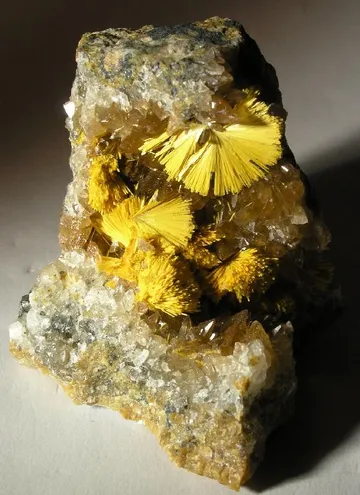
Tubussis, Namibia — a premier garnet locality known for Green Dragon demantoid in marble/skarn, with sharp, gemmy green crystals prized by collectors.
Key facts
Tubussis is one of the names that moved Namibian mineral collecting from “excellent pegmatites” into the top rank of modern gem garnet localities. The locality lies on Farm Tubussis 22 at the western foreland of the Erongo Mountains, historically recorded under Karibib District and now placed within the Dâures area after administrative boundary changes. For collectors, the central attraction is the Green Dragon demantoid occurrence: green andradite garnet crystallized in marble and calc-silicate rocks where Neoproterozoic Damara metasediments were affected by granitic intrusions of the Erongo complex. That geology gives Tubussis demantoid a very different personality from the classic serpentinite-hosted Russian material—less a horsetail-inclusion locality than a skarn-and-marble locality prized for bright, lively green crystals and gems with high fire.
Regional View
Country View
The best Green Dragon specimens have a look that is immediately recognizable: sharp, glassy to gemmy green dodecahedral andradite crystals, commonly under a centimeter but occasionally larger, perched in pale calcite, marble, quartz-rich calc-silicate, or associated pocket material. The contrast is part of the charm. A fine piece is not just “green garnet on rock”; it is a flash of leaf-green or bluish green against cream-white carbonate, with enough translucency for the crystal to glow from within when backlit. Ordinary pieces can be dark, fractured, brownish, or merely granular; the collector-grade specimens have isolated, well-formed crystals, clean luster, pleasing placement, and the unmistakable optical snap that made Namibian demantoid commercially important from the late 1990s onward.

Photo: Wikimedia Commons
Tubussis is also broader than the Green Dragon pit alone. Farm Tubussis 22 includes miarolitic cavities in Erongo granite, calc-silicate garnet occurrences, and small-scale pegmatite and granite-pocket workings that have produced beryl, smoky quartz, schorl, topaz, fluorite, metazeunerite, and other species. That mixed identity explains why locality labels may read Tubussis, Tubusis, Tubessis, Tubussis Farm 22, Green Dragon Mine, Parrot Mine, Karibib District, or Dâures Constituency. For a specimen collector, the essential question is not merely the spelling on the label, but whether the piece is from the demantoid-bearing calc-silicate/marble system or from the granitic miarolitic and pegmatitic systems around the same farm.
Search for specimens: View all specimens from Tubussis, Karibib District, Namibia
Tubussis Farm 22 sits in the Erongo Region of west-central Namibia, reached from the Omaruru–Usakos road system and associated in mineral literature with the road between Usakos and Okombahe. The Green Dragon Mine is described as being about 30 km north of Usakos, reached by a rough track off the D2306 road; older labels commonly use Karibib District, while modern geographic databases list the farm under Dâures Constituency. Mindat records the official-historical spelling variants Tubussis, Tubusis, and Tubessis, which helps explain the inconsistent labels found in older collections.
The demantoid mineralization is not a pegmatite occurrence in the usual Erongo sense. It is a calc-silicate and marble-hosted garnet system developed in Damara-age metasedimentary rocks—schists, amphibolites, marbles, and calc-silicate layers—near granitic dikes, veins, and plugs related to the Erongo igneous complex. At Green Dragon, green andradite occurs in marble and calc-silicate rocks, especially along contacts where carbonate rocks were metasomatized and locally opened into vein-type pockets. Published descriptions note green garnets close to andradite end-member composition in calcite matrix with quartz and minor silicates, and record inclusions and associations such as diopside, wollastonite, quartz, calcite, sphalerite, prehnite, and locally apophyllite in pocket environments.
The ore geometry is irregular. Productive bands follow the structure of the calc-silicate and metasedimentary rocks and may extend along strike but are not broad, predictable ore sheets. Some demantoids occur as individual crystals embedded in hard host rock, some in fractured rough, and some in pockets where the crystals were good enough for faceting or preservation on matrix. Weathering also liberated garnets from carbonate-rich pockets into small secondary accumulations: calcite dissolved or broke down, and garnets accumulated locally as residual or short-transported material. This dual primary-and-secondary character matters to collectors, because matrix specimens, loose crystals, and gem rough can all be legitimate Tubussis products but should not be assumed to have come from the same exact pocket or mining style.
The best-known commercial operation is the Green Dragon Mine, an open-pit, hard-rock demantoid mine. Published gem-trade accounts describe early rediscovery and development in the late 1990s, exploration programs beginning in 1999, and production from the mid-2000s onward. Mining at Green Dragon became mechanized: hard rock was drilled and blasted, overburden removed by excavators and trucks, and garnet-bearing material either hand-worked or processed through crushing, screening, washing, and sorting. One published account describes a main pit more than 130 m long and as deep as 23 m, with a crushing and screening plant rated at 30 tons per hour. GIA later reported that Green Dragon received a 25-year mining license in 2017 and operated with a mine-to-market model covering mining, processing, sorting, cutting, grading, and wholesale.
Production has been important but selective. Reports from the early 2000s estimated about 8 kg per month of demantoid production, roughly 2 kg of gem quality, mostly in the 0.3–1 g rough range, with only a fraction in top green color. Later reporting gave monthly production around 15–20 kg, of which a little over 10% was gem quality. The yield into finished gems is low because fine demantoid requires tight clarity, color, cutting, and calibration standards. Most finished stones are melee or small calibrated gems; large clean singles are the exception, which is why documented gems above 5 ct from Green Dragon are treated as exceptional and why the famous 11.63 ct round brilliant attracted attention in the gemological press.
Tubussis Farm 22 also includes small-scale mining outside the demantoid pit. Environmental and mining documentation for the Tubussis small-scale mining hotspot describes claims worked by individuals and groups using artisanal to semi-mechanized methods for tourmaline, smoky quartz, beryl, amethyst, prehnite, rock crystal, and schorl. Workings may be open pits, shallow underground excavations, trenches, or pocket digs in weathered Erongo granite and pegmatite bodies. A 2020 assessment recorded approximately 100–120 small-scale miners operating on 35 mining claims in the Farm Tubussis area, with activity concentrated in the Erongorus/Erongo Complex, Springbokfontein, and Tumib areas. For modern collectors, that means access is not casual recreational rockhounding: claims, communal or state land administration, traditional authority interests, conservancy issues, environmental clearance requirements, and private operators all overlap. Specimens should be obtained through established dealers, mine representatives, or collectors with documented permission and provenance.
Notable pockets at Tubussis divide into two families. The Green Dragon pockets are the demantoid pockets—calcite-, quartz-, prehnite-, and locally apophyllite-bearing cavities in marble or calc-silicate rock that produced clean, shaped green garnets. Separately, the granitic miarolitic pockets of Farm Tubussis 22 include the published “Metazeunerite Pocket,” a uranium-arsenate and tungsten-molybdenum-bearing assemblage that produced a suite of microminerals including metazeunerite, metanováčekite, walpurgite, uranophane, uranotungstite, arseniosiderite, russellite, stolzite, wulfenite, xenotime-(Y), monazite-(Ce), fluorite, topaz, opal, goethite, and associated species. Those two pocket styles should not be conflated: one gives the locality its demantoid fame, the other its micromineral and Erongo-granite significance.
Andradite from Tubussis is most valued when it is the green demantoid variety from the Green Dragon calc-silicate and marble system, but the locality also produces brownish to reddish-brown and greenish-yellow andradite/grossular-rich garnet compositions. In the calc-silicate zones, crystals may reach 1–2 cm, though many specimen crystals are smaller; they occur in calcite-rich matrix with quartz and minor silicates, and published work notes complex zoning toward grossular and Ti-rich rims in some crystals. Good Tubussis andradite specimens show sharp dodecahedral or modified dodecahedral form, bright vitreous luster, translucency, and attractive contrast on pale marble or calc-silicate matrix; ordinary examples are darker, fractured, granular, or lack a clean individual crystal presentation.
Demantoid is the signature mineral of Tubussis, especially from the Green Dragon Mine, where green andradite occurs in marble and calc-silicate rocks near granitic contacts rather than in the serpentinite setting of the classic Urals deposits. The crystals are commonly small—well suited to 2–6 mm calibrated gems and matrix specimens with sub-centimeter crystals—but pockets have yielded individual, gemmy crystals to a few centimeters and rare faceted stones over 5 ct. Color ranges from yellowish green and “lemongrass” green through leaf-green to slightly bluish green, with darker brownish-green material also present; the prized collector specimens combine sharp form, glassy luster, clean translucent interiors, minimal bruising, and a contrasting white to cream matrix of calcite, marble, quartz, prehnite, or calc-silicate rock.
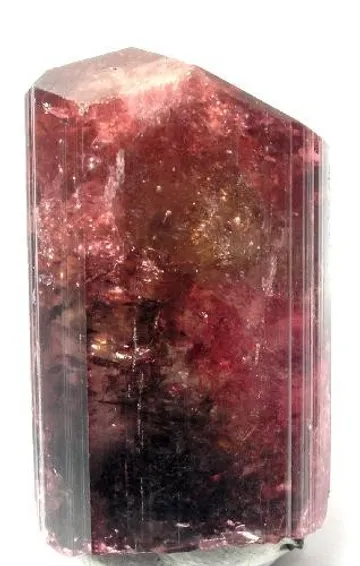
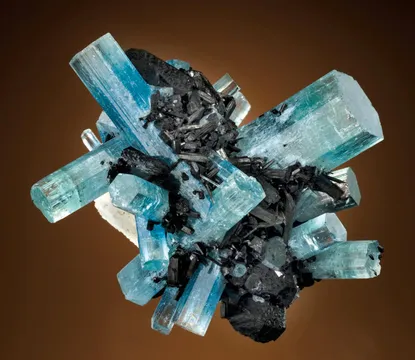
Elbaite attributed to Tubussis, Karibib District belongs to the pegmatite and granitic-pocket side of the locality story rather than the Green Dragon demantoid skarn. The best documented EarthWonders material includes multicolored tourmalines from the Ochua mine, Karibib, collected in the 1990s and cataloged under Tubussis, including 5 cm elbaite crystals and green-pink or tricolor crystals associated with smoky quartz; one described specimen is a matrix-free floater with deep gemmy green tourmalines to 4.8 cm, pink tips, and complete doubly terminated smoky quartz crystals. Strong Tubussis elbaite pieces are valued for complete terminations, color zoning from green through yellow to pink, association with sharp smoky quartz, and clean pocket surfaces rather than the large single-crystal size seen at Namibia’s more famous lithium pegmatites.
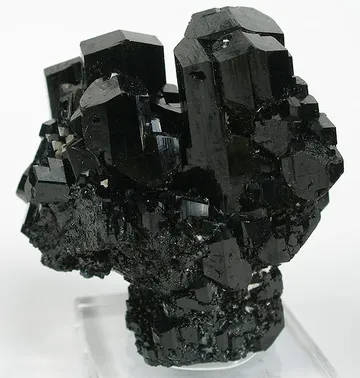
Tourmaline from Tubussis spans black schorl in the Erongo granite and miarolitic pockets, unidentified tourmaline recorded from the Metazeunerite Pocket, and colored elbaite represented by Karibib/Tubussis-labeled pegmatite finds. Schorl specimens are typically black, lustrous, striated prisms on quartz and feldspar-rich matrix, sometimes doubly terminated or etched at one end by later pocket fluids, while colored tourmaline pieces may show deep green, yellow, and pink zoning with quartz. Good examples are judged by termination integrity, luster, color contrast, and association—especially complete tourmaline crystals with complete smoky quartz—whereas massive black sprays or damaged prisms are commoner and less selective.
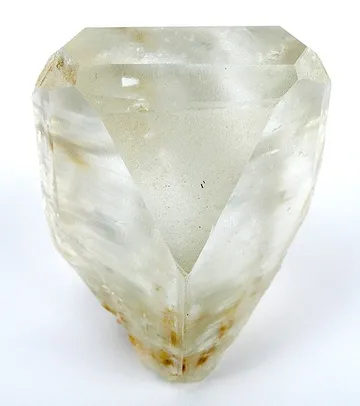
Quartz occurs in both major Tubussis collecting environments: as calcite- and garnet-associated quartz in the Green Dragon demantoid pockets, and as rock crystal or smoky quartz in the Erongo granite and pegmatite pockets. Specimen descriptions from Tubussis-labeled elbaite material note complete doubly terminated smoky quartz crystals attached to tricolor tourmaline, and field notes from the Ochua mine describe abundant quartz crystals in vugs during early 1990s collecting. The most desirable quartz from this locality is not generic loose smoky quartz, but crystals that preserve pocket context—complete doubly terminated forms, clean surfaces, and direct association with elbaite, schorl, prehnite, or demantoid-bearing matrix.
Other minerals documented from Tubussis Farm 22 make the locality far richer than a single-species demantoid mine. The Green Dragon assemblage includes calcite, grossular, quartz, diopside, wollastonite, prehnite, vesuvianite, and sphalerite-related inclusions or associations in the garnet system. Farm Tubussis 22 more broadly has recorded albite, microcline, beryl including aquamarine and goshenite, fluorite, topaz, schorl, smoky quartz, clinozoisite, epidote, hedenbergite, fluorapatite, monazite-(Ce), xenotime-(Y), and the vanadium garnet goldmanite. The Metazeunerite Pocket is especially notable for micromount species and uranium-arsenate/tungstate rarities, including metazeunerite, metanováčekite, uranophane, uranotungstite, walpurgite, arseniosiderite, russellite, stolzite, wulfenite, segnitite, ferrimolybdite, ferberite, opal-AN, cristobalite, and tridymite. No valid mineral species is documented here as a Tubussis type locality in the sources consulted, but the farm is an important published occurrence for several rare species and for Namibia’s first reported axinite-(Mg).
The most important authenticity issue with Tubussis specimens is locality precision. Labels may say Tubussis, Tubusis, Tubessis, Tubussis Farm 22, Green Dragon Mine, Parrot Mine, Karibib District, Dâures Constituency, Erongo Region, or simply “Erongo, Namibia.” Those names are not always equivalent. A demantoid on pale calc-silicate or marble matrix is likely tied to the Green Dragon/nearby garnet workings; a schorl, beryl, smoky quartz, topaz, or uranium micromount specimen may instead belong to the granite and pegmatite pocket systems of the farm. Older Karibib District labels should not be “corrected” away, but modern records may use Dâures because of the 2014 boundary changes.
Documented fakes specific to Tubussis demantoid are not a major theme in the literature, but misrepresentation can occur through over-broad labeling and through confusing Namibian demantoid with Russian, Iranian, or Madagascar material. Namibian demantoid generally lacks the classic Russian horsetail inclusion scene; a seller using horsetails as proof of Tubussis origin is giving the wrong diagnostic emphasis. Chemical origin work has shown that Namibian demantoid can be separated from major Russian and Madagascar sources by trace-element patterns, especially manganese/titanium relationships, chromium plus vanadium, and aluminum content, but such testing belongs to gemological laboratories rather than routine specimen buying.
Condition is critical. Many Tubussis demantoids are fractured because the rough was stressed by tectonic events, and individual crystals on matrix often have small edge bruises, contact marks, or internal veils. The pale carbonate and calc-silicate matrix can be friable; calcite-rich pieces should be kept away from acids and harsh cleaners. Do not oil or lacquer demantoid crystals to hide fractures—serious collectors notice unnatural surface gloss and residue in matrix cavities. Faceted Green Dragon stones are valued for liveliness and high dispersion, but specimen crystals should be judged as minerals: crystal form, luster, transparency, placement, and matrix aesthetics come before carat logic.
Heat treatment is not normally a selling point for Tubussis demantoid. Published reports state that Green Dragon demantoid and andradite did not respond well to heating tests and could become browner rather than greener. That makes untreated, well-colored crystals especially desirable. In the specimen market, the finest pieces with sharp green crystals on contrasting matrix are much scarcer than loose small garnets or dark granular garnet plates. Faceted Namibian demantoid remains available in calibrated melee and small sizes, but clean larger gems and first-rate matrix specimens are difficult to replace. Uranium-bearing micromineral specimens from the Metazeunerite Pocket should be stored and handled with sensible radioactive-mineral precautions: boxed, labeled, kept out of living spaces, not cut or abraded, and handled with handwashing afterward.
The modern Tubussis demantoid story begins with one of those field episodes that sounds almost too simple for a deposit of international importance: a goat herder wandering in central Namibia near Spitzkoppe stumbled over a rock bearing green, shiny crystals. The stones were passed along, recognized as demantoid garnet, and the find ignited a rush of claims near the village of Tubusis. From those original claims came the foundation of the Green Dragon Mine. The discovery seemed sudden to the gem trade, but it also had a buried prehistory: tin-bearing andradite had reportedly been noted decades earlier from Davib Ost 61, a nearby reminder that Namibia’s green andradite story did not begin only when the market was ready for it.
Once Green Dragon was developed, the romance of the discovery gave way to hard desert mining. The road in was not a showroom road; the mine lay off the D2306, reached by a roughly 10 km track suitable only for pickups and four-wheel-drive vehicles. Water and food had to be brought to the site. Temperatures swung from freezing nights to baking daytime heat. The main pit was described as more than 130 m long and up to 23 m deep, and the work was not delicate pocket collecting at first pass: drill holes, explosives, cleaning, excavators, trucks, crushing, screening, washing, and sorting. Yet within that industrial rhythm, the collector’s miracle still happened irregularly—pockets at five meters depth or more could open with calcite, prehnite, quartz, apophyllite, and demantoid crystals clean enough to beat the general production average.
The Ochua mine field notes preserved with Gene Meieran specimens give the pegmatite side of the district a very different texture. In 1992, Meieran collected quartz from a vug during a trip with Wayne Thompson and Bill Barker to examine a new tourmaline deposit; his note has the unmistakable sound of a productive pocket, recalling that one could reach into the hole and pull out quartz crystals seemingly without end. In 1994, he returned to the Ochua mine with Bill Barker and Wayne Thompson and collected lepidolite clusters so clean and well formed that, as with the quartz, they could simply be pulled from the vug. The same 1994 tourmaline find produced multicolored elbaites, and one boulder with watermelon tourmalines from that discovery is recorded as being preserved at the Rice Northwest Museum of Rocks and Minerals in Hillsboro, Oregon.
The demantoid market produced its own memorable moments. At the GJX show, Stefan Reif showed GIA an 11.63 ct round brilliant from Green Dragon—an extraordinary size for a mine whose strength is usually calibrated small gems. The original rough weighed about 46 ct, roughly 9 g, and the finished stone yielded a little over 25%. That figure matters because most Green Dragon production is not destined for showy single stones; it becomes 2–3 mm calibrated gems, melee, accent stones, and tightly cut small goods. The 11.63 ct gem was therefore not merely large. It was a statistical exception from a deposit known for fire in small sizes.