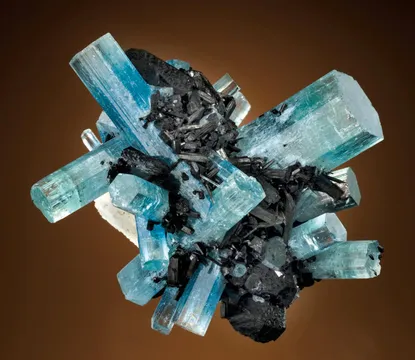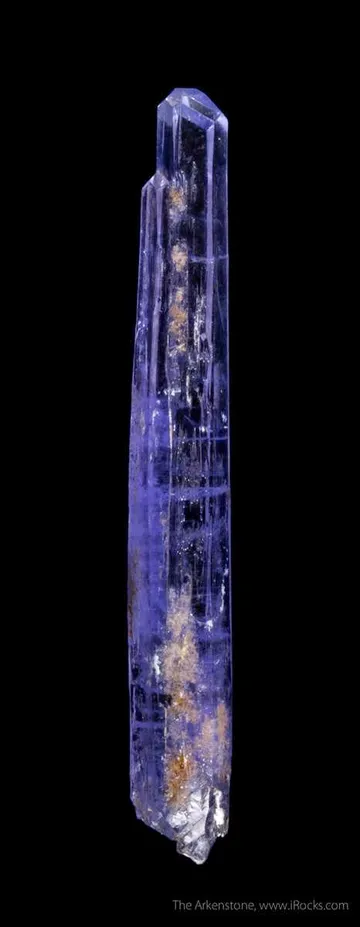
Klein Spitzkopje Granite Stock, Namibia — historic topaz locality famed for glassy colorless to pale blue/yellow crystals, often with smoky quartz and feldspar.
Key facts
Klein Spitzkopje is one of the classic Namibian specimen localities: a desert granite stock whose fame rests not on ore tonnage but on pockets. The hill is a small, pale granitic inselberg in the Spitzkoppe area of Erongo, part of the same spectacular Cretaceous igneous province that produced the better-known Gross Spitzkoppe, Erongo, Brandberg, Messum and Cape Cross complexes. Mineralogically, Klein Spitzkopje is the topaz specialist among them. Its best pieces are glassy, water-clear to pale blue or yellow topaz crystals, commonly “silver” topaz in the Namibian gem trade, with sharp orthorhombic form and unexpectedly complex terminations. When those crystals remain naturally attached to smoky quartz, microcline, amazonite or pale feldspar matrix, they become the locality’s most coveted cabinet specimens.
Regional View
Country View
Geologically, the locality is a remnant of a topaz-bearing A-type granite stock related to the Paraná–Etendeka rift-magmatic event. The specimen pockets formed in miarolitic cavities and pegmatite-lined druses within highly evolved, fluorine-rich granite. That fluorine-rich chemistry explains the topaz abundance, the beryl suite, and the unusual assemblage of Be-, F-, Sn-, W-, Nb-, Ta- and rare-earth-bearing accessory minerals that make the locality far more interesting than a simple “topaz hill.”

Photo: Wikimedia Commons
The historical importance of Klein Spitzkopje is unusually deep for a Namibian gem locality. Topaz was reported from here in 1889, making it one of the earliest recorded Namibian topaz sources. By the early twentieth century and especially in the 1930s, the locality was already known for facet-quality colorless topaz, aquamarine and other beryl. Later specimen mining and collecting, much of it informal and local, supplied generations of collectors with loose crystals, thumbnails, miniatures, and occasional matrix pieces. A fine Klein Spitzkopje topaz is immediately recognizable: bright glass luster, high transparency, pale “ice” color or complete colorlessness, chisel-like termination, and, on the best examples, a sculptural association with smoky quartz rather than a solitary loose crystal.
Search for specimens: View all specimens from Klein Spitzkopje Granite Stock, Namibia
Klein Spitzkopje lies in the Spitzkoppe area of the Dâures Constituency, Erongo Region, in western Namibia, near the road corridor between Usakos and Swakopmund. In locality literature it appears under several spellings, including Klein Spitzkoppe, Kleine Spitzkoppe and Klein Spitzkopje. Collectors should treat these as the same classic granite-stock locality unless a label specifies a sublocality such as Stiepelmann Mine, Marenica or the cassiterite prospect.
The deposit is best understood as a miarolitic, topaz-bearing granite-pocket locality rather than a conventional mine. The stock belongs to the anorogenic Damaraland intrusive complexes, emplaced into the Damara orogenic belt during Early Cretaceous rifting connected with the opening of the South Atlantic. The Gross and Klein Spitzkoppe stocks are texturally varied, topaz-bearing biotite granites; their accessory suite includes columbite, zircon, magnetite and monazite, and their margins include aplite–pegmatite stockscheiders. At Klein Spitzkopje, vapor saturation in the late granite melt produced open cavities, pegmatite-lined druses and local greisenized zones. These are the pockets that yielded topaz, quartz, smoky quartz, microcline, beryl, fluorite, schorl, phenakite, bertrandite and a long list of rarer accessory species.
The productive “ore bodies,” from a collector’s standpoint, are discontinuous pegmatitic and miarolitic zones rather than persistent veins. Cavities occur in the granite and in quartz–feldspar pegmatitic segregations; some are small druses lined with microcline, quartz, topaz and mica, while the famous Stiepelmann pocket system was a much larger pegmatitic cavity complex. Quartz veins and quartz-rich zones could pinch and swell, and where open space existed they carried euhedral quartz, feldspar and fluorite. The gem minerals are reported as most abundant with the quartz–feldspar assemblage; biotite-rich portions are less favorable.
The historical mining record is a mixture of gem digging, specimen collecting, granite quarrying and small prospecting. The first recorded topaz discovery in Namibia included Klein Spitzkopje in the late 1880s. Production figures for specimen material are necessarily fragmentary because most digging was informal, but one published figure records 34.5 kg of facet-quality topaz collected in Namibia, mostly from the Klein Spitzkopje deposits, during 1930–1938. Much of this material was cut as colorless “silver” topaz. At the same time, Klein Spitzkopje never developed into a large, mechanized gemstone mine in the way an ore deposit might; the locality has been worked by local diggers, small operators and collectors, while granite quarrying in the broader area has been a separate large-scale activity.
Stiepelmann Mine, the best-known sublocality, is central to the locality’s history. Discovered in the mid-1930s, Stiepelmann’s pegmatite was described from information supplied to Paul Ramdohr by the operator Stiepelmann himself. The pegmatitic zone was approximately 100 meters long, with pockets reportedly reaching 20–25 meters wide in places. The internal zones included open quartz veins, massive quartz with fine-grained albite, orthoclase with bertrandite and phenakite, blue beryl in stockwork veins, large mica crystals, pale blue beryl, quartz, rare fluorite and unusually large altered or resorbed topaz. That pocket system is why labels reading “Stiepelmann Mine” deserve careful attention; they may refer to a particular Be-rich assemblage within the wider Klein Spitzkopje granite stock.
Other named or recognized areas around Klein Spitzkopje add complexity to old labels. Marenica is known for lead secondary minerals including wulfenite, vanadinite, mimetite, cerussite, galena and associated alteration minerals. A cassiterite prospect on the northwestern flank has yielded tin- and copper-bearing minerals such as cassiterite, chalcocite, covellite, malachite, chrysocolla, chenevixite, scorodite, shattuckite and quartz. These are not the classic silver-topaz pockets, but they belong to the broader Klein Spitzkopje locality field and explain why some labels from the area look more like small ore-prospect assemblages than gem-pocket assemblages.
Collecting access today must be approached conservatively. The Spitzkoppe area is a managed desert tourism and community landscape, and mineral rights, land access, conservation rules and local arrangements matter. Modern visitors encounter local sellers and roadside mineral markets, but specimens from several Namibian localities are often mixed together in trade. Anyone intending to collect, buy, export or commercially deal in Namibian specimens should verify current permissions with landholders, mineral-rights holders and Namibian authorities. Namibia’s Ministry of Mines and Energy has specifically noted that private collectors and researchers need permits for material collected or purchased, and commercial export requires additional authorization. For serious collectors, the safest route is to buy from reputable Namibian dealers or from collections with old, specific labels and credible provenance.
Topaz is the defining mineral of Klein Spitzkopje, occurring in miarolitic pegmatite cavities as colorless “silver” crystals, rarer pale blue crystals, and pale yellow to yellowish green examples whose color can fade on prolonged exposure to sunlight. The classic crystals are transparent, lustrous, orthorhombic prisms with chisel-like to complex terminations; published work recognizes several recurring habits, from simple colorless forms to complex colorless crystals, stubby yellow prismatic crystals, yellow crystals associated with unaltered microcline, and late long thin yellow crystals associated with needle-like aquamarine and corroded microcline. Most collectible pieces are loose crystals from thumbnail to miniature size, but exceptional crystals reach several centimeters, with historical reports of crystals around 15 x 12 x 8 cm and over 2 kg. Associations with microcline, schorl, biotite, fluorite, rutile, large quartz, smoky quartz and feldspar define better specimens. The finest pieces are not merely clear crystals: they are undamaged, highly lustrous, well terminated, and, above all, naturally seated on smoky quartz or feldspar matrix, a combination far rarer and more desirable than the abundant loose “silver” topaz.
Quartz at Klein Spitzkopje is both a matrix mineral and a specimen species in its own right, forming rock crystal, smoky quartz, amethyst and rose quartz within the miarolitic and pegmatitic granite system. In the Stiepelmann pocket description, open quartz veins contained quartz crystals reportedly up to 1 meter long and 35 cm wide, so large that they were compared to mine timbers; elsewhere, rock crystal occurs with topaz, feldspar, fluorite, beryl, bertrandite and phenakite in discontinuous cavities. For collectors, ordinary quartz from Klein Spitzkopje is less important than quartz that preserves pocket context: clean prisms with attached topaz, quartz plates carrying feldspar and schorl, or clear crystals that show the same sharp, dry-pocket luster as the locality’s topaz. Good pieces retain undisturbed terminations and natural contacts; mediocre ones are simply detached quartz fragments from the granite pocket rubble.
Smoky quartz is the preferred stage on which Klein Spitzkopje topaz performs. It occurs in vuggy pegmatitic segregations within the Mesozoic granite, commonly with microcline and locally amazonite, and it is repeatedly documented as an association for the topaz pockets. The crystals range from small, glassy smoky points to substantial miniature and cabinet-scale prisms; modern documented specimens include smoky quartz crystals several centimeters long with perched or penetrating topaz, and the best examples show transparent brown-gray quartz rather than dull, fractured material. Collector value rises sharply when a smoky quartz crystal carries a pristine topaz in natural position, especially where the quartz is gemmy, lustrous and undamaged. Topaz-on-smoky-quartz combinations from Klein Spitzkopje are widely considered scarcer and more important than loose topaz crystals because they preserve the pocket relationship that most mining and digging destroyed.
Beyond the three collector staples, Klein Spitzkopje has a broad evolved-granite assemblage. Documented minerals include albite, microcline, amazonite, orthoclase, schorl, biotite, muscovite, beryl varieties aquamarine and heliodor, fluorite including yttrofluorite, phenakite, bertrandite, hydroxylherderite, florencite-(Ce), bastnäsite-(Ce), euxenite-(Y), columbite-series minerals, zircon, rutile, scheelite, ferberite or wolframite-group minerals, molybdenite, pyrite, pyrophyllite, nacrite, talc, gibbsite, goethite and hyalite opal. Marenica adds a small secondary lead–molybdate–vanadate suite, while the cassiterite prospect contributes cassiterite and copper alteration minerals. Klein Spitzkopje is not an accepted type locality for a new mineral species; some historically reported rarities require caution, notably ottemannite from Stiepelmann Mine, which is listed with uncertain source, and ferronigerite-2N1S, which has been flagged as erroneously attributed to Stiepelmann material from another mine.
Klein Spitzkopje topaz rewards close inspection. The best crystals are transparent, lustrous, sharp and complete, but many old specimens are loose, naturally contacted at the base, chipped on prism edges, or etched and frosted on selected faces. Topaz has perfect basal cleavage, so even very hard, gemmy crystals can split or bruise if dropped or knocked against other minerals. Matrix pieces are much rarer but should be examined carefully for repairs, reattachments and artificial mounting, especially where a topaz sits dramatically on quartz or feldspar.
This is a locality where documented fakery matters. Published gemological work specifically notes fake topaz specimens fashioned from locally mined pale green fluorite, with the topaz crystallography copied well enough to deceive casual buyers. Fake aquamarine from Klein Spitzkopje has also been reported. The problem is understandable: a fine topaz crystal has a recognized collector value, and the locality’s fluorite can provide workable material for imitations. A collector should test hardness discreetly only when appropriate, compare crystal symmetry, look for unnatural tool marks, check whether the “topaz” shows fluorite cleavage or softness, and be wary of improbable loose crystals glued to matrix. UV response is not a magic test here; published measurements found Klein Spitzkopje topaz inert under both shortwave and longwave ultraviolet.
Color also needs a locality-specific warning. Most Klein Spitzkopje topaz is colorless, while pale blue and pale yellow examples are rarer and more marketable. Some yellow, brownish or bluish color in topaz can be related to radiation-induced color centers and may fade with prolonged sunlight; old accounts suggest this is one reason much weathered or surface-collected material is colorless. Strong, modern “London blue” or intense treated-blue material should not be represented as natural Klein Spitzkopje color unless the treatment history is stated clearly.
Mislabelling is common in a different way: “Spitzkoppe,” “Erongo,” “Klein Spitzkoppe,” “Gross Spitzkoppe,” and even broader “Namibia” labels have been used loosely in the marketplace. Gross Spitzkoppe is geologically similar, but the classic topaz and aquamarine specimen production is overwhelmingly associated with Klein Spitzkopje. Erongo Mountain specimens can also be confused with Klein Spitzkopje material, particularly topaz, quartz and beryl associations sold through the same regional dealers. Old labels from Sid Pieters, House of Gems, Charlie Key, Desmond Sacco, Rob Smith, William Larson, Dr. Erika Pohl-Ströher and other well-known southern African or international collections can add confidence, but they do not replace mineralogical scrutiny.
Availability is uneven. Loose colorless topaz thumbnails and small miniatures appear regularly enough that the species remains obtainable, though top-quality old crystals are not abundant. Fine pale blue crystals, large crystals above several centimeters, and undamaged matrix pieces with smoky quartz or microcline are distinctly scarcer. The market especially prizes topaz-on-smoky-quartz combinations because only a small fraction of recovered specimens retain that association intact. Serious collectors should pay for condition, natural matrix relationship and provenance rather than sheer size alone.
The old stories from Klein Spitzkopje have the feel of a desert locality discovered before the specimen market knew what to do with it. In the late nineteenth century, the first recorded Namibian topaz finds included Klein Spitzkopje, then appearing in old literature under earlier names and spellings. Later writers looking back on the deposits describe bags of loose crystals gathered from the granite pockets and surrounding weathered ground. Many were brilliant, colorless and transparent; a few showed pale blue to bluish green, yellow or yellowish green color. Some were not saved as mineral specimens at all but cut into the faceted “silver” topaz that became part of Namibia’s gemstone identity.
The Stiepelmann pocket is the great underground episode. Discovered in the mid-1930s, it was not a neat little vug opened by a prospector’s chisel but a large pegmatitic cavity system. Ramdohr’s later cross-section, based on Stiepelmann’s own descriptions, reads almost like a mine plan through a crystal-filled cave: a zone about 100 meters long, pockets up to 20–25 meters wide in places, a vertical shaft that inclined and flattened with depth, open quartz veins, massive quartz with albite, orthoclase with bertrandite and phenakite, blue beryl in stockwork veins, and two “tubes” containing large mica crystals, pale blue beryl, quartz and rare fluorite. One detail has haunted collectors ever since: open quartz veins reportedly held quartz crystals 1 meter long and 35 cm wide, so blocky that they resembled mine timbers.
The same Stiepelmann description places the largest topaz in a frustrating category for specimen collectors: huge, but altered or resorbed. Ramdohr noted that other Klein Spitzkopje localities had produced topaz crystals around 8 x 12 x 15 cm and weighing more than 2 kg, yet the altered topaz from Stiepelmann’s pocket was even larger. That is the recurring paradox of the locality. Klein Spitzkopje could grow big crystals, but the best collectible topaz is usually valued not by maximum mass but by survival: clear faces, intact terminations, no cleaved bruises, and the rare preservation of a natural matrix relationship.
Modern collecting at Klein Spitzkopje has often belonged to local hands. Published accounts and travel notes describe local Damara diggers, including women, working the deposits and selling crystals to visitors, dealers and collectors. This matters because much of the locality’s production never passed through a single mine office or company ledger. It moved by hand: from shallow workings and pocket debris into roadside stalls, Swakopmund and Windhoek dealers’ inventories, old South African collections, gem cutters’ parcels, and eventually international shows. That informal chain is part of the charm and part of the labeling problem; a superb old “Spitzkoppe” topaz may be exactly right, but a tray of tourist minerals at the road can contain pieces from Klein Spitzkopje, Erongo, Brandberg, Goboboseb and other Namibian localities mixed together.
A smaller but memorable gem-trade story belongs to the “Windmill Cut.” Colorless Klein Spitzkopje topaz is bright and abundant enough as rough, but a colorless stone can look sleepy if cut conventionally. Mike Thygesen of Desert Gems/Bead World in Swakopmund developed a faceting style for the material in the mid-1990s, using alternating pavilion effects to create a spoke-like pattern when viewed through the table. At the Namibian Coloured Gemstone & Jewellery Showcase in Windhoek on 12–13 October 2017, several hundred examples were shown in sizes from 6 to 22 mm. It is a distinctly Namibian solution to a distinctly Namibian stone: make the “silver” topaz flash by design rather than by color.