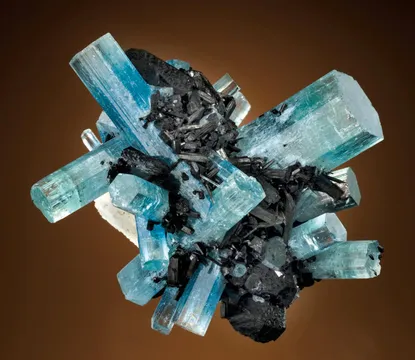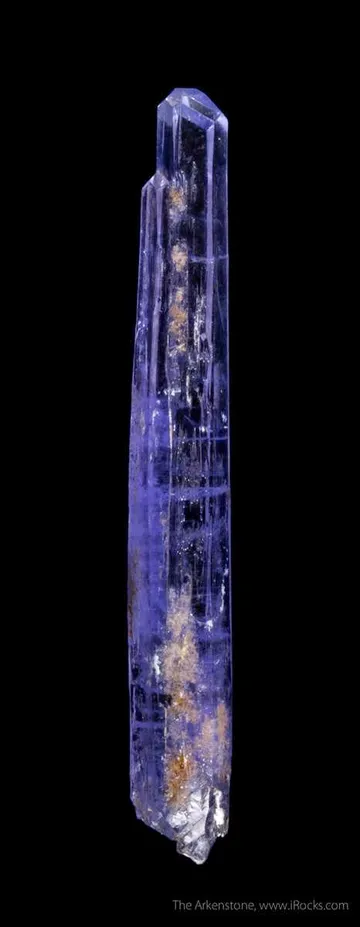
Otjua Mine, Namibia — a defining tourmaline locality famed for pocket elbaite with polychrome colors and smoky-quartz associations, prized by collectors.
Key facts
Otjua Mine, better known in older collecting circles as the Becker’s or Beckers pegmatite on Farm Otjua 37, is one of the defining Namibian localities for pocket elbaite. It lies south of Karibib in the Erongo Region, in the central Damara pegmatite country where differentiated granitic pegmatites cut high-grade metasedimentary rocks. For collectors, Otjua matters because it produced the kind of tourmaline that is instantly localizable when seen in good light: compact to elongate prismatic crystals, often broken internally by natural fractures but carrying superb color architecture—green, blue-green, teal, pink, red, and cranberry-red in repeated zones, caps, cores, and rinds. The best pieces are not simply “Namibian tourmaline”; they are Otjua tourmalines, with a particular polychrome character and a frequent association with smoky quartz that gives fine specimens an architectural, pegmatitic look.
The deposit is a complex lithium-bearing granitic pegmatite, historically worked for tourmaline and quartz crystals rather than as a bulk industrial mine. It is exposed in open-cut workings along a tourmaline-bearing zone, with the pegmatite intruding at the contact between marble on one side and darker fine-grained metamorphic rock on the other. Published field observations describe an elongate open cut and shallow tunnels, a pegmatite body at least 100 m long and up to about 40 m wide, and a moderately to steeply north-dipping attitude. Its mineral assemblage—elbaite, lepidolite, albite/cleavelandite, quartz, smoky quartz, beryl, amblygonite, fluorapatite, schorl, columbite-tantalite, native bismuth, and monazite-(Ce)—places it firmly among the evolved rare-element pegmatites of the Karibib district, but its reputation rests overwhelmingly on specimens.
Regional View
Country View
Otjua’s historical fame has two strands. The first is the tourmaline production of the late 1980s and early 1990s, when a small number of pockets yielded unusually aesthetic polychrome crystals and clusters, some later distributed internationally through well-known American dealers. The second is the discovery of giant smoky quartz crystals at the mine, including a 14.1-tonne quartz cluster now displayed at the Kristall Galerie in Swakopmund. That museum connection is unusually important for a specimen locality: the mine is not just represented by cabinet pieces but by monumental quartz that became a public Namibian mineral landmark.

Photo: Wikimedia Commons
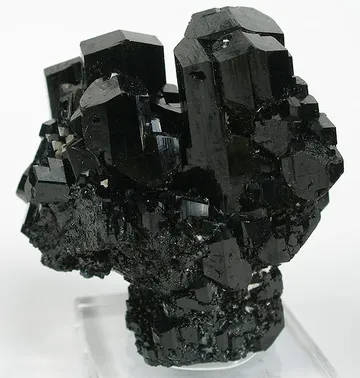
Fine Otjua tourmalines are typically judged less by absolute perfection than by color, completeness, transparency, and composition. Many crystals are internally fractured or naturally contacted, and many are darker in ordinary lighting than photographs suggest; backlighting can transform a somber green-black crystal into intense gem green or reveal a pink core beneath a blue-green rind. The most desirable specimens keep their color zoning visible without needing heroic lighting, show intact or only lightly rubbed terminations, and ideally sit with quartz or albite in a way that records the pocket environment rather than looking like isolated rough.
Search for specimens: View all specimens from Otjua Mine, Namibia
Otjua Mine is situated on Farm Otjua 37, approximately 40 km south of Karibib, in the Erongo Region of Namibia. The mine coordinates published for the locality are close to 22° 7' 47" S, 16° 6' 41" E, and environmental documentation for Mining Licence 189 places the operation along the district-road approach south of Karibib. The locality should not be confused with the Otjua tungsten prospect, a separate skarn-related tungsten occurrence elsewhere in central Namibia; the collector locality treated here is the tourmaline- and quartz-bearing pegmatite known historically as Becker’s pegmatite.
Geologically, Otjua belongs to the Karibib district’s evolved lithium-bearing pegmatites of the Damara Orogen. Older geological work lists Becker’s pegmatite on Otjua 37 among the major lithium-beryllium-bearing pegmatites of the Karibib district, with lepidolite and tourmaline as exploited minerals and with its stratigraphic setting given in the Upper Hakos Stage. More detailed pegmatite descriptions recognize internal zoning, including border and graphic-granite zones; albite-quartz-muscovite zones with schorl; cleavelandite-bearing units with quartz, muscovite, schorl, and beryl; zones carrying dark greenish tourmaline; a blocky feldspar-quartz-albite-muscovite-green tourmaline assemblage; a lepidolite zone; core-margin zones; and a quartz core. That internal architecture is exactly what a collector sees in the specimens: tourmaline rising from or embedded in quartz, albite, and mica, with pocket material grading into fractured wall-rock tourmaline and massive quartz.
The ore—or more accurately, the specimen-bearing zone—has been followed by small-scale open-pit mining. Public environmental filings for Hoanib Exploration describe blasting and conventional drilling used to access the tourmaline-bearing zone, with small blasts intended to loosen rock without unnecessarily damaging crystals. Waste rock is moved by front-end loader, and the operation is small: filings list typical equipment as a front-end loader, compressor, three one-tonne trucks, and basic maintenance tools. The mine’s commercial products are tourmaline and quartz crystals, not a conventional metal concentrate.
Otjua has been mined intermittently for decades. The most famous specimen-producing period was 1985–1990, when a 45 m deep crystal cavity discovered during tourmaline mining yielded enormous smoky quartz groups. A later gemological field report recorded that specimens from the mine, including the 14.1-tonne quartz cluster and faceted tourmalines in varied colors, were displayed at the Kristall Galerie in Swakopmund. The same report noted that many decorative specimens reached the U.S. market in the early 1990s through Bryan Lees of Collector’s Edge, and that gem tourmaline was recovered both from pegmatite pockets and from crystallized wall rock in pocket zones.
The pocket distribution was irregular. At the western end of the open pit lay the giant quartz “cave,” while the eastern end later produced about 120 smaller cavities containing smoky quartz and/or light green tourmaline. That distinction helps explain the range of surviving specimens: massive and monumental smoky quartz from the great cavity; cabinet and small-cabinet smoky quartz/tourmaline combinations from smaller cavities; and many individual tourmalines, some fat and stubby, some slender, many showing striking color zoning but also the internal fractures typical of pocket elbaite from this mine.
Ownership and access have evolved from the older mining-claim era into the ML 189 framework. Hoanib Exploration (Pty) Ltd is identified in public documentation as the operator associated with ML 189, and environmental records describe the continuation of small-scale extraction of semi-precious stones through open-pit mining. The site is an operating or licensed mining area rather than a casual collecting locality. Any field visit requires permission from the land and mineral-rights holders, and collectors should assume that uninvited collecting, dump searching, or entry into workings is inappropriate and potentially dangerous.
Material from Otjua is also tied to the Kristall Galerie in Swakopmund, where mine products have historically been sorted, cut, and incorporated into jewellery and display pieces. This is important for provenance: legitimate Otjua material may appear as mineral specimens, faceting rough, polished or cut stones, jewellery, or museum-scale quartz. For specimen collectors, the strongest provenance attaches to older labels mentioning Otjua, Farm Otjua 37, Beckers/Becker’s pegmatite, Karibib district, Collector’s Edge, Gene Meieran, Wayne Thompson, or the Kleynhans/Kristall Galerie connection.
Elbaite is the signature mineral of Otjua and occurs as prismatic, commonly striated crystals in green, dark green, blue-green, blue, pink, red, rubellite, indicolite, achroite, and watermelon-style zoned varieties; older locality descriptions regard Otjua as having produced the best pocket tourmaline specimens from Namibian pegmatites, while also noting that many crystals are badly fractured and that common examples can have green to blue-black rinds with red to pink cores but modest luster. Documented crystals reach exceptional sizes for the locality—up to about 30 cm in older summaries, with most collectible pieces far smaller—and notable specimens include fat polychrome crystals with pink caps, blue-green interiors surrounding pink cores, and green crystals that become intensely gemmy under backlight. The best Otjua elbaites combine clean terminations, strong luster, visible color zoning, and preferably smoky quartz or albite association; ordinary pieces tend to be darker, more fractured, poorly terminated, or attractive only when strongly backlit.
“Tourmaline” on Otjua labels is often a field or trade term for elbaitic tourmaline rather than a formally analyzed tourmaline-group species, and this is especially true for older specimens that predate modern tourmaline nomenclature and fluor-elbaite recognition. At Otjua the collector look is distinctive: compact sprays or parallel-growth clusters, doubly terminated or partly doubly terminated crystals, small sidecar prisms on larger crystals, and tourmaline emerging from smoky quartz or quartz-rich pocket matrix. The locality’s strongest pieces show polychrome zoning from pastel green into pink and cranberry-red, or darker blue-green to pink-capped crystals that reward backlighting; lesser examples are often fractured, dull, or too dark to reveal their internal color without a lamp. Because many older pieces are simply labelled “tourmaline,” a good Otjua specimen should be evaluated by morphology, color zoning, termination quality, and provenance rather than by a varietal name alone.
Quartz from Otjua ranges from ordinary pegmatitic quartz to smoky quartz crystal groups of extraordinary scale, including the giant Otjua quartz cluster displayed at the Kristall Galerie in Swakopmund and smaller pocket specimens associated with elbaite. The most collectible cabinet pieces pair smoky quartz crystals with polychrome tourmaline, sometimes with doubly terminated quartz crystals or quartz growing in unusual relation to tourmaline; at least one well-known example shows a sceptered quartz crystal growing from the side of a tourmaline crystal, forcing the tourmaline to continue growth around the obstruction and develop multiple terminations. Otjua quartz is therefore valued in two very different markets: monumental museum display pieces from the giant cavity and hand-specimen associations that frame the tourmaline. Good specimens show sharp quartz form, pleasing smoky color, and balanced placement with tourmaline rather than broken quartz masses with scattered dark crystals.
Indicolite at Otjua appears as the blue to blue-green expression of the elbaitic tourmaline suite, usually in small crystals or color-zoned crystals rather than abundant large, uniformly blue prisms. Documented specimens include teal-blue zones between rubellite portions and darker indigo terminations, as well as small blue crystals around the centimetre scale; the finest examples are prized because much Otjua blue material trends dark, grayish, or enclosed in fractured polychrome crystals. The most appealing indicolite pieces show a distinct blue or teal zone visible in normal light, with luster and termination quality strong enough that the stone reads as an Otjua indicolite rather than merely a dark tourmaline. Associations with smoky quartz, quartz, and other elbaite colors add locality character, and a blue zone sharply set against pink or green is generally more desirable than a single dark, opaque-looking crystal.
Other documented Otjua minerals complete the rare-element pegmatite picture. Albite, including cleavelandite, muscovite, beryl, amblygonite, lepidolite, fluorapatite, schorl, columbite-tantalite, native bismuth, ankerite, monazite-(Ce), and fluor-elbaite are all recorded from the locality or the Becker’s pegmatite. Lepidolite is specifically noted in association with elbaite and purple apatite, monazite-(Ce) has been recorded as small crystals to about 4 mm, and fluor-elbaite has been identified from Otjua by crystal-structure refinement and SEM-EDS work reported in locality databases. Otjua is not celebrated as a type-locality mine; its rarities matter because they document a highly evolved Li-F-B-bearing pegmatite system that produced world-class collector tourmaline.
Otjua tourmaline rewards careful lighting. Many crystals that appear blackish green in a tray reveal intense green, blue-green, pink, or red zoning when backlit, and some of the best documented specimens are specifically illustrated or described under backlight. That is not a treatment or a deception by itself; it is a normal optical reality of dark, internally zoned elbaite. The collector’s question is whether the specimen still has life under ordinary display lighting. A crystal that only becomes attractive with a flashlight may be a lesser piece than one whose zoning and luster are evident in ambient light.
Condition is the central issue. Older references and specimen descriptions repeatedly stress that many Otjua crystals are fractured, edge-worn, contacted, or lackluster. Look closely at terminations, especially pink caps and dark blue-green ends, because tiny bruises and repaired tips can disappear against the deep color. Matrix pieces can hide contact damage where tourmaline meets quartz, and single crystals may have one end sawn or polished from removal or preparation. Internal fractures are common and should not automatically disqualify a piece, but open cracks, glue lines, and reattached terminations should be disclosed and priced accordingly.
Mislabelling is possible in several directions. Older labels may say Becker’s pegmatite, Beckers pegmatite, Otjua pegmatite, Farm Otjua 37, Karibib district, or Otjua Mine; those names can all refer to the same collector locality. Confusion with the Otjua tungsten prospect should be avoided, as that is a different deposit type and mineral story. Confusion is also possible with other Namibian tourmaline localities such as Neu Schwaben, Usakos, Rubikon, Helikon, and Omapyo; these may share broad color families but differ in crystal style, matrix, and mining history.
A documented caution for Namibian tourmaline rough is glass imitation. A 2002 gemological report described a dark bluish green glass imitation of tourmaline obtained from local dealers in Omaruru; its color was plausible for Karibib-area tourmaline, but it lacked normal tourmaline striations, had nonparallel edges, felt lighter and warmer than tourmaline, and showed gas bubbles and curved growth zoning under magnification. That report was not specifically a fake Otjua specimen case, but it is directly relevant to collectors buying loose “Namibian tourmaline” crystals or rough. A 10x loupe, attention to striations, heft, bubbles, and growth features remain essential.
Heating is relevant mainly to cut gems and rough, not to crystallized cabinet specimens. Namibian tourmaline from some mines has been heated to lighten tone or remove brownish hues, and heat treatment has been reported in the broader Namibian gem-tourmaline trade. For Otjua display specimens, the more common concerns are lighting-dependent color, repairs, polishing of contacted ends, and label accuracy rather than heat.
Market availability is limited but not vanishingly rare. Small Otjua tourmalines and quartz-tourmaline associations appear periodically, while top pieces with strong color zoning, good terminations, matrix aesthetics, and old provenance can be expensive and competitive. The best examples tend to trace to late-1980s through early-1990s production or to later small specimen-mining efforts, and exceptional pieces with Gene Meieran, Wayne Thompson, Collector’s Edge, Rob Lavinsky/iRocks, or Kristall Galerie-related histories carry a premium. Buyers should expect strong price differences between a dark, fractured individual and a balanced polychrome cluster with visible pink and green/blue zoning.
In 1985, Hannes Kleynhans was mining tourmaline on Farm Otjua when the drill did something no miner forgets: it dropped into darkness. The equipment had broken into a void 45 m below the surface, a hidden chamber in the pegmatite where smoky quartz crystals had grown with room enough to become giants. The find changed the mine’s story. What could have become broken industrial quartz instead became a preservation project, because Kleynhans chose to extract the crystals intact.
That choice turned a mineral discovery into an engineering ordeal. The removal of the giant quartz was not a quick extraction but a five-year operation carried out delicately enough to preserve massive crystals that could have shattered under ordinary mining. During that period, the cave itself had to be protected as if it were a vault; one later account called it “the biggest safe in Namibia,” guarded against both weather and theft while the crystals were still underground. The largest single crystal from Otjua is described as a floater 2.2 m long, 1.8 m in circumference, and weighing about 1 tonne; the famous cluster displayed in Swakopmund weighs 14.1 tonnes.
The Kristall Galerie in Swakopmund became the public afterlife of that underground chamber. Hannes Kleynhans spent years creating a setting for the crystals, and the main quartz cluster reportedly took three months to position by hydraulics at the same angle in which it had been found in the cave. The gallery also includes a 32 m replica tunnel of the original Otjua Tourmaline Mine, turning a private pegmatite discovery into a public mineral experience.
The tourmaline story is more intimate but equally important to collectors. In the early 1990s, Otjua specimens entered the American market through Collector’s Edge, and material from pockets and crystallized wall rock supplied both cabinet specimens and gem rough. The mine’s eastern workings later produced about 120 small cavities with smoky quartz and/or light green tourmaline, a number that explains why Otjua is known for many modest-sized but distinctive pieces rather than a single large, uniform production run.
A small, special pocket around 1990 occupies a particular place in collector lore. Specimen-mining projects financed by Gene Meieran and Wayne Thompson produced unusually good Otjua tourmaline, including large and gemmy green crystals that surprised collectors familiar with the mine’s more typical small, fat, darker, polychrome crystals. One documented crystal measured 14.8 x 1.7 x 1.5 cm and was described as much more impressive when backlit, showing intense gem green color despite appearing dark in ordinary light. Another 7.5 cm crystal from the same collecting world was praised for its very gemmy, lustrous, parallel-growth dark green form with reddish-pink terminations—exactly the kind of Otjua piece that proves why locality specialists keep looking past the fractured and ordinary material.