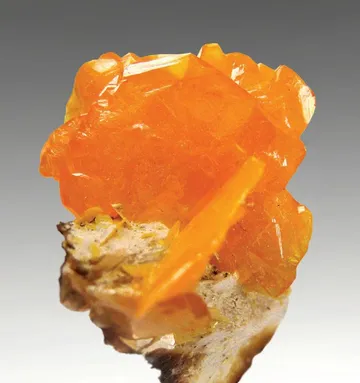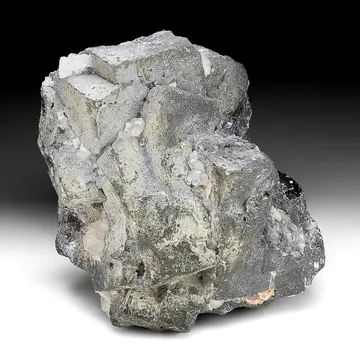
El Hammam, Morocco — classic fluorite locality known for green to yellow fluorite cubes, pyrite, quartz, and REE-rich mineralization prized by collectors.
Key facts
El Hammam is Morocco’s classic fluorite locality and one of the defining fluorite deposits of North Africa: a vein field on Djebel el Hammam, southwest of Meknès, where fluorite was mined industrially for decades and where collectors received an unmistakable suite of green to yellow fluorite cubes, glittering pyrite, white quartz, and late calcite. Its importance is not just aesthetic. The deposit is a well-studied example of REE-rich fluorite mineralization in the Central Moroccan Massif, formed in a structurally active Paleozoic basement cut by major shear zones, late Hercynian to Triassic magmatism, and hot saline brines. For collectors, that geology translates into specimens with a look few other Moroccan localities share: translucent sea-green fluorite cubes, often with sharp stepped faces, dustings or crusts of brassy pyrite, sugar-like quartz overgrowths, and, on some pieces, small pearly calcite plates or “poker-chip” calcite.
Regional View
Country View
The mine worked several fluorite-bearing vein systems, with the familiar pale green material especially associated with the El Hammam vein and purple fluorite reported from the Bergamou and Gouaïda veins. Scientific work has emphasized the unusually high rare-earth-element content of both fluorite and carbonates here, and that chemical peculiarity helps explain why El Hammam fluorite is more than just another attractive green cube locality. Many specimens fluoresce under longwave and shortwave ultraviolet light, and some show strong daylight or sunlight response reported by dealers and collectors.

Photo: Didier Descouens, Wikimedia Commons
The best specimens are not simply “fluorite from Morocco.” They are strongly architectural pieces: cubes with clean geometry and glassy luster, color zoning parallel to edges, quartz microcrystals growing selectively on faces, and pyrite either as sparkling microcrystalline dust or as a bright metallic skin. Cabinet specimens can be dramatic, especially where a cluster of fluorite cubes is balanced on quartz or selectively armored by pyrite. The locality’s production history also gives older collection pieces a real premium: labels may read El Hammam, El Hamman, Meknès, Meknès-Tafilalet, Khémisset, or Ait Mimoune, reflecting both spelling habits and administrative changes rather than different specimen sources.

Search for specimens: View all specimens from El Hammam, Morocco
The El Hammam mine is a fluorite vein deposit on Djebel el Hammam, southwest of Meknès, in the El Hammam district of central Morocco. The locality is often given as El Hammam Mine, El Hammam, Ait Mimoune Caïdat, Khémisset Province, Rabat-Salé-Kénitra Region, Morocco; older labels commonly say Meknès or Meknès-Tafilalet. “El Hamman” is a frequent spelling error on labels and in older dealer descriptions.
Geologically, El Hammam sits in the northeastern part of the Central Moroccan Massif, within a Variscan basement made of folded and metamorphosed Paleozoic sedimentary and volcaniclastic rocks. The host succession is described in the literature as Silurian to Namurian, with schists, pelites, sandstones, quartzites, limestones, and calc-schists. The district was later intruded by granitic and mafic bodies: late Hercynian granitic stocks or apophyses, microgranite, dolerite-diabase dikes, and lamprophyres. The fluorite veins are structurally controlled, concentrated along a prominent NE-trending shear corridor known as the El Hammam shear zone, where fractures, Riedel-type splays, pull-apart openings, and steeply dipping veins provided the open space for hydrothermal deposition.
The deposit is not a single simple vein. Published descriptions name several major vein systems and vein swarms, including the El Hammam, Bergamou, Gouaïda, Moufrès-Bergamou, Tlatezma-Achmmach, and Mizourza systems. The El Hammam main vein and satellites are hosted largely by Middle Viséan schists and limestones, and the main vein has been described as more than 4 km long. Structural studies describe mineralized lenses and branching veins, with important fluorite bodies developed in pull-apart geometries. Around the central deposit, the vein swarm between Moufrès and Bergamou is reported over roughly 8 km, while the broader mega-shear zone has been described as more than 10 km long and about 8 km wide.
The paragenesis is particularly useful for collectors because it explains the standard El Hammam look. A commonly cited sequence begins with early sparry calcite, then green fluorite, then banded fluorite with pyrrhotite and other sulfides, followed by dolomite plus quartz, leaching of earlier green fluorite, and finally late yellow fluorite with hexagonal calcite crystals. In collector pieces this becomes a recognizable layering of green or yellow fluorite, white quartz crusts or microcrystal plates, brassy pyrite, and colorless to white calcite. The internal aureole of the district contains metric veins of green fluorite with sulfides and baryte, while more peripheral or lower-temperature zones include fluorite veins and stockworks in microgranite dikes, with green and yellow fluorite and sulfides but little calcite.
Fluid-inclusion and geochemical studies portray El Hammam as a brine-driven fluorite system rather than a simple low-temperature cavity occurrence. The mineralizing fluids were hot, highly saline NaCl-CaCl2-rich brines, with reported homogenization temperatures generally in the low- to moderate-hydrothermal range. Later work connected REE-rich fluorite and carbonates with evolved basin-derived brines, fluid-rock interaction, and possible inheritance of chemical signatures from older magmatic rocks. A 40Ar/39Ar age of about 205 Ma for K-feldspar associated with fluorite ties at least part of the mineralization to Late Triassic–Early Jurassic tectonothermal events, broadly in the context of Central Atlantic opening.
Industrial mining history is long by Moroccan fluorite standards. Early recognition of fluorite in the district is credited to Barthoux in 1923, followed by geological work in the 1930s and 1940s and activity in the Bergamou sector. SAMINE, the Société Anonyme d’Entreprises Minières, was created in 1961 and became the key operator. The mine was operated by SAMINE from 1974 onward and, for decades, was Morocco’s principal fluorspar producer. Public company and government sources describe the mine as producing acid-grade fluorspar concentrate, with plant capacity increased in the 1985–1987 period from 60,000 t to 100,000 t. Later corporate milestones include the discovery of K Est in 2004, Achemache in 2005/2007, and Bergamou in 2007. USGS reporting for 2014 listed 74,854 t of acid-grade fluorspar production, while 2019 reporting listed SAMINE production of 50,397 t and a mine capacity of 80,000 t/yr of acid-grade fluorspar.
Mining for fluorspar ceased in 2021, though low-grade fluorspar material continued to be recovered for sale to cement producers. In August 2024, Atlantic Tin completed the acquisition of SAMINE from Managem through its Moroccan subsidiary Titan Tin. The new plan described by Atlantic Tin is not a return to specimen fluorite mining but the integration of El Hammam infrastructure with the nearby Achmmach tin project: Achmmach ore would be mined underground and hauled about 7 km to the El Hammam/SAMINE processing site for treatment. As a collecting locality, El Hammam should therefore be regarded as an industrial mine and private concession, not an open public collecting site. Most specimens reaching collectors come through mine recovery, old dealer stocks, Moroccan exporters, and collections dispersed from the years when the fluorite operation was active.
El Hammam fluorite is most prized as sharp cubic crystals and intergrown cube groups, typically translucent pale green to sea-green, but also yellow, greenish yellow, bluish green, and purple depending on vein system and generation; the El Hammam vein is especially associated with pale green fluorite, while Bergamou and Gouaïda are reported for mostly purple material. Good crystals are commonly a few centimeters on edge, with documented collector specimens showing main crystals from about 2 cm to more than 6 cm, and the most desirable pieces combine transparency, glassy luster, sharp or stepped cube geometry, internal color zoning or phantoms, and selective coatings of quartz, pyrite, or calcite. The locality also produced less common yellow finds, including a well-noted 2015–2016 appearance of bright glassy yellow fluorite that stood apart from the usual green El Hammam production. Many specimens are fluorescent under longwave and shortwave UV, and the best display pieces avoid the common bruising, cleaved backs, and edge rub that occur on large, industrially mined fluorite.
Pyrite at El Hammam is rarely collected as isolated major crystals; its collector value is as the metallic accent that makes the fluorite combinations instantly recognizable. It occurs as tiny lustrous brassy cubes, microcrystalline druses, spheroidal aggregates, and mirror-bright coatings spread over fluorite cube faces or tucked among quartz and calcite. On strong pieces, pyrite is selective rather than muddy: it outlines cube faces, sparkles on crystal edges, or forms a continuous glittering skin without completely hiding the green fluorite beneath. Associations with fluorite and quartz are the classic look, with calcite appearing on some later pieces. Fine El Hammam pyrite combinations depend on brightness and placement; dull, oxidized, rubbed, or overly crusted pyrite quickly turns an otherwise good fluorite into a merely representative specimen.
Quartz from El Hammam is usually subordinate but visually important, occurring as white to colorless drusy coatings, short-prism microcrystals, “sugar quartz” crusts, radiating knolls, and geodic quartz in later fractures. It commonly sits on, around, or between fluorite cubes and is especially attractive when it grows selectively on cube faces or forms a sparkling base for pyrite-coated fluorite. Documented specimens show quartz crystals around 1 cm and smaller on cabinet pieces, with some fluorite crystals heavily coated by quartz to the point that the fluorite form is partly disguised. Good quartz-bearing El Hammam pieces keep a balance between species: enough quartz to create contrast and texture, but not so much that it masks the fluorite’s color and geometry. Ferruginous quartz is also reported from the locality, and late quartz-ankerite fillings occur in some structures.
Calcite is both an ore-stage mineral and a collector accent at El Hammam, with early sparry calcite in the vein sequence and late yellow fluorite accompanied by hexagonal calcite crystals. Specimens on the market show colorless to white calcite microcrystals, small rhombohedra, pearly flattened rhombs, and laminar hexagonal “poker-chip” habits, often on fluorite with pyrite and quartz. Recorded collector pieces include calcite crystals from millimeter-size druses to plates and laminar crystals around 2–3 cm, and at least some calcite-bearing pieces are fluorescent under longwave and shortwave UV. The most desirable calcite combinations are clean and architectural: calcite crystals perched visibly on green or yellow fluorite, with brassy pyrite as a third accent. Ordinary examples have calcite that is chalky, abraded, too dense, or confused with undiagnostic white crusts.
Beyond the four collector staples, El Hammam has a much broader and more technical mineral list. Baryte, chalcopyrite, galena, siderite, pyrrhotite, arsenopyrite, marcasite, goethite, hematite, ankerite, and dolomite are documented from the vein system and specimen associations. The surrounding district and skarn environment add a rarer suite that makes El Hammam important in the mineralogical literature: axinite-(Fe), axinite-(Mn), scheelite, cassiterite, malayaite, burtite, datolite, pectolite, prehnite, grossular, and pyroxene-group minerals including diopside and hedenbergite. Burtite, Ca[Sn(OH)6], was described in 1981 as a new mineral from a tin-rich garnet skarn near the El Hammam fluorite deposit, specifically in the Wadi Beht/Oued Beht area; while not a typical cabinet-specimen species from the fluorite mine, it is one of the rare minerals that gives the broader El Hammam district its specialist significance.
El Hammam material is common enough that representative specimens remain available, but fine, undamaged, well-composed examples are much scarcer than the volume of industrial production might suggest. The mine was worked for fluorspar, not specimens, so many pieces show bruised cube corners, cleaved backs, peripheral trimming damage, scuffed pyrite, or quartz/calcite coatings that were abraded during extraction and handling. Large green fluorite cubes with bright luster, translucency, good zoning, and balanced pyrite-quartz-calcite association deserve careful scrutiny because condition varies enormously.
The most common locality problem is labelling, not fakery. Older labels may give Meknès, Meknès-Tafilalet, Mount Hammam, Djebel el Hammam, Ait Mimoune, Khémisset, or simply “Morocco.” “El Hamman” is a frequent misspelling. These variations can all refer to the same mine, but they should be normalized carefully on collection labels, especially for specimens acquired before Morocco’s regional administrative changes.
A specific identification issue concerns white to colorless late carbonate crystals. Flattened hexagonal calcite from El Hammam is sometimes casually called aragonite by non-specialist sellers, especially when the crystals have a pseudohexagonal look. The classic El Hammam association documented for these specimens is calcite on fluorite with pyrite, and the late paragenesis specifically includes hexagonal calcite crystals. When the distinction matters, calcite can be checked by habit, cleavage, reaction to dilute acid, and, if needed, Raman or XRD.
Fluorescence is a real added value for this locality. Many El Hammam fluorites are sold as fluorescent under longwave and shortwave UV, and some calcites also fluoresce. The response can vary from specimen to specimen and by wavelength, so a good label should state the wavelength observed rather than simply “UV reactive.” Because pyrite coatings and quartz crusts can mask the fluorite, fluorescence is often patchy across a single piece.
Pyrite is the other handling concern. Bright El Hammam pyrite is part of the aesthetic, but thin microcrystalline coatings can be mechanically delicate; avoid aggressive brushing, ultrasonic cleaning, acids, and prolonged damp storage. Fluorite is brittle and cleaves perfectly, so large cubes should be supported from the matrix rather than lifted by exposed corners. Calcite can be etched by acids, and quartz crusts can trap dust; the safest cleaning is usually gentle air, a soft brush, and minimal water only when the specimen is stable and fully dry afterward.
El Hammam’s story begins less like the romantic discovery of a gem pocket and more like the slow recognition of a district. Barthoux is credited with first discovering fluorite ore there in 1923, at a time when the Central Moroccan Massif was still being pieced together structurally and stratigraphically by generations of French and Moroccan geologists. By the 1930s and 1940s, names such as Termier and the Dubois brothers were attached to work in the district, including the Bergamou sector, and the NNE calcite-fluorite vein at El Hammam entered the geological record. Those early observations eventually matured into a modern mining operation run by SAMINE, founded in 1961 and active at El Hammam from 1974.
The mine then became one of Morocco’s most unusual industrial mineral producers: a fluorite operation in a country collectors usually associate with cobalt arsenates, vanadinites, azurites, cerussites, and silver minerals rather than fluorspar. Its scale was significant. In the 1985–1987 period the plant capacity was increased from 60,000 t to 100,000 t, and later summaries placed SAMINE among notable world fluorite producers. For collectors, the irony is that the mine’s ordinary purpose—feeding an acid-grade fluorspar plant—created the byproduct stream that supplied many of the green fluorite-pyrite-quartz combinations now traded internationally.
One of the more memorable modern specimen episodes came around 2015–2016, when new El Hammam material appeared with glassy yellow fluorite. Collectors were used to the locality’s green fluorite with pyrite dusting, so the yellow pieces caused a stir precisely because they looked related but different: sharper in color, more golden, and less typical of the mine’s long-established “sea-green cube” identity. The find reinforced something the geological papers had already shown chemically: El Hammam fluorite is not one uniform event but a multi-stage system, with several fluorite generations and shifting fluids recorded in color, texture, and rare-earth chemistry.
The mine’s later chapter is equally striking because El Hammam did not simply disappear when fluorspar mining stopped in 2021. Its industrial skeleton—roads, processing facilities, exploitation license, and skilled local workforce—became part of a new tin story. Atlantic Tin’s 2024 acquisition of SAMINE recast the old fluorite mine as infrastructure for the Achmmach tin project, about 7 km away. In that new plan, ore would come from Achmmach, but the old El Hammam/SAMINE site would process it. For collectors, that means the classic fluorite mine is now best understood as a past-producing specimen source embedded in a living mining district, not an abandoned public dig.
Bouabdellah, M., Zemri, O., Jébrak, M., Klügel, A., Levresse, G., Maacha, L., Gaouzi, A., & Souiah, M. (2016). “Geology and Mineralogy of the El Hammam REE-Rich Fluorite Deposit (Central Morocco): A Product of Transtensional Pangean Rifting and Central Atlantic Opening.” In Mineral Deposits of North Africa, Mineral Resource Reviews, Springer, pp. 307–324. Major synthesis of the deposit’s geology, vein systems, REE-rich fluorite chemistry, and genetic model.
Jébrak, M., Debbah, B., & Touray, J.-C. (1984). “Saumures associées aux fluorines filonniennes du Maroc Central, dans le district d’El Hammam.” Bulletin de Minéralogie, 107, 233–240. Classic fluid-inclusion study of brines associated with the El Hammam fluorite veins.
Cheilletz, A., Gasquet, D., Filali, F., Archibald, D. A., & Nespolo, M. (2010). “A late Triassic 40Ar/39Ar age for the El Hammam high-REE fluorite deposit (Morocco): mineralization related to the Central Atlantic Magmatic Province?” Mineralium Deposita, 45, 323–329. Important age study linking the high-REE fluorite mineralization to Late Triassic tectonothermal events.
Sonnet, P. M., & Verkaeren, J. (1989). “Scheelite-, malayaite-, and axinite-bearing skarns from El Hammam, central Morocco.” Economic Geology, 84(3), 575–590. Key paper on the W-Sn-B skarn mineralization associated with the El Hammam district.
Sonnet, P. M. (1981). “Burtite, calcium hexahydroxostannate, a new mineral from El Hamman, central Morocco.” The Canadian Mineralogist, 19, 397–401. Original description of burtite from a tin-rich garnet skarn near the El Hammam fluorite deposit.
Chraibi, I., Talbi, F., Bouya, N., & El Ouardi, H. (2013). “REE geochemistry applied to the genetic study of fluorite in the mining district of El Hammam (Central Morocco).” Geogaceta, 54, 59–62. Concise study distinguishing four fluorite types: massive green, brecciated green, white, and blue shaded yellow.
Baamar, B., Badra, L., Gaouzi, A., Benyounes, M., & Souiah, M. (2017). “Structural control of the fluorite vein mineralization of El Hammam district (central Morocco) and implication for regional exploration.” Bulletin de l’Institut Scientifique, Rabat, Section Sciences de la Terre, 39, 1–24. Detailed structural model of the fluorite vein field, including Riedel fractures, pull-apart lenses, and exploration implications.
Lecumberri-Sanchez, P., Bouabdellah, M., & Zemri, O. (2017). “Characterization of Mineralizing Fluids at the El Hammam REE-Rich Fluorite Deposit.” Geological Society of America Abstracts with Programs, Vol. 49, No. 6. Abstract emphasizing REE-rich, hydrocarbon-bearing brines and low-temperature REE transport.
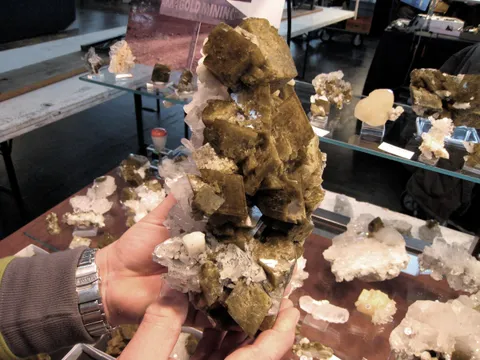
“Fluorite with Quartz from El Hammam, Ait Mimoune, Morocco” — Fabre Minerals Specimen video showing a large El Hammam fluorite group heavily coated by quartz.
“QPJ2090 Fluorite with Pyrite, El Hammam Mine, Morocco” — Crystal Classics Specimen video focused on the classic El Hammam fluorite-pyrite association.
Mindat: El Hammam Mine The central locality record, useful for mineral list, coordinates, alternate labels, paragenesis, and photo references.
Wikimedia Commons: Category El Hammam Mine Open-license specimen photographs showing the range of El Hammam fluorite, pyrite, quartz, and calcite combinations.
USGS 2014 Minerals Yearbook: Morocco and Western Sahara Useful industrial context for SAMINE production, El Hammam capacity, and Morocco’s fluorspar sector.
USGS Fluorspar 2021 Minerals Yearbook Notes the closure of the El Hammam underground fluorspar mine in December 2021 and its historical role in Moroccan fluorspar production.
Atlantic Tin: Achmmach Project Current corporate context for the SAMINE acquisition and proposed use of El Hammam infrastructure in the Achmmach tin project.
Atlantic Tin announcement: Acquisition of SAMINE Primary source for the 2024 SAMINE transaction, 2021 cessation of mining, and continued low-grade fluorspar recovery.
Fabre Minerals Morocco reference specimens: El Hammam fluorite Dealer archive with detailed specimen descriptions, sizes, associations, and UV notes for high-quality El Hammam fluorite.
McDougall Minerals: Morocco Fluorite Update, February 2016 Collector-market note on the unusual yellow fluorite material that appeared from El Hammam around 2015–2016.