






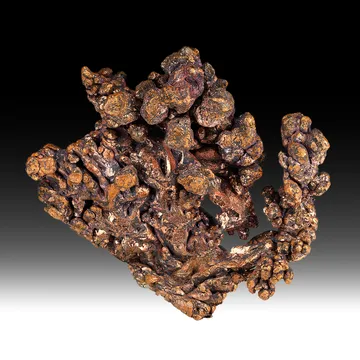
A collector's guide to DR Congo: its geology, mining history and notable minerals, illustrated with the 81 specimens documented from this locality on EarthWonders.
Key facts
The Democratic Republic of the Congo is not one mineral locality in the tidy, single-mine sense; for collectors it is an entire country-sized mineral province whose best specimens come from several very different geological worlds. The most famous is the southern Copperbelt of historical Katanga—now chiefly Haut-Katanga and Lualaba—where the Central African Copperbelt bends through Neoproterozoic rocks of the Katanga Supergroup. There, sediment-hosted copper-cobalt ores have been folded, faulted, oxidized, and reworked into one of the great secondary-mineral theaters on Earth: malachite, chrysocolla, heterogenite, cuprite, dioptase, plancheite, pseudomalachite, cobalt-bearing calcite, uranium minerals, selenium minerals, and a long roll call of type-locality species.
Regional View
Country View
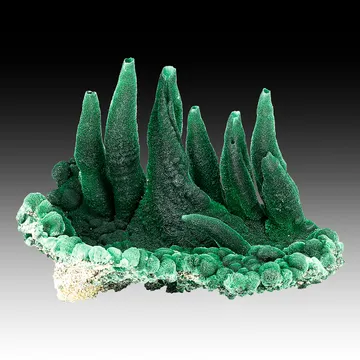
The look of a first-rate Congolese specimen is immediately recognizable. Katanga malachite may appear as velvety stalactites, lustrous primary crystals, rounded botryoidal masses, fibrous sprays, or sharp pseudomorphs after azurite; chrysocolla supplies sky-blue to turquoise contrast; cobalt-bearing calcite brings saturated pink scalenohedra; and dioptase from Tantara and related Copperbelt occurrences flashes deep emerald-green against shattuckite, plancheite, malachite, quartz, or gossan. A different collecting language appears in the Kivu and Tanganyika pegmatite fields, where tourmaline—commonly sold as elbaite when sufficiently characterized—comes from granitic pegmatites associated with the tin-tantalum-niobium belts of eastern and southeastern Congo. A third great chapter is diamond: the Mbuji-Mayi kimberlite field and Kasai alluvials have made the DRC one of Africa’s historic diamond-producing countries, with brown, yellowish, gray, colorless, and industrial stones reaching collections when crystals retain natural octahedral, dodecahedral, or aggregate form.
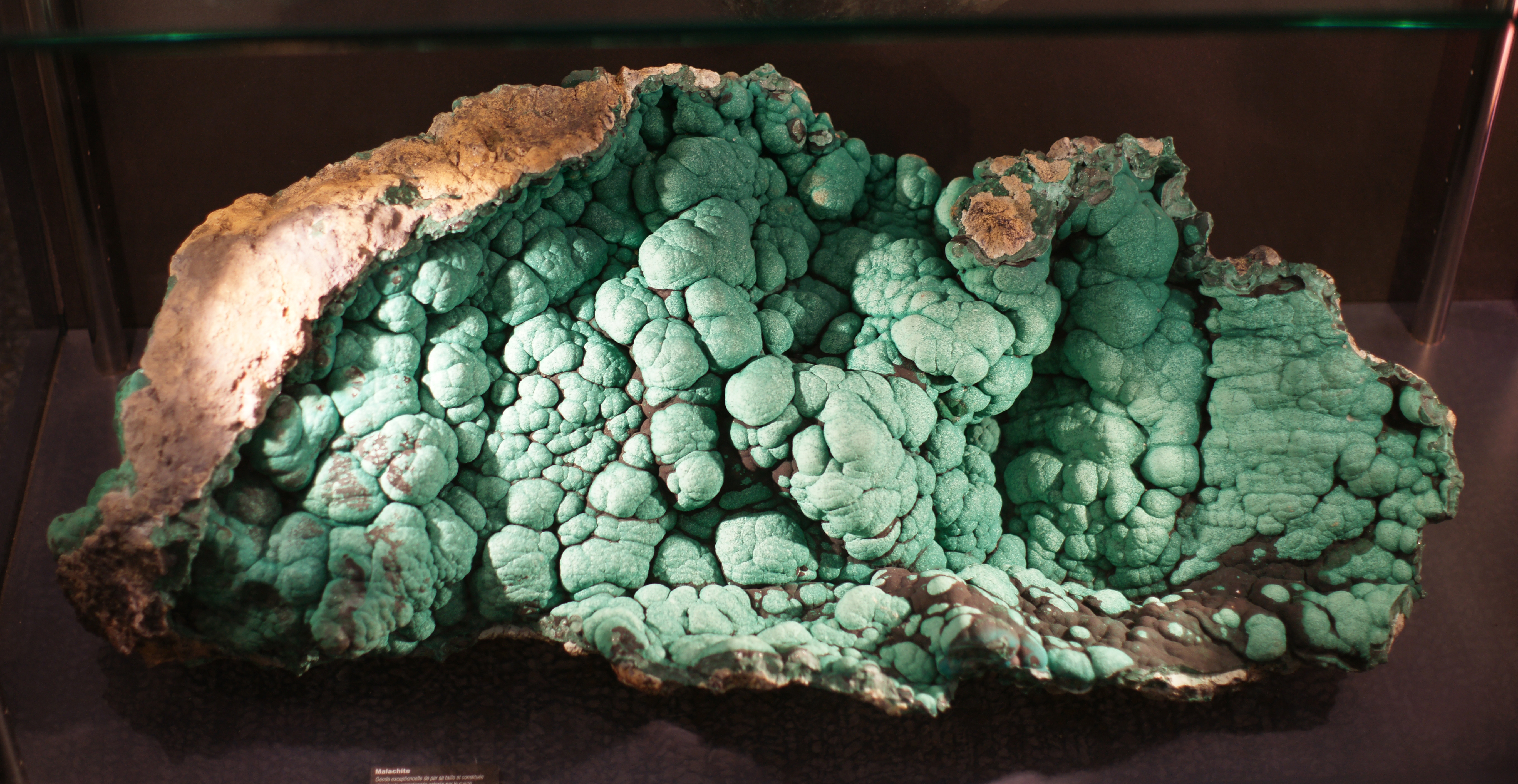
Photo: Wikimedia Commons

Photo: Wikimedia Commons

Photo: Wikimedia Commons
Historically, the country matters to mineral collectors for far more than beauty. Shinkolobwe and Musonoi are among the most important uranium-mineral localities ever worked, both for science and for twentieth-century history. Musonoi is the type locality for selenium-bearing and uranium-bearing rarities such as demesmaekerite, derriksite, guilleminite, marthozite, oosterboschite, kolwezite, and verbeekite. Shinkolobwe is associated with an extraordinary suite of uranium secondary minerals and with the wartime uranium supply that fed the Manhattan Project. Even ordinary “Congo malachite,” when properly localized, can carry the weight of this wider geological and historical context.
Search for specimens: View all specimens from DR Congo
The collector’s “DR Congo” label most often points to the Katanga Copperbelt, a Congolese segment of the Central African Copperbelt stretching through Haut-Katanga and Lualaba from the Lubumbashi–Likasi–Kambove area westward toward Kolwezi. The ore deposits are classic sediment-hosted, stratabound to stratiform copper-cobalt systems developed mainly in Roan Group and related Katanga Supergroup rocks: dolomites, dolomitic shales, siltstones, sandstones, breccias, and carbonate-rich units that were later folded and thrust during the Lufilian orogeny. Primary ore minerals include chalcocite, bornite, chalcopyrite, carrollite, and other sulfides; collectors, however, mostly see the oxidized and supergene products formed where those sulfides were exposed to groundwater and weathering.
In the oxidized zones, copper and cobalt were remobilized into a spectacular secondary assemblage. Malachite and chrysocolla are the broad visual signatures of the district, accompanied at many localities by pseudomalachite, cuprite, azurite, heterogenite, kolwezite, plancheite, dioptase, shattuckite, cobalt-bearing calcite, dolomite, quartz, baryte, and an important suite of uranium minerals where uranium-rich orebodies were involved. The oxidized zone is commonly tens of meters thick and locally extends deeper, which explains why both large industrial open pits and artisanal workings can encounter richly colored specimen pockets.
The great named mines are a collector’s map of Congolese mineral history. L’Etoile du Congo, also called Star of the Congo or Kalukuluku, sits near Lubumbashi and is a classic source of botryoidal and stalactitic malachite, chrysocolla, cuprite, and associated secondary copper minerals. Kambove, Kamfundwa, Shangulowe, Luishia, and the Tantara area around Shinkolobwe belong to the central Copperbelt world near Likasi and Kambove, where dioptase, plancheite, shattuckite, malachite, baryte, and uranium minerals enter the collector picture. Farther west, the Kolwezi district—Mutoshi, Musonoi, Kamoto, Mashamba West, Dikuluwe, and related deposits—has produced some of the most distinctive cabinet specimens from the country: dense velvet malachite, cobalt-pink calcite, blue chrysocolla, cuprite on copper-silicate matrix, and extraordinary radioactive microminerals from uranium-selenium pockets.
The mining history is layered. Preindustrial copper working in Katanga is old, and surface malachite was part of the region’s metallurgical landscape long before European industrial mining. The modern corporate era began under Union Minière du Haut-Katanga in the early twentieth century, with development around the southern, central, and western mining groups. After Congolese independence and subsequent nationalization, Gécamines inherited the former Union Minière operations and became the dominant state mining company. In the late twentieth and early twenty-first centuries, many former Gécamines assets were worked through joint ventures, state-company arrangements, or private operators, while artisanal miners also recovered ore and specimens from dumps, shallow pits, and oxidized zones.
Specimen production has rarely followed the orderly rhythm of a purpose-run specimen mine. Many of the best pieces were saved opportunistically from ore mining, open pits, or artisanal workings. Mashamba West is a prime example: collectors know it for crystallized and pseudomorphic malachite on chrysocolla, for cuprite on blue-green copper silicates, and for the coveted pink cobalt-bearing calcite specimens that entered the market in relatively small quantities from the 1980s onward. Mutoshi and Musonoi are old Kolwezi-area names with deep collector resonance; Mutoshi is strongly associated with old malachite, chrysocolla, heterogenite, and cobalt mineral specimens, while Musonoi is one of the world’s great localities for uranium and selenium rarities. Tantara, near Shinkolobwe, is the proper DR Congo locality behind important dioptase specimens—especially those with shattuckite, plancheite, calcite, malachite, and quartz—though modern market material labeled simply “Congo dioptase” must be checked carefully because similar-looking specimens from the Republic of Congo are routinely confused with the Democratic Republic of the Congo.
The eastern pegmatite localities tell a different story. Tourmaline from the DRC is tied to granitic pegmatites in the Kivus and Tanganyika, within tin-tantalum-niobium-bearing pegmatite belts such as the Kibara and Karagwe-Ankole systems. Documented tourmaline-producing areas include Masisi in North Kivu, especially the Rwangara/Shakubangwa–Rubaya region; Kalehe in South Kivu, including Numbi, Fungamwaka, Kishanga, Chez Madame, and Lumbishi; and Kyoboyi in the Manono area. These are largely artisanal gemstone localities, and fine crystals are pulled between two markets: cutters seeking clean color and collectors seeking intact, terminated, zoned crystals.
Diamond localities are centered in a different geological province, most famously around Mbuji-Mayi in Kasaï-Oriental. The Mbuji-Mayi kimberlite field and nearby alluvial and eluvial deposits have been worked industrially and artisanally, historically through MIBA and associated operations. Collector diamonds from this region are not normally large, flawless display crystals in the Brazilian or South African museum-specimen tradition; they are often brown, yellowish, gray, or colorless crystals, aggregates, macles, and worn alluvial forms valued for locality, natural morphology, and historical context.
Collecting access today is complex. Industrial mines are not collecting grounds, and many sites are active, controlled, dangerous, or legally restricted. Some classic specimens are old-stock material from the Union Minière, Gécamines, museum, or dealer pipeline; some are modern artisanal recoveries; and some are poorly localized exports from regional trading centers. The best buying practice is to prefer labels that name a mine, district, province, and former historical name where relevant—Mashamba West, Mutoshi, Musonoi, Tantara, L’Etoile du Congo, Mbuji-Mayi, Rubaya, Rwangara/Shakubangwa, Numbi—rather than accepting a vague “Congo” label at face value.
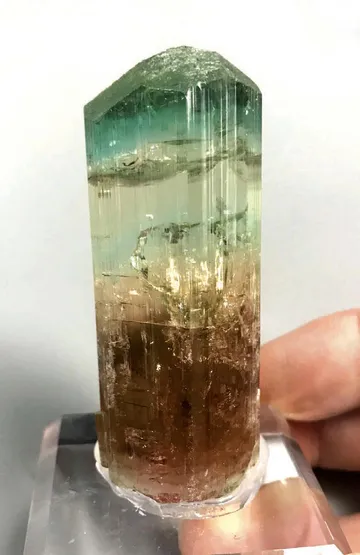
DR Congo tourmaline belongs chiefly to the eastern and southeastern pegmatite story rather than to the Katanga copper-oxide story: documented production comes from granitic pegmatites and related alluvial or eluvial workings in North Kivu, South Kivu, and the Manono–Tanganyika region, with notable modern attention on Rubaya–Rwangara/Shakubangwa in Masisi and the Numbi–Lumbishi field in Kalehe. Collector crystals are generally prismatic, vertically striated, and commonly broken from gem production, but the best pieces show clean terminations, glassy luster, and transparent to translucent color in green, pink, red-pink, yellow-green, blue-green, peach-brown, and bicolored or tricolored zones. Good pieces are separated from ordinary production by integrity: a sharp termination, undamaged prism faces, balanced color zoning, and freedom from the heavy bruising and rehealed fractures common in artisanal gemstone lots. Because much Congolese tourmaline moves through trading centers and may be recorded under evolving site names, precise provenance—Rubaya, Rwangara/Shakubangwa, Numbi, Fungamwaka, Kishanga, Chez Madame, Lumbishi, or Kyoboyi—adds real value.
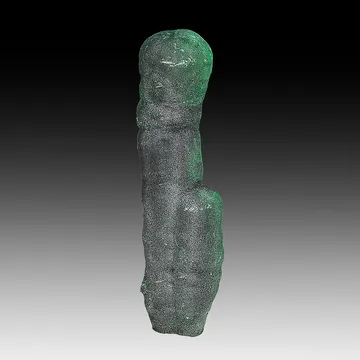
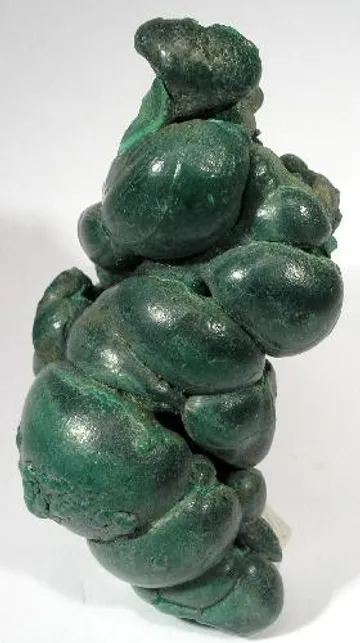
Malachite is the visual emblem of the Congolese Copperbelt, occurring from Lubumbashi through Likasi–Kambove to Kolwezi in nearly every habit a copper collector could want: botryoidal crusts, stalactites, fibrous “velvet” coatings, mammillary masses, sprays of acicular crystals, sharp primary crystals, and pseudomorphs after azurite. L’Etoile du Congo is a classic source of botryoidal and stalactitic material; Mashamba West is prized for crystallized malachite on chrysocolla, malachite after azurite on cobalt-bearing calcite, and sharp green contrast on pink or blue matrix; Mutoshi, Musonoi, Shinkolobwe, Kambove, Shangulowe, Luishia, and related mines all contribute distinctive material. Fine pieces have saturated emerald to deep forest-green color, undamaged velvet surfaces, sculptural stalactitic form, or well-defined crystal faces; ordinary pieces tend to be massive, dull, sawn, polished, or too vaguely localized to carry premium specimen interest. The best Congolese malachite is not simply “green copper carbonate”—it is a direct expression of a world-class copper-cobalt oxidized zone.
Elbaite from DR Congo is the collector-grade lithium tourmaline behind much of the country’s colored tourmaline trade, although many market labels stop at “tourmaline” unless analytical confirmation has been made. The most desirable crystals are gemmy prisms from Kivu pegmatites, especially the Rubaya–Masisi and Numbi–Kalehe producing belts, where pink, red-pink, green, yellow-green, blue-green, and bicolored crystals have circulated through Goma, Numbi, and regional export channels. Habits are typical pegmatitic tourmaline—striated prisms with flat to complex terminations—but collector quality depends heavily on survival: intact crystals with clean termination geometry, transparent windows, and vivid zoning are far scarcer than broken cutting rough. Associations may include quartz, feldspar, mica, cassiterite, coltan-group minerals, microlite, and other pegmatite minerals, but matrix specimens are far less common in trade than loose crystals and fragments. A premium Congolese elbaite should have both a good mineral label and the kind of color architecture that makes the stone desirable even before faceting.
DR Congo dioptase is most securely represented by the Tantara Mine at Shinkolobwe in Haut-Katanga, where old-time specimens show deep emerald-green, lustrous crystals in vugs, commonly with shattuckite, plancheite, calcite, malachite, quartz, or gossan. Tantara crystals are typically smaller than the great Tsumeb dioptases, but excellent pieces have a dense, saturated color, sharp rhombohedral form, glassy luster, and superb blue-green contrast when shattuckite or plancheite is present. Recent material marketed from the Kolwezi-area “Kapata” locality has required caution because locality attribution has been under investigation and may reflect sale locality, concealed source, or confusion with Republic of Congo dioptase rather than a firmly established DR Congo mine. The best Congolese dioptase is therefore judged not only by crystal quality but by documentation: a Tantara, Shinkolobwe, or well-supported Copperbelt provenance matters greatly, especially when many “Congo” labels are geographically ambiguous.
DR Congo diamonds are historically tied to the Kasai region, especially the Mbuji-Mayi kimberlite field and related alluvial and eluvial deposits in Kasaï-Oriental, where industrial and artisanal production made the region one of Africa’s best-known diamond districts. Collector specimens include octahedra, dodecahedral or rounded alluvial forms, macles, aggregates, and irregular crystals, with colors ranging from colorless and pale yellow to brown and dark brown; many examples in collections are valued more for natural morphology and locality than for gem clarity. The strongest pieces retain recognizable crystal faces, growth markings, trigons, or natural luster, while heavily abraded industrial stones and undocumented parcels lose much of their specimen appeal. Mbuji-Mayi material may be associated geologically with Late Cretaceous kimberlite pipes, but many diamonds are vastly older than their host kimberlite, having been carried upward from mantle depths and later redistributed into secondary deposits. Provenance is especially important because DRC diamond production has long moved through complicated formal and informal channels.
Calcite from DR Congo is most collectible when cobalt enters the picture, producing the famous pink to rose cobalt-bearing calcite specimens from Kolwezi-area copper-cobalt deposits, especially Mashamba West. These specimens commonly form scalenohedra, rhombohedra, drusy coatings, or stacked generations of crystals, with color ranging from pale bubblegum pink to intense saturated magenta-rose; associations with malachite, chrysocolla, dolomite, kolwezite, heterogenite, and older white calcite generations give the best pieces their contrast. Mashamba West examples from the 1980s and later small finds are particularly sought after because fine crystallized material was never abundant, and many market pieces are small cabinet or miniature specimens rather than large display plates. Good Congolese cobalt-bearing calcite should show strong natural color, sharp crystal form, minimal bruising on terminations, and attractive association with green malachite or blue chrysocolla; dull pink massive carbonate or dyed lookalikes are not in the same collecting class.
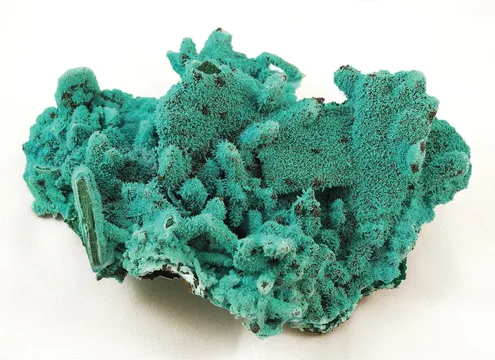
Chrysocolla is one of the great color partners of Congolese malachite, especially in the oxidized copper-cobalt deposits of Katanga where it forms turquoise to sky-blue crusts, botryoidal coatings, vein fillings, massive seams, and silica-rich replacements. Mashamba West, Mutoshi, L’Etoile du Congo, Tenke-Fungurume, Musonoi, and other Copperbelt localities have supplied chrysocolla in association with malachite, cuprite, heterogenite, calcite, kolwezite, quartz, and cobalt-bearing minerals. The most desirable examples use chrysocolla as architecture rather than background: blue botryoids with sharp green malachite crystals, cuprite crystals embedded on or in blue copper silicate, or vivid turquoise fields that set off pink cobalt-bearing calcite. Massive polished chrysocolla is common in decorative trade, but serious specimen value rises sharply when the surface is natural, the locality is specific, the color is saturated, and the piece preserves a mineral association rather than a lapidary slab.
Beyond these seven species, DR Congo is one of the world’s outstanding countries for type-locality rarities. Musonoi alone is the type locality for demesmaekerite, derriksite, guilleminite, kolwezite, marthozite, oosterboschite, and verbeekite, many of them uranium-, selenium-, copper-, cobalt-, or palladium-bearing species of intense interest to systematic collectors. Shinkolobwe is a historic type locality for numerous uranium secondary minerals, including becquerelite, billietite, curite, parsonsite, paraschoepite, and several later-described uranium species. The broader Copperbelt also yields carrollite, heterogenite, cuprosklodowskite, sklodowskite, kasolite, uranophane, torbernite, metatorbernite, vandenbrandeite, soddyite, sengierite, baryte, dolomite, azurite, cuprite, plancheite, shattuckite, pseudomalachite, and many other species that make precise locality attribution far more rewarding than a generic country label.
The first authenticity issue with DR Congo specimens is locality ambiguity. “Congo” can mean the Democratic Republic of the Congo or the Republic of Congo, and this matters especially for dioptase, plancheite, and some copper-silicate specimens. Republic of Congo localities such as Mindouli, Renéville, and Kimbedi have produced famous dioptase and plancheite specimens, but they are not DR Congo. A label reading only “Congo” should not be upgraded mentally to Katanga, Tantara, or Shinkolobwe without supporting evidence.
The second issue is overbroad Katanga labeling. The old province name “Katanga” remains useful historically, but modern labels should ideally specify Haut-Katanga or Lualaba and name the mine or district. “Katanga malachite” may be perfectly honest for older material, yet a specimen from Mashamba West, Mutoshi, Musonoi, L’Etoile du Congo, Shangulowe, or Tantara carries more information—and often more value—than a specimen labeled only “Katanga, Congo.”
Tourmaline provenance is also tricky. In the Kivus, material has moved through Goma, Numbi, Bukavu, and cross-border trading channels; site names around Numbi and Rwangara/Shakubangwa have changed as workings shifted; and official records have at times used broad or confusing names. For collector elbaite, ask whether the label is a true mine-site attribution, a trading-center attribution, or simply the exporter’s best understanding.
Malachite from Congo is widely imitated in the decorative and tourist market. Watch for resin-bound fragments, dyed or impregnated massive malachite, reconstructed “stalactites,” polished slices sold as natural display specimens, and artificial-looking velvety coatings on unrelated matrix. Natural Congolese malachite commonly shows fibrous, botryoidal, stalactitic, or crystalline growth with believable attachment and association; suspicious specimens may show uniform neon color, glue lines, repeated shapes, unnatural bases, or powdery surfaces that do not match the matrix.
Condition matters. Fibrous malachite bruises and polishes easily; velvet surfaces flatten under rubbing; chrysocolla can be porous and fragile; dioptase has perfect cleavage and is unforgiving of knocks; cobalt-bearing calcite terminations chip readily; cuprite may dull if poorly handled; and radioactive uranium minerals from Musonoi and Shinkolobwe require knowledgeable storage, labeling, and handling. Uranium specimens should be kept away from living spaces, food preparation areas, and children, stored with ventilation appropriate to radon considerations, and handled with basic contamination discipline—do not grind, cut, lick, wash aggressively, or leave loose crumbs in trays.
Fluorescence is not the main selling point of most Katanga copper specimens, but diamond may fluoresce variably, and uranium minerals can be visually reactive under ultraviolet light depending on species. Calcite may fluoresce in some examples, though cobalt-bearing color is far more important to collectors than UV response. For diamonds, natural crystal form, surface features, and provenance are usually more meaningful than fluorescence unless the specimen is being evaluated gemologically.
Market availability is broad but uneven. Common malachite and chrysocolla are abundant; fine old labeled malachite, crystallized primary malachite, and aesthetic malachite after azurite are much scarcer. Good Mashamba West cobalt-bearing calcite remains in demand and is not produced in large quantities. Tantara dioptase with strong documentation is significantly scarcer than generic “Congo dioptase.” Fine Congolese elbaite appears periodically but competes with the gem trade and may be poorly localized. Musonoi and Shinkolobwe uranium rarities are specialized, often small, sometimes expensive, and increasingly dependent on old collections.
The most famous Congolese mineral story begins not with a cabinet specimen but with ore so rich that it changed world history. Shinkolobwe, in the Haut-Katanga copper-uranium district, was known first as a mining locality and later as one of the critical uranium sources for the Manhattan Project. In 1940, as the European war widened and German control of strategic materials became a real fear, Edgar Sengier of Union Minière du Haut-Katanga arranged for roughly 1,200 tons of high-grade Shinkolobwe uranium ore to be shipped out of Africa and stored in steel drums in a warehouse on Staten Island. The details read like a spy novel because they were, in effect, wartime resource intelligence: ore from a remote Katanga mine, moved through Angola, sitting near New York Harbor before the United States had fully mobilized its atomic program. When American procurement officers later needed high-grade uranium quickly, part of the answer was already in New York.
Shinkolobwe also sits at the uncomfortable intersection of mineralogy and geopolitics. To collectors, the mine means curite, becquerelite, billietite, parsonsite, cuprosklodowskite, torbernite, uranophane, kasolite, and many more secondary uranium species. To historians, it means the raw material behind the atomic age. To Congolese miners, it was also a dangerous mineral landscape—radioactive, politically controlled, and repeatedly entered by artisanal diggers long after formal closure. This dual identity gives old Shinkolobwe specimens a particular gravity: a small yellow or orange crust on matrix may be both a mineralogical rarity and a fragment of one of the twentieth century’s most consequential ore bodies.
The eastern tourmaline fields have a very different kind of drama. In the Masisi highlands of North Kivu, researchers documented the Rwangara/Shakubangwa tourmaline rush that local people called “the Boom.” Around September 2014, the site reportedly held about 400 to 700 artisanal workers and as many as 3,000 to 4,000 dependants, with hundreds more involved in local stone trading. The mine had no road access. From Ngungu, the route involved a motorbike ride to Luzirantaka and then a long walk toward the hilltop workings; bags of sand were brought down to the Luzirantaka River, where washer women recovered stones below the site. In that setting, a terminated pink or green crystal was not merely a collector object—it was a day’s hope, a trader’s gamble, and sometimes a contested piece of wealth.
The same field notes capture how quickly a gemstone rush can rise and fade. During the Rwangara/Shakubangwa boom, miners followed the tourmaline as the 3T market slowed and prices for colored stones climbed. Later, production fell as worker numbers dropped and the cooperative tried to move away from shaft mining toward more open-pit methods. Some better stones shown to visitors were predominantly green or pink, with a few bicolors, but local informants said that “tops” had become scarce. That word—short, trade-specific, and brutally practical—marks the difference between ordinary material and the crystals that cause miners, traders, cutters, and collectors to lean in.
South Kivu’s Numbi–Lumbishi tourmaline country gives another vivid picture of specimen origins. Numbi sat within walking distance of several producing sites—Fungamwaka I, Fungamwaka II, Kishanga, Chez Madame—and Lumbishi lay farther along the valley. Tourmaline around Numbi had reportedly been exploited since about 2000, with Chez Madame remembered as the oldest source. By the time later workings advanced, Kishanga had become the more productive area, drawing miners away from the older ground. On one field visit, observers estimated roughly 150 to 180 miners at Kishanga, about 60 to 70 people at Fungamwaka II, only about 20 miners still working at Chez Madame, and 100 to 120 artisanal workers digging and washing along the Lumbishi river area that afternoon. Those numbers explain why loose Congolese tourmaline crystals can appear suddenly in the market, then vanish or degrade in quality just as quickly.
There is also an old-time collecting story hidden in a dioptase photograph. A Tantara Mine specimen of dioptase with shattuckite, later photographed from the Philadelphia Academy of Sciences collection, was recorded as having been collected by Samuel Gordon on the Fourth Vaux-Academy Mineralogical Expedition in 1929–1930. The piece is a classic: dark emerald-green dioptase crystals lining vugs in gossan almost covered by sky-blue shattuckite. In modern terms it is a cabinet specimen; in historical terms it is evidence that serious institutional collectors were already reaching deep into the mineral wealth of the Belgian Congo nearly a century ago. The best Tantara specimens still carry that aura of old labels, expedition history, and a locality overshadowed by Shinkolobwe’s uranium fame.


_(17986218061).jpg)