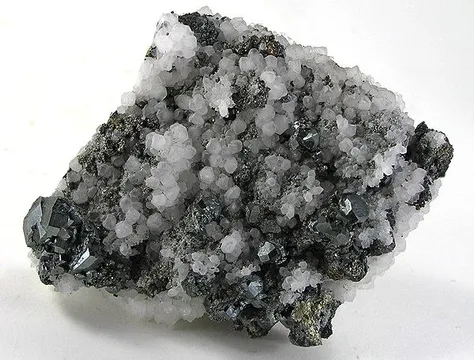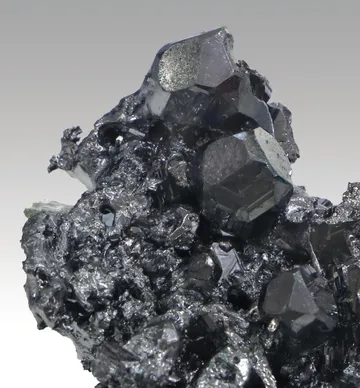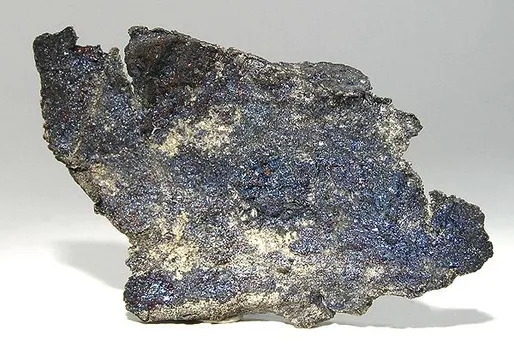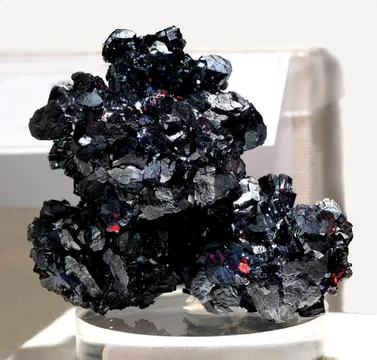
Concepción del Oro, Mexico — copper district in Zacatecas yielding vivid azurite and malachite, quartz-lined vugs and pyrite; prized locality for collectors.
Key facts
Concepción del Oro is one of the great old copper districts of northern Mexico and, for collectors, a classic source of vivid secondary copper minerals from a hard, skarn-dominated ore environment. The locality sits in northeastern Zacatecas, near the Coahuila border, where folded Jurassic and Cretaceous carbonate and calcareous sedimentary rocks of the Sierra Madre Oriental were intruded by Eocene granodioritic to quartz-monzonitic bodies. The result is a copper-gold-silver skarn and carbonate-replacement district whose specimen reputation rests above all on lustrous blue azurite, sparkling malachite, quartz-lined cavities, pyrite, calcite, chalcopyrite, and old tennantite-tetrahedrite-group pieces from mines such as El Cobre, Aranzazú, Arroyos Azules, Cabrestante, Socabón, Bonanza, and related workings around the town.
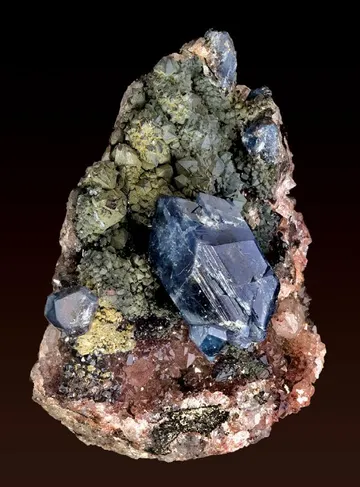
The best Concepción del Oro specimens are instantly recognizable: deep azure-blue azurite blades and rosettes on green malachite, often against pale quartz or limonitic gossan; botryoidal malachite lining quartz vugs; mirror-bright pyrite cubes; and metallic gray tennantite crystals set off by white quartz. The azurites are not usually huge by modern Milpillas standards, but they have a taut, electric color and old-Mexico pedigree that serious collectors prize. Many of the famous pieces entered collections from finds made in the 1950s through the 1970s, with a later 1986 pocket represented by a few celebrated rosette specimens.
Regional View
Country View
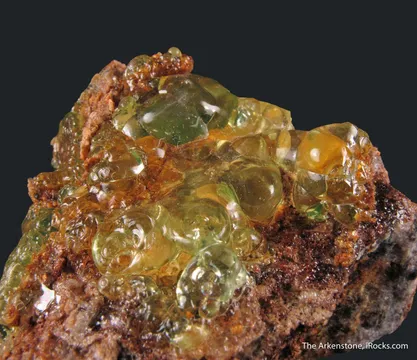
The district is more than a specimen locality. It was also the subject of important economic-geology work because its ores show the transition from intrusive-centered copper skarn and porphyry-style mineralization outward into zinc-lead-silver replacement bodies. In practical collecting terms, that means specimens from Concepción del Oro may look very different depending on where they came from: oxidized copper-carbonate vugs at El Cobre and Aranzazú; sulphide-rich skarn pieces with chalcopyrite, pyrite, arsenopyrite, and tennantite; distal lead-zinc-silver assemblages; or phosphate- and arsenate-bearing oxidized pockets such as scorodite, olivenite, conichalcite, mixite, and related rarities.

Photo: Wikimedia Commons

Photo: Wikimedia Commons
Search for specimens: View all specimens from Concepción del Oro, Mexico
Concepción del Oro lies in the eastern part of the Mexican silver-lead-zinc-copper belt, in a structurally complex part of the Sierra Madre Oriental where Laramide folding, faulting, and intrusive activity focused mineralization along receptive carbonate horizons. The principal host in the Aranzazú–El Cobre area is the Jurassic Zuloaga limestone, with La Caja Formation and Cretaceous units contributing calcareous and shale-rich beds that were locally marbleized, hornfelsed, or converted to skarn. Eocene granodioritic and quartz-monzonitic intrusions drove contact metamorphism and metasomatism; garnet-pyroxene skarn, hornfels, marble, intrusive contacts, faults, and replacement zones all play roles in the ore geometry.
The specimen-producing environment is the oxidized and partly supergene-modified upper part of a copper-rich skarn system. Near surface and in shallow mine levels, primary chalcopyrite, bornite, tennantite-tetrahedrite-group minerals, pyrite, arsenopyrite, sphalerite, and galena were altered to colorful copper carbonates, copper arsenates, iron oxides, and quartz-lined cavities. Below the oxidized levels, the mine geology becomes much more sulphide-rich: chalcopyrite is the principal copper ore mineral, with bornite, chalcocite, enargite, pyrite, and minor tennantite in different zones. The modern Aranzazú operation recognizes copper-gold-silver skarn lenses and deeper mineralized zones such as Glory Hole, Mexicana, BW, and Arroyos Azules, but the classic collector pieces overwhelmingly reflect older openings, oxidized pockets, and historic mine dumps or saved mine-run material rather than present-day specimen mining.
Historically the district reaches back into the earliest Spanish mining of north-central Mexico. Silver was worked first in the broader Mazapil–Concepción del Oro area, gold was known near the present town by the late sixteenth century, and the town itself is traditionally dated to 1587. The big industrial step came in 1889, when the Mazapil Copper Company consolidated old mines and developed the district on a much larger scale. Operations began in 1891 and continued under Mazapil Copper until 1962, after which ASARCO operated the mines until Mexican nationalization in 1982. Fomento Minero controlled the property through the 1980s, Macocozac operated from 1989 to 1998, mining ceased in 1999, and the property later passed through joint-venture and option arrangements before Aura Minerals acquired it in 2008. Aura resumed production in 2011, suspended operations in 2015 during a weak-price period, and restarted full production in 2018.
The old mine names matter on labels. “Concepción del Oro” may be a town-level locality, a district label, or shorthand for one of several individual mines. El Cobre, Aranzazú, Arroyos Azules, Cabrestante, Socabón, Bonanza, Perla, Cata Arroyo, and Albarradón have all appeared on labels or in locality databases, and old collection labels may use Spanish accents inconsistently or omit the mine entirely. El Cobre and Aranzazú are especially important for azurite, malachite, quartz, tennantite, pyrite, and related copper minerals; Cabrestante is important for scorodite and sulphide-quartz material; Albarradón, in the municipality, is historically notable as the type locality for iodargyrite.
Collecting access today should be approached as closed or highly restricted unless explicit permission is obtained. Aranzazú is an active industrial underground mine with formal concessions, surface rights, pits, underground workings, tailings facilities, and operating infrastructure. Historic mine workings are dangerous, and the district includes both active and abandoned openings, unstable stopes, old shafts, and privately or corporately controlled ground. Most specimen material now circulating is old collection material, dealer stock, auction material, or pieces recovered decades ago from oxidized pockets and dumps. Good old labels are therefore a significant part of a specimen’s value.
The most admired finds include the mid-twentieth-century azurite-malachite pockets, the larger and richer old azurites with gemmy blue crystals on botryoidal malachite, tennantite crystals on white quartz from El Cobre, and malachite-quartz vugs in which green needles or botryoidal crusts sparkle against iron-oxide-coated quartz. A later 1986 find by Jimmy Vacek produced rosette-like azurite aggregates of exceptional color and definition; a documented 6.1 × 4.7 × 3.9 cm floater from that find is considered among the best known specimens from the locality.
Azurite is the signature collector mineral of Concepción del Oro, especially from El Cobre–Aranzazú oxidized copper zones, where it occurs as dark to electric-blue blades, sharp prismatic crystals, crystal sprays, rosettes, and small gemmy groups on malachite, quartz, limonite, goethite, and occasionally calcite or olivenite-bearing matrix; individual crystals are commonly only a few millimeters, with better old pieces showing transparent blue crystals from about 5–8 mm, exceptional crystals exceeding 1 cm, and rare historical reports of much larger blades. The most desirable pieces combine saturated color, undamaged terminations, transparency under strong light, and contrast against green botryoidal malachite or pale quartz; ordinary examples are more granular, crushed, heavily altered to malachite, or visually lost in dark limonitic matrix.
Quartz at Concepción del Oro is chiefly a gangue and pocket mineral, but it is crucial to the look of many specimens: small clear to white crystals line vugs with malachite, azurite, pyrite, tennantite, scorodite, and iron oxides, while botryoidal chalcedony and iron-oxide-coated quartz form sculptural bases for green malachite sprays. Fine quartz specimens from the district are seldom judged as standalone crystal groups; their value comes from clean, bright quartz providing contrast, open vug architecture, and undamaged terminations that frame the copper minerals or sulphosalts rather than smother them.
Malachite from Concepción del Oro appears as velvety to sparkling botryoidal crusts, sprays of slender emerald needles, lenticular microcrystals, and pseudomorphs after azurite blades, most commonly with azurite, quartz, chalcedony, limonite, and calcite in oxidized copper pockets. The best specimens are not merely green coatings: they show distinct crystal habit, textural sparkle, two-tone green zoning, crisp pseudomorph outlines, or rich botryoidal malachite supporting gemmy azurite; lesser pieces are powdery, abraded, dull, or dominated by brown iron oxide without strong color contrast.
Pyrite is abundant in the Concepción del Oro skarn system and occurs both as ore-stage sulphide and as collector-quality crystals, including bright interlocked cubes, pyrite on quartz, and pyrite associated with calcite, galena, chalcopyrite, tennantite-group minerals, and arsenopyrite. The best collector pyrites from the town-level locality show mirror-bright cubic crystals, sharp edges, and compact “cityscape” groups around thumbnail to miniature size, whereas sulphide ore pieces with dull, massive pyrite or oxidized surfaces are far more common and have less specimen appeal unless accompanied by quartz, calcite, or unusual sulphosalts.
Calcite occurs in the carbonate-replacement and skarn environment as vein, druse, and matrix material, and collector specimens from Concepción del Oro include calcite with malachite, quartz, pyrite, galena, cuprite, native copper, and locally pink manganese-bearing calcite. Good pieces depend on contrast and condition: bright calcite crystals hosting or contrasting with green malachite, sulphides, or copper oxides are far more desirable than ordinary massive carbonate, and the best examples preserve crisp crystal faces without the bruising, cleaving, or acid etching common in mine-run carbonate specimens.
Chalcopyrite is the principal primary copper ore mineral in the Aranzazú–Concepción del Oro system, present in sulphide-rich skarn lenses with pyrite, bornite, chalcocite, enargite, tennantite-tetrahedrite-group minerals, quartz, garnet, and pyroxene, and it is the parent mineral behind much of the oxidized azurite-malachite specimen suite. As a collector mineral here it is usually valued in context rather than as large freestanding crystals: attractive examples show brassy chalcopyrite disseminations or crystal faces in quartz-pyrite skarn, while ore fragments are common and less collectible unless they display clear associations, structural replacement textures, or evidence of the primary-to-supergene transition.
Tennantite and tennantite-subgroup specimens from El Cobre are among the district’s most important sulphosalt pieces, typically appearing as metallic gray to dark gray crystals on white quartz, sometimes with pyrite and locally with baryte or green secondary copper minerals; documented specimens show sharp crystals around 1–2 cm, and exceptional old pieces are large, rich plates of tennantite with many lustrous faces. The best examples are those with well-defined tetrahedral or modified tetrahedral forms, bright metallic luster, balanced quartz contrast, and old provenance; massive gray sulphosalt without crystal definition is far less desirable and may require analytical confirmation because tetrahedrite-group minerals are visually difficult to separate.
Other documented minerals from Concepción del Oro and its sublocalities make the district much richer than an azurite locality alone: andradite and grossular record the skarn; arsenopyrite, bornite, bournonite, chalcopyrite, emplectite, galena, sphalerite, pyrite, jamesonite, and tennantite-tetrahedrite-group minerals record the sulphide and sulphosalt stages; and brochantite, chrysocolla, conichalcite, cuprite, goethite, hematite, mimetite, mixite, native copper, olivenite, plancheite, scorodite, spangolite, tenorite, turquoise, and stolzite occur in oxidized assemblages. Cabrestante scorodite is especially notable, with documented world-class-quality material, and Albarradón in the Concepción del Oro municipality is the type locality for iodargyrite, AgI. Mindat flags “spherocobaltite” as erroneous and “marcasite” as questioned for the town-level locality, so those names deserve caution on labels unless supported by analysis.
The most common locality problem is not outright fakery but imprecise labeling. “Concepción del Oro” is often used for the town, the municipality, and the broader district, while better labels may specify El Cobre, Aranzazú, Cobre Mine, Arroyos Azules, Cabrestante, Socabón, Bonanza, Cata Arroyo, or another working. Older labels may also read “Concepcion del Oro” without accents, “El Cobre Mine,” “Cobre Mine,” or simply “Zacatecas.” For high-end azurite-malachite and tennantite specimens, mine-level provenance and older collection history add real value.
No widely recognized wave of locality-specific fabricated Concepción del Oro specimens is a standard concern in the market, but treatments and misattributions should still be watched. Deep-blue azurite on green malachite from Mexico is sometimes loosely sold as “Milpillas,” “Zacatecas,” or “Concepción del Oro” based on appearance alone; Concepción del Oro azurites tend to be older, often smaller, more bladed or rosette-like, and commonly associated with malachite, quartz, limonite, goethite, and oxidized skarn matrix rather than the large, glassy, modern Milpillas aesthetic. Tennantite versus tetrahedrite subgroup identifications should be treated cautiously without analysis, and arsenate minerals such as olivenite, conichalcite, mixite, and scorodite can be visually deceptive at thumbnail scale.
Condition is critical. Azurite blades chip along edges and terminations, and even a small contact can ruin the visual impact of a specimen whose value rests on a few vivid crystals. Malachite sprays and velvety botryoidal surfaces abrade easily. Quartz-lined cavities can conceal broken azurite tips, while limonitic matrix sheds dust and may stain labels or boxes. Calcite is soft, cleaves readily, and should never be cleaned with acids if it is associated with copper carbonates. Avoid ultrasonic cleaning for azurite, malachite, and delicate vug specimens.
Handling is straightforward but should be thoughtful. Azurite and malachite are copper minerals and should not be ingested, soaked, or handled roughly; tennantite, olivenite, conichalcite, mixite, and scorodite contain arsenic and are best treated as display specimens, not cutting material. Wash hands after handling arsenate- or sulphosalt-rich pieces, keep friable material boxed, and avoid producing dust. Display azurite away from prolonged strong sunlight, high humidity swings, and acidic vapors; old labels and provenance should be stored separately or protected in archival sleeves.
Market availability is uneven. Small azurite-malachite pieces and malachite-quartz specimens appear periodically, but high-quality old azurites with bright gemmy crystals, good malachite contrast, and clean condition are scarce. Tennantite on quartz from El Cobre is much less common than azurite and is pursued by both Mexican-mineral specialists and sulphosalt collectors. Pyrite, calcite, and quartz pieces are more obtainable, but truly aesthetic examples with sharp crystals and reliable Concepción del Oro provenance remain selective rather than abundant.
The district’s history begins in the rough frontier setting of sixteenth-century northern Mexico, when the Spanish push into Zacatecas followed the lure of silver and gold into country that was still remote, contested, and difficult to supply. One historical account places the discovery of the Concepción del Oro mining district with Francisco de Urdiñola, one of Cortés’ captains and later Marquis of Aguayo, who is said to have worked native silver from exposed upper parts of zinc-lead-silver deposits. Mazapil, about 21 km from Concepción del Oro, was founded in 1568, and by 1569 it reportedly had about 150 Spanish inhabitants. The town of Concepción del Oro is traditionally placed in 1587, with gold known near the present site by the end of the sixteenth century.
By 1905 the district was no longer a frontier camp but an industrial copper center. J. R. Southworth’s period description, quoted in later technical reporting, gives the scale in the language of the day: the mines were producing monthly about 6,000 to 7,000 tons of copper ore, 2,500 to 4,000 tons of silver and silver-lead ores, and 2,500 tons of flux ores. The Concepción del Oro copper smelter was said to have a capacity of 15,000 tons per month, and the copper ore moved to it by aerial tramways, while silver-lead ores came by rail from the San Pedro camp. Eight mine groups were named under Mazapil Copper Company control: Aranzazú for copper; Cabrestante for copper; Promontorio for fluxes; San Eligio for lead; Naranjoia for silver; Cajon for lead; San Francisco for lead; and El Potrero for lead. For a collector holding a small azurite or tennantite today, those names explain why so many old labels are confusing: the specimen locality was part of an integrated industrial district, not a single romantic hole in the ground.
The mineral-story highlight is the old azurite production. Fine blue crystals from Concepción del Oro were entering the United States by the early 1950s, and classic descriptions emphasize distinctive, transparent, sword-like crystals on limonite, most often small but occasionally far larger. The best pieces became Mexican classics because they did not rely on size alone: they combined saturated blue, sharp form, green malachite, and high-contrast matrix. Later, in 1986, Jimmy Vacek recovered a small number of exceptional azurite rosette specimens. One documented floater from that find, 6.1 × 4.7 × 3.9 cm, has rosette growths with sharply defined azurite crystals and vivid color, and is repeatedly cited by dealers as among the finest known pieces from the locality.
Modern Concepción del Oro is still a mining town, not a frozen historic district. Aranzazú is an active underground copper-gold-silver operation on the western edge of town, and the old mining connection is embedded in the local workforce and families. That living-mining context cuts both ways for collectors: it keeps the district geologically important and well documented, but it also means old workings, dumps, and access roads are not casual collecting grounds. The best modern “field note” for a collector is therefore conservative: treat every specimen with an old label as historical evidence, and treat the mine area itself as active industrial property unless permission is explicit.