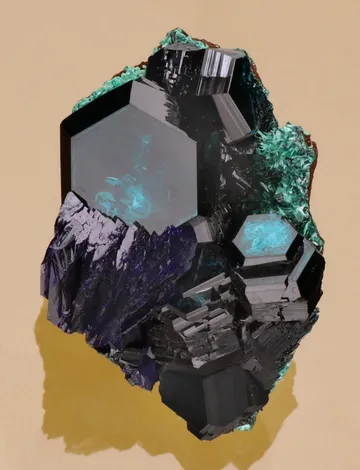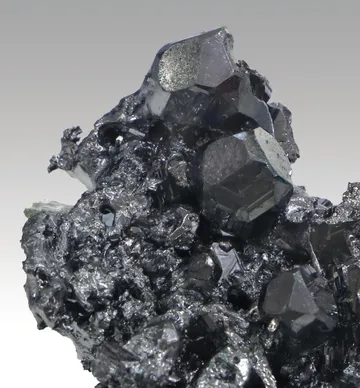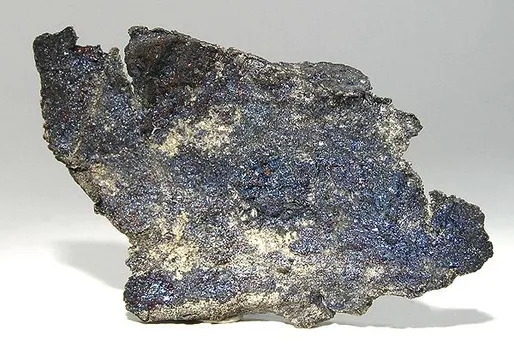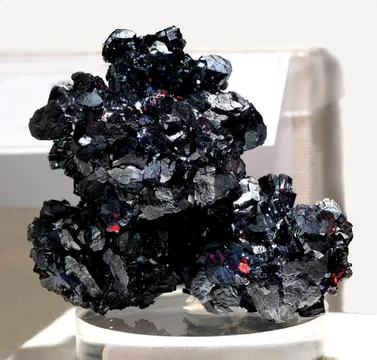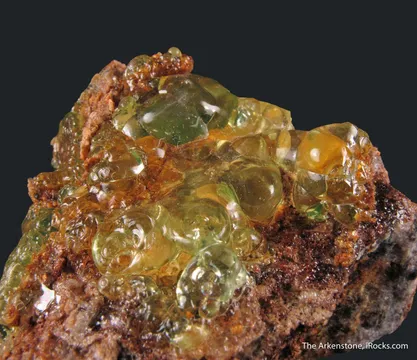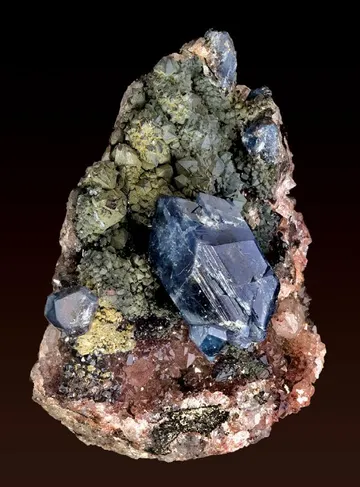
Aranzazú Mine, Mexico — copper-skarn locality in Zacatecas, yielding tennantite, azurite, malachite, and copper-sulfide crystals prized by collectors.
Key facts
Aranzazú is one of the great copper localities of northern Zacatecas, and for collectors it occupies a different place from Mexico’s more familiar silver-vein and oxide-zone showpieces. The mine is part of the Concepción del Oro district near the Zacatecas–Coahuila line, where Jurassic and Cretaceous carbonate rocks were intruded by Eocene quartz monzonitic to granodioritic bodies and converted into a copper-gold-silver skarn system. That setting matters in the hand: the locality’s classic specimens are not delicate low-temperature vein miniatures, but dense, sharply contrasted pieces born of skarn, sulfide, and oxidation. The best old Aranzazú—often labeled El Cobre Mine, Cobre Mine, or Arroyos Azules Mine—combines metallic gray-black tennantite-subgroup crystals, bright white quartz, pyrite, chalcopyrite, sphalerite, and in the oxidized zone vivid azurite, malachite, chrysocolla, olivenite, plancheite, and spangolite.
Historically, the broader Concepción del Oro district has been worked since the Spanish colonial period, with documented mining activity from the mid-16th century and a long industrial phase under Mazapil Copper, ASARCO, Mexican federal ownership, Macocozac, and Aura Minerals. Aranzazú’s specimen identity is older than its present corporate name: collectors still encounter labels from “El Cobre,” “Cobre Mine,” “Concepción del Oro,” or “Arroyos Azules,” and those labels often represent the same productive copper-skarn system now grouped under Aranzazú. Its best tennantites are among the finest crystallized examples from Mexico: modified, steel-gray to black, metallic crystals sitting on milky quartz plates, often with enough three-dimensional relief and contrast to stand out immediately in a cabinet of Mexican classics.
Regional View
Country View
In geological terms, Aranzazú is a skarn-porphyry hybrid with collector consequences. Prograde garnet-pyroxene skarn formed where intrusive rocks met limestones and marls; later retrograde and porphyry-style alteration introduced amphibole, magnetite, epidote, quartz, calcite, chlorite, pyrite, chalcopyrite, bornite, chalcocite, enargite, tennantite-tetrahedrite-group minerals, and subordinate lead-zinc-silver phases. Near-surface oxidation produced the color suite—azurite rosettes and blades, malachite replacements and sprays, chrysocolla, and rarer copper arsenates, silicates, sulfates, and oxides—that gives the locality a second collecting personality beyond the black-on-white tennantite classics.
Search for specimens: View all specimens from Aranzazú Mine, Mexico
Aranzazú lies in the municipality of Concepción del Oro, Zacatecas, a rugged mining district only a few kilometers from the town of Concepción del Oro and close to the northern state boundary with Coahuila. Modern mine coordinates place the Aranzazú mine area around 24°37' north latitude and 101°27' west longitude. The property is reached from Zacatecas by the highway system toward Fresnillo and Highway 54, or from Saltillo to the northeast; the mine area sits only a short distance from the paved road system serving Concepción del Oro, Mazapil, and neighboring mines.
The deposit is a copper-gold-silver skarn formed where Eocene intrusive rocks—described in company technical work as quartz monzonite to granodiorite and related porphyry phases—cut a thick Mesozoic carbonate and clastic sequence. The important host rocks include the Jurassic Zuloaga Formation, with fossiliferous limestones, and the La Caja Formation, with thin-bedded marls and limestones; Cretaceous Taraises, Cupido, La Peña, and Cuesta del Cura units also form part of the district stratigraphy. Contact metamorphism converted limestones and clastic rocks to marble and hornfels, while metasomatism produced endoskarn and exoskarn along the intrusion-carbonate contacts.
Structurally, Aranzazú is controlled by the La Caja anticline and by fault and fracture systems related to the Concepción del Oro block. The anticline trends roughly northwest-southeast and was strongly modified by magma emplacement, giving the deposit its complicated geometry. Modern technical descriptions identify the mineralization as extending about 1.5 km along strike, up to 250 m across strike, and to depths approaching 850 m. The current resource model divides the ore into multiple domains, including Glory Hole footwall and hanging-wall zones, Mexicana zones, BW, Cabrestante, Arroyos Azules, Esperanzas, La Caja, and connecting bodies.
The paragenesis explains the collector mineralogy. Early contact metamorphism formed marble and hornfels; prograde skarn introduced garnet and pyroxene; retrograde alteration brought amphibole, magnetite, specular hematite, mushketovite, epidote, vesuvianite, quartz, calcite, and chlorite; and the economically important sulfide stage introduced copper, gold, and silver mineralization. Copper minerals vary by alteration style: chalcopyrite and covellite are noted in propylitic zones, while potassic zones may carry chalcocite, copper sulfosalts, chalcopyrite, and bornite. Arsenic-bearing copper minerals such as enargite and tennantite are important enough in the ore that modern metallurgical work treats arsenic as a concentrate-quality issue.
Near the old surface, sulfides were oxidized for tens of meters below the pre-mine land surface. Semi-massive pyrite-rich retrograde skarn became limonitic gossan, and supergene solutions produced secondary copper minerals while also enriching some retrograde skarn ore with chalcocite replacing chalcopyrite and tennantite-tetrahedrite. This oxidized cap is the logical source of the old azurite, malachite, chrysocolla, plancheite, olivenite, spangolite, tenorite, goethite, and native copper specimens long associated with El Cobre and Aranzazú labels.
The mine’s production history is unusually long. The district’s earliest documented mining dates to 1546, although the modern Aranzazú-El Cobre story becomes clearer in the late 19th century. In 1889, the English-owned Mazapil Copper Company acquired old mines in the district, consolidated concessions, and expanded production to copper and zinc. Operations continued from 1891 until 1962, when the mines were sold to ASARCO. ASARCO operated until Mexican nationalization of mining interests in 1982; the Federal Mining Commission then controlled the property until 1989. Macocozac operated from 1989 to 1998, but fluctuating metal prices, taxes, and labor issues contributed to the shutdown of mining and milling in 1999. Aura Minerals acquired the Aranzazú project in 2008, paused production in 2009, restarted limited work in 2010, declared commercial production in 2011, suspended operations again in 2015, and resumed underground mining and processing in 2018.
Older workings are extensive and confusing, which is one reason labels can be inconsistent. The historical Aranzazú area had at least 13 underground levels; the Catarroyo area had 23 levels and was mined as recently as the 1980s; Cabrestante, Arroyos Azules, and Mexicana included eight levels and additional sublevels; and the Arroyos Azules area also included an open pit. Historical development included at least 5 km of underground workings, open stopes, shrinkage stopes, and open-pit work. Some classic labels refer to El Cobre rather than Aranzazú because El Cobre was the older collecting and mine name for material now commonly placed within the Aranzazú mine system.
Collecting access today should be considered closed unless specifically arranged through the operator. Aranzazú is an active industrial underground mine with controlled surface rights, modern security, operating infrastructure, tailings facilities, underground workings, blasting, and professional safety requirements. The old workings described in technical reports are not casual collecting ground; ladders and hoists have been removed in some historical areas, and access to many levels is difficult or unsafe. Present-day specimens on the market are overwhelmingly old-stock pieces, former collection pieces, auction material, or specimens recovered historically from mine operations rather than legal field-collected material available to visitors.
The most important specimen finds are the old sulfide-quartz tennantite pieces, especially those attributed to the El Cobre/Aranzazú finds of the 1970s, and the oxidized-zone azurite-malachite material, including rosettes, bladed crystals, and malachite pseudomorphs after azurite. Dealer and museum labels document individual Aranzazú-El Cobre specimens in small-cabinet to cabinet sizes, with tennantite crystals commonly around 1 cm and exceptional crystals around 1.4 to 1.6 cm, set on plates of white quartz. Azurite specimens include vugs and floater rosettes, some acquired by institutions in the early 1960s, which suggests an older generation of oxide-zone production predating the better-known modern Mexican azurite discoveries elsewhere.
Aranzazú tennantite is the locality’s signature cabinet mineral: dark steel-gray to nearly black, metallic, modified crystals on stark white quartz, often historically labeled El Cobre Mine or Cobre Mine. The finest known pieces are old material, especially from the 1970s, and are typically described as tennantite-subgroup rather than a rigorously analyzed end-member because the tennantite-tetrahedrite series is compositionally complex here; collectors should expect labels such as tennantite, tennantite subgroup, tennantite-tetrahedrite series, or tetrahedrite-tennantite. Habits include sharp modified trapezohedral, dodecahedral, tetrahedral, and cube-like forms, commonly from a few millimeters to about 1.6 cm, perched on milky quartz plates with chalcopyrite, sphalerite, pyrite, and occasionally chalcocite or other copper sulfides. Good pieces have isolated, complete crystals with bright metallic luster, strong contrast against the quartz, minimal bruising on the exposed corners, and a sculptural arrangement rather than a flat sprinkling of gray grains.
Quartz from Aranzazú is most prized not as a standalone quartz locality mineral but as the essential white stage on which the mine’s sulfides perform. Classic tennantite specimens carry milky to white quartz crystals and sugary druses coating plates, sometimes with quartz crystals only a few millimeters across covering both sides and edges of a plate, and sometimes as thicker bladed or upright crystal groups that give the specimen its architecture. In the skarn, quartz belongs to both retrograde alteration and sulfide-stage assemblages, and modern ore descriptions also treat quartz as a major gangue component with pyrite, magnetite, and garnet. The best collector quartz here is clean, bright, and undamaged enough to frame metallic tennantite, chalcopyrite, and sphalerite; ordinary pieces are less compelling when the quartz is iron-stained, massive, bruised, or visually dominated by broken sulfide patches rather than sharp crystal contrast.
Beyond tennantite and quartz, Aranzazú has a compact but interesting copper-skarn and oxidation-zone suite. Documented primary and hypogene minerals include arsenopyrite, chalcopyrite, pyrite, hematite, grossular, calcite, and the tennantite-tetrahedrite group, with emplectite recorded as a notable bismuth sulfosalt. The oxidized-zone list includes azurite, malachite, chrysocolla, native copper, olivenite, plancheite, scorodite, spangolite, tenorite, and goethite. Spangolite with azurite and malachite is a notable rarity for the locality, and olivenite and plancheite add interest for copper-secondary specialists. One caution for records: “spherocobaltite” has been carried historically but is treated as erroneous or unestablished for this locality because cobalt dominance over calcium has not been demonstrated. No confirmed Aranzazú mine type-locality mineral is documented in the sources checked for this guide.
Aranzazú specimens require label literacy. The names Aranzazú Mine, El Cobre Mine, Cobre Mine, and Arroyos Azules Mine are often intertwined in the specimen trade, and many older pieces were sold under the older El Cobre or broad Concepción del Oro label. A well-documented old label should not be discarded merely because it lacks the modern Aranzazú name; in fact, such labels can be part of the specimen’s value. Conversely, “Concepción del Oro” is a district-level label and may not guarantee the piece came from the Aranzazú-El Cobre workings unless supported by an older collection label, dealer history, or a diagnostic style.
The most important mineralogical authenticity issue is not fakery but nomenclature. Many old specimens called “tennantite” are better handled as tennantite subgroup unless analyzed. Some labels also read “tennantite-tetrahedrite series,” which is reasonable for older material but less precise under current tetrahedrite-group nomenclature. Buyers should be skeptical of confident end-member names such as tennantite-(Fe) or tennantite-(Zn) unless analytical support is supplied. For pink “cobaltoan calcite” or “spherocobaltite” material from Aranzazú or nearby Aranzazú village labels, the cobalt claim should be treated cautiously unless tested; the spherocobaltite entry for the mine has been flagged as unestablished.
No well-documented, locality-specific fake industry is known for Aranzazú tennantite, but condition and restoration deserve attention. Tennantite crystals are dark, metallic, and commonly sit on fragile quartz points; broken crystal edges, repaired matrix plates, and reattached sulfide groups can be difficult to see without strong side lighting. Inspect the high points of the black crystals for flat gray bruises, exposed chalcopyrite or sphalerite cores beneath thin tennantite coatings, and chipped quartz terminations. The finest specimens show complete tennantite crystals distributed over undamaged white quartz rather than isolated survivors on a battered plate.
Azurite and malachite from Aranzazú are also condition-sensitive. Azurite rosettes and bladed crystals are vulnerable to edge chipping, and vug specimens can hide broken interiors behind a good display face. Malachite pseudomorphs after azurite should preserve blade or rosette morphology; shapeless green coatings are much less significant. Avoid washing oxidized copper specimens aggressively, especially those containing soft secondary minerals such as chrysocolla, plancheite, spangolite, or possible olivenite/scorodite. Keep them dry, dust gently, and avoid acids.
Market availability is limited but real. Aranzazú tennantites appear sporadically in old collections, dealer inventories, and auctions rather than as fresh mine-run material. Fine cabinet tennantite-on-quartz specimens with crystals over 1 cm are much scarcer than small or moderately worn examples, and old provenances—Oliete, Kay Robertson, Dick Hauck, Jack Halpern, University of Arizona Museum, and similar collection histories—can materially affect desirability. Azurite and malachite pieces from the locality are less common than casual “Mexican azurite” labels might imply, and good old Aranzazú oxide specimens should not be confused with newer Milpillas azurite, whose style, age, and locality context are quite different.
The story of Aranzazú begins as a landscape of scattered old workings rather than a single neat mine portal. The earliest documented mining in the Concepción del Oro district reaches back to 1546, when gold was found near the present town and the district began its long colonial life. By the 17th century the district had become economically important, then declined in the 18th century as the richest early targets lost their attraction. That rise and fading left a terrain full of ruins, chapels, residences, shafts, adits, and irregular excavations—physical remnants of a district where veins and deposits once had separate owners, sometimes several owners along the same mineralized structure.
The old system was so fragmented that later technical descriptions read almost like a map of a mining maze. Before consolidation, there was a surplus of adits and shafts, many inefficiently placed because each owner worked his piece of ground. That changed in 1889, when Mazapil Copper Company of England acquired the old mines, consolidated many of the older concessions, and expanded production beyond precious metals into copper and zinc. Operations began in 1891 and continued through 1962, a remarkable span that carried the district from 19th-century consolidation into the era of ASARCO.
One of the most vivid underground details is Level 11 in the historical Aranzazú area. The tunnel is reached from a portal in the arroyo above the Mexicana mine, runs more than one kilometer, and cuts through the main intrusive body to reach skarn on the western contact. It was described as a 3 m by 3 m tunnel in good condition, with water for operations and the townsite pumped from Level 12 through a pipeline passing in the Level 11 tunnel. For a collector used to thinking of the locality only as a label under a tennantite specimen, that image is a useful corrective: the beautiful black-on-white crystals came from a large, engineered, water-bearing mine system cut through intrusive rock into skarn, not from a tidy little pocket locality.
The Catarroyo area adds another layer of scale. It contained 23 levels and was mined as recently as the 1980s, though later reports noted that internal ladders and hoists had been removed, making many levels difficult to access. Cabrestante, Arroyos Azules, and Mexicana carried eight levels and additional sublevels, while a small open pit at Arroyos Azules had already moved at least 2.385 million tonnes of 0.6% copper material and 2.687 million tonnes of waste. The property overall had at least 5 km of underground workings before the modern Aura phase. Those numbers help explain why locality labels are so tangled: a specimen may carry the name of a mine, area, pit, or old operating identity within a broader Aranzazú system.
The specimen trade preserves its own stories. A famous style of Aranzazú tennantite—old El Cobre material from the 1970s—has been repeatedly described by dealers as one of the finest crystallized tennantite occurrences in the Western Hemisphere. Individual specimens record a chain of careful collectors: an Oliete-collection tennantite bought in 1971 with a 1.4 x 0.9 cm main crystal on quartz; Kay Robertson and Dick Hauck pieces with sharp modified tennantite crystals on milky quartz; Jack Halpern material with crystals to about 1.6 cm and associations of chalcopyrite and reddish-brown sphalerite. These are not anonymous bulk minerals. They are old Mexican classics whose value often lies as much in continuity of ownership and locality identity as in crystal size.
The oxidized-zone specimens have a different tone. One large Aranzazú azurite, sold with an old University of Arizona museum label, was recorded as having been acquired by the museum from Susie Davis in February 1963. It was a large floater “rose” of saturated blue azurite with minor green malachite, weighing 2.13 pounds, and was understood as 1960s material from the top of the deposit. Another documented specimen carried a malachite pseudomorph after azurite main crystal measuring 6.6 x 2.7 x 1.6 cm and provenance through Evan Jones and Gene Schlepp. Such pieces show why Aranzazú matters beyond tennantite: before modern Mexican azurite from newer localities reshaped the market, Concepción del Oro and El Cobre material already had a place among serious collectors of Mexican copper minerals.
Modern Aranzazú is a different world from the old specimen finds. Aura’s operation is an active underground copper mine with a concentrator, longhole stoping, planned production domains, water pipeline, power infrastructure, tailings facilities, and metallurgical attention to arsenic-bearing copper minerals. The same minerals that please collectors—tennantite and related copper sulfosalts—can complicate concentrate economics because arsenic reports to copper concentrate. That tension is part of the locality’s identity: in the cabinet, the tennantite is the prize; in the plant, the arsenic-bearing copper mineral is a metallurgical problem to manage.
Buseck, P. R. (1966). “Contact metasomatism and ore deposition: Concepcion Del Oro, Mexico.” Economic Geology, 61(1). A foundational district study describing the Concepción del Oro copper-skarn setting around a granodiorite stock. https://asu.elsevierpure.com/en/publications/contact-metasomatism-and-ore-deposition-concepcion-del-oro-mexico/
Panczner, William D. (1987). Minerals of Mexico. Van Nostrand Reinhold, 459 pp. A key printed reference for Mexican mineral localities, repeatedly cited for Aranzazú/El Cobre mineral records including quartz, tennantite-group minerals, tetrahedrite-group minerals, chalcopyrite, malachite, scorodite, emplectite, and the historically problematic spherocobaltite entry. https://www.mindat.org/reference.php?id=180641
Larson, William F. (2001). “What’s New in Minerals—Sainte-Marie-aux-Mines Show 2001.” The Mineralogical Record, 32(6), 487–495. Includes an Aranzazú olivenite reference cited in locality records. https://www.mindat.org/reference.php?id=202966
Wilson, Wendell E. (2016). “The El Cobre and Cabrestante mines, Concepcion del Oro district, Zacatecas, Mexico.” The Mineralogical Record, 47(5), 585–603. The principal modern collector-mineral publication specifically addressing El Cobre/Aranzazú and Cabrestante specimens. https://www.mindat.org/reference.php?id=10515622
Keogh, C., Riles, A., Molavi, M., Lewis, W. J., & Boxill, L. (2012). Preliminary Economic Assessment of the Expansion of the Aranzazú Mine, Zacatecas, Mexico. AMC private report. A technical-economic report cited for Aranzazú district geology and mineral occurrences. https://www.mindat.org/reference.php?id=16078406
SLR Consulting (Canada) Ltd. (2025). NI 43-101 Technical Report, Aranzazu Mine, Zacatecas, Mexico. Effective March 28, 2025. The most detailed public modern source for Aranzazú geology, history, ore domains, mineralization, production, access, and metallurgical mineralogy. https://minedocs.com/28/Aranzazu-TR-03282025.pdf
SLR Consulting (Canada) Ltd. (2025). Aranzazu Mine S-K 1300 Technical Report Summary. Filed with the U.S. Securities and Exchange Commission for Aura Minerals. A searchable public filing with extensive details on history, property tenure, geology, mineral domains, production, and metallurgical mineralogy. https://www.sec.gov/Archives/edgar/data/1468642/000121390025052236/ea024467901ex96-1_aura.htm
Solis, Oscar, and Chang, Zhaoshan. “Aranzazu Skarn: Zoning Patterns and Geological Controls.” Colorado School of Mines extended abstract/report. A recent geological synthesis emphasizing La Caja anticline control, Eocene granodioritic intrusions, calcic skarn paragenesis, Re-Os molybdenite dating at 43.03 ± 0.19 Ma, and endoskarn/exoskarn zoning. https://www.researchgate.net/publication/395449715_Aranzazu_Skarn_Zoning_Patterns_and_Geological_Controls
“Mineralogy, geochemistry, geochronology, and fluid inclusion constraints of the Concepción del Oro-Mazapil Fe-Cu skarns, central Mexico.” Journal of South American Earth Sciences / ScienceDirect record. A recent district-scale study placing Concepción del Oro-Mazapil skarns in their regional geological and geochronological context. https://www.sciencedirect.com/science/article/pii/S0895981124004905
Mindat: Aranzazú Mine (Cobre Mine; El Cobre; Arroyos Azules mine) — The central locality page for mineral list, coordinates, synonyms, photo counts, and references.
Mindat: Aranzazú Mine, Aranzazú — A related Aranzazú locality page useful for sorting older labels and broader Aranzazú village material from the El Cobre/Arroyos Azules mine entry.
Mindat: Concepción del Oro municipality — District-level mineral list and locality hierarchy for understanding how Aranzazú, El Cobre, Cabrestante, and neighboring mines relate.
Aura Minerals: Aranzazu Operation — Current operator overview with production, life-of-mine, geology, mining method, and exploration targets.
NI 43-101 Technical Report, Aranzazu Mine, Zacatecas, Mexico — Detailed public technical report covering geology, history, domains, reserves/resources, production, and metallurgical mineralogy.
SEC filing: Aranzazu Mine S-K 1300 Technical Report Summary — Searchable technical-report filing for Aura Minerals’ Aranzazú disclosure.
MineralAuctions: Tennantite Subgroup on Quartz, Aranzazú Mine — Market example documenting old-stock tennantite on quartz, late-1970s El Cobre attribution, crystal size, associations, and auction result.
MineralAuctions: Tennantite Subgroup on Quartz, classic material — Useful specimen description for Aranzazú tennantite habits and quartz matrix style.
Mindat photo: Tennantite Subgroup with Quartz — Documented Aranzazú tennantite-subgroup specimen with dimensions, crystal description, and provenance.
Mindat gallery entry: Concepción del Oro district gallery — Gallery examples including Aranzazú tennantite-quartz and azurite-chrysocolla entries.
Fabre Minerals: Zacatecas reference specimens — Dealer reference page with an El Cobre tennantite on quartz and a classic Concepción del Oro azurite record.
Wikimedia Commons: Tennantite-Quartz from Concepción del Oro — Freely licensed photograph of a major Concepción del Oro tennantite-quartz specimen from the Dr. Miguel Romero collection.
Spangolite encyclopedia page with Aranzazú note — Secondary reference noting spangolite, azurite, and malachite from Aranzazú.