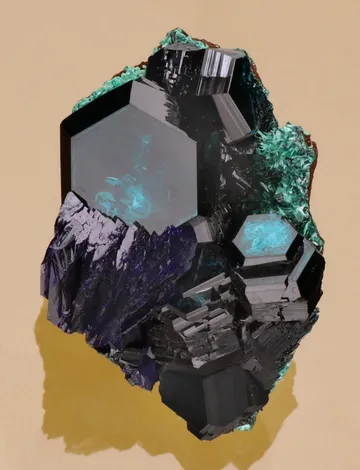
Cabrestante Mine, Mexico: renowned for blue scorodite on quartz in the Concepción del Oro district, offering striking blue arsenate with collector cachet.
Key facts
Cabrestante Mine is one of those Mexican localities whose reputation rests on a small number of extraordinary specimens rather than on a long, steady flow of collector material. It lies in the Concepción del Oro district of northern Zacatecas, within the broader Aranzazu mining area, a copper-gold-silver skarn and carbonate-replacement system developed where Eocene granodioritic to quartz-monzonitic intrusions cut Jurassic and Cretaceous carbonate rocks of the Sierra Madre Oriental. For ore geologists, Cabrestante is part of a structurally complex skarn corridor; for mineral collectors, it is above all a classic source of blue scorodite on quartz, some of it good enough to be discussed alongside the world’s elite scorodite occurrences.
The best Cabrestante specimens have a very distinctive look: sparkling blue to blue-green scorodite crystals, commonly near 1 cm and exceptionally a little larger, scattered or richly set on contrasting white drusy quartz. The visual appeal comes from the clean color separation—cool arsenate crystals on pale silica—combined with unusually sharp, lustrous scorodite for a Mexican occurrence. Good miniatures can be surprisingly dramatic, while the finest small-cabinet pieces have the kind of balanced composition and historical cachet that place them in serious systematic and classic-Mexico collections.
Regional View
Country View
Cabrestante is not a broad “many-mineral” showpiece locality in the manner of Ojuela, Mapimí or Santa Eulalia. Its documented collector suite is compact: scorodite, quartz, sphalerite, pyrite and galena. That narrowness is part of its appeal. A Cabrestante label does not promise abundance; it promises a particular historical find from a famous mining district, and a specimen style that is instantly recognizable when the scorodite is vivid, lustrous and well exposed.
Search for specimens: View all specimens from Cabrestante Mine, Mexico
Cabrestante Mine is in the Concepción del Oro Municipality of Zacatecas, Mexico, close to the town of Concepción del Oro and within the Aranzazu mining property. Modern technical reports treat Cabrestante as one of the principal mineralized zones or near-mine bodies in the Aranzazu system, southeast of the Glory Hole area and tied structurally to the Cabrestante-Diamante-El Roble corridor. The locality sits in the Eastern Fold Belt of the Sierra Madre Oriental, where Jurassic and Cretaceous limestones, shales and siltstones were folded, faulted and then intruded by Eocene granodioritic to quartz-monzonitic bodies. Those intrusions produced skarn, hornfels, marble and associated porphyry-style alteration.
The key host in the district is the Zuloaga limestone, with the La Caja Formation also important in the local stratigraphy. Around Aranzazu, the intrusions metamorphosed carbonate rocks into calc-silicate assemblages and created copper-gold-silver skarn mineralization, with zinc-lead-silver enrichment more distal from the intrusive contacts. In the Cabrestante and Glory Hole areas, the mineralized bodies are described as irregular to tabular, generally oriented north-northwest, and developed at or near limestone-intrusive contacts or in hanging-wall limestones. Cabrestante is also structurally important because dilational zones there are linked to strike-slip movement along the intrusive-limestone contact and to the northeast-trending Cabrestante-Diamante-El Roble structural corridor.
From an ore standpoint, Cabrestante belongs to a larger porphyry-skarn system in which copper and molybdenum are more proximal, while zinc, lead, silver and arsenic become important in peripheral zones. This metal zoning helps explain why collectible scorodite—an iron arsenate produced by oxidation of arsenic-bearing minerals—could occur in association with quartz rather than as a random late coating. The mine’s documented specimen assemblage of scorodite on quartz, plus sphalerite, pyrite and galena, fits neatly with an oxidized arsenic-bearing peripheral to skarn-replacement environment.
The mining history around Concepción del Oro is much older than the specimen fame of Cabrestante. Mining in the district is documented from 1546, with early gold discoveries near the present town and major economic importance in the seventeenth century. In 1889 the Mazapil Copper Company consolidated old mines and expanded production to copper and zinc; ASARCO later operated the property until Mexican nationalization in 1982. The Federal Mining Commission then controlled operations until 1989, after which Macocozac operated the mine intermittently through the difficult metal-price years of the 1990s. Mining and milling stopped in 1999, Aura acquired the Aranzazu property in 2008, production restarted in stages in 2010–2011, was suspended in 2015, and resumed underground mining and on-site processing in 2018.
The Cabrestante workings are not casual collecting ground. Technical documentation describes a serviceable Cabrestante headframe and a two-compartment shaft giving access to Levels 1 through 5, with repairs to shaft timbering made down to Level 6 in 2004. The wider Cabrestante-Arroyos Azules-Mexicana area contains multiple levels, sublevels and stopes, and is part of an active modern mining property controlled by Aura. Collectors should regard access as closed unless explicitly arranged through the operator; available specimens are overwhelmingly historic or from old collections, not from contemporary field collecting.
The notable collector find was a short-lived pocket or pocket zone that produced the famous scorodite-on-quartz pieces attributed to Cabrestante, especially specimens from the 1969 discovery. Some older material circulated under broader or neighboring Concepción del Oro labels, and a number of specimens have been corrected from “El Cobre” to Cabrestante as the locality history has been refined. That matters: Cabrestante scorodite is not merely “Mexican scorodite.” The best pieces represent one of the classic arsenate finds of the district and are now treated as a distinct locality suite.
Cabrestante scorodite is the locality’s defining mineral: lustrous blue to blue-green crystals, typically millimetric to around 1 cm and reported to about 1.2–1.5 cm on notable pieces, perched on white to pale drusy quartz. The crystals may be scattered as individual bright points or richly concentrated across miniature-size plates, and the best examples show sharp form, translucency, saturated color and clean contrast with the quartz rather than dark, crowded matrix. The classic material is tied to a limited 1969 pocket and is considered very rare; ordinary pieces may show only sparse or dull crystals, while top Cabrestante specimens have enough coverage, color and relief to rank among the great world scorodites.
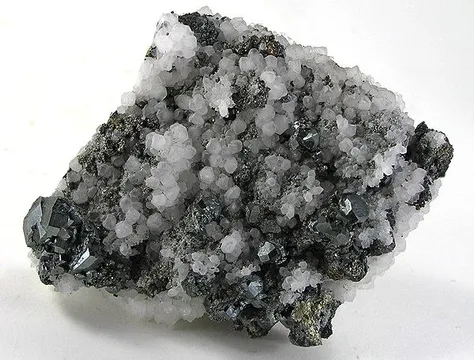
Quartz at Cabrestante is most important as the pale stage on which the scorodite performs, but it also occurs as attractive specimen material in its own right. The classic quartz is white to colorless drusy coverage or short terminated crystals forming plates and pockets; some specimens show more than one generation, including larger satin-luster terminated crystals to roughly 2.3 cm with smaller second-generation points dusting prism faces. Sphalerite, pyrite and scorodite are the important associations, and the best quartz pieces combine sculptural, undamaged crystal growth with contrasting sulfide or scorodite accents rather than presenting as simple massive vein quartz.
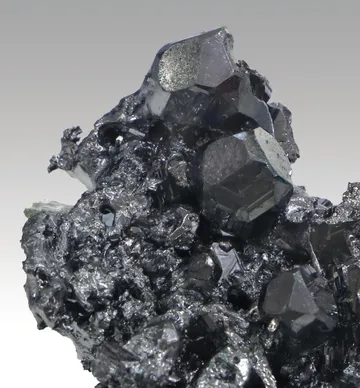
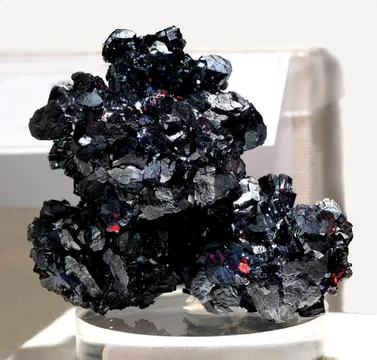
Beyond scorodite and quartz, the documented Cabrestante suite is concise: sphalerite, pyrite and galena. These sulfides are important context minerals rather than the locality’s main collector draw. Sphalerite appears on quartz plates and can provide dark, twinned crystals that sharpen the visual contrast; pyrite and galena reflect the lead-zinc-silver side of the district’s skarn and carbonate-replacement zoning. No type-locality mineral species are documented from Cabrestante in the standard locality records consulted; its rarity status rests instead on world-class scorodite from a very limited occurrence.
The principal authenticity issue for Cabrestante is locality precision, not artificial treatment. Some older specimens were recorded or sold as El Cobre or simply Concepción del Oro, and later work has reassigned certain scorodite-on-quartz specimens to Cabrestante. That is understandable in a district where mines, zones and modern property names overlap, but it means serious collectors should pay close attention to old labels, collection history and photographs. A Cabrestante scorodite with a strong provenance—especially one traceable to an old collection, dealer archive or published specimen—is far more desirable than a loose “Mexico” or “Zacatecas” label.
No widely documented fake or treated Cabrestante scorodite problem emerged from the locality literature. The greater risk is mislabeling: Ojuela, Tsumeb, Baishiding and other scorodite localities can all supply blue-green scorodite, but Cabrestante pieces have a characteristic association with white drusy quartz and a history tied to a narrow Mexican find. Compare crystal habit, matrix, label style and provenance before paying a Cabrestante premium.
Condition is crucial. Scorodite is brittle, relatively soft, and commonly perched as isolated crystals on quartz; edge rubs, missing tips and compressed pocket surfaces can reduce a specimen sharply. Quartz plates may also have repaired corners, contacted backs or trimmed edges, which is not unusual for older material but should be reflected in price. The most desirable pieces show intact scorodite crystals standing proud of the quartz, good separation between crystals, and no obvious glue, oiling, staining or trimming that affects the display face.
Handling should be conservative. Scorodite is a hydrated iron arsenate, so specimens should be kept dry, handled minimally, and stored away from food preparation areas and children. Normal dry display is appropriate; avoid acid cleaning, ultrasonic cleaning, soaking or aggressive brushing. Scorodite is not noted for useful fluorescence, so value rests on daylight color, luster, crystal form and provenance rather than ultraviolet response.
Market availability is thin. Cabrestante scorodite appears mostly as thumbnails and miniatures from older collections, with occasional small-cabinet pieces. Fine examples with lustrous blue crystals around 1 cm on clean quartz can command strong prices because the find was limited and because the locality is repeatedly cited among the top scorodite sources. Quartz with sphalerite from Cabrestante is scarcer in the trade than generic Mexican quartz and should be judged as a locality specimen: strong locality documentation, sculptural form and sulfide contrast matter more than sheer size.
The enduring Cabrestante story is the 1969 scorodite pocket. It was not a continuing production run, not a locality that fed shows year after year, but a brief find whose best pieces were good enough to enter the language of world-class scorodite. Later dealer and museum descriptions return to the same point: these specimens were from a one-time pocket, and the great ones belong in the conversation with Tsumeb. That is a remarkably high bar for a Zacatecas skarn locality whose documented species list is otherwise only a handful of names.
One of the pleasures—and hazards—of Cabrestante collecting is watching the labels evolve. A photographed Jeff Scovil specimen on Mindat was originally recorded as El Cobre, Zacatecas, and later changed to Cabrestante after discussion among knowledgeable collectors. That sort of correction is not merely clerical. In Concepción del Oro, El Cobre, Aranzazu, Arroyos Azules, Cabrestante and adjacent mine zones can sit close together in historical memory and in modern mining records, and the difference between a broad district label and the correct pocket locality can materially affect a specimen’s identity.
The mining landscape behind the specimens is equally vivid. Technical descriptions of the Aranzazu property describe a district riddled with old openings and workings—haphazard near the surface, more systematic at depth—with ruins of mine buildings, chapels and residences still testifying to former wealth. At Cabrestante itself the old infrastructure persisted into the modern era: a working headframe, a two-compartment shaft, access to five levels, and shaft timbering repaired down to Level 6 in 2004. It is a useful reminder that the little blue crystals in a display case came from an industrial landscape of shafts, stopes, levels and repeated cycles of boom, closure and restart.