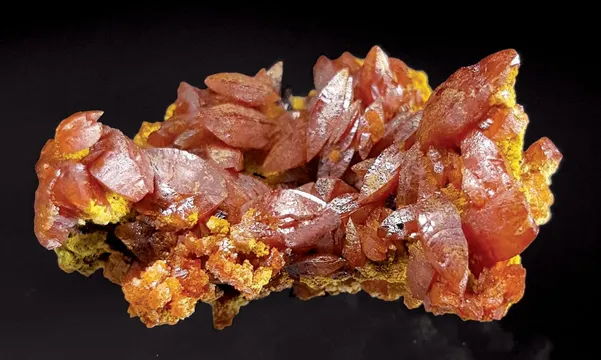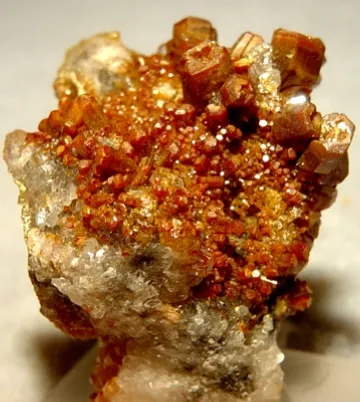
Cocineras Mine, Mexico, Santa Eulalia district’s classic cinnabar locality, yielding vivid scarlet cinnabar on gypsum with small crystals prized by collectors.
Key facts
Cocineras Mine is a small but highly distinctive mercury occurrence tucked into the West Camp of the Santa Eulalia mining district, near Francisco Portillo—also known historically as Santo Domingo—in Aquiles Serdán Municipality, Chihuahua. Santa Eulalia itself is one of the great Mexican carbonate-replacement districts: a long-lived silver-lead-zinc system hosted in Cretaceous carbonate rocks, cut and influenced by intrusive rocks, oxidized deeply in places, and famous to collectors for the sheer range and quality of its secondary minerals. Cocineras matters because it is not just another Santa Eulalia calcite or gypsum locality. It is the district’s classic cinnabar locality, historically noted as the only Santa Eulalia mine showing quicksilver, and modern collectors know it for vivid scarlet to vermilion microcrystalline cinnabar in bright contrast with white gypsum, colorless to pale calcite, and quartz.
Regional View
Country View
The best Cocineras specimens are miniature-scale pieces whose impact comes from texture and color rather than large crystal size: tiny, lustrous rhombohedral cinnabar crystals and rich red dustings spread through open, sparkling carbonate-sulfate matrices. The modern 2019 find, brought to collector attention as a Tucson 2020 novelty, made the locality newly visible in the specimen market. Pieces from that find were described as carefully analyzed cinnabar, not metacinnabar, with crystals generally around a millimeter across, set on saccharoidal or lamellar gypsum and accompanied by small calcite and quartz crystals. In a district celebrated for calcite caves, hemimorphite, smithsonite, creedite, gypsum, mimetite, and rhodochrosite, Cocineras occupies a narrower but memorable niche: Santa Eulalia’s bright red mercury signature.

Photo: Fabre Minerals
Search for specimens: View all specimens from Cocineras Mine, Mexico
Cocineras Mine lies in the West Camp of the Santa Eulalia mining district, in the Francisco Portillo cluster of mines east of Chihuahua City. The district is a classic Mexican carbonate-replacement system developed in a broad, north-northwest-trending carbonate range later affected by felsic intrusions and volcanic cover. Regionally, Santa Eulalia belongs to the great belt of northern Mexican CRD deposits that includes such specimen localities as Naica, Mapimí-Ojuela, Los Lamentos, San Pedro Corralitos, Charcas, and San Martín-Sabinas. Within that setting, the West Camp is characterized by massive sulfide manto and chimney bodies, with local skarn development and strong oxidation in the older workings.
The main Santa Eulalia ore story is silver, lead, and zinc, with sphalerite and galena as principal economic sulfides and silver minerals in important accessory roles. Cocineras is unusual because its collector identity is tied to mercury. Early twentieth-century reporting described the mine—under the spelling Cocineros/Cosineros—as the only mine in Santa Eulalia then showing cinnabar, with a new shaft being sunk near an old ore spout that reached the surface. The same account noted fine cinnabar specimens visible in old workings about 150 feet below the surface, making the locality significant not merely as a modern specimen source but as a historically recognized quicksilver occurrence inside a district otherwise known overwhelmingly for Ag-Pb-Zn mineralization.
The broader West Camp was developed through a maze of adjoining mines around Santo Domingo and Francisco Portillo. Santa Eulalia’s mining history is deep: the district’s early discoveries are traditionally placed in the Spanish colonial period, and large-scale formal exploitation developed strongly in the nineteenth and twentieth centuries. In modern corporate reporting, Santa Eulalia’s principal mines are Buena Tierra and San Antonio; Buena Tierra represents the West Camp, while San Antonio anchors the East Camp. The West Camp’s major production era had largely passed by the late twentieth century, and modern reporting describes Santa Eulalia as suspended since the first quarter of 2020 because of flooding. That status should not be read as public collecting permission. The old workings are part of a historically mined, privately controlled district, and casual collecting underground would be unsafe and inappropriate without explicit legal access.
The specimen-producing event that put Cocineras back into circulation for many collectors was the 2019 find distributed internationally around Tucson 2020. Those pieces are small but visually strong: cinnabar crystals and rich red crystalline coatings on matrices of white saccharoidal or lamellar gypsum, small colorless calcite, and quartz. Dealer and specimen records show miniatures typically in the 3–5.5 cm range, with cinnabar crystals reported around 0.1 cm. Several specimens were offered with analytical confirmation that the red mercury sulfide was cinnabar; this matters because metacinnabar was rumored in the find, but analyses cited by Fabre Minerals did not detect it in their specimens.
Cinnabar is the defining Cocineras mineral: brilliant red to vermilion HgS occurring as tiny but sharp and lustrous crystals, commonly with dominant rhombohedral habit and subordinate forms, scattered richly through white gypsum, calcite, and quartz. The modern collector material is mostly thumbnail to miniature in overall specimen size, with individual cinnabar crystals typically about a millimeter, so quality is judged by intensity of color, sparkle under magnification, contrast against clean white gypsum or glassy calcite, and whether the red mineral is crystallized rather than merely powdery. Cocineras cinnabar is especially desirable when the red crystals sit in open vugs or coat ridges of gypsum-calcite matrix without abrasion, because ordinary pieces can look like red staining whereas the best show true crystalline luster and a vivid, freshly exposed scarlet color.
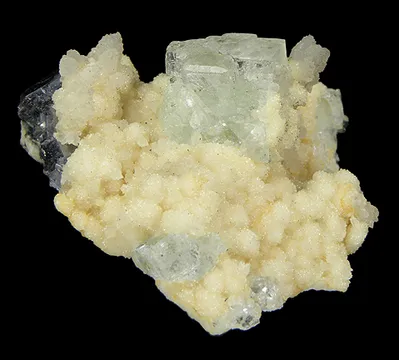
Calcite from Cocineras is chiefly a supporting mineral to cinnabar, forming colorless, white, or pale translucent crystals on the same small matrices that carry gypsum and quartz. Its collector importance here lies in contrast and presentation: sparkling calcite provides relief around the red mercury sulfide, and some documented Cocineras specimens show shortwave ultraviolet fluorescence in the calcite. Fine examples have clean, lustrous calcite that frames the cinnabar without burying it; lesser pieces are more massive, bruised, or so thickly coated by red material that the calcite becomes merely a pale substrate. Because Santa Eulalia is a world-class calcite district in its own right, Cocineras calcite should be evaluated specifically as part of the cinnabar association rather than as a stand-alone calcite occurrence.
Gypsum at Cocineras occurs as white saccharoidal masses, lamellar aggregates, and delicate crystalline matrix material associated with cinnabar, calcite, and quartz. It is not the giant selenite of Naica nor the celebrated cavern gypsum of other Santa Eulalia mines; its significance is textural and chromatic, giving the cinnabar a bright white ground that makes the red crystals visually pop. The better gypsum-bearing pieces retain crisp lamellar or sugary surfaces with cinnabar sitting visibly on and between the gypsum crystals, while ordinary pieces are dull, friable, or stained without clear crystallization. Because gypsum is soft and easily scuffed, undamaged matrix edges and intact red-on-white contrast are much more important here than sheer specimen size.
Other documented Cocineras minerals form a short but useful supporting cast. Quartz is a recurring associate in specimen records, typically as small clear to whitish crystals with cinnabar, calcite, and gypsum. Fluorite has been noted on at least one dealer-described specimen with quartz, calcite, gypsum, and cinnabar, but it is not the locality’s main claim to fame. Cocineras is not known as a type locality, and the broader Santa Eulalia district itself has not produced a species unique to the district despite its roughly 200-species mineralogical breadth; Cocineras is best understood as a focused cinnabar occurrence within that much larger CRD mineral province.
Cocineras specimens invite close inspection. Most of the important cinnabar crystals are micro to very small thumbnail-scale individuals, so a hand lens or microscope is often needed to see whether the red material is actually crystallized. The strongest pieces have vivid, lustrous red cinnabar visibly perched on white gypsum, colorless calcite, or quartz, rather than a general earthy red smear across broken matrix.
The specific authenticity issue for Cocineras is not a known fake problem but a species-identification one. Some specimens from the 2019 find were said to possibly contain metacinnabar; Fabre Minerals reported that their analyzed examples were cinnabar and that metacinnabar was not detected in those analyses. For a serious collection, labels that simply say “cinnabar” are acceptable when provenance is solid, but analytical documentation adds value, especially for premium pieces from the Tucson 2020 material.
Mislabelling can occur through spelling and locality hierarchy. Cocineras appears in older and market sources under variants such as Cocineros or Cosineros, and the locality may be abbreviated to “Santa Eulalia, Chihuahua” without the mine name. That broader label is not wrong geographically, but it erases the point of the specimen: Cocineras is the Santa Eulalia cinnabar locality. Retain old labels, especially those naming Cocineras/Cocineros and Francisco Portillo, because they help distinguish these pieces from the district’s far more common calcite, gypsum, hemimorphite, smithsonite, and creedite material.
Condition matters. Gypsum is soft, calcite cleaves easily, and the cinnabar is commonly present as minute surface crystals or crystalline coatings. Rubbing, ultrasonic cleaning, aggressive brushing, and acid treatment are poor choices. Dust should be minimized, both to preserve the specimen and because cinnabar is a mercury sulfide. Normal display is not hazardous when the specimen is stable and left alone, but collectors should avoid grinding, sawing, licking, or creating dust; wash hands after handling and keep delicate pieces away from children.
Market availability is episodic. The 2019 find supplied a recognizable group of miniatures and thumbnails, many sold through established dealers, and pieces continue to appear through resale and old stock. They are not usually expensive in the way that large Chinese cinnabar crystals or classic European mercury specimens can be, but fine Cocineras examples are scarcer than ordinary small red-stained matrix pieces. Look for strong color, undamaged white matrix, clear mine-level provenance, and, when possible, documentation of analysis.
In the 1909 account of Santa Eulalia by mining engineer William Adams, Cocineras appears in a brief but memorable passage under the variant spelling Cocineros. The district around it was a roaring silver-lead-zinc camp, crowded with named mines, companies, shafts, tramways, and speculation, yet Cocineras stood out for a different metal. Adams wrote that I. M. Terry & Co. owned the Democracia and held options on Inglaterra Anexas, Emma, the Cosineros, and Concepcion. Steam hoists had gone up on Democracia and Inglaterra Anexas, and development was being pushed “as fast as possible.” Then came the detail that gives the locality its collector identity: Cocineros was the only mine showing cinnabar in Santa Eulalia, and Terry was sinking a new shaft near an old ore spout that came to the surface. About 150 feet down in the old workings, Adams reported that fine cinnabar specimens could be seen—“the only discovery of quicksilver in the camp.”
More than a century later, Cocineras reappeared in collector consciousness through small, vivid specimens rather than ore shipments. The 2019 find was marketed as a Tucson 2020 novelty, and the descriptions read like the opening of a pocket: tiny rhombohedral cinnabar crystals, translucent and unusually bright for their size, scattered on white saccharoidal or lamellar gypsum with small calcite and quartz. The find carried a modern twist. Rumors circulated that metacinnabar might be present in the material, so the best documented dealers had pieces analyzed. The answer, for the specimens they tested, was cinnabar. That made the red crystals not only attractive but also properly anchored mineralogically—a modern analytical footnote to a mine that had already been singled out in 1909 as Santa Eulalia’s quicksilver occurrence.