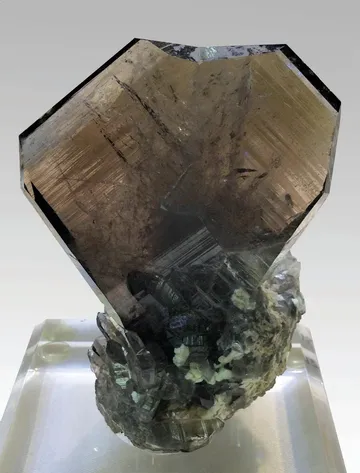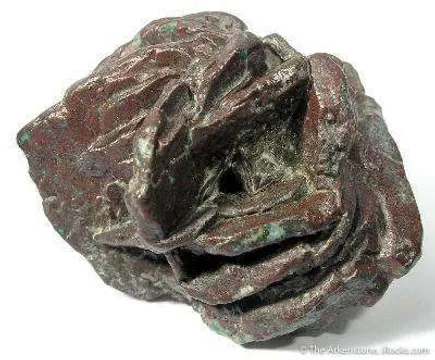
Cliff Mine, USA - historic Keweenaw native-copper producer, yielding sculptural copper crystals, prehnite veins, and documented provenance prized by collectors.
Key facts
Cliff mine is one of the essential names in American mineral collecting: the first truly profitable native-copper mine of Michigan’s Keweenaw Peninsula, a classic fissure-vein deposit at the base of the Greenstone flow, and a source of old-time copper and silver specimens whose provenance carries unusual historical weight. Its best pieces are not simply lumps of metal from a famous mine; they are sharp, sculptural copper crystals, wires, mossy growths, arborescent masses, and copper-in-prehnite combinations from a vein system that helped prove the commercial reality of the Lake Superior native-copper district.
Geologically, Cliff belongs to the Keweenaw native-copper province, where mineralizing hydrothermal fluids moved through Mesoproterozoic rift volcanic rocks and interflow sedimentary units. The mine worked the Cliff fissure, a steep vein cutting basalt and conglomeratic horizons near the great basalt bluff southwest of Eagle River. Unlike the later giant amygdaloid and conglomerate lodes farther south, Cliff was an early fissure-vein bonanza: it yielded large masses of native copper, rich pockets of crystallized copper, and specimen minerals deposited in cavities, seams, and prehnite-calcite veinlets.
Regional View
Country View
The Cliff aesthetic is old Keweenaw at its most concentrated: dark antique patina on native copper, pale apple-green to whitish prehnite in vugs and veinlets, occasional bright native silver, black or reddish oxide coatings, and rare zeolite-group associates. The finest antique specimens can show complex modified cubic, octahedral, dodecahedral, and tetrahexahedral copper crystals; later dump finds tend more often toward micromount-scale copper, silver, hematite, malachite, chalcocite, and prehnite-lined cavities. For serious collectors, a well-documented Cliff label matters nearly as much as the mineralization itself, because many nineteenth-century “Lake Superior” coppers have lost their exact mine attribution.

Photo: James St. John / Wikimedia Commons

Search for specimens: View all specimens from Cliff mine, USA
Cliff mine is in Allouez Township, Keweenaw County, Michigan, about 6.5 km southwest of Eagle River, at the foot of the Greenstone flow’s basalt bluff. The setting is visually inseparable from the mineralogy: the old workings sit against a wooded escarpment, with the West Branch of the Eagle River crossing the property and dump material still visible from the mine’s long period of activity.
The deposit is a native-copper fissure vein in the Keweenaw Peninsula native-copper district. The host rocks are part of the Mesoproterozoic Midcontinent Rift sequence, especially the Portage Lake volcanic succession and related interflow sedimentary beds. At Cliff, the fissure cut basalt, breccia, amygdaloidal zones, and conglomeratic horizons; hydrothermal fluids deposited native copper and native silver with prehnite, calcite, quartz, epidote, zeolites, and minor copper sulfides and oxides. This is the key distinction between Cliff and the later industrial giants of the district: Cliff was a vein mine, not a broad stratiform amygdaloid or conglomerate operation, and its specimen character reflects that narrow, cavity-rich, metal-mass-bearing environment.
The ore bodies were spectacularly irregular. The Cliff fissure carried copper through a vertical structure, with especially rich mass-copper zones that had to be cut underground rather than simply hoisted. Large native-copper masses were too heavy to remove intact, so miners laboriously separated them with hammer and chisel into liftable pieces. The mine also produced smaller crystallized pockets in which copper grew as sharp crystals, plates, mossy aggregates, dendritic forms, wires, and arborescent groups, commonly with prehnite or calcite. Microcrystals from Cliff are particularly celebrated because the old fissure environment yielded beautifully formed crystals on a very small scale, including copper, silver, hematite, chalcocite, and associated secondary minerals.
The first important work began after the Pittsburgh & Boston Copper Harbor Mining Company’s early Copper Harbor ventures failed to justify expectations. In 1845 attention shifted to the Cliff location, where copper-bearing quartz had been noted near the cliff and work soon exposed a large mass of native copper. The Avery shaft, named for investor Dr. Charles Avery, became one of the key early workings. By the end of 1845, roughly 20,000 pounds of mass copper had reportedly been removed, and the mine’s early success quickly changed the financial mood of the entire Keweenaw copper country.
The Pittsburgh & Boston interests reorganized as the Pittsburgh & Boston Mining Company in 1848 and worked the Cliff fissure until 1870. The mine paid its first dividend in 1849 and became the first dividend-paying property in the Michigan copper district. In the 1850s it was the district’s outstanding producer; from 1846 to 1858 no other copper mine in the region matched it. The mine ultimately produced more than 38 million pounds of refined copper over its main productive life and returned more than $2.5 million in dividends to investors on an initial investment reported at about $110,000. After the first company’s principal phase ended, the property passed to the Cliff Copper Company, then to the Tamarack Mining Company, and eventually became part of the Calumet & Hecla sphere. Later work, tribute mining, exploration, and drilling never restored the original bonanza character.
Today the surface is an historic ruin and collecting locality rather than an operating mine. The waste-rock piles are county-owned and accessible off Cliff Drive, and they remain a familiar stop for Keweenaw rockhounds. The old shafts and underground workings are not collecting targets: they are hazardous, capped or sealed in places, and should be treated as historic industrial remains. Collectors work the dumps for small copper pieces, copper in prehnite, prehnite vein material, calcite, epidote, quartz, malachite, cuprite, hematite, and micromount material. Good modern finds are usually small, but careful splitting of basalt breccia, quartz stringers, and prehnite-calcite seams can still reveal miniature and micro specimens with real Cliff character.
The most collectible finds are those that preserve the locality’s fissure-vein identity: sharp native copper crystals on or in prehnite, copper wires, silver with copper, bright silver microcrystals, copper in bleached basalt breccia, and pieces that can be tied to the Avery shaft, the main Cliff mine, or the Cliff vein between the Avery and North Cliff workings. Antique specimens with nineteenth-century labels are in a different class altogether. Because Cliff was famous early, many fine pieces entered institutional and elite private collections before locality labels were standardized; a provenanced Cliff specimen from an old collection is therefore considerably more important than a merely plausible “Keweenaw” copper.
Copper is the signature mineral of Cliff mine and the reason the locality became a landmark: it occurs as mass copper, sharp crystals, wires, moss copper, arborescent groups, plates, and micromount crystals, commonly in intimate association with prehnite and locally with calcite, quartz, epidote, malachite, cuprite, chalcocite, and native silver. The best specimens show well-defined modified crystal forms—especially tetrahexahedral habits, with cubes, octahedrons, and dodecahedrons also represented—rather than merely hackly or massive copper. Antique pieces can reach large cabinet scale, including important old 15–20 cm specimens in institutional or former institutional collections, while modern dump finds are more often thumbnail to miniature or microscope-scale crystals. A good Cliff copper is separated from an ordinary Keweenaw copper by sharp form, natural antique patina, convincing fissure-vein matrix, prehnite association, and, above all, a label or collection history strong enough to support the mine attribution.
Prehnite from Cliff mine is most important as a matrix and pocket mineral for copper and silver, forming pale green, whitish, grayish, botryoidal, bladed, and vein-filling material in basalt breccia, quartz stringers, and prehnite-calcite seams. It is not usually collected here as large decorative globular prehnite in the style of some amygdaloid localities; instead, the best Cliff pieces are locality-specific combinations—copper crystals or wires on prehnite, native silver in or on prehnite, tiny copper balls and torn fragments altering around prehnite-lined vugs, and micromount cavities with sharp bladed prehnite. Modern finds from the southwest waste-rock pile and related dumps can be extremely small, with vugs measured in millimeters or less, so high-quality prehnite specimens from Cliff are judged by association, freshness, undamaged cavity linings, and the presence of bright native copper or silver rather than by prehnite size alone.
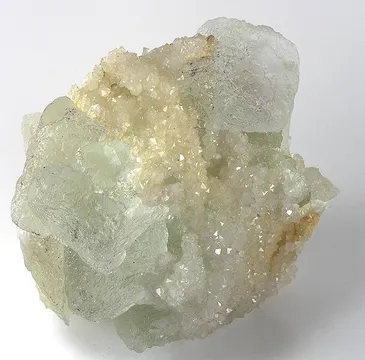
Apophyllite at Cliff mine is a rare associate, most accurately represented in modern species terms by fluorapophyllite-(K), and it is far less common here than copper or prehnite. Documented specimens show small colorless to pale, transparent, glassy, tabular crystals, commonly around the centimeter scale at best, on fissure-vein matrix. Its importance is historical as well as mineralogical: J. D. Dana noted apophyllite from the Cliff mine in 1854, placing the species among the classic early mineral records of the Lake Superior copper district. A strong Cliff apophyllite specimen should have sharp glassy tabular crystals, clean matrix, and reliable provenance, because small apophyllite crystals from other Keweenaw fissure mines can be deceptively similar and Cliff material is genuinely scarce.
Other documented Cliff minerals include native silver, calcite, datolite, epidote, quartz, analcime, laumontite, natrolite, thomsonite-Ca, pumpellyite-(Mg) including chlorastrolite-variety material, albite, microcline, adularia, babingtonite, wollastonite, hematite, magnetite, ilmenite, cuprite, tenorite, malachite, azurite, chrysocolla, chalcocite, digenite, covellite, domeykite, chalcopyrite, sphalerite, galena, pyrite, acanthite, baryte, anhydrite, gypsum, ankerite, chlorite-group minerals, clinochlore, chamosite, and delessite. Native silver is the most celebrated rarity after copper: Cliff silver can occur with copper and prehnite as dendrites, grains, wires, hoppered crystals, and bright microcrystals. Chalcocite is notable because copper sulfides are rare in the Lake Superior native-copper district outside the White Pine environment. Hematite has been described as microscopic flat rhombohedral crystals on botryoidal prehnite and native copper in prehnite-calcite veins, and the Cliff vein was important enough for S. A. Williams to publish a dedicated morphological study of several well-crystallized minerals from the Avery shaft–North Cliff interval.
Provenance is the central issue with Cliff mine specimens. The Keweenaw produced enormous numbers of native-copper specimens, many labeled only “Lake Superior,” “Keweenaw,” “Michigan,” or “Copper Country.” Such labels are historically interesting but not equivalent to a Cliff attribution. Serious buyers should look for old collection labels naming Cliff, Avery shaft, Cliff vein, Allouez Township, or Keweenaw County; corroborating collection history; or matrix and association consistent with the Cliff fissure. Fine nineteenth-century Cliff coppers are scarce because relatively few properly attributed specimens survived, and many were dispersed through museums and major private collections long before modern locality discipline.
Mislabeling is common in the market, usually not from fraud but from optimistic upgrading of vague Keweenaw material. Copper from Central, Copper Falls, Phoenix, North Cliff, North American, and other fissure or nearby amygdaloid localities can resemble Cliff material, especially when the specimen is loose native copper without matrix. Conversely, some authentic Cliff dump finds are unimpressive at first glance until examined under magnification. For high-value specimens, do not accept “looks like Cliff” as evidence; demand a label trail or a documented collection source.
Condition issues vary by mineral. Native copper is tough but can be bruised, bent, cut, polished, acid-brightened, wire-brushed, lacquered, or stripped of its natural patina. On Cliff material, a stable dark brown to reddish antique surface is often desirable, while unnaturally bright, raw-orange copper may indicate aggressive cleaning unless it is a fresh modern find. Copper crystals and wires are physically vulnerable despite copper’s toughness; thin wires, dendrites, and arborescent branches bend easily. Prehnite-lined vugs and zeolite associates are more fragile and should be kept dry and handled as cabinet specimens rather than rough rockhounding material. Laumontite, where present, can dehydrate and crumble, so any suspected laumontite-bearing piece should be stored away from heat and low-humidity extremes.
Modern collecting at the dumps is still possible, but the yield is mostly small. Metal detectors may locate copper-bearing pieces, though much of the best mineralogical material is found by careful visual inspection and trimming of vein material rather than by chasing bulk metal. The historic underground workings should be avoided entirely. Old mines in the Keweenaw have unstable openings, hidden voids, rotten timber, bad air risks, water, loose rock, and legal restrictions; the collectible value of Cliff today is in its waste rock, documented old specimens, and preserved history, not in underground trespass.
Market availability is uneven. Small Cliff copper pieces and copper-in-prehnite specimens appear periodically, especially from modern dump collecting and older regional accumulations. Fine crystallized copper with indisputable Cliff provenance is much rarer and competes with other classic American native-element specimens. Silver from Cliff is rarer still, particularly anything larger than a micromount or thumbnail. Apophyllite from Cliff is a specialist item; when well-crystallized and correctly labeled, it appeals as much to Keweenaw locality collectors as to zeolite collectors.
The Cliff story begins with a failure. The Pittsburgh and Boston investors had already spent heavily at Copper Harbor, where their early hopes near Hays Point did not deliver the copper bonanza they imagined. Then attention shifted inland to the cliff: a narrow copper-bearing quartz vein appeared near the top of a basalt wall roughly 200 feet high. At first it hardly looked like salvation. But as miners traced the vein down to the base of the bluff and drove into it, the character of the place changed completely. About 70 feet into the bluff, German miners uncovered a mass of native copper measured in the thousands of pounds. It was the kind of discovery that turns a difficult wilderness venture into a mining district.
That first great mass was not a tidy ore shoot that could be shoveled into cars. Cliff’s riches came in native copper bodies large enough to become a practical problem. When miners hit the big masses, they had to cut them underground with hammer and chisel, sometimes for months, until the copper could be broken into pieces small enough to hoist by horse-powered whim. The romance of “solid copper” can obscure the reality: the men were not simply mining ore, they were quarrying metal inside the earth.
The mine quickly became the financial proof that the Keweenaw needed. It paid its first dividend in 1849, and for years it stood as the district’s dominant producer. The figures still carry their old shock: more than 38 million pounds of refined copper over roughly forty years, more than $2.5 million in dividends, and an initial investment reported at about $110,000. In an era when many mining companies promoted dreams more vigorously than ore, Cliff was the rare property that could point to copper, cash, and dividends.
There is a wonderful old counterpoint to that booster culture in a story preserved from Jacob Houghton’s 1897 letter to State Geologist Lucius Hubbard. Houghton recalled visiting Captain Joseph Paul near the Cliff mine and looking through old company reports. When Houghton remarked that the reports were “very interesting,” Paul snapped back, “Pack of lies, pack of lies.” Houghton replied that Paul himself had written many of them. Paul’s answer was even better: “No difference, no difference, had to lie, had to lie, stockholders wouldn’t pay assessments.” It is hard to imagine a more concise footnote to the speculative atmosphere of early Copper Country mining.
Cliff also became a place where mineral specimens began traveling into the wider collecting world. Mine captain John Daniell owned a transparent pale-yellow calcite crystal from the mine, 3.2 cm long, that was acquired by Clarence Bement in 1873. From Bement it passed through the American Museum of Natural History and later to Phil Scalisi, eventually entering the William Severance collection. That little calcite’s chain of custody says much about the Cliff: even its non-copper specimens could become part of the grand old specimen traffic between captains, connoisseurs, museums, and elite private cabinets.
The town of Clifton grew around the mine and then thinned away with it. Today the landscape is quiet: forest, rock piles, masonry foundations, road traces, capped shafts, and the faint geography of a company town. Archaeological work has shown how much of the old industrial life lies just beneath the surface. The stamp mill area, where copper-bearing rock was crushed and washed, was later buried under stamp sand, probably during the 1890s when Henry Warren built a smaller mill on top of earlier remains. That burial, destructive in one sense, helped preserve traces of the earlier works.
Even the village left collectible ghosts. The Clifton Bottling Works is known from extremely rare amber quart bottles with applied Baltimore loop seal tops, dating to about 1885–early 1890s. Their scarcity suggests a small, short-lived local operation, but the name on the glass preserves the vanished mining settlement. For a mineral collector standing on the dumps, such details matter: Cliff is not just a source of copper crystals, but a whole nineteenth-century material world collapsed into forest and rock.