






A collector's guide to Chessy, France: its geology, mining history and notable minerals, illustrated with the 146 specimens documented from this locality on EarthWonders.
Key facts
Chessy—more properly Chessy-les-Mines in the Rhône department of eastern France—is one of the foundational European localities for copper minerals. Its fame rests on an extraordinary geological accident: Devonian submarine volcanic-hosted sulphide mineralization, rich in chalcopyrite, pyrite, sphalerite, galena and baryte, was later brought into chemical conversation with Triassic sandstones and clays. Oxidizing waters worked through that contact and produced the blue, green and red secondary copper suite that made the mine legendary: azurite, malachite and cuprite, with smithsonite, chrysocolla, baryte and numerous rarities in attendance.
For collectors, Chessy is above all the classic home of “chessylite,” the old name long used for azurite from this mine. The locality is deeply historical: the copper workings were active for centuries, but the decisive mineralogical moment came with the discovery of the Mine Bleue in the early nineteenth century. Its vugs and nodules supplied richly crystallized azurite that entered the great European cabinets and became a reference point for the species. Even today, a fine Chessy azurite has an instantly recognizable old-European personality: compact, dark royal-blue, often in sparkling ball-like or rosette aggregates of short prismatic to tabular crystals, sometimes relieved by emerald malachite or a brick-red cuprite remnant.
Regional View
Country View
The best Chessy specimens are not modern cabinet monsters in the manner of Tsumeb or Bisbee; their power is concentration. A miniature with sharp blue azurite balls, a clean malachite pseudomorph after a cuprite octahedron, or a tiny red cuprite crystal on chessylite can carry more historical weight than a much larger specimen from a younger mining district. Fine nineteenth-century examples are especially prized because they represent the short-lived productive glory of the Mine Bleue before it was worked out.

Photo: Wikimedia Commons

Photo: Wikimedia Commons
Search for specimens: View all specimens from Chessy, France
The Chessy copper mines lie in the southern Beaujolais, northwest of Lyon, near the entrance to the Azergues valley. The mineralization belongs to the broader Brévenne volcano-sedimentary belt on the eastern edge of the French Massif Central. In modern terms, the primary ore is a volcanic-hosted polymetallic sulphide system: baryte, galena, sphalerite, chalcopyrite and pyrite in altered soda-dacitic volcanic rocks associated with the Devonian Brévenne rift. Later Triassic argillaceous and sandy sediments covered the older sulphide-bearing rocks, and the supergene and hydrothermal alteration of this combined system generated the celebrated secondary copper minerals.
The old miners and engineers divided the deposit into four practical ore zones, and those names are still the collector’s best map of Chessy. The Mine Jaune was the primary sulphide zone, with chalcopyrite and pyrite in the altered volcanic host. The Mine Noire represented a strongly altered, reduced copper zone in which tenorite, chalcocite and native copper were important. The Mine Rouge was the red clay and fault-hosted oxidized zone, famous for cuprite and native copper. The Mine Bleue—the collector’s shrine—was the highly oxidized carbonate zone in Triassic clays and sandstones, where azurite, malachite, cuprite and smithsonite occurred in the forms that made Chessy internationally famous.
The deposit is compact but mineralogically dense. The commune’s own heritage summary gives an extent of roughly 850 meters along strike and about 250 meters in depth. The Mine Bleue itself has been described in museum and geological literature as a zone within Triassic sandstones and clays on the order of hundreds of meters long and tens of meters thick. Its value was not just ornamental: the azurite-rich carbonate ore was high-grade copper ore, and that economic fact explains both the abundance of surviving small specimens and the scarcity of large untouched vug plates. The best material was mined, sorted and smelted with care.
Mining at Chessy is traditionally traced back to antiquity, with renewed activity from the fifteenth century and the period of Jacques Cœur and the Lyonnais mining interests. By the eighteenth century, the mine was a serious copper producer. A refining furnace at Chessy treated black copper from Chessy and neighboring Sain-Bel, and the Jars family became central to the expansion of mining and metallurgy in the region. The most famous phase began around 1810–1811, when the Saxon master miner Christian Traugott Woellner was brought in during a period of declining production. His work led to the discovery of the Mine Bleue, transforming Chessy from a struggling copper mine into a mineralogical landmark.
Between 1812 and 1828, the Mine Bleue supplied roughly 4,000 tonnes of copper. Daily treatment figures from the 1820s show a wide range of raw ore throughput and a rapid fall in grade as the richest material was exhausted. By the 1830s the glory of the blue carbonate orebody was fading. In 1839 the Perret family acquired the mines and turned the focus toward pyrite and the production of sulfuric acid, a shift that helped feed the rise of the Lyon chemical industry. The underground copper operation never regained the brilliance of the Mine Bleue years. A major collapse in the old workings in the nineteenth century effectively ended underground extraction at Chessy, and the mine closed in the 1870s.
The modern afterlife of the locality is unusually important to collectors. The old mine is closed, and casual underground collecting is not an option. The dumps, however, became the focus of organized mineralogical work; the Association Minéralogique de l’Arbresle Chessy-les-Mines, generally known as AMAC, acquired and manages the dump area and organizes controlled searches. Today’s dump finds can still produce azurite, malachite, cuprite, baryte and microminerals, but the great cabinet-grade Mine Bleue specimens are overwhelmingly historical pieces, old collection material, or rare recoveries from carefully worked dump material.
Modern geological interest has also returned to Chessy for reasons beyond specimens. BRGM exploration in the late twentieth century identified a deeper polymetallic sulphide body beneath the old workings, with copper, zinc and pyrite of potential economic interest. That exploration led to new underground work, drilling and feasibility studies, but economic conditions prevented a modern mine from being developed. The site is now also a case study in after-mine management, especially because sulphide-rich waste and old workings generate acidic, metal-bearing mine waters requiring treatment.
Chessy azurite is the locality’s defining mineral and the historical “chessylite” of old labels: deep royal-blue to nearly black-blue, typically in compact aggregates of short prismatic, rhombohedral, tabular or ball-like crystals rather than large isolated blades. Fine pieces may show sparkling drusy surfaces, rosettes, rounded nodular groups or vugs lined with sharp crystals, commonly with malachite, cuprite, smithsonite, baryte or pale carbonate-clay matrix. Most collectible specimens are thumbnails to miniatures, with especially good old examples reaching several centimeters; crystals and aggregates from noted dealer and museum examples commonly fall in the sub-centimeter to few-centimeter range, while historic cabinet specimens are far scarcer. The best Chessy azurite combines saturated blue color, visible crystal definition, old Mine Bleue character, minimal bruising, and ideally a classic association such as malachite after cuprite or white baryte for contrast.
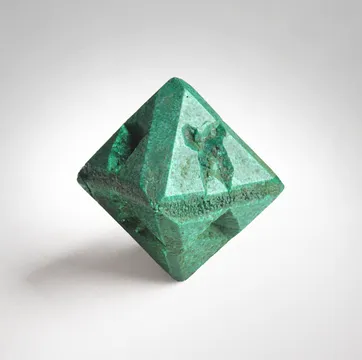
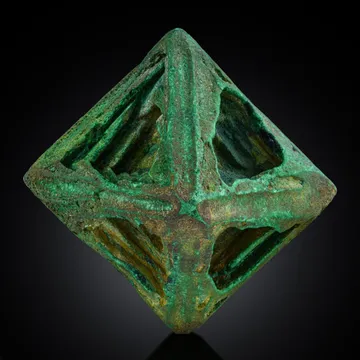
Chessy malachite is most coveted when it preserves the geometry of the mineral it replaced: sharp green pseudomorphs after cuprite, commonly octahedral, dodecahedral, or modified forms with smooth faces and a compact, slightly silky to satiny surface. It also occurs as coatings, fibrous masses, spherules and alteration rims with azurite, but the pseudomorphs are the pieces collectors recognize across a room. These are usually small—often around a centimeter, with better examples somewhat larger—and they are at their most desirable when freestanding or perched on blue azurite from the Mine Bleue/Mine Rouge system. Ordinary Chessy malachite can be attractive but anonymous; exceptional Chessy malachite has crisp inherited cuprite form, strong even green color, visible red cuprite remnants or blue azurite association, and an old European provenance.
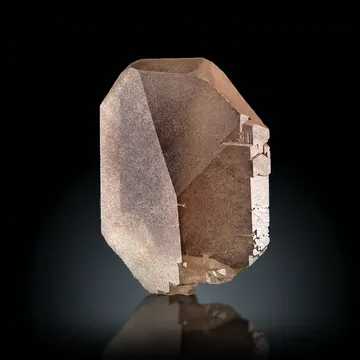
Cuprite from Chessy is a classic of form rather than size: red, red-brown to purplish crystals, typically octahedral or modified by dodecahedral faces, occurring as isolated crystals in clay, impregnations in sandstone, and crystals associated with azurite and malachite. Historical and locality records describe crystals to about 3 centimeters, while French collecting literature has cited exceptional crystals approaching 4 centimeters; most collectible examples are much smaller, and many survive only as malachite pseudomorphs after cuprite. The Mine Rouge was the principal cuprite zone, with red clay and oxidized copper mineralization, but the most prized cabinet associations place red cuprite—or malachite after cuprite—on deep blue chessylite. Fine Chessy cuprite should have sharp geometry, visible red color, minimal replacement unless the pseudomorph is itself the point, and a believable old-locality context.
Beyond the three classic copper minerals, Chessy is a serious micromineral and type-locality locality. Azurite is the great historic type-locality species associated with the mine, and orthoserpierite, Ca(Cu,Zn)4(SO4)2(OH)6·3H2O, was described from Chessy as an orthorhombic polymorph of serpierite. The documented suite includes smithsonite, baryte, chrysocolla, tenorite, native copper, chalcocite, galena, sphalerite, chalcopyrite, pyrite, cerussite, aurichalcite, hydrozincite, hemimorphite, pseudomalachite, brochantite, chalcophyllite, agardite-group material, devilline/serpierite-related species, halloysite, calcite and a long list of rarities from both the mine and slags. For the advanced collector, Chessy is therefore two localities at once: the old Mine Bleue of classic azurite, and the dump-and-micro world of late-forming secondary copper, zinc, lead and sulphate species.
The greatest authenticity issue with Chessy specimens is not dyeing or routine laboratory treatment; it is provenance. Dark-blue azurite aggregates and azurite-malachite combinations from Bisbee, Burra Burra, Tsumeb, Moroccan localities and other copper districts can be visually close enough to invite optimistic or inherited mislabelling. A convincing Chessy piece should be judged by the whole specimen: compact old-European habit, scale, matrix, associated cuprite or malachite-after-cuprite, label history, and whether the piece fits the Mine Bleue/Mine Rouge style rather than merely being “blue azurite with green malachite.”
Old labels matter enormously. A nineteenth-century or early twentieth-century European label, especially one naming Chessy, Chessy-les-Mines, “Chessylite,” “Chessy près Lyon,” or “Chessy, Rhône,” adds both confidence and value. Conversely, a specimen with no provenance but a broad locality claim deserves caution, particularly if it is unusually large, highly lustrous in a style alien to Chessy, or on matrix that does not match the Triassic sandstone-clay and altered ore context of the mine.
Condition is a real concern. Chessy azurite is commonly in compact aggregates of small crystals; edges and high points chip easily, and old specimens may have bruised terminations, rubbed surfaces, or matrix losses from decades of cabinet handling. Malachite pseudomorphs after cuprite should be checked for broken corners, repainted-looking green surfaces, concealed repaired contacts, and loss of the crisp inherited geometry. Cuprite, especially if only partly replaced, is vulnerable to dulling, abrasion and clay staining; remaining red areas can be small but important.
Azurite can slowly alter to malachite under unfavorable conditions, although well-kept specimens are stable on the scale of normal collecting. Avoid prolonged damp storage, acidic environments, direct sunlight, heat, and repeated washing. Chessy pieces from old clays and dump material should never be aggressively cleaned; water, acids or ultrasonic cleaning can loosen clay matrices, damage delicate malachite fibers, and change the surface character that helps identify the locality. Fine Chessy specimens are best stored dry, handled minimally, and mounted so that old labels stay with the specimen.
Market availability is uneven. Small azurite groups and malachite-after-cuprite thumbnails appear regularly enough that Chessy remains accessible, but sharp, aesthetic, damage-free examples with old provenance are much scarcer than casual listings suggest. True Mine Bleue specimens of high quality are historical classics, and the best pieces tend to move through specialist dealers, old European collections and curated auctions. Modern dump finds add life to the market, especially for thumbnails and micromounts, but they rarely replace the historical specimens that established the locality’s reputation.
In 1810 the Chessy mine was near exhaustion. Workings had gone deep, ore grades were falling, and miners had begun extracting support pillars in expectation of closure. Into that discouraging mine came Christian Traugott Woellner, a Saxon master miner brought in as a last hope. The discovery that followed was the Mine Bleue: a body of blue copper carbonate ore so rich and so visually arresting that it rescued the mine for roughly two decades and changed mineral collecting history. Later writers lingered on the “grotte bleue,” a blue cavern large enough for visitors to stand inside, its walls lined with glittering chessylite in shades of blue.
The nineteenth-century practicalities behind those beautiful specimens were less romantic. The blue ore was not mined for collectors; it was copper ore. Contemporary production summaries describe raw ore being washed, hand-sorted with great care, crushed, stamped and concentrated. Between 1822 and 1826 the mine treated anywhere from 12 to 42 tonnes of raw ore per day. One thousand tonnes of raw material could yield several hundred tonnes of concentrate, and that concentrate in turn contained tens of tonnes of refined copper. Those figures also record the Mine Bleue’s decline: the average copper grade fell sharply as the richest ore was removed.
By the early twentieth century, Chessy had already become a pilgrimage site for collectors rather than miners. A 1924 excursion report captures the scene perfectly: the copper mines had long been abandoned, and the serious search was in the voluminous dumps of the old operation. Collectors looked for cuprite “à plat ventre et la loupe à la main”—flat on their stomachs, hand lens in hand—because the octahedra were scarce and often tiny. Yet hope remained after rain: if the dump had been scratched over with a rake and washed by weather, a flash of blue or red might still appear among the waste.
The old dumps still carry that psychology. AMAC’s own account of the site speaks in the language every field collector understands: luck, perseverance and elbow grease, then the sudden deep blue that makes the effort worth it. Chessy is no longer a place where one walks into a glittering blue chamber; it is a place where history has been broken, sorted, weathered, searched, searched again, and searched once more. The collector’s reward today is usually small, but at Chessy a small blue crystal can belong to one of the great stories in mineralogy.

.jpg)