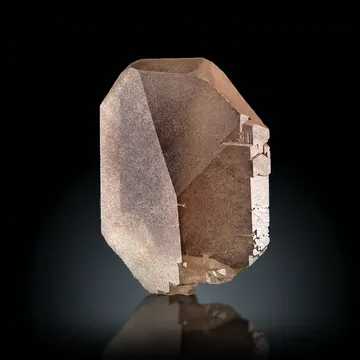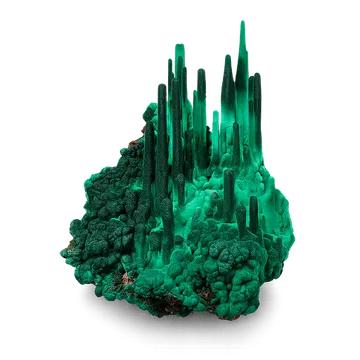
Malachite from Chessy Copper Mines, France - sharp pseudomorphs after cuprite, deep green color, often with azurite, a historic European copper-oxide classic.
Key facts
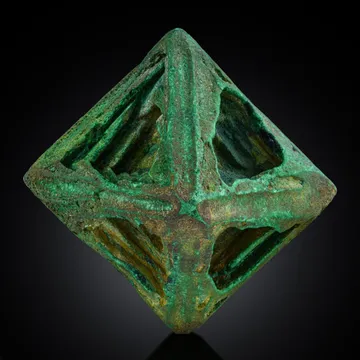
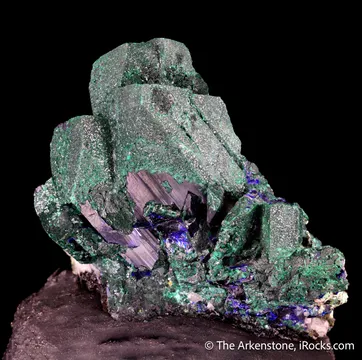
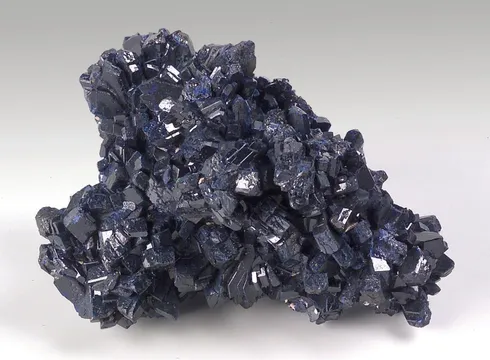
Malachite from the Chessy Copper Mines is not the banded lapidary malachite of the Congo or the plush botryoidal material of Arizona. Its great collecting identity is sharper, older, and more mineralogical: green malachite preserving the forms of earlier copper minerals in one of Europe’s most storied copper-carbonate localities. The most prized pieces are pseudomorphs—especially malachite after cuprite—where green copper carbonate has retained the octahedral, dodecahedral, or modified octahedral outline of the original cuprite crystal. Many of these sit on, or are associated with, Chessy’s famous azurite, the deep-blue “chessylite” that made the locality internationally known.

Photo: Wikimedia Commons
The appeal is partly visual—old European green against deep blue, angular forms instead of soft botryoids—but also historical. Chessy is the classic French source that put “chessylite” into the collector’s vocabulary, and its specimens entered European collections during the great nineteenth-century age of systematic mineral collecting. Malachite here is inseparable from that story. It occurs in the oxidized copper assemblage of the celebrated Mine Bleue, in Triassic sandstones and clays charged by copper-bearing acidic waters derived from the oxidation of a deeper sulfide system.
Geologically, Chessy is an unusually elegant accident. A Devonian sulfide body in volcanic rocks of the Brévenne basin was later brought into close structural relationship with carbonate-bearing Triassic sediments. Oxidizing fluids mobilized copper from primary sulfides and encountered carbonate-rich sandstones and clays, precipitating azurite, malachite, smithsonite, cuprite, and related secondary minerals. The result was a deposit that is famous not merely because it produced copper, but because its chemistry and structure produced display-quality mineral specimens with strong color, recognizable crystal form, and a remarkably early collecting history.

Photo: Wikimedia Commons
Collectors look for three things above all: convincing old Chessy form, strong green malachite color, and association. A freestanding or nearly freestanding malachite pseudomorph after cuprite is immediately recognizable when the octahedral geometry is sharp and the faces are clean. Pieces with blue azurite matrix or residual azurite are especially desirable, as are examples with older European labels. Fine Chessy malachite is not common in quantity; the mine is long closed, and the best material is either nineteenth-century “époque mine” material, old collection pieces, or limited material recovered from managed dumps.
Search for specimens: View all malachite specimens from Chessy Copper Mines, France
The Chessy Copper Mines are at Chessy-les-Mines in the Rhône department, northwest of Lyon, in the Auvergne-Rhône-Alpes region of France. The historical mine group is often listed mineralogically as the Chessy copper mines, Chessy, Villefranche-sur-Saône, Rhône, Auvergne-Rhône-Alpes, France. The locality lies on the eastern margin of the Massif Central, in a setting where Devonian volcanic and volcano-sedimentary rocks of the Brévenne basin meet Mesozoic sedimentary cover along faulted contacts.
The deposit is a copper-zinc sulfide system with important secondary copper-carbonate mineralization. The primary mineralization is described as stockwork-style, with baryte, galena, sphalerite, chalcopyrite, and pyrite hosted in altered soda-dacitic volcanic rocks near the Devonian Brévenne rift. Later Triassic clays and sandstones covered or came into structural contact with the ore system; hydrothermal and supergene processes then created the famous oxidized assemblages. In the Mine Bleue, copper-bearing acidic waters reacted with carbonate-bearing Triassic sandstones and clays, producing the azurite and malachite assemblages that made Chessy a world locality.
Historically, miners and engineers distinguished several “mines” or ore zones. The Mine Jaune was the yellow mine, with pyrite and chalcopyrite in the altered volcanic rocks. The Mine Noire was associated with reduced black copper-bearing material, including tenorite and native copper in altered zones near the dacite/Triassic contact. The Mine Rouge carried oxidized copper ore, especially cuprite and limonite, in red clay along a fault zone. The Mine Bleue was the legendary blue mine: highly oxidized ore in Triassic clays and sandstones, rich in azurite and accompanied by malachite, cuprite, smithsonite, halloysite, baryte, and other secondary minerals.
Mining at Chessy has deep roots. The mines were probably known in antiquity, were worked from at least the late Middle Ages, and were revived in the fifteenth century under the influence of Jacques Cœur. The decisive mineralogical event was the discovery of the Mine Bleue in 1811. That discovery transformed Chessy from a regional copper working into an international mineral locality. The Mine Bleue was exploited until its exhaustion in the 1840s; the wider Chessy copper workings declined in the nineteenth century and ceased underground production by the later 1800s. Sulfide-rich material from Chessy and nearby Sain-Bel also fed the development of sulfuric acid production, tying the mines to the industrial chemistry history of the Lyon region.
The old underground workings are not a collecting destination. The galleries are collapsed, flooded, sealed, or otherwise inaccessible, and natural surface exposures were worked out long ago. What remains at the locality are mine dumps, traces of old mine infrastructure, and a managed heritage landscape. The dumps were acquired by the Association Minéralogique de l’Arbresle Chessy-les-Mines, generally known as AMAC, which operates the site and organizes controlled searches. Permission and site rules matter here; Chessy is a historic and environmentally sensitive locality, not an open-access mine.
Notable finds include the classic azurite “fleurs de mine,” spherical or nodular crystallized masses that formed in the sandstone, and the famous green malachite pseudomorphs after cuprite. Chessy cuprite crystals were commonly octahedral or modified octahedral, and later replacement by malachite preserved those forms. Some examples still show dark cores, earthy iron-copper oxides, or blue azurite associations. A sharp malachite-after-cuprite octahedron from Chessy is one of the distinctive French classics: compact, sculptural, and instantly recognizable.
Chessy malachite occurs in several collector-recognized forms. The most characteristic is malachite replacing cuprite, preserving octahedral, dodecahedral, or modified octahedral crystal shapes. These pseudomorphs may appear as isolated green crystals, crystal groups, or malachite forms perched on azurite. Some are complete replacements; others show partial replacement or an exterior malachite skin over earlier cuprite. The best examples are sharp, geometric, and three-dimensional, with crisp edges and visible crystal architecture.
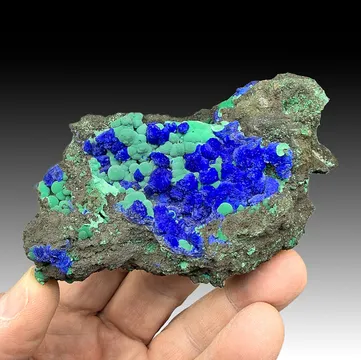
A second important habit is malachite replacing or accompanying azurite. In these specimens, the green may appear as fibrous coatings, velvety crusts, patches on blue azurite, or partial pseudomorphs after azurite crystals. Chessy azurite can occur as nodules, crystalline linings, and “fleurs de mine,” and malachite may mark alteration zones within or around those blue masses. Fine azurite-and-malachite specimens are admired for the strong blue-green contrast that is unusually tied here to a specific historical mine zone.
Malachite also forms small spheroidal and radial aggregates at Chessy. Documented examples include green spherules a few millimeters across and tiny “urchin”-like aggregates where radiating crystals stand apart rather than forming a closed sphere. This material is more micromount and small-cabinet in spirit than monumental, but it is highly locality-specific and appealing under magnification. Associated smithsonite, agardite-group minerals, and other secondary species can make these small specimens mineralogically rich.
Color ranges from medium green to bright saturated emerald green, sometimes with darker olive, blackish, or brown-stained areas from iron and copper oxides. The highest-quality malachite is strongly colored, not chalky, and not excessively iron-stained. On pseudomorphs, luster varies from silky to dull to subtly sparkling; a clean display face and retained original geometry usually matter more than glassy brilliance. On fibrous material, a lively radial texture can be attractive, especially when contrasted with deep blue azurite.
Size expectations should be realistic. Many Chessy malachite pseudomorphs after cuprite are thumbnail to small-miniature specimens, with individual replaced cuprite crystals commonly around the centimeter scale. Exceptional cuprite-derived forms can be larger, and older literature and specimen records document Chessy cuprite crystals reaching several centimeters, but large, sharp, undamaged malachite pseudomorphs are scarce. The common collector range is small, sculptural pieces rather than large cabinet plates.
Associated minerals are central to assessing Chessy malachite. Azurite is the most important association, both aesthetically and historically. Cuprite is the key precursor for the classic pseudomorphs. Smithsonite, halloysite, baryte, tenorite, native copper, goethite/limonite, chrysocolla, brochantite, connellite, agardite-group minerals, serpierite, gypsum, and other secondary species are all part of the broader Chessy assemblage. A good Chessy label should specify whether the piece is malachite, malachite after cuprite, malachite with azurite, or malachite after azurite, because those are meaningfully different collecting categories.
The strongest locality character is the combination of green malachite with old-world pseudomorph form. A Chessy specimen that merely shows green crusts is interesting; a Chessy specimen that preserves a cuprite octahedron is classic. A Chessy specimen that combines sharp malachite pseudomorphs, deep-blue azurite, old provenance, and minimal damage is the kind of piece that anchors a French suite.
Authenticity for Chessy malachite is primarily a locality and form question. The mineral itself is not difficult to identify, but good Chessy provenance is essential because malachite after cuprite occurs elsewhere. Look for old labels, documented collection history, typical Chessy associations, and morphology consistent with the locality. “Chessy” should not be used loosely for any green pseudomorph after cuprite; the best examples have the compact, sharp, historic French character collectors expect from this mine.
No well-documented, locality-specific plague of fabricated Chessy malachite pseudomorphs is evident in the standard online references consulted. The broader malachite market does contain fake banded malachite beads, imitation carvings, and reconstructed decorative material, but those are a different collecting category from old Chessy pseudomorph specimens. For Chessy, the greater risk is misattribution, over-optimistic labeling, repaired crystals, glued groups, or specimens from other localities sold into the prestige of the Chessy name.
Condition is a major value factor. Malachite after cuprite can be sharp but brittle, and projecting octahedral corners are vulnerable to bruising. Edge wear, rubbed faces, clay-filled recesses, old glue, matrix breaks, and repaired mounts all need inspection under magnification. Some pieces are naturally earthy or iron-stained; that is not necessarily damage, but it affects aesthetics. On azurite-associated specimens, watch for bruised azurite, color dulling, or crumbly altered areas along the boundary between blue azurite and green malachite.
Old Chessy pieces commonly carry complicated surfaces: residual cuprite, malachite replacement fronts, iron oxides, and sandy or clayey matrix. These should not be over-cleaned. Aggressive cleaning can remove historic patina, loosen friable secondary minerals, or dull fibrous malachite. Avoid acids; both azurite and malachite are copper carbonates and react readily with acid. Stable dry storage and gentle handling are preferred.
Rarity varies sharply by type. Simple small malachite or azurite-malachite fragments from Chessy are obtainable from time to time. Sharp malachite pseudomorphs after cuprite are much scarcer and more desirable. Fine examples with strong form, blue azurite association, and old provenance are genuinely classic European specimens and appear only intermittently. Pieces with nineteenth-century labels, museum deaccession or old institutional provenance, or named collection history carry a premium.
Current market availability is thin but not nonexistent. Specimens circulate through European dealers, auction archives, old collection dispersals, and occasional finds from controlled dump work. Many available pieces are small. The best specimens are usually sold as French classics rather than as ordinary malachite, and prices reflect form, association, provenance, and historical importance more than sheer size.
In the Chessy story, the great scene is always the opening of the Mine Bleue. Before 1811, Chessy was already a copper district with a long, uneven history, but the discovery of the blue ore changed its destiny. Miners entered a zone of Triassic sandstone and clay where copper-bearing waters had done something extraordinary: they had replaced carbonate cement and filled openings with azurite, malachite, cuprite, and smithsonite. The blue was not a surface stain. It occurred in nodules, fissures, crystalline masses, and vugs—the kind of ground that could turn a working copper mine into a supplier of mineral cabinets.
The old accounts give the Mine Bleue an almost theatrical scale. The most repeated legend says that some azurite geodes were large enough for a miner to enter. Whether one takes that literally or as the embroidery of nineteenth-century collecting culture, it captures the point: Chessy was not merely producing blue specks in rock. It was producing cavities, nodules, and crystallized masses capable of exciting museums, dealers, engineers, and miners alike.
The miners had their own name for one of the characteristic forms: “fleurs de mine,” flowers of the mine. These were spherical or nodular azurite masses formed in sandstone, where the carbonate cement had been replaced and the quartz and feldspar grains of the original rock remained embedded in the blue copper carbonate. Some showed only a little malachite; others preserved the texture of the sandstone so clearly that the specimen became both mineral and sedimentary memory. Under that name—fleurs de mine—the specimens bridge mine vocabulary and collector poetry.
There is a telling human economy behind the specimens. During the Mine Bleue years, miners and foremen supplemented their wages by selling azurite specimens to museums, collectors, and occasional visitors. The trade became visible enough that it entered the mineralogical literature. In 1838, Pierre Auguste Joseph Drapiez Brard wrote that workers had so abused the small gratuity allowed for samples offered to visitors that measures had to be taken to prevent the richest ore from being squandered; thereafter, one had to apply to the heads of the establishment to obtain specimens. Behind every old Chessy label is that tension: a cabinet specimen was also copper ore, and the most beautiful pieces were money twice over.
The numbers explain the temptation. The Mine Bleue was the most productive of the Chessy workings, yielding roughly 100 to 150 tonnes of copper metal per year during its active period. Other Chessy zones could be modest by comparison. In 1827, one account gives 180 workers, 914 tonnes of ore from the Mine Bleue, and only 3.4 tonnes from the Mine Rouge. Between 1812 and 1828, the Mine Bleue supplied about 4,000 tonnes of copper. Yet the same mine that produced industrial tonnage also produced the delicate crystallized specimens now found under glass in European collections.
The Mine Rouge, active for a shorter period beginning in the 1820s, adds the second great Chessy image: red clay in a fault zone, carrying cuprite crystals that later became green malachite pseudomorphs. The red clay band was only a few meters thick, but it produced some of the forms that modern collectors most associate with Chessy malachite. A cuprite octahedron is a precise thing; when malachite preserves it, the result is both replacement and sculpture. The green crystal is not shaped as malachite would normally grow—it is the ghost architecture of cuprite.
The later history is less romantic but no less important. By the 1830s, Chessy’s mining activity was declining and the operating company turned increasingly toward sulfuric acid production from ore, dumps, and regional sulfide sources. In 1857, a major collapse of old workings reportedly ended remaining hopes for much underground extraction. The mine that had sent blue and green specimens across Europe moved from production into memory, then into heritage.
A last modern episode belongs to the BRGM exploration campaign of the late twentieth century. In the years around 1978 to 1980, geophysical work identified a deep anomaly beneath the old mine area. Between 1983 and 1986, drillholes, a decline, and reconnaissance galleries investigated a sulfide mass 200 to 300 meters below the surface—deeper than the old miners had worked. The newly recognized resource was large enough that production on the order of thousands of tonnes per year was considered, but changing economics and political-environmental realities kept it from becoming a new mine. The galleries were sealed, and the deep sulfide body remains inaccessible. For collectors, that means Chessy’s great malachite story remains what it has always been: a nineteenth-century oxidation-zone miracle, not a modern mining product.