






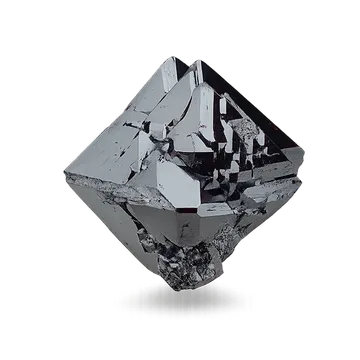
Cuprite from Chessy copper mines, France — a European classic with sharp red octahedra often mantled by malachite and azurite, prized for provenance.
Key facts
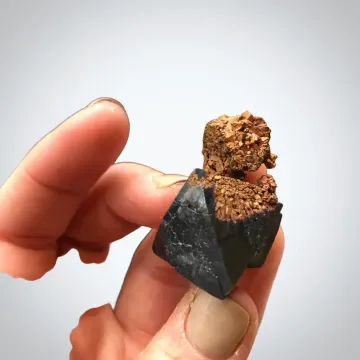
Cuprite from the Chessy copper mines is one of the great small-scale classics of European mineral collecting: compact, sharp, often freestanding crystals whose deep red to purplish cuprite is partly or wholly mantled by green malachite, sometimes perched dramatically on the dark blue azurite that made Chessy famous under the old name “chessylite.” The Chessy aesthetic is not about large cabinet-sized cuprite masses; it is about form, contrast, and pedigree. A fine specimen may be only a centimeter across, yet show a crisp octahedron, a modified octahedron, or a dodecahedral form with enough green replacement to read instantly as a Chessy piece.

Photo: Wikimedia Commons
The locality’s mineralogical identity comes from the unusual meeting of copper-bearing Devonian volcanic-hosted sulphide mineralization with Triassic sedimentary rocks and later oxidation. The older orebody supplied chalcopyrite, pyrite, sphalerite, galena, baryte, and related sulphides; supergene and hydrothermal alteration then produced the celebrated suite of azurite, malachite, cuprite, native copper, tenorite, smithsonite, chrysocolla, and other secondary species. Cuprite was especially important in the “Mine Rouge,” where it occurred in red clay along a fault zone, and it also appears in the classic collector association of malachite after cuprite on azurite.

Photo: Wikimedia Commons
Historically, Chessy belongs to the same old-world collecting tier as Tsumeb, Bisbee, and the Saxon classics—not for abundance today, but for the way its specimens entered the foundations of European mineralogy. The blue copper carbonate from Chessy enriched early nineteenth-century collections and literature; the green pseudomorphs after cuprite became, for serious collectors, a visual shorthand for the locality. A sharp Chessy cuprite or malachite-after-cuprite crystal with old provenance is therefore both a mineral specimen and a historical object.
Search for specimens: View all cuprite specimens from Chessy copper mines, France
The Chessy copper mines are at Chessy-les-Mines, in the Rhône department northwest of Lyon, within the Brévenne volcano-sedimentary belt on the eastern margin of the French Massif Central. The deposit is best understood as a Devonian copper-zinc sulphide system, developed in altered volcanic rocks and later overprinted by faulting, sedimentary cover, hydrothermal circulation, and oxidation. Older descriptions divide the workings into the “Mine Jaune,” “Mine Noire,” “Mine Rouge,” and “Mine Bleue,” a practical miners’ taxonomy that remains remarkably useful to collectors.
The Mine Jaune represented the primary sulphide side of the system, especially chalcopyrite and pyrite in altered volcanic rocks. The Mine Noire was a reduced secondary copper zone with tenorite and native copper in altered material near the contact of the volcanic rocks and Triassic cover. The Mine Rouge was the cuprite ground: a red, ferruginous clay and fault-breccia zone carrying cuprite and native copper. The Mine Bleue, opened in 1811, was the source of the azurite that made Chessy a household name among mineralogists; it occurred where copper-bearing acidic solutions interacted with carbonate-cemented Triassic sandstone, precipitating azurite, malachite, smithsonite, and associated copper minerals.
The mining history is long, but not all early claims carry the same weight. The site is often described as having ancient or Roman activity; the secure written record is much firmer from the late medieval period, especially the fifteenth-century revival associated with Jacques Cœur and the Lyonnais mining interests. A major eighteenth-century phase followed under the Jars, Blanchet, and Pernon interests, with copper smelting and refining tied to the wider industrial history of Lyon. By 1810 the older workings were deep and poor enough that closure seemed likely; the discovery of the Mine Bleue by the Saxon master miner Christian Traugott Wöllner changed the future of Chessy almost overnight.
The most important specimen-producing period was the first half of the nineteenth century. The Mine Bleue was discovered in 1811 and was essentially exhausted by the 1840s; the Mine Rouge worked cuprite-bearing red clays particularly during the 1825–1833 period. Contemporary and later technical accounts describe careful washing, breaking, hand sorting, screening, stamping, and concentration of the ore. The cuprite-bearing material was not merely a collector’s curiosity: it was part of the copper ore stream, and the red oxide was treated mechanically along with the carbonate ores.
Underground access is not a collecting possibility today. The historical galleries are collapsed, flooded, or sealed, and no natural outcrop of the old ore zones remains available at surface. The old dumps have been heavily searched for generations. Modern collecting is associated with the old waste areas and with the local mineralogical association, the Association Minéralogique de l’Arbresle Chessy-les-Mines, which has stewarded the site and organized searches. Anyone considering field activity should treat Chessy as a controlled historical mining site, not an open collecting ground.
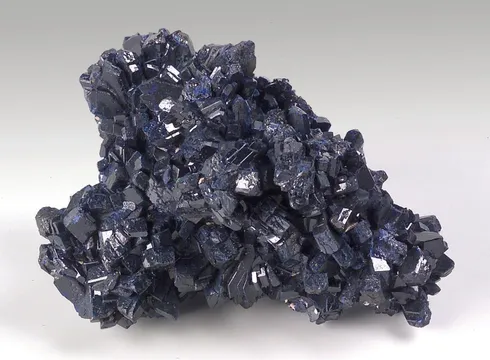
Notable finds from Chessy include dark blue azurite “flowers of mine,” rounded nodules and spheroidal aggregates, sharp azurite crystals, cuprite crystals, malachite after cuprite pseudomorphs, and rare azurite after cuprite pseudomorphs. The classic cuprite specimens are usually thumbnails: red to purple cuprite crystals partly greened by malachite, or full malachite pseudomorphs preserving the octahedral or dodecahedral cuprite form. The most desirable pieces combine those forms with azurite matrix, making a three-color specimen that could scarcely be mistaken for any other European locality.
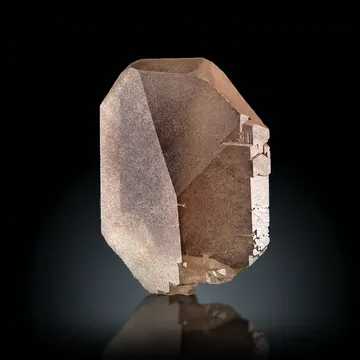
Chessy cuprite is prized first for crystal form. The standard crystal is octahedral, commonly modified and sometimes with bevelled edges; dodecahedral forms are also well documented. Hoppered or depressed growth surfaces on the crystal faces are a particularly attractive feature when preserved cleanly. Many crystals are “floaters,” complete or nearly complete all around, which gives even thumbnail specimens a sculptural presence.
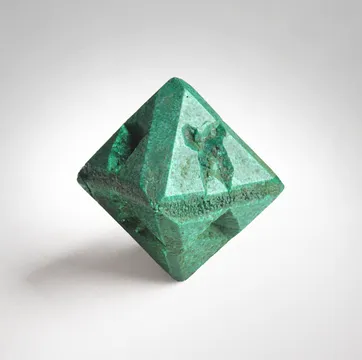
Color ranges from deep red and purplish red to dark brownish red where cuprite remains visible. Much of the famous Chessy material is partly or wholly altered to malachite, producing green octahedra and dodecahedra that preserve the original cuprite habit. The most evocative specimens show a red cuprite core or exposed face beneath a green malachite coating; others are complete malachite pseudomorphs after cuprite, valued not for the remaining red oxide but for the perfection of the cuprite form. Rarely, azurite replaces or overgrows the cuprite form, creating blue pseudomorphs after cuprite.
Size expectations must be realistic. Many good Chessy cuprites are 1 cm or less; strong thumbnails around 1–1.7 cm are already highly collectible. Documented examples include crystals around 1 x 0.9 x 0.9 cm, 1.5 cm loose octahedra, and 1.7 cm old classics. Groups and larger pseudomorphs occur, and some references note Chessy malachite-after-cuprite forms exceeding 3 cm, but those are exceptional and should be judged carefully for condition, form, and provenance.
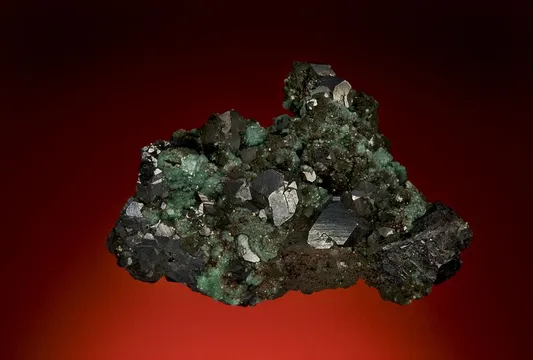
The essential associations are azurite and malachite. Chessy’s most coveted cuprite-related specimens are green malachite-after-cuprite crystals sitting on blue azurite, or red cuprite partially mantled by malachite on azurite. Native copper may accompany the red-clay Mine Rouge material. In the wider deposit, associated minerals include tenorite, limonite, smithsonite, halloysite, baryte, chalcopyrite, pyrite, sphalerite, galena, chrysocolla, and other secondary copper species. Specimens with blue azurite matrix and sharply isolated green pseudomorphs have the strongest locality “signature.”
Quality is a matter of geometry and survival. Sharp edges, undamaged terminations, all-around completeness, visible octahedral or dodecahedral form, and a clean contrast between green malachite, red cuprite, and blue azurite are the premium features. A single freestanding pseudomorph with no bruised corners can be better than a larger but shapeless mass. Old labels matter greatly, because the best Chessy cuprite material is historical and because locality confusion is easy when small green pseudomorphs are detached from their matrix.
Authentic Chessy cuprite is usually small, old, and specific in habit. The safest acquisitions are specimens with a convincing old label, a recognized collection history, or publication-quality provenance from a reputable dealer. Loose green octahedra are attractive, but without matrix or documentation they require caution: the market has seen malachite-after-cuprite from other localities, and some Arizona pieces can superficially evoke the Chessy look. A blue azurite association helps, but it is not a substitute for provenance.
No well-documented pattern of fabricated Chessy cuprite fakes appears in the standard collector references consulted, and one current cuprite reference explicitly notes no known fakes for the species. That said, malachite as a material is widely imitated in decorative objects, and general malachite fakes, resin reconstructions, and glued composites do exist in the broader market. For Chessy specimens, the more realistic risks are misattribution, repaired crystals, glued-on or reattached floaters, enhanced display mounting, and optimistic “cuprite” descriptions applied to complete malachite pseudomorphs where no red cuprite is actually visible.
Condition issues are common because the very features collectors prize are vulnerable. Octahedral corners nick easily; hoppered faces collect dirt and glue; azurite matrix can be friable; and old specimens may have been trimmed, cleaned, or mounted repeatedly over two centuries of collecting. Under magnification, look for bruised vertices, bright fresh breaks on dark red cuprite, glue at contact points, and mismatched matrix around a supposedly attached crystal. A pristine one-centimeter floater is not “too small”—for Chessy, it may be exactly the size and format of the best material.
Rarity is real. The underground mines are closed and inaccessible, the principal specimen-producing zones were exhausted in the nineteenth century, and the dumps have been worked hard by generations of French collectors. Good cuprite and malachite-after-cuprite specimens appear episodically from old collections, estate dispersals, European dealers, and occasional auction lots. Public market records show strong interest even in thumbnails: a small complete malachite-after-cuprite floater sold for several hundred dollars in 2021, while finer old pseudomorphs with strong labels or multiple sharp crystals have reached the low thousands. The market rewards sharpness, old provenance, and the classic blue-green-red association far more than bulk.
By the early nineteenth century, Chessy seemed to be running out of chances. The older copper workings had deepened, the ore had become poorer, and by 1810 the miners were even taking out support pillars in anticipation of closure. Into that exhausted mine came Christian Traugott Wöllner, a Saxon master miner brought in for his practical skill. His search gallery was driven southeast to test whether a lateral branch of the pyritic copper vein might exist. Instead, the gallery left the old “primary” ground and entered sandstone without the miners realizing they had crossed into a different geological world. That mistake became the mine’s great discovery. The drift reached the copper-rich beds of what would become the Mine Bleue, and Chessy found the orebody that no rule of mining practice had predicted.
The Mine Bleue turned the village name into mineralogical shorthand. Accounts speak of azurite geodes so large that a miner could enter them, and of a “blue grotto” whose walls glittered in shades of blue. The image is tantalizing because no photograph of the Mine Bleue’s great cavities appears to survive; the mine had closed before photography was truly practical in such a setting. What remains are the specimens—spherical aggregates, rosettes, nodules, and crystal groups scattered through European collections—and the written accounts of visitors and engineers trying to convey what had been opened underground.
For cuprite collectors, the most vivid chapter is the Mine Rouge. From about 1825 to 1833, miners worked a red clay zone in a fault, only 2 to 4 meters thick, carrying cuprite and native copper. The name was literal: red clay, red copper oxide, and iron-rich material in a vertical fault band. It was small beside the celebrity of the Mine Bleue, but it supplied the material that would later fascinate collectors as sharp red crystals and green malachite pseudomorphs after cuprite. In 1827, while the Mine Bleue employed around 180 people and produced 914 tonnes of ore, the Mine Rouge produced only 3.4 tonnes. That disparity explains much about the collector market today: the cuprite classics came from a narrow and short-lived source within an already historic mine.
Specimens were part of the human economy of Chessy almost from the beginning. During the Mine Bleue years, miners and foremen supplemented their wages by selling crystals to museums, collectors, and rare visitors. The practice became troublesome enough that later accounts describe measures to stop the richest ore from being “dilapidated” through specimen sales. To modern collectors that word sounds harsh, but it captures the tension of the place: every fine azurite or cuprite was at once a scientific specimen, a tourist object, a miner’s gratuity, and copper ore.
The scientific world noticed quickly. In 1813, Nicolas Louis Vauquelin wrote of specimens sent to René Just Haüy, including “beaux cristaux solitaires” of blue copper carbonate and associated substances. The phrase matters because it shows what early crystallographers wanted: detached crystals, clean enough to measure and compare. Today, collectors often prefer an aesthetic matrix specimen, but the early nineteenth-century savant wanted form above all. Chessy supplied that form in abundance for azurite, and in miniature perfection for cuprite and its malachite pseudomorphs.
After the blue and red riches waned, Chessy’s story shifted from specimen mining to industrial chemistry. The Perret brothers acquired the mine in 1839 and turned attention toward sulphuric acid from pyrite, part of the industrial base that helped shape the Lyon chemical region. The mine and plant disappeared in 1877, but the chemistry did not end neatly. A century later, acidic mine waters still carried dissolved copper from the old workings; the water was passed through wooden channels containing scrap iron, and copper precipitated onto the iron by metal exchange. Even after closure, Chessy was still yielding copper—about 800 kilograms a year in the 1970s—long after the great crystals had vanished into collections.
.jpg)
