A collector's guide to Cerro Warihuyn, Peru: its geology, mining history and notable minerals, illustrated with the 47 specimens documented from this locality on EarthWonders.
Key facts
Cerro Warihuyn is a compact modern classic among Peruvian mineral localities: a high-Andean barite occurrence near Miraflores in Huamalíes Province, Huánuco, where relatively small, erratic hydrothermal veins produced specimens of exceptional delicacy. Its importance to collectors rests not on bulk production but on one memorable visual formula—thin, glassy, tabular barite blades, commonly honey-yellow, smoky, gray-blue, or nearly colorless, standing freely on pink to cream dolomite. In the finest pieces the crystals have the transparent “windowpane” quality, sharp beveled edges, and airy three-dimensional placement that separate first-rate display specimens from ordinary barite.
The locality sits within a broader central Peruvian polymetallic setting. Prospecting and small mine workings around Miraflores followed silver-lead-zinc mineralization, with pyrite, marcasite, calcite, dolomite, and barite appearing in the vein system. The collectible barite formed in open cavities and fractures, so the best specimens are not massive vein chunks but pocket pieces: isolated blades, stacked laminae, offset parallel groups, and gemmy compound crystals on carbonate matrix. Many labels preserve alternate spellings—Huarihuyn, Huarihuayin, Warihuayin, and Huari Huayin—which all refer to the same hill/mountain locality.
Regional View
Country View
Cerro Warihuyn’s reputation was made in the early to mid-2000s. Earlier material reached the market with little fanfare, but the 2005 finds brought water-clear to golden tabular crystals of much higher quality, and another important recovery followed in 2008. That short production window created a familiar but finite supply: enough specimens to make the locality known worldwide, not enough for fine examples to become commonplace. Today the best Warihuyn pieces are collected as modern classics of South American barite.

Photo: Ivar Leidus, Wikimedia Commons

Search for specimens: View all specimens from Cerro Warihuyn, Peru
Cerro Warihuyn is recorded as a hill or mountain locality at about 2,850 meters elevation near Miraflores, in the Miraflores District of Huamalíes Province, Huánuco, Peru. Older and dealer labels may give the locality as Warihuyn Hill, Huarihuyn, Huarihuayin, or Huari Huayin, and Fabre Minerals labels commonly include the Puños–Miraflores–Huamalíes–Huánuco hierarchy. The name variations matter in commerce: attractive golden and smoky Peruvian barites labelled only “Huánuco,” “Dos de Mayo area,” or with a phonetic Huarihuyn spelling are often worth checking against Cerro Warihuyn material.
The deposit is best treated as a small hydrothermal, polymetallic vein and vug occurrence rather than a large industrial barite mine. The Miraflores area contains erratic silver-lead-zinc vein mineralization in fractured intrusive country rock described in collector literature as quartz-monzonite and granite. Late-stage fluids and gases opened cavities in some veins, allowing unrestricted growth of tabular barite with dolomite, calcite, pyrite, marcasite, and minor hematite. This open-space growth is the reason the locality produced freestanding blades and balanced cabinet pieces rather than only massive barite.
The ore bodies were small and irregular. Public specimen literature describes prospect holes, exploration tunnels, and small underground workings on the slopes of Cerro Huarihuyn/Warihuyn, with the known metal mineralization considered subeconomic in earlier exploration campaigns. In the 1990s, higher silver and base-metal prices renewed interest in Miraflores; high-grade hand-cobbed silver-lead-zinc ore was reportedly hauled south to the mill-and-smelter center of Cerro de Pasco. No major named operator is consistently attached to the collector specimens. The published story is instead one of local miners and small workings, with barite specimens moving through mineral dealers only after the miners transported them out of the district.
The historical arc is unusually short for a classic locality. Mineralized outcrops in the Miraflores district were reportedly noticed by Spanish prospectors as early as the late 1500s and revisited during later Peruvian mining booms, but the barite specimens that define Cerro Warihuyn did not become famous until the modern collector market. Material appeared before the main boom, yet the decisive finds were the 2005 pockets, followed by a further major recovery in 2008. Dealer archives also record pieces described as mined circa 2003–2004 and dated 2005–2007, showing that the productive specimen interval was concentrated in the early and mid-2000s.
Access today should not be assumed. Cerro Warihuyn is not a public collecting site, and the known workings are local Andean mine prospects, not an organized fee-dig or tourist locality. Anyone contemplating a visit would need current permission from land and mineral-rights holders, local guidance, and appropriate mine-safety precautions. For most collectors, provenance will come from old dealer labels, auction histories, and specimen records rather than from field collection.
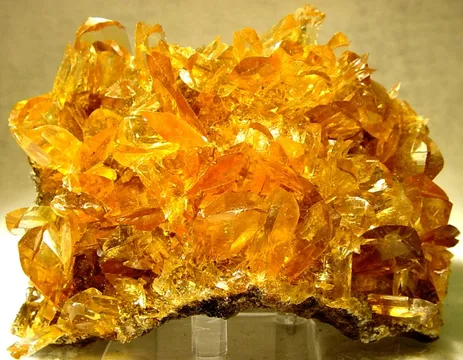
The notable pockets produced specimens across the miniature to cabinet range, with the highest-value pieces showing clean architecture rather than sheer size. Commonly reported specimen sizes include miniatures around 4–6 cm, small cabinets around 6–9 cm, and larger cabinet pieces exceeding 10 cm; Gemdat records tabular yellow to brown crystals to 10 cm and up to about 5 mm thick. Classic examples show transparent tabular crystals perched on pastel dolomite; some have sulfide speckling, pyrite or marcasite accents, smoky internal zoning, or sharply defined phantoms. A few dealer records describe nearly colorless crystals, blue-gray to silvery crystals, mint-green tinges, and rich golden-yellow blades.
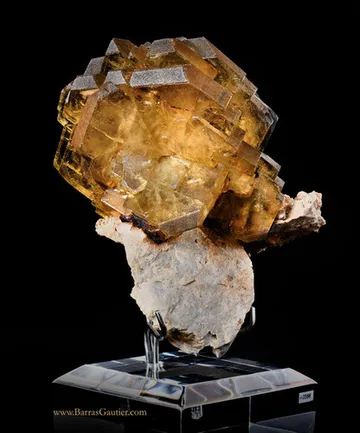
Barite from Cerro Warihuyn is the locality’s defining mineral and one of the most recognizable modern Peruvian specimen styles: BaSO4 in thin tabular to bladed crystals, with broad glassy faces, beveled edges, and frequent parallel or polycrystalline growth. The best pieces range from thumbnails with a single dominant honey blade to small-cabinet and cabinet specimens with crystals around 2–5 cm, while published gem records note crystals to 10 cm; color spans colorless, smoky, gray-blue, minty, pale brown, and the coveted deep honey-yellow. The classic association is pink or cream dolomite, often sprinkled with marcasite or pyrite microcrystals, and top quality here means transparency, undamaged rims, an “aerial” crystal arrangement, and enough matrix contrast to make the blades appear to float rather than lie flat.
Under the international spelling “baryte,” Cerro Warihuyn material is best represented by the European dealer-label tradition, especially Fabre Minerals specimens from the 2005–2007 period and later reference pieces. These are typically described as fine, very sharp, tabular to laminar crystals, transparent to translucent, lustrous, and either smoky or intense yellow on dolomite matrix, with main crystals commonly around 2–4 cm and exceptional groups arranged as offset blades or doubly terminated plates. Many good examples show zoned or minor fluorescence under both longwave and shortwave UV, and the finest barytes from this locality are those in which the plate edges remain complete, the crystal group rises cleanly above the carbonate, and the color is saturated without sacrificing internal clarity.
Dolomite at Cerro Warihuyn is chiefly the matrix mineral that gives the barite its unmistakable setting: pale cream to pastel pink rhombs and aggregates, locally described as manganese-bearing, covering small mounds, breccia fragments, or layered matrix beneath the barite. It is not usually collected here as a standalone species; its value is compositional, providing color contrast, texture, and evidence of the carbonate-rich pocket environment. Good dolomite on Warihuyn specimens is clean, sparkling, and sculptural enough to frame the barite without overwhelming it, while ordinary pieces have dull, broken, or dirtied carbonate that weakens the otherwise elegant blade-and-matrix presentation.
Other minerals documented from Cerro Warihuyn are few but useful for confirming locality context. Mindat records calcite, pyrite, marcasite, hematite, and manganese-bearing dolomite in addition to baryte and dolomite. Pyrite and marcasite most often appear as small metallic accents or specks on the carbonate and can contribute dark internal zoning or phantom-like growth lines in the barite. Hematite is a rarity here, recorded as tabular crystals on dolomite with baryte. No type-locality mineral is documented for Cerro Warihuyn in the standard online locality records; its significance is not taxonomic novelty but the exceptional specimen quality of a narrow barite-producing episode.
Condition is the central buying issue. Cerro Warihuyn barite blades are often thin, exposed, and brittle, with broad faces and vulnerable beveled rims. Tiny cleaves, bruised corners, edge rubs, and contacts from extraction are common; some are minor and acceptable, while others destroy the floating-windowpane look that makes the locality desirable. Examine the main crystal edges with a loupe, especially the upper bevels and projecting corners. At the same time, do not mistake every stepped edge for damage: some Warihuyn barites show natural stepped growth, polycrystalline rims, or overgrowth textures that can look chipped until closely inspected.
There are no well-established locality-specific fake assemblages or routine treatments tied to Cerro Warihuyn in the major public records and dealer literature. The more realistic concern is mislabelling. Early examples may have been sold under broad Huánuco or “Dos de Mayo” labels, and the locality name has several spellings. A convincing specimen should match the known style: tabular transparent to translucent barite, commonly golden, smoky, gray-blue, or colorless, on pinkish to cream dolomite, with possible pyrite or marcasite accents. Be cautious of unusual associated species not recorded from the locality unless the specimen has strong analytical or provenance support.
Fluorescence is a bonus, not the principal value driver. Fabre Minerals documented Warihuyn barites with zoned fluorescence under longwave and shortwave ultraviolet light, and dealer records mention soft yellow to bright longwave response in some pieces. Because response can vary, buy the specimen first for daylight aesthetics—clarity, form, color, matrix, and condition—then regard fluorescence as an added diagnostic and display feature.
Market availability is intermittent. Lower-grade and small damaged examples still appear, but clean, balanced miniatures and small cabinets from the 2005–2008 production window have become increasingly desirable. Auction records show modest examples selling in the low hundreds, while especially aesthetic, pristine, well-provenanced pieces can climb much higher. Rich golden color, intact edges, strong three-dimensional architecture, and old labels from respected dealers or collections all add value.
The Cerro Warihuyn story begins with a name that refused to sit still. The Quechua-rooted Huarihuyn was anglicized and hispanicized in several ways, and collectors now encounter Warihuyn, Huarihuyn, Huarihuayin, Huari Huayin, and Warihuayin on labels. For a locality whose great specimens came from such a short market window, that spelling drift has become part of the hunt. A specimen labelled only “Huánuco” or “Huarihuayin Mt.” can be a quiet clue, especially when the object itself shows the telltale glassy tabular blades on pale pink dolomite.
The published collector account gives Cerro Huarihuyn an almost paradoxical status: an 8,835-foot mountain that is a “hill” by Andean standards. Its slopes were marked by prospect holes and exploration tunnels, yet the mineralization was too erratic and small to become a celebrated ore mine. The collectible crystals came out of that marginality. Late-stage fluids left barite in cavities where it could grow freely; later erosion exposed pieces of the vein system; local miners opened small workings; and only then did the specimens begin their difficult journey toward the international market.
That journey was physical, not romantic. Dealers did not routinely travel into the remote Miraflores district just for barite. Instead, miners had to get the specimens to Cerro de Pasco, the smelting and milling town about 80 miles south, using rough roads and the same practical transport available for ore. Thin bladed barite is not an ideal passenger on heavy ore trucks, and suitable packing materials were scarce. The surprise, in the collector literature, is not that some crystals were chipped; it is that so many reached dealers at all with their beveled edges and transparent faces intact.
The 2005 find changed everything. Earlier pieces from Cerro Warihuyn had reached the international market in the late 1990s but did not create much excitement. Then came the better pockets: water-clear transparency, sharp crystal development, and sculptural groups on pink dolomite. Those specimens were praised at international gem-and-mineral shows, and the locality’s status rose quickly. A second major recovery in 2008 reinforced the reputation and gave collectors enough material to recognize a “Warihuyn look” at a glance.
Individual specimen records preserve the character of that period. Fabre Minerals documented a 2005–2006 specimen with tabular to laminar crystals on a small dolomite matrix and striking zoned fluorescence under UV. Their 2007 records include deep yellow, very transparent crystals described as different from the earlier material, with sharp faces and an aerial position on dolomite. One reference specimen measured 14.6 × 6.9 × 3.9 cm, with multiple transparent, slightly smoky crystals on matrix and zoned fluorescence—large enough to show the locality’s architecture at cabinet scale while still depending on delicate blade preservation.
Carles Millan’s publicly posted specimens give another snapshot of the 2008 material. One honey-colored group on matrix, extracted in summer 2008, measured 68 × 51 mm and weighed 149 g. Another specimen was nearly colorless: a 56 × 53 mm cluster of transparent tabular crystals, the major crystal only 22 mm wide and 3 mm thick, weighing 74 g and recorded with no damage. These are not enormous numbers, but they are exactly the dimensions collectors remember because they describe the essence of the locality—thin plates, clarity, modest matrix, and survival.
Auction descriptions from later years tell the afterlife of those finds. Pieces mined in 2004, specimens from the 2005 find, and mid-2000s examples from old collections repeatedly resurfaced with the same language: glassy, gemmy, tabular, beveled, pristine, golden, smoky, silvery-blue, on pink dolomite. One 2025 auction record explicitly notes that some early fine specimens were first seen under a “Dos de Mayo” area label in Huánuco before being confirmed as Cerro Warihuyn. That is the modern collector’s fieldwork: not climbing the hill, but reading labels, dates, spelling variants, matrix, and crystal habit until the provenance comes into focus.