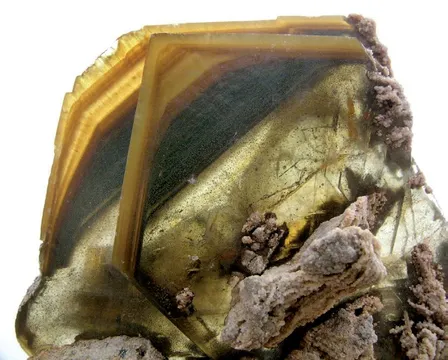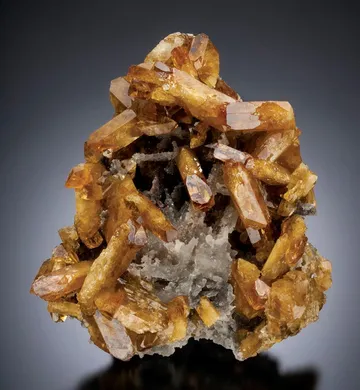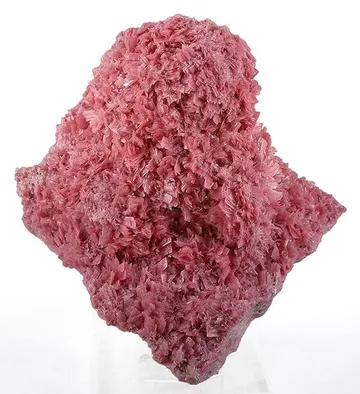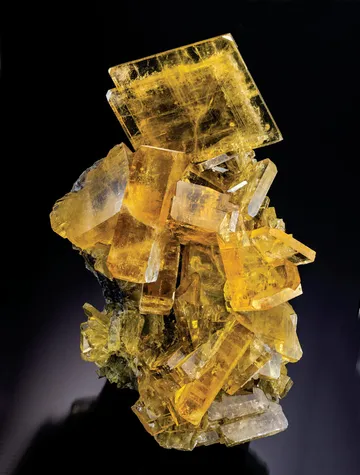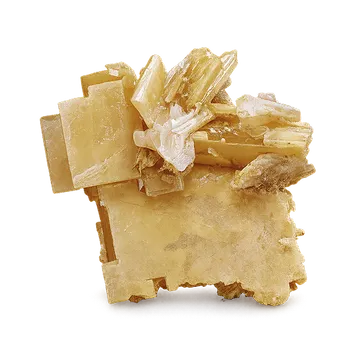
Barite, Cerro Warihuyn, Peru — famed locality with glassy honey-yellow to smoky-blue tabular crystals on pink dolomite, prized for clarity, form, and rarity.
Key facts
Cerro Warihuyn is one of the modern classic Peruvian barite localities: a compact, high-altitude specimen occurrence near Miraflores in Huamalíes Province, Huánuco, that became known to collectors for bright, transparent to translucent tabular crystals perched on pale carbonate matrix. The best examples have the qualities collectors want in barite but rarely get all together—thin blades, beveled edges, glassy luster, internal clarity, warm honey-yellow to smoky gray-blue color, and three-dimensional groups that seem to float above pinkish dolomite.

Photo: Ivar Leidus, Wikimedia Commons
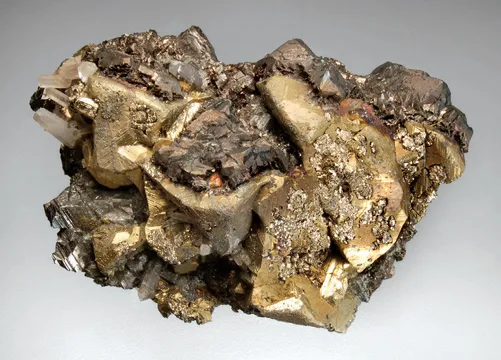
The locality’s identity is inseparable from its setting in the central Peruvian Andes, where small, erratic polymetallic vein systems carry pyrite, marcasite, calcite, dolomite, and barite. The barite grew in open spaces within veins, which explains why the finest specimens are not massive industrial barite but freestanding crystals with sharp outlines and open composition. Pink to cream dolomite is the signature matrix; pyrite or marcasite may appear as metallic microcrystals, dustings, inclusions, or dark phantom-like internal zoning.
Cerro Warihuyn also has a useful collector’s shorthand: if a specimen is unusually clean, thin, glassy, tabular, and honey-golden on pink dolomite, it is probably this locality—or being compared to it. Some pieces are nearly colorless and water-clear; others are smoky gray, blue-gray, minty, or golden yellow. The golden crystals have become especially desirable because they combine color with clarity and the sculptural “bladed” habit that displays so well under case lighting.

Photo: Robert M. Lavinsky, Wikimedia Commons
The locality’s fame rose quickly. Some earlier material was reported on the market before the main collecting boom, but Cerro Warihuyn became widely recognized after the strong finds of 2005, followed by further important production around 2008. Those years supplied the market with enough specimens to make the locality familiar, but not enough to make fine pieces common. Today, the best matrix examples—particularly undamaged golden blades with high transparency—are treated as modern classics rather than ordinary Peruvian barites.
Search for specimens: View all barite specimens from Cerro Warihuyn, Peru
Cerro Warihuyn, also seen on labels as Huarihuyn, Huarihuayin, Warihuayin, or Warihuayín, is a hill or mountain locality near Miraflores in Huamalíes Province, Huánuco Department, Peru. Mindat places the locality at roughly 2,850 meters elevation and treats it as a mineral-specimen occurrence rather than a large named industrial mine. The alternate spellings are not trivial: older labels, auction records, and dealer descriptions may use any of them, and good provenance often requires recognizing that all refer to the same Cerro Warihuyn specimen source.
The deposit is best understood as a small barite-bearing vein occurrence within a broader polymetallic district. Silver-lead-zinc exploration and small-scale underground work have been reported around Miraflores, with mineralized veins carrying sulfides and carbonates. At Cerro Warihuyn, barite occupies open spaces where crystals could grow freely; pyrite, marcasite, calcite, dolomite, manganese-bearing dolomite, and hematite are documented from the locality. Barite is the collector species here, not a byproduct of a major specimen mine with a long public production history.
The practical mining history is episodic. Specimen accounts describe the locality as remote and locally worked rather than a heavily dealer-accessed mine. The better-known collecting period began in the early to mid-2000s, with major recognition after the 2005 discoveries and another significant recovery in 2008. Dealer records also preserve labels for pieces mined in 2004, and some accounts mention earlier market appearances, so the cleanest way to read the history is that isolated earlier material existed, but the locality’s reputation was made by the 2005–2008 specimen production.
Collecting access should not be assumed. This is a local Andean occurrence, not a public collecting site. Permission, land and mineral-rights status, safety conditions, and local relationships would have to be established before any visit. Mindat’s own locality guidance is especially relevant here: mineral locality pages are reference information, not an invitation to collect.
The notable finds are defined less by huge size than by aesthetics and preservation. The classic specimens are miniatures to small cabinets: sharp tabular blades rising from dolomite, compound crystal groups with offset parallel growth, isolated gem crystals on contrasting matrix, and occasional pieces with pyrite or marcasite accents. The best examples are airy and transparent enough that light passes through the blades; this is one reason well-trimmed matrix specimens are so sought after.
Cerro Warihuyn barite is typically tabular to bladed, with flat, broad faces, beveled edges, and stacked or parallel growth that can resemble overlapping glass plates. Individual crystals reported in specimen and gem references commonly range from about 1 to 4 cm on collector pieces, with crystals to about 10 cm documented for the locality. The blades may be thin—sometimes only a few millimeters thick—yet still surprisingly heavy because barite is BaSO4 and has high specific gravity.
Color is one of the locality’s pleasures. The most familiar range is honey-yellow to golden brown, but specimens also occur colorless, smoky, gray-blue, pale blue, minty, silvery, and yellowish gray. Some crystals show subtle zoning, and dealer descriptions document phantom-like edges marked by tiny sulfide inclusions—likely marcasite or pyrite—lined up along internal growth zones. Under magnification these can give the crystal a shadowed rim without reducing its transparency.
The matrix is usually carbonate-rich, especially cream to pink dolomite. Manganese-bearing dolomite gives some pieces their warm pink base, and the contrast between pale matrix and glassy golden barite is a hallmark of fine specimens. Associated pyrite and marcasite may be scattered on the matrix, dusted across barite, or included within the crystals. Calcite is documented, hematite occurs as tabular crystals on dolomite with barite, and goethite, quartz, and siderite have been recorded in photo-associated data.
A strong Cerro Warihuyn specimen should have sharp blades, high luster, good transparency, and an uncluttered composition. On matrix pieces, collectors look for crystals set at lively angles rather than lying flat. The ideal matrix is trimmed enough to let light through the crystals but not so aggressively cut that the specimen loses context. Color matters, but clarity and edge quality matter just as much: a pale but water-clear and undamaged group can be more desirable than a richer golden piece with bruised rims.
Fluorescence is an interesting but secondary trait. Some auctioned specimens from the locality have been described as showing soft yellow fluorescence, and Fabre Minerals documented a specimen with sharply zoned UV response. It is not the main reason collectors buy Cerro Warihuyn barite, but it can add another layer of interest when paired with visible zoning.
The main collecting issue with Cerro Warihuyn barite is condition. Barite has perfect cleavage, modest hardness, and brittle edges, and this locality’s blades are often thin and exposed. Tiny chips, cleaved corners, bruised bevels, and rubs along the rims are common. Some damage can be difficult to see without magnification because stepped growth, natural beveling, and partial overgrowths can look like chipping at first glance. Always inspect the terminations and broad blade edges with a loupe.
Authenticity concerns are comparatively straightforward. The locality has a distinctive combination of tabular golden to smoky barite on pinkish dolomite with pyrite or marcasite accents, and there are no well-established, locality-specific fake assemblages or routine treatments associated with Cerro Warihuyn material in the major locality records and dealer literature. The more realistic concerns are mislabeled Peruvian barite, overly optimistic “perfect” condition claims, and repaired or reattached blades that are not disclosed.
Trimming deserves attention. Many good specimens are intentionally trimmed to remove excess matrix and allow light through the crystals. That is not a defect when done well; in fact, well-trimmed pieces can be far more displayable. But collectors should distinguish clean preparation from aggressive cutting, back-side sawing too close to the crystal bases, or matrix reduction that leaves a specimen unstable.
Market availability is moderate but uneven. Lower-grade miniatures and small cabinet pieces still appear regularly, including single crystals, loose clusters, and lots of smaller material. Fine matrix specimens with glassy, undamaged blades are harder to buy than the number of market listings might suggest. Recent dealer and auction records show everything from affordable small pieces to much more expensive top examples, with premium value concentrated in transparency, golden color, lack of edge damage, balanced matrix, and provenance to the mid-2000s finds.
The Cerro Warihuyn story is a good reminder that some modern classics did not come from famous corporate mines or a long-published district with generations of collectors at the dumps. The locality emerged from a remote Andean setting where local miners and villagers worked small occurrences and moved specimens through practical mining channels. According to collector accounts, dealers were not routinely traveling to the site for barite; specimens often had to make their way out from Miraflores toward the mining and smelting town of Cerro de Pasco.
That journey mattered. These are not tough quartz clusters that can be tossed into sacks. They are thin, glassy, cleavable plates of barite on matrix, exactly the kind of specimens that suffer when bounced over rough roads or packed with ore. Steve Voynick’s account of the locality captures the unlikely nature of their survival: miners transported pieces over rough terrain, often without the sort of careful packing a mineral dealer would use, and some material rode out with heavier ore shipments. The surprise is not that many pieces are chipped; it is that so many reached the market with their edges intact.
The 2005 finds changed the locality’s status. Earlier specimens had attracted little notice, but the water-clear barites with strong crystal development from 2005 were different enough to be praised at international shows. By 2008, another major recovery brought more material into circulation. That short interval is why collectors now speak of Cerro Warihuyn as a “modern classic”: it is recent enough that many pieces still carry dealer labels from their original market years, yet old enough that top examples are no longer casually abundant.
One of the small pleasures of the locality is that its best details are often hidden until close inspection. McDougall Minerals described a honey-yellow specimen whose outer crystal zones were marked by “thousands of micro crystals” lined up along a shadowy rim—probably marcasite or pyrite. On a display shelf it reads as a clean golden barite; under magnification it becomes a record of interrupted growth, sulfide precipitation, and renewed clarity inside the same crystal.