






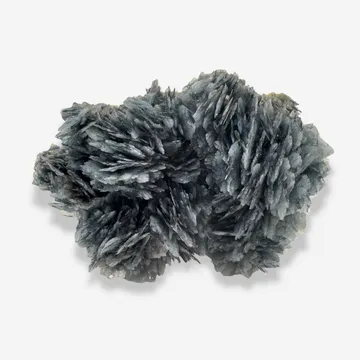
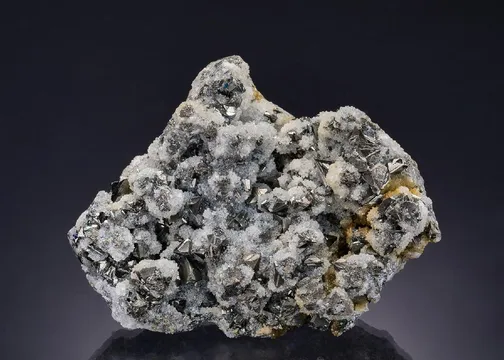
Cavnic, Romania — storied European locality for rhodochrosite and varied parageneses (chalcopyrite on sphalerite, baryte, quartz), highly valued by collectors.
Key facts
Cavnic is one of the classic names of European mineral collecting: the old Kapnik / Kapnikbánya mining camp of Maramureș, set in the Gutâi Mountains of northern Romania and belonging to the Baia Mare metallogenic district. Its veins are Neogene hydrothermal systems, best described for collectors as low- to intermediate-sulfidation epithermal base-metal–gold veins developed in volcanic and subvolcanic rocks, with carbonate-rich late stages that produced the display specimens for which the locality is famous. The district is not a single “one-look” locality. Cavnic specimens range from brassy chalcopyrite on black sphalerite, to pink rhodochrosite rosettes on quartz, to pale blue or honey baryte, to lustrous quartz-and-calcite groups accented by pyrite, galena, tetrahedrite, stibnite, and dolomite.
The best Cavnic pieces have a distinctly old-European architecture: stacked generations, sharp contrast, and a tendency toward busy but balanced association specimens rather than isolated single crystals. Quartz commonly provides the pale, sparkling framework; calcite, dolomite, baryte, and rhodochrosite add pale white, cream, pink, blue, or brown planes and rosettes; sulfides supply the metallic punctuation. In the finest examples, the eye moves across a whole paragenesis in miniature: transparent quartz points, black resinous sphalerite, bright chalcopyrite, pearly calcite, and patches of rose-pink manganese carbonate.
Regional View
Country View
Cavnic also matters historically. Rhodochrosite, now a global collector staple, has its accepted type locality at Cavnic, where early nineteenth-century work on rose-colored manganese carbonate fixed the name in mineralogical literature. Later scientific attention has kept the locality active in another way: modern studies of the Rotunda dump material documented uncommon Ca-Mn-Fe silicate assemblages including inesite, hubeite, ruizite, apophyllite, sudoite, manganoan ilvaite, specularite, siderite, sphalerite, pyrite, quartz, and native gold. For collectors, that means Cavnic is both a specimen locality and a research locality—one of those districts where cabinet aesthetics and mineralogical nuance overlap.

Photo: James St. John / Wikimedia Commons


Search for specimens: View all specimens from Cavnic, Romania
Cavnic lies in Maramureș County, in the Gutâi Mountains, east of Baia Mare. The mining district belongs to the Baia Mare ore field, a major Neogene volcanic-hosted metallogenic province of northwestern Romania. The Cavnic deposit is described in the modern literature as a carbonate–base-metal–gold system, with Pb-Zn-Cu-Au-Ag mineralization deposited in epithermal veins. The known vein system follows mainly NE-SW fractures; published work describes fourteen veins, roughly 400 to 1500 m long, 1 to 8 m thick, and with more than 900 m of vertical development. Neogene volcanic rocks host much of the system, while deeper and middle parts involve Paleocene–Miocene sedimentary formations and Pannonian-age dioritic bodies.
The most useful collecting framework is the paragenetic one. Cavnic’s mineralization is commonly divided into cooling stages: an early Fe ± W stage; a Cu-Fe stage; a Zn-Pb-Fe-Cu stage represented by sphalerite, galena, pyrite, and chalcopyrite; and a later manganese-rich stage with Mn silicates, carbonates, bournonite, tetrahedrite, and related minerals. A national mineral-resources synthesis gives a closely collector-friendly sequence: hematite, goethite, magnetite, pyrite, chalcopyrite, quartz, colloform silica, and chlorite in an early stage; then pyrite, galena, sphalerite, chalcopyrite, tetrahedrite, sulfosalts, quartz, and clay minerals; then a rhodochrosite-dominant stage associated with common sulfides, quartz, calcite, and gypsum.
The old mining names matter. Specimens are variously labeled Cavnic, Kapnik, Kapnikbánya, Cavnic Mine, Cavnic mining area, Bolduț Mine, Roata Mine, Rotunda dump, and occasionally with shaft or vein names. Serious labels should be preserved rather than “standardized” away, because the best old labels often retain historical mine names that are more specific than the modern town-level locality. Bolduț is especially prominent on modern specimen labels, particularly for quartz, chalcopyrite, rhodochrosite, sphalerite, baryte, calcite, and sulfosalt combinations. Roata is important both historically and as a mining sector associated with older workings and the Logolda gold-processing site.
Mining at Cavnic is documented in medieval and early modern records. The locality was already tied to gold and silver extraction in the late medieval period, and a 1455 decree granted privileges to miners who opened workings in Capnic. By the eighteenth century, mining expanded with new adits, shafts, and water-management works; nineteenth-century modernization brought new galleries, deeper shafts, improved processing, and eventually electrification. The Roata Mine was re-opened in the eighteenth century and later passed through private, British, concessionary, and state ownership. In the communist period, production was intensified; by the early twenty-first century, the mines that had been worked until 2007 were no longer active in the old production sense and were reported as being in conservation.
For collectors today, Cavnic is essentially a historic specimen locality, not a casual collecting destination. Underground access is closed or restricted, and mine dumps, old workings, and industrial ruins should be treated as hazardous and subject to local regulation. Most quality specimens on the market come from old mine production, old Romanian collections, historic European dealer stock, and collections dispersed from the 1960s through the early 2000s. The Rotunda dump is particularly important in the scientific literature because studied samples of the rare Ca-Mn-Fe silicate assemblage were collected there, but that does not make it an open collecting invitation.
The most notable specimen finds were not just “ore with crystals” but true open-space vein pockets. Cavnic produced bright chalcopyrite twins on quartz and calcite; black sphalerite with quartz, galena, pyrite, and chalcopyrite; pink rhodochrosite rosettes, coralloid crusts, and saddle-like rhombs; transparent to pale blue tabular baryte; tetrahedrite crystals on quartz; stibnite and realgar-bearing baryte; and calcite-dolomite-quartz plates with strong visual contrast. Old cabinet pieces often show several mineralizing pulses, and the best examples are valued as much for paragenesis and provenance as for any one crystal.
Quartz from Cavnic is the stage on which much of the locality’s drama plays out: colorless to milky prismatic crystals, drusy crusts, and locally more complex two-generation growths in which idiomorphic quartz is overgrown by fibrous or radiating quartz. It is commonly associated with sphalerite, galena, pyrite, chalcopyrite, calcite, dolomite, baryte, rhodochrosite, and tetrahedrite, and the best pieces are those where the quartz is not merely a white background but a crisp, lustrous framework carrying metallic sulfides or pink manganese carbonates in well-spaced contrast. Old Bolduț pieces with transparent quartz supporting brassy chalcopyrite twins, rhodochrosite rosettes, or lustrous tetrahedrite are far more desirable than massive vein quartz or indistinct druse, and rare lilac quartz has been documented in association with rhodochrosite and small yellow helvine.
Calcite at Cavnic is one of the locality’s great architectural minerals, occurring as white, cream, colorless, and locally pale pink manganese-bearing crystals that finish sulfide-quartz plates with rhombs, flattened forms, lenticular aggregates, and bladed or stepped growths. It is especially strong in associations with quartz, chalcopyrite, pyrite, sphalerite, galena, dolomite, rhodochrosite, and gypsum, and some specimens show the attractive contrast of pearly calcite over dark ore or beside brassy chalcopyrite. Good Cavnic calcite is judged by sharpness, luster, undamaged edges, and the role it plays in the composition; a sharp white calcite group on black sphalerite or golden chalcopyrite can outrank a larger but chalky mass, while pale pink material and calcite after earlier bladed minerals attract additional interest, especially when accompanied by old Bolduț or Roata provenance.
Sphalerite is a principal ore mineral at Cavnic and one of the key visual anchors of its specimens, typically appearing as lustrous brown to black crystals or aggregates associated with galena, chalcopyrite, pyrite, quartz, calcite, dolomite, baryte, and rhodochrosite. Published geochemical work places Cavnic sphalerite among the lower-iron sphalerites of the Baia Mare–Oaș region, while specimen material may still look dark because of crystal thickness, inclusions, surface films, or compact growth. Fine pieces show bright, well-defined sphalerite rather than dull massive ore, and the strongest collector examples use sphalerite as a glossy black counterpoint to white quartz, pearly calcite, golden chalcopyrite, pink rhodochrosite, or steel-gray sulfosalts; isolated high-quality sphalerite crystals are less common than association specimens.
Barite from Cavnic is best known as tabular, platy, or rosette-like crystals in colorless, white, honey, pale blue, gray, or locally included dark material, commonly in association with quartz, rhodochrosite, dolomite, calcite, realgar, stibnite, pyrite, and sphalerite. The most attractive pieces have open, glassy plates rather than blocky cleavages, and Cavnic’s distinctive charm often comes from color contrast: pale blue or water-clear barite on pink rhodochrosite, transparent plates rising from quartz, or barite carrying inclusions of stibnite or realgar. Damage along thin blade edges is common, so sharp undisturbed terminations, transparent interiors, and a convincing old locality label separate first-rank specimens from ordinary barite plates.
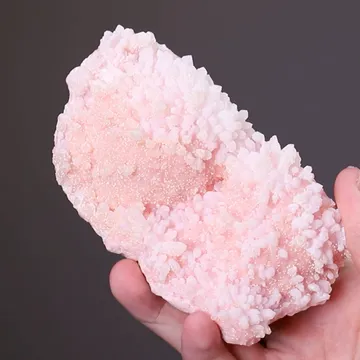
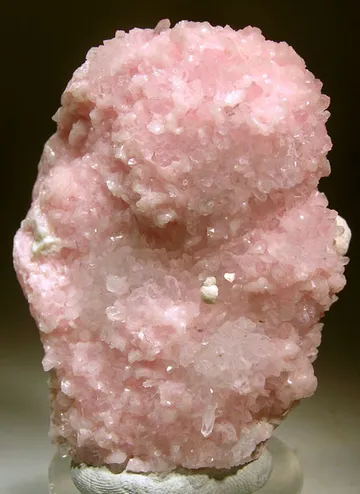
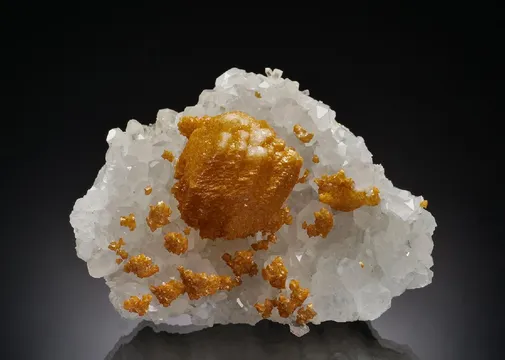
Rhodochrosite is Cavnic’s signature mineral and its great contribution to mineralogical history, with the Cavnic Mine accepted as the type locality for the species. Collector material ranges from pale to intense pink rhombohedra, flattened lenticular or saddle-shaped crystals, rosette aggregates, botryoidal to coralloid crusts of microcrystals, and vein sections showing rhodochrosite with quartz, pyrite, sphalerite, calcite, dolomite, and baryte. The finest pieces are not necessarily the largest: strong, uniform pink color; fresh luster; individual crystal definition; airy rosette or coralloid form; and sharp contrast against white quartz or dark sulfides are the features that distinguish classic Cavnic rhodochrosite from plain massive manganese carbonate. Old Bolduț specimens from the 1960s to 1980s are especially prized when accompanied by collection labels.
Chalcopyrite from Cavnic occurs as bright brassy crystals, commonly twinned and dominated by sharp disphenoid or bisphenoid forms, on quartz, calcite, sphalerite, galena, pyrite, and dolomite. Good Cavnic chalcopyrite is scarcer than the locality’s abundance of sulfide ore might suggest, and fine specimens are recognized by sharp crystal form, strong metallic luster, minimal iridescent alteration unless natural and attractive, and clean placement on contrasting white quartz or calcite. Documented high-quality examples include crystals around the 1.5 to 2.7 cm range on quartz or calcite-bearing matrix; pieces with dull coatings, bruised faces, or indistinct massive chalcopyrite are far less desirable than crisp twinned crystals with visible form.
Dolomite is a frequent companion mineral at Cavnic, forming cream, tan, reddish, gray, or pale sparkling rhombs and curved aggregates on quartz, calcite, chalcopyrite, pyrite, sphalerite, baryte, gypsum, and rhodochrosite. It often acts as a second-generation coating, softening and coloring earlier quartz or calcite while leaving sulfides exposed, and some specimens show dolomite after calcite or intergrown with calcite and gypsum. The best Cavnic dolomite is crisp and sparkly enough to add texture without burying the more important crystals beneath it; heavy dull coatings reduce value, while light preferential coatings on quartz, chalcopyrite, or sulfide matrix can make a piece more visually complete.
Pyrite at Cavnic is both an ore-stage mineral and a collector accent, occurring as small cubes, grains, crusts, and bright metallic crystals with quartz, sphalerite, chalcopyrite, galena, calcite, rhodochrosite, dolomite, siderite, and rare Mn-silicate assemblages. In studied Rotunda material, pyrite is associated with manganoan ilvaite and native gold in late low-temperature relationships, while in cabinet specimens it more commonly supplies the golden sparkle that animates white quartz, pink rhodochrosite, or black sphalerite. Good Cavnic pyrite is valued less as a stand-alone species and more for placement: sharp, fresh crystals distributed across quartz or carbonate make a specimen lively, whereas massive brassy patches or oxidized grains mainly serve as locality evidence rather than a focal point.
Baryte is the same mineral species as barite, but the older European spelling is often retained on labels for Cavnic, especially on specimens from older collections. Cavnic baryte is most desirable as lustrous tabular plates, open rosettes, or transparent blades with quartz, rhodochrosite, dolomite, realgar, stibnite, and calcite, and the locality is particularly appealing where baryte preserves inclusions or sits in balanced contrast with manganese carbonates. Collectors should look closely at the edges of platy crystals, because minor chipping is common; old, glassy, undamaged pale blue or colorless baryte on pink rhodochrosite or sparkling quartz is much scarcer and more important than massive baryte or isolated loose plates lacking association.
Tetrahedrite is one of Cavnic’s classic sulfosalts, occurring as steel-gray to black metallic tetrahedra or modified crystals on quartz with sphalerite, pyrite, chalcopyrite, galena, calcite, and related sulfosalts. Old Cavnic tetrahedrite specimens are particularly desirable when they retain the historic Kapnik or Kapnikbánya attribution, because nineteenth- and early twentieth-century European collections treated these as important cabinet pieces rather than routine ore specimens. Sharp, lustrous, isolated tetrahedra with recognizable triangular form are the standard of quality; dull gray aggregates, indistinct sulfosalt masses, or unverified “tetrahedrite” labels on mixed dark ore need closer examination, especially because freibergite, tennantite-group compositions, and other sulfosalts also occur in the district.
Galena is a normal but important Cavnic ore mineral, typically appearing as metallic gray cubes, cubo-octahedral crystals, cleavages, or granular masses with sphalerite, chalcopyrite, pyrite, tetrahedrite, quartz, calcite, dolomite, and locally chalcostibite. As a specimen species it is usually strongest as part of an association rather than as a pure galena plate: small bright galena crystals can add weight and contrast to quartz-sphalerite-calcite groups, while larger cleaved masses tend to be less attractive unless crystal faces are intact and lustrous. Cavnic galena should be assessed carefully for fresh surfaces, minimal edge bruising, and a convincing paragenetic setting; oxidized gray coatings and broken cleavages are common on old ore pieces.
Fluorite from Cavnic is a secondary collector interest compared with quartz, rhodochrosite, baryte, and the sulfides, but good examples are desirable because they add an uncommon transparent or pale-colored phase to the classic assemblage. Cavnic fluorite has been documented with quartz, sphalerite, calcite, dolomite, rhodochrosite, gypsum, galena, and stibnite, and specimen material tends to be valued for association rather than for large isolated cubes. The best pieces show clear crystal form, visible translucency, and placement in a typical Cavnic matrix; loose or poorly labeled fluorite without sulfide-carbonate context is harder to attribute confidently, since northern Romania and neighboring European ore fields produced superficially similar fluorite-bearing specimens.
Realgar is one of Cavnic’s vivid but more delicate accessory minerals, occurring as orange to red crystals or inclusions, especially in association with baryte and other late-stage vein minerals. Old collection records and museum holdings document realgar with baryte from Cavnic, and the best specimens show strong color contrast: red-orange realgar set against pale, transparent, or white baryte, sometimes with quartz or sulfides nearby. Realgar is photosensitive and should be kept away from prolonged strong light; collector value depends heavily on freshness of color, lack of powdery alteration, and intact association, because faded, loose, or friable realgar loses much of the locality’s visual and mineralogical appeal.
Siderite at Cavnic occurs in both the collector assemblage and the more specialized Mn-rich late hydrothermal assemblage, where a calcian-manganoan siderite has been distinguished from rhodochrosite and calcite in association with ruizite, manganoan ilvaite, sudoite, and specularite. In hand specimens, Cavnic siderite may appear as brown globular, rhombohedral, or crustiform aggregates with quartz and rhodochrosite, and it can be easily overlooked or miscalled dolomite, ankerite, or brown rhodochrosite if no testing has been done. The best Cavnic siderite pieces are those where the brown carbonate provides distinct contrast and documented association, rather than forming an unattractive coating over more important species.
Stibnite from Cavnic occurs as metallic gray needles, sprays, and locally included crystals, with dolomite, baryte, quartz, calcite, and other sulfide-sulfosalt minerals. Fine Cavnic stibnite is much less common on the market than quartz-carbonate-sulfide combinations, and the most memorable examples are delicate bouquet-like clusters or baryte specimens with visible stibnite inclusions. Because stibnite is soft and brittle, condition is critical: bent or broken needles, rubbed tips, and old glue repairs can greatly reduce value, while undisturbed sprays on matrix with good locality documentation are far more collectible than loose acicular fragments.
Gypsum is part of Cavnic’s late carbonate-sulfate assemblage and occurs as clear to white selenitic blades, tabular crystals, or subordinate crystals with calcite, dolomite, quartz, rhodochrosite, sphalerite, galena, stibnite, and baryte. It is most interesting when it helps explain replacement textures: Cavnic specimens may show calcite, dolomite, or quartz relationships around earlier bladed forms, and old labels sometimes preserve the gypsum association even when the exposed habit looks partly altered or coated. The best gypsum-bearing pieces are clean, transparent, sharply bladed, and undamaged; as with stibnite and baryte, edge wear and dehydration-related dullness are the main condition concerns.
Beyond the main collector species, Cavnic has a deep mineral list that rewards careful labels and analytical work. Rhodochrosite is the locality’s type-mineral headline, while modern studies of Rotunda material have added uncommon late hydrothermal Mn-Ca-Fe silicates and related phases to Cavnic’s reputation: inesite, hubeite, ruizite, manganoan ilvaite, apophyllite, sudoite, specularite, and calcian-manganoan siderite. Hubeite from Cavnic has been described as the first Romanian occurrence and the third known world occurrence at the time of publication; ruizite and inesite were also confirmed as first Romanian occurrences. Other documented or reported Cavnic minerals include native gold, native arsenic, native bismuth, altaite, petzite, calaverite, wurtzite, arsenopyrite, bournonite, boulangerite, berthierite, chalcostibite, freibergite, tennantite-tetrahedrite group minerals, rhodonite, kutnohorite, marcasite, pyrolusite, hematite, goethite, albite, adularia, and helvine.
Cavnic is generally not a locality plagued by mass-market manufactured specimens, but it does have several locality-specific authentication concerns. The most important is mislabeling: old specimens may be labeled Kapnik, Kapnikbánya, Cavnic, Cavnic Mine, Bolduț, Roata, or simply “Romania,” and many visually similar quartz-sulfide-carbonate specimens also exist from Baia Sprie, Herja, Băiuț, Madan in Bulgaria, Trepča / Stan Terg in Kosovo, and other Balkan or Carpathian ore fields. A good Cavnic attribution is strongest when supported by an old Romanian, Hungarian, German, Austrian, French, Spanish, or dealer collection label, especially one naming Bolduț, Roata, or Kapnik.
The one documented treatment issue collectors should know is smoky quartz. A Mindat discussion records concern that some “smoky quartz from Cavnic” offered by dubious traders on European mineral-show tables was artificial or otherwise not a natural Cavnic color. Treat strongly smoky Cavnic quartz with skepticism unless provenance is excellent; the classic locality look is normally colorless to milky quartz, locally with lilac amethystine tones but not a standard smoky-quartz production.
Condition is central. Cavnic specimens are often complicated, multi-mineral plates, and each species fails in a different way: baryte blades chip on edges, calcite bruises and cleaves, stibnite needles bend and break, realgar fades or alters in strong light, sphalerite and galena show edge knocks, and rhodochrosite rosettes lose their best microcrystal surfaces through abrasion. Old mine-run specimens may have sawed backs, trimmed edges, or minor stabilized contacts; these are not automatically disqualifying, but repairs to delicate sprays, reattached crystals, and heavy oiling or cleaning should be disclosed.
Fluorescence can be attractive but should not be used alone for identification. Some Cavnic calcite, particularly manganese-bearing material, fluoresces under UV in orange, red, pinkish, or yellowish tones, but response varies within the locality and even within a specimen. Rhodochrosite is not reliably fluorescent in the same way and can be confused with pink calcite, kutnohorite, or manganoan siderite in mixed carbonate specimens. When a pink carbonate is costly or scientifically important, simple visual identification is not enough: crystal form, hardness, acid reaction, density, and ideally Raman, XRD, or microprobe work are appropriate.
Market availability is moderate but uneven. Quartz-calcite-dolomite-pyrite-chalcopyrite association specimens from old production remain obtainable, from thumbnail to large-cabinet size. Fine rhodochrosite, sharp chalcopyrite twins, transparent blue or included baryte, old tetrahedrite, good stibnite, and well-provenanced rare sulfosalt pieces are much scarcer. The strongest Cavnic pieces tend to move through specialty dealers, European old-collection dispersals, and advanced collector networks rather than bulk mineral channels.
The story of Cavnic begins in the hard language of privilege, danger, and ore. A 1455 decree connected to the Baia Mare and Baia Sprie mining towns permitted miners to open workings in Capnic and granted an eight-year exemption from taxes—a remarkably concrete medieval incentive to go into the mountain. The same historical account preserves a darker early trace underground: in the Voievod adit, an inscription reads “Hier hats erschlagen Iacob Huber,” indicating that Jacob Huber was killed there in 1511, likely in a mine accident. For a mineral collector holding a Cavnic specimen, that inscription is a reminder that these elegant quartz-and-carbonate plates came from a working landscape where the mine itself was an archive of names, blows, water, smoke, and loss.
By the second half of the fifteenth century, Cavnic was already rich enough to attract trouble. A Baia Mare official named Ioan Torday reported that the mines were very rich but could not be properly exploited because of thieves, and he asked for stronger guards. That is a vivid little window into the early mining economy: not a romantic mountain village full of crystals, but a contested district where ore, royal income, private leasing, labor, and security were tangled together.
The seventeenth and eighteenth centuries brought new people into Cavnic. German, Ruthenian, and Slovak miners came to the region, and many stayed. Then came 1717, remembered in local history not for a mineral pocket but for a boundary stone. During the Tatar invasion, the Tatars entered Cavnic and threatened devastation, but local inhabitants, helped by peasants from Șurdești, resisted them. A stone obelisk 7.2 m high was raised in memory, bearing the Latin inscription “Anno 1717 usque hic fuerunt tartari”—“In the year 1717, up to here came the Tatars.” It is known locally as Piatra Tătarilor or Piatra Scrisă, the Tatar Stone or Written Stone. The object is striking because it fixes a frontier moment in the landscape: not an abstract “raid,” but a line beyond which the invaders did not pass.
Cavnic’s mining history also includes a surprisingly international industrial episode. The Logolda smelter, built in the mid-1800s in the Roata area, is remembered locally as the first gold smelter in Europe and the fifth in the world to apply cyanide technology for ore separation. Today the site is reduced to walls and forest-covered ruins near the school and Hotel Roata, on the left side of the road climbing toward Sighet after the turnoff to Băiuț. For a collector, that ruin has an odd double significance: it belongs to the industrial side of the same hydrothermal system that supplied cabinet specimens, and it marks Cavnic as a place where local ore and global metallurgical experimentation met.
The Roata Mine passed through a particularly telling sequence of ownership. Re-opened in 1750 by Romanian locals of the region, it continued into the next century, declined, and then revived after mechanization of the stamp mills, reportedly producing a net income of 40,000 to 60,000 florins. In 1858 it became the property of the Nicolae and Ana Roata mining association; in 1899 that association sold it to Creewel Iacob of London, and after one year it was bought by another British firm, Rota Aurra Mines Limited. Four years later the shares went to a concessionaire in Sibiu, and in 1910 the mine was purchased by the state for 300,000 florins. Those changes help explain why old Cavnic labels can be so varied: Romanian, Hungarian, German, Austrian, British, and later state frameworks all touched the same mountain.
.jpg)


