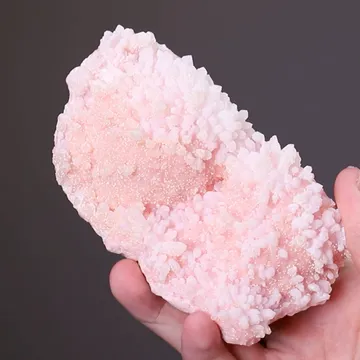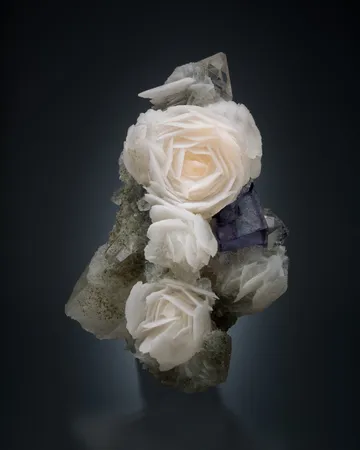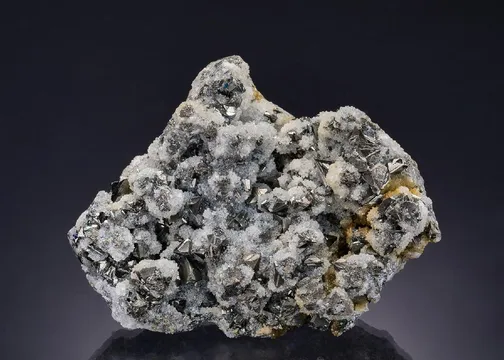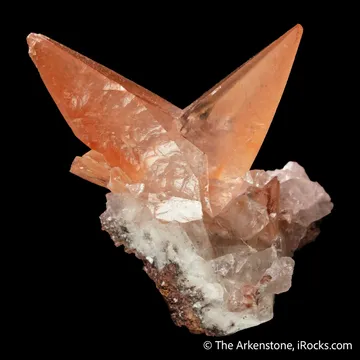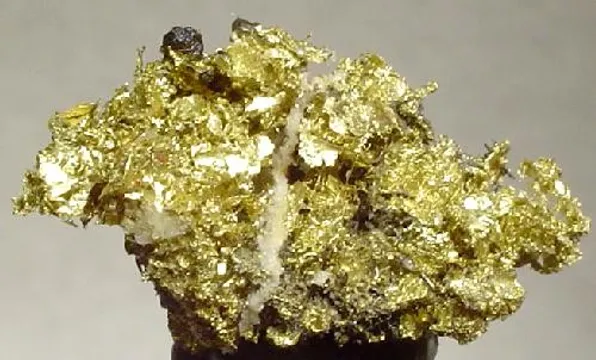
Calcite from Cavnic Mine, Romania: pearly white rhombs on dark ore with pink manganoan blades; famed for sculptural forms and rich mineral associations.
Key facts
Calcite from the Cavnic Mine belongs to one of the great European sulfide–carbonate specimen traditions: the old Kapnik / Kapnikbánya district of Maramureș, northern Romania. The mine is best known to many collectors for chalcopyrite, sphalerite, stibnite, rhodochrosite, fluorite, baryte, quartz, and sulfosalts, but calcite is the mineral that often gives Cavnic specimens their architectural finish: pearly white rhombs over dark ore, pale pink manganoan blades beside brassy chalcopyrite, cream-colored “forests” of sharp crystals, and unusual replacements after gypsum.
Cavnic calcite is distinctive because it sits at the crossing of two collecting pleasures. It can be showy and decorative, with sculptural forms and strong contrast, but it is also rooted in a serious ore-deposit setting. The Cavnic system is part of the Baia Mare metallogenetic district in the Neogene volcanic belt of the Eastern Carpathians, a low- to intermediate-sulfidation epithermal base-metal and gold system developed in fracture-controlled veins. That geological setting matters visually: calcite here is rarely just “calcite on rock.” It is commonly part of a complex mineral tableau with quartz, dolomite, sphalerite, galena, chalcopyrite, pyrite, rhodochrosite, siderite, fluorite, baryte, gypsum, stibnite, and manganese minerals.

Photo: Wikimedia Commons
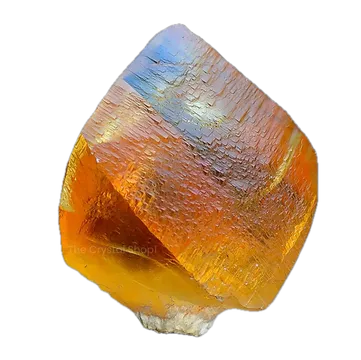
The most coveted Cavnic calcites are those that look unmistakably Romanian: pale pink to salmon manganoan calcite, lustrous tabular rhombs, creamy aggregates on dark sulfide matrix, and pieces with chalcopyrite or pyrite providing metallic punctuation. Some examples fluoresce orange, red, or reddish pink under longwave ultraviolet light, especially the manganese-bearing material. Others are memorable for habit rather than color: distorted rhombohedra with stacked “petal” forms, tapered yellowish crystals, hollow casts, or pearly calcite pseudomorphs after bladed gypsum.

Photo: Wikimedia Commons
Historically, the locality has the depth collectors want in a classic European mine. Cavnic is a medieval mining town, long known under older names such as Kapnik and Kapnikbánya, and the district remained important into the modern industrial mining period. The locality also sits near the mineralogical origin story of rhodochrosite, first described in 1813 from material tied to Cavnic / Kapnik. That association is relevant for calcite collectors because Cavnic’s carbonate suite is not incidental gangue: calcite, manganese-bearing calcite, rhodochrosite, dolomite, siderite, and related Mn-Fe minerals record the late carbonate-rich stages of a famous hydrothermal ore system.
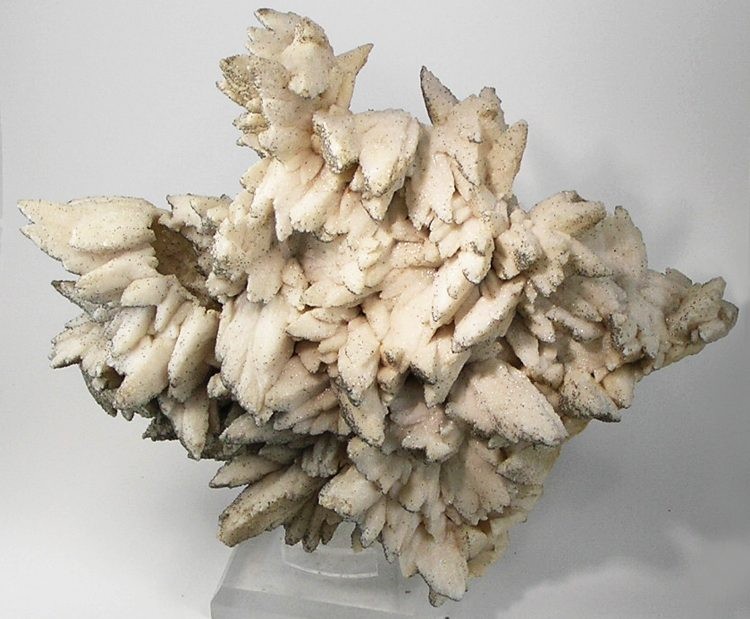
Photo: Wikimedia Commons
For the collector, Cavnic calcite is best approached as a locality mineral rather than as a species rarity. Calcite itself is abundant worldwide, but good Cavnic examples combine recognizable habit, association, provenance, and historic context. A modest matrix specimen with quartz and chalcopyrite can be more desirable than a larger but anonymous calcite cluster if it captures the Cavnic look.
Search for specimens: View all calcite specimens from Cavnic Mine, Romania
Cavnic Mine is at Cavnic, Maramureș County, in northern Romania’s Eastern Carpathians. Older labels may read Kapnik, Kapnikbánya, Kapnic, or Cavnic, reflecting the region’s Hungarian, German, and Romanian historical usage. In specimen literature, “Cavnic” may also be used broadly for the mining area, while more precise labels may name workings such as Boldut, Roata, Rainer / Reiner, or Rotunda. Serious collectors should preserve any old labels because they can clarify whether a specimen came from the Cavnic Mine sensu stricto or from one of the associated mines in the Cavnic mining district.
Geologically, Cavnic is a fracture-controlled epithermal polymetallic vein system of the Baia Mare metallogenetic district. Published work describes the deposit as a carbonate–base-metal–gold system, with rare Au-Ag concentrations, hosted mainly by Neogene volcanic rocks and, in deeper and middle parts, by Paleocene–Miocene sedimentary rocks and Pannonian dioritic bodies. The ore-bearing structures trend broadly NE-SW; the deposit-scale vein system includes multiple veins hundreds to more than a thousand meters long, several meters thick, and with major vertical extent.
The mineral paragenesis is a cooling hydrothermal story. Studies distinguish early Fe ± W assemblages, then Cu-Fe, then Zn-Pb-Fe-Cu assemblages with sphalerite, galena, pyrite, and chalcopyrite, followed by late manganese silicates and carbonates with bournonite and tetrahedrite. Calcite belongs naturally to this carbonate-rich evolution and occurs in several generations with quartz, dolomite, sulfides, sulfosalts, and manganese minerals. The presence of manganese-bearing calcite is especially important for collectors because it explains the pale pink coloration and the attractive UV fluorescence seen on some Cavnic specimens.
Mining at Cavnic reaches deep into history. Local historical sources place mining activity at least by the medieval period, with privileges connected to mining in Capnic granted in the fifteenth century. The town’s Voievod gallery is associated with a 1511 inscription commemorating the death of Iacob Huber, one of the most striking surviving details from the old mine. Later centuries brought repeated reopening, leasing, modernization, and foreign investment. By the nineteenth century, Cavnic’s precious-metal processing was well developed enough that its techniques and metallurgists were known beyond Romania.
In the communist period and later twentieth century, Cavnic became an industrial mining town producing lead, zinc, copper, gold, and silver ores. The mine and neighboring Maramureș operations were among Romania’s important non-ferrous ore sources until closure in the late 2000s. Romanian reporting cites 2007 as the closure year for Cavnic alongside Herja, Șuior, and Baia Borșa; mineral-market and locality references often refer to the end of activity as 2008. In either case, active mining is over, and the underground workings are not a normal collecting destination.
Modern access should be treated as closed-mine access, not recreational collecting. The former mine area has post-closure environmental and safety issues, including mine-water and pollution concerns reported in Romanian media. Collector specimens reaching the market now are therefore mainly from older mine production, historical collections, dealer stock, and occasional recycled material from estate collections rather than from routine new collecting underground.
Notable finds for calcite collectors include pink manganese-bearing calcite on quartz, calcite with chalcopyrite and sphalerite, cream to white calcite with pyrite, calcite on dolomite and quartz, and rare calcite pseudomorphs after gypsum. Some documented specimens from the 1990s and earlier show that Cavnic produced both attractive small-cabinet pieces and large display specimens. Fine calcite was not the mine’s most famous product, but the best examples are unmistakably part of the great Cavnic suite.
Cavnic calcite is unusually varied in habit. Collectors encounter rhombohedral crystals, tabular rhombs, flattened nailhead-like forms, scalenohedral to dogtooth crystals, tapered crystals, drusy coatings, botryoidal or nubby crusts, and jackstraw-like aggregates. Some specimens show two or more generations of calcite on the same piece: earlier straw-yellow or translucent crystals may be overgrown by later white, cream, or pink rhombs, or hollow interiors may be lined with an additional generation.
Color is one of the locality’s strengths. White and ivory calcite are common, but Cavnic also produced pale pink, salmon-pink, yellowish, straw-yellow, cream, and colorless to translucent examples. Pink material is usually described as manganese-bearing calcite, with the formula commonly given as (Ca,Mn)CO3. A good Cavnic pink calcite should not be expected to look like saturated Sweet Home rhodochrosite; the best specimens are often delicate in color, relying on luster, transparency, and association for their charm.
Luster ranges from pearly to vitreous to waxy, depending on generation and surface texture. Some crystals have a sugary surface sparkle, especially on pink manganoan examples. Others are more satiny or pearly, particularly pseudomorphs and flattened rhombohedral aggregates. On well-preserved specimens, the contrast between soft carbonate luster and hard metallic sulfides is one of the locality’s signature visual effects.
Associated minerals are central to judging Cavnic calcite. The most desirable combinations include quartz, dolomite, chalcopyrite, sphalerite, galena, pyrite, marcasite, rhodochrosite, fluorite, baryte, gypsum, siderite, and stibnite. Chalcopyrite can occur as sharp golden sphenoids or twinned crystals, giving strong contrast against white or pink calcite. Pyrite may appear as tiny brassy spheres or cube aggregates on white calcite. Quartz commonly forms a sparkling base, sometimes with smoky zoning or doubly terminated crystals. Dolomite adds pale rhombs or rounded aggregates that are easy to confuse with calcite unless the specimen is well labeled or tested.
Size ranges are broad. Thumbnail and miniature specimens occur, but much of the classic market material is small-cabinet to cabinet size, roughly 5 to 15 cm across. Documented large cabinet examples exceed 18 cm, and some older display specimens reach impressive plate dimensions. Crystal size ranges from millimeter-scale druse to tabular rhombs several centimeters across; one documented large manganoan calcite and chalcopyrite specimen carried pink tabular rhombs to about 6 cm, while another Boldut calcite specimen showed tapered crystals to about 3.7 cm.
Fluorescence is a useful and attractive feature but not a stand-alone proof of locality. Cavnic calcite specimens have been documented with faint orange, yellow-orange, red, reddish-pink, and vivid neon-orange longwave UV response, especially in manganese-bearing material. The fluorescence can vary across a single specimen, with larger pink calcites responding more strongly than smaller cream-colored generations.
Quality factors are locality-specific. The best Cavnic calcites have a balanced composition, good crystal separation, fresh luster, minimal bruising, and a recognizable association. Pink manganoan calcite should be evaluated for color, fluorescence, and crystal definition, but a pale specimen with sharp form and good chalcopyrite contrast can be more important than a brighter but damaged cluster. White calcites are most desirable when they show unusual habit, excellent contrast on sulfide matrix, attractive pyrite or chalcopyrite accents, or complex multigeneration growth. Calcite pseudomorphs after gypsum are a special subcategory: they are valued for preserving tapered, feather-like bladed forms rather than for transparency or color.
Cavnic calcite is collectible because of locality, association, and history—not because calcite itself is rare. Ordinary white calcite from Cavnic remains affordable when available, especially if it lacks strong matrix minerals or old provenance. Better pieces, especially pink manganese-bearing calcite with chalcopyrite, undamaged sculptural cabinet specimens, rare pseudomorphs after gypsum, or old collection pieces with labels, can climb sharply in price.
The mine’s closure has changed the market. Cavnic material still appears regularly through European dealers, auction houses, and estate collections, but choice pieces are no longer replenished by active production. As a result, good old specimens with labels from German, French, Romanian, Hungarian, British, or American collections deserve attention. Older labels may use Kapnik, Kapnikbánya, Kapnic, Cavnic, Boldut, Roata, or Maramureș; retain every label, even if the wording seems imprecise.
No well-documented, systematic, locality-specific fake trade in Cavnic calcite is a standard collecting concern. The more realistic problems are mislabeling, over-broad locality attribution, and mineral confusion. Pale pink Cavnic calcite may be confused with rhodochrosite, and pale rhombohedral dolomite may be mistaken for calcite. Conversely, some Cavnic rhodochrosite is quite pale and can be visually understated. For important specimens, a label alone is not enough: check habit, hardness, reaction to dilute acid where safe, fluorescence, and associations. Analytical confirmation is worthwhile for high-value “manganoan calcite” or ambiguous calcite–rhodochrosite pieces.
Condition matters greatly. Calcite has perfect rhombohedral cleavage and a hardness of only 3, so Cavnic crystals often show edge bruising, cleaved tips, or rubbed corners. This is especially common on protruding tabular rhombs, dogtooth crystals, and cabinet specimens with exposed edges. White and cream calcites also show dirt and handling marks readily. Pyrite, marcasite, and chalcopyrite associations can develop tarnish or instability in poor storage conditions, so keep specimens dry and avoid humidity swings.
Avoid aggressive cleaning. Acid will attack calcite. Even brief acid exposure can dull luster, round micro-features, or remove delicate druse. Mechanical cleaning around chalcopyrite, pyrite, sphalerite, and quartz should be conservative; the best Cavnic pieces often depend on fine contrast between carbonate and metallic minerals, and overcleaning can make a specimen look lifeless or suspiciously “fresh.”
When buying, ask what the specimen is doing that is specifically Cavnic. A strong answer might be: pink manganese-bearing calcite on quartz, white rhombs with chalcopyrite sphenoids, calcite after gypsum, calcite with rhodochrosite from an old Kapnik collection, or a multigeneration calcite cluster with pyrite on sulfide matrix. A weak answer is merely “Romanian calcite.” Cavnic has enough personality that a good specimen should not need vague locality prestige to carry it.
The Cavnic mine has one of those old European details that makes a mineral locality feel suddenly human. In the Voievod gallery, local history records a German inscription dated 1511: “Hier hats erschlagen Iacob Huber” — here Iacob Huber was killed. It is a stark sentence, more memorial than document, but it places the collector’s specimen into a landscape where mining was already old, dangerous, and personal more than five centuries ago. Long before calcite rhombs from Cavnic sat in drawers under neat labels, men were driving galleries into the mountain, leaving marks in the rock when the mountain took one of them.
Cavnic’s nineteenth-century story is not only underground. Around the 1850s, a gold smelting place known locally as Logolda entered the town’s memory. Local accounts connect the name to the English word “gold,” filtered through popular speech as “La gold” — “at the gold.” In 1856, the Austrian Imperial Crown Treasury reportedly leased the Cavnic mines to an English company based in Paris, and in 1862 the English built a gold smelter there. The place later became known for advanced ore-treatment practice, and Cavnic specialists were respected enough that, in 1891, they were sent to Russia to help commission an alkalinization installation in the Altai region. The smelter eventually closed, leaving ruins and a name that still sounds half Romanian, half mining-camp English.
The darker modern chapter came in the early 1950s, when Cavnic was also a forced-labor site for political prisoners. On 6 June 1953, fourteen prisoners working at the Cavnic lead mine escaped in what Romanian memorial sources describe as the most spectacular escape from a labor colony. The plan had begun among men who had been working at Baia Sprie; when they were transferred to Cavnic, they rebuilt the plan there and brought in new participants. The escape happened at the mine exit, at the Rainer station. The men left in two ore skips. The first six immobilized the guard and the civilian worker watching the exit, climbed ladders, and reached the forest surrounding the camp.
The plan had been to flee as a group, but once outside the mine the men scattered. Some went alone, others in small groups, trying to put distance between themselves and the colony. Ion Ioanid, who later became known for his memoir of imprisonment, was among the escapees. Accounts of his flight read like a map drawn under fear: from Cavnic eastward across Maramureș and the Rodna Mountains, relying on shepherds and peasants for food, trying and often failing to hide the fact that they were fugitives. After eighteen days, on 24 June, Ioanid and a companion reached Iacobeni; with money from the local priest, they bought train tickets to Bucharest and arrived the next day. He remained free until 13 September 1953.
These episodes are not mineral stories in the narrow sense, but they belong to the same mine. Cavnic specimens carry the name of a place where medieval inscriptions, Habsburg-era metallurgy, modern industrial ore production, and forced-labor memory are layered over the same mineralized veins. For a collector, that history is part of the weight of the label.