Cavnic Mine, Romania — classic tetrahedrite from the Baia Mare district; sharp steel-gray crystals, Kapnik provenance, and large, lustrous pieces prized by col…
Key facts
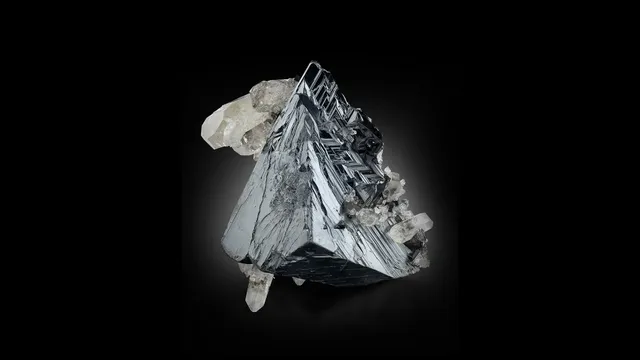
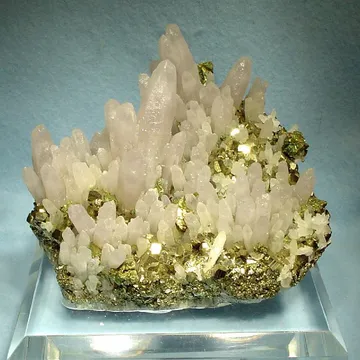
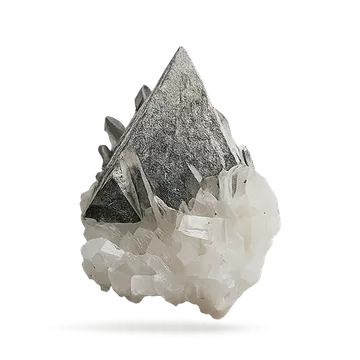
Cavnic tetrahedrite is one of the classic European sulfide specimens: sharp steel-gray to black metallic tetrahedra, commonly bright enough to throw hard reflections under a lamp, scattered across quartz, calcite, rhodochrosite, pyrite, sphalerite, and chalcopyrite. The best pieces have exactly the look collectors want from tetrahedrite: broad triangular faces, crisp modified edges, high luster, and a pleasing contrast against pale quartz or carbonate gangue.

Photo: Wikimedia Commons
The locality’s appeal is not only aesthetic. Cavnic sits in the Baia Mare metallogenic district of northern Romania, a Neogene epithermal base-metal and precious-metal province famous for complex sulfide-carbonate vein mineralization. In collector language, “Cavnic” often evokes old Austro-Hungarian labels reading Kapnik or Kapnikbánya, and the best tetrahedrites have long moved through old European and American collections under those names.
Modern mineral nomenclature adds an important nuance: many specimens historically labeled simply “tetrahedrite” from Cavnic belong within the tetrahedrite group or tetrahedrite subgroup, and analyzed material may be tetrahedrite-(Zn), Cu6(Cu4Zn2)Sb4S12S. A 2020 electron-microprobe study of Romanian tetrahedrite-group minerals found that the mean composition of studied samples corresponded to tetrahedrite-(Zn), with three Cavnic samples containing manganese up to 0.17 atoms per formula unit. For collectors, the practical point is straightforward: the old label “tetrahedrite” remains the collecting name, but a species-level label should be treated as analytical unless the specimen is supported by data.
The finest Cavnic pieces are prized for size as much as form. Published Romanian mineralogical summaries describe Cavnic as the country’s best-known tetrahedrite occurrence, with crystals exceeding 4 cm reported. Market examples and photographed museum/dealer pieces more commonly show sharp crystals in the millimeter to 2–3 cm range, with exceptional cabinet specimens carrying fields of lustrous tetrahedra on quartz and sulfide matrix.
Search for specimens: View all tetrahedrite specimens from Cavnic Mine, Romania
Cavnic Mine is in Cavnic, Maramureș County, northern Romania, in the eastern part of the Baia Mare metallogenic district. Older labels may read Capnic, Kapnik, Kapnikbánya, or simply Kapnik, reflecting the locality’s Austro-Hungarian history. Mindat records the Cavnic Mine coordinates near 47°39′50″ N, 23°51′41″ E and notes that the deposit was known before 1400.
The deposit is part of the Neogene volcanic belt of the Eastern Carpathians. Cavnic is described in the geological literature as an epithermal, low- to intermediate-sulfidation base-metal plus gold system, and more specifically as a carbonate–base-metal–gold vein deposit with rare Au-Ag concentrations. The veins are fracture-controlled, trending mainly northeast-southwest, and are hosted by Neogene volcanic rocks, with deeper and middle levels involving Paleocene–Miocene sedimentary formations and Pannonian dioritic bodies.
The scale of the old ore system is substantial. Fourteen veins are described, each about 400–1500 m long, 1–8 m thick, and with more than 900 m of vertical development. Mineralization developed through cooling hydrothermal stages: an earlier Fe ± W stage near 320°C; a Cu-Fe stage near 300°C; a Zn-Pb-Fe-Cu stage with sphalerite, galena, pyrite, and chalcopyrite near 260°C; and a later manganese-silicate and carbonate stage with bournonite and tetrahedrite near 200°C. This late-stage setting helps explain why attractive tetrahedrite specimens are so often tied to quartz-carbonate gangue and manganese minerals.
Mining at Cavnic has a deep historical footprint. The town is documented from 1336, and the mining tradition is older than many museum labels can capture. Mineral specimens circulated for generations under Hungarian locality names before Cavnic became part of Romania after World War I. In the twentieth century the district continued as a working polymetallic mining area, producing lead, zinc, copper, gold, and silver ores. Modern mining has ceased; the mines have been closed since the late 2000s, and collector access to underground workings should be considered closed, unsafe, and legally restricted unless one has explicit current permission from the proper authorities.
For mineral collectors, the most important production period is not one single bonanza but a long succession of underground finds, stockpiles, and old collection dispersals. Cavnic and adjacent district mines produced an enormous variety of sulfide and carbonate specimens: tetrahedrite, tennantite, pyrite, chalcopyrite, sphalerite, galena, bournonite, chalcostibite, stibnite, rhodochrosite, calcite, dolomite, quartz, and fluorite. Fine tetrahedrite specimens continue to surface mainly from old collections, European dealer stock, and occasional estate dispersals, not from active collecting in the mine.
Cavnic tetrahedrite is usually seen as lustrous metallic crystals in the classic tetrahedral habit, from simple triangular-faced tetrahedra to modified forms with beveled or stepped faces. Good examples have a dark steel-gray to black color, sometimes with subtle brownish, bluish, or rainbow iridescence on selected faces. The most desirable specimens show sharp, isolated crystals with reflective faces rather than massive or granular patches.
Typical collector specimens range from small thumbnails with a single well-formed tetrahedron to cabinet plates with many crystals. Verified examples include 7 mm crystals on rhodochrosite and manganocalcite, 11 mm crystals on quartz and calcite, crystals to about 1.2 cm on quartz-pyrite matrix, and sharp crystals to 2.2–2.7 cm in old collection pieces. Romanian mineralogical literature records crystals exceeding 4 cm from Cavnic, which places the locality among the great European sources for large tetrahedrite.
Associated minerals are a major part of the Cavnic look. Quartz is the most common and most visually effective matrix, ranging from small white crystals to drusy crusts and occasional scepter-like forms. Pyrite adds brassy contrast, commonly as small bright crystals. Sphalerite and chalcopyrite are frequent sulfide companions, while calcite, dolomite, siderite, and rhodochrosite provide the pale or pink carbonate settings that make the dark tetrahedrite stand out. Bournonite, chalcostibite, galena, marcasite, gypsum, and baryte occur in the broader assemblage and may appear on combination specimens.
Quality is judged first by crystal sharpness and luster. The best Cavnic tetrahedrites are not merely dark sulfides on matrix; they have clean triangular geometry, crisp edges, and enough reflectivity that each face reads clearly. Second is contrast: black tetrahedrite on white quartz, pale calcite, pink rhodochrosite, or glittering pyrite is far more compelling than tetrahedrite lost in dark sulfide matrix. Third is placement. A balanced spray or isolated crystal perched on matrix is preferable to a crowded mass where the tetrahedral forms are hard to read.
Condition is especially important because tetrahedrite’s sharp corners and projecting edges chip easily. A few tiny contact points are common on old specimens, but obvious broken tips, dulled faces, and bruised edges reduce value quickly. Matrix specimens should also be checked for bruised quartz points, crushed carbonate, and old repairs along contact zones.
Old labels matter with Cavnic. Specimens labeled Kapnik, Kapnikbánya, Kapnik Bánya, or Hungary can be perfectly legitimate Cavnic material, especially if they predate 1918 or came through old European collections. Conversely, labels that say only “Cavnic” may refer to the mining district rather than the exact Cavnic Mine; nearby mines such as Boldut and Suior produced related material and are sometimes confused in trade. Provenance should be preserved exactly, with any modern clarification added separately rather than replacing the historical label.
Species-level naming deserves caution. A specimen sold as “tetrahedrite” may properly be a tetrahedrite-group specimen unless analyzed. Cavnic has verified tetrahedrite subgroup material, tetrahedrite-(Zn), tennantite-(Zn), tennantite subgroup, and tennantite-tetrahedrite series material. Without analytical data, “tetrahedrite group” or “tetrahedrite subgroup” is often the most conservative modern label; “tetrahedrite-(Zn)” should be reserved for analyzed or reliably referenced pieces.
No well-documented Cavnic-specific fake tetrahedrite problem is prominent in the sources reviewed, but Romanian smoky quartz from the Cavnic area has a long-standing treatment issue. Dark smoky quartz specimens from the region have been discussed as artificially irradiated or otherwise enhanced, and collectors should be cautious when a Cavnic tetrahedrite specimen is marketed primarily for unnaturally dark smoky quartz. This does not make the tetrahedrite itself fake, but it can affect the integrity and value of the specimen as a natural association.
Condition issues are predictable: chipped tetrahedron corners, abraded high points, bruised quartz, and unstable sulfide-rich matrix. Cavnic tetrahedrite can be very lustrous, but excessive oiling, waxing, or cleaning residue may make a specimen look suspiciously glossy. Under magnification, natural luster should sit on the crystal faces rather than in cracks or smeared across matrix.
Rarity depends on size and composition. Small tetrahedrite-bearing Cavnic specimens remain obtainable, and old-stock examples still appear on dealer sites and auction platforms. Sharp, well-placed crystals above 1 cm are more selective. Fine cabinet plates with large, undamaged tetrahedra, strong contrast, and old provenance are genuinely desirable and should be considered classic European sulfide specimens rather than ordinary tetrahedrite.
One of the most evocative Cavnic tetrahedrites on public record is less a single specimen than a chain of names. A Wikimedia Commons image from the Rob Lavinsky archive shows a 9.2 x 7.2 x 4.5 cm old-time specimen from Cavnic, with lustrous steel-gray tetrahedrite crystals to 2.2 cm covering quartz and minor sphalerite. The description traces it through the Hans Karabacek, Mitch Gunnell, and Dr. Bob Byers collections. Karabacek, born in 1878 and active in the old Austrian collecting world, is described in the source as a collector who sought only the best; the piece was accompanied by his handwritten label. That is exactly the sort of provenance serious collectors hope to see with Cavnic: not just a mineral name, but the European history carried with it.
Cavnic itself has a darker underground memory preserved in a short German sentence from the Voievod Gallery: “Hier hats erschlagen Iacob Huber” — “Here was killed Iacob Huber.” The inscription is dated 1511 and is understood as a memorial to a mining accident. Few mineral localities give collectors such a stark reminder that the old specimens we admire came from a working landscape of hand tools, galleries, timbering, ore carts, and risk.
The town’s history also carries the drama of borderlands. Cavnic was destroyed by Ottoman forces in 1460 and by Tatars in 1717, and local tradition remembers the latter with the so-called Tatar Pole or Written Rock, bearing a Latin inscription that marks the point to which the Tatars came in 1717. A collector holding an old Kapnikbánya tetrahedrite with a pre-World War I label is therefore holding more than a sulfide specimen: it is a small object from a mining valley that has moved through Hungarian, Austro-Hungarian, and Romanian historical identities while keeping its mineralogical reputation intact.