Boldut Mine, Romania: Cavnic locality famed for cavity quartz, calcite, rhodochrosite, chalcopyrite and pyrite, prized by collectors.
Key facts
Boldut Mine is one of the collector-famous workings of Cavnic, the old Kapnik/Kapnikbánya mining district in Maramureș County, northern Romania. Its importance lies in a very specific marriage of geology and aesthetics: a Miocene, low-sulfidation epithermal polymetallic vein system carrying Pb-Zn-Cu with Au-Ag enrichments, later invaded by manganese-rich carbonate stages that made Cavnic a classic name for rhodochrosite, rhodonite, calcite, dolomite, quartz, sulfides, and sulfosalts. Boldut specimens are not usually admired for a single spectacular gem species; they are admired for architecture—white quartz sprays, chalky to pearly calcite, golden chalcopyrite twins, black sphalerite, glittering pyrite, pink rhodochrosite crusts, and occasional steel-gray tetrahedrite and black chalcostibite arranged in high-contrast miniature to cabinet compositions.
Regional View
Country View
The mine belongs to the Cavnic-Bolduț sector, the northwestern part of the Cavnic deposit, as opposed to the Cavnic-Roata sector to the southeast. Published geological descriptions place the veins in Neogene volcanic rocks, Paleogene-Miocene sedimentary units, and Pannonian dioritic bodies, with repeated brecciation, banding, drusy cavities, and argillic alteration accompanied locally by silicification and pyritization. That combination explains why the best pieces are so three-dimensional: they are cavity specimens from a repeatedly reopened hydrothermal system, not monotonous massive ore.

Photo: Wikimedia Commons
For collectors, Boldut’s signature look is immediately recognizable: a bright, brassy, metallic sulfide base or accent, usually chalcopyrite and pyrite, set against pale quartz and calcite. The quartz may be milky, glassy, acutely tapered, or in small sprays; the calcite may be white, pale yellow, grayish, spherical, lenticular, laminar, or scalenohedral; and the manganese stage adds pink rhodochrosite and related carbonate textures that link Boldut to the broader Cavnic tradition. Fine pieces from the 1990s and early 2000s have become modern classics because the mine is now closed and the most attractive pockets were tied to active mining, not casual collecting.

Photo: Wikimedia Commons
Search for specimens: View all specimens from Boldut Mine, Romania
Boldut Mine is at Cavnic, Maramureș County, in the Baia Mare metallogenetic district of the Eastern Carpathians. Older labels may use Kapnik, Kapnic, Kapnikbánya, or simply Cavnic; serious collectors should preserve old labels because “Cavnic” can mean the town, the mining district, the formal Cavnic Mine, or the associated Boldut and Roata sectors. Mindat records Boldut Mine as a separate mine locality at Cavnic, with the locality placed at approximately 47.66505 N, 23.84557 E.
Geologically, Boldut is part of the Cavnic polymetallic epithermal system. The broader Cavnic deposit is divided into Cavnic-Bolduț in the northwest and Cavnic-Roata in the southeast. The mineralization is vein-dominated: numerous roughly parallel structures, commonly described as NNE-SSW to NW-SE in district summaries, cut Neogene volcanic rocks and older sedimentary packages intruded by dioritic bodies. Veins in the Cavnic system range from narrow ore shoots to multi-meter structures and may persist for hundreds to thousands of meters, with a vertical extent of as much as about 900 m in published descriptions. The repeated opening of these veins produced breccias, cockade textures, banding, druses, disseminations, and stockwork-like zones.
The Cavnic-Boldut ore system is listed in Romanian mineral-resource summaries as a Miocene hydrothermal Pb-Zn-Cu deposit with Au and Ag. Accessory and trace elements reported from the Cavnic-Boldut resource include Cd, As, Sb, Bi, In, Ti, Mn, Ga, Tl, Sn, Ge, Se, and Te, which helps explain the locality’s mixture of base-metal sulfides, antimony sulfosalts, manganese carbonates, and occasional native gold. The mineral sequence is usually simplified into early iron-silica assemblages, a base-metal sulfide stage with pyrite, galena, sphalerite, chalcopyrite, tetrahedrite-group minerals, sulfosalts, quartz, and clays, and a later manganese-carbonate stage dominated by rhodochrosite with common sulfides, quartz, calcite, and gypsum. Native gold is reported locally in the upper part of the Cavnic system.
Mining at Cavnic has deep historical roots, and the deposit was worked for precious metals and base metals long before it became a specimen locality. Modern geological literature emphasizes that the most intense exploitation took place during the second half of the twentieth century. In April 2000, the Romanian government approved mining concession licenses between the National Agency for Mineral Resources and Compania Națională a Metalelor Prețioase și Neferoase “Remin” S.A. for several perimeters, including Cavnic (Boldut, Roata), Baia Sprie, and Șuior. That places Boldut firmly within the late state-company era of Romanian polymetallic mining.
The collector-producing period most often encountered on labels is the 1960s through the early 2000s, with especially memorable pockets in the 1990s and around 1999–2005. Fabre Minerals documented an April 1999 find from the 61 level, 350 m down, that produced outstanding chalcopyrite-calcite-quartz combinations. Other Boldut labels record 1992 tetrahedrite with calcite and pyrite, 1993 calcite-dolomite combinations, circa 1995 uncommon acute scalenohedral calcites with dolomite and sulfides, 1999 dolomite pseudomorphs after calcite, 2001 chalcostibite on quartz and dolomite, and 2003–2006 chalcopyrite, sphalerite, quartz, and calcite specimens.
Collecting access today should be regarded as closed. The mine and related Baia Mare district workings are not casual field-collecting localities, and old underground access is unsafe, restricted, or legally unavailable. The specimens now reaching the market are overwhelmingly from mine-era production, old Romanian stock, dealer holdings, and older European and North American collections. As a result, a precise old label—especially one naming Boldut, a level, a year, a collector, or a dealer provenance—adds real value.
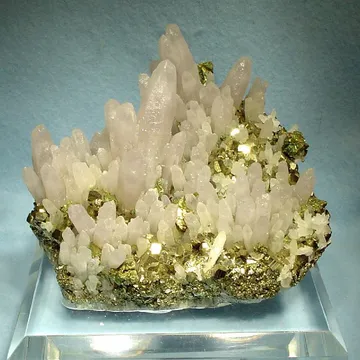
Quartz is the backbone of Boldut display specimens: it appears as milky quartz, clear to translucent prismatic crystals, tapered white points, small sprays, and drusy crusts that support chalcopyrite, pyrite, sphalerite, calcite, rhodochrosite, dolomite, and sulfosalts. Better pieces show sharp isolated crystals or airy sprays standing proud of the matrix rather than dull massive vein quartz; the most attractive examples combine a clean quartz architecture with brassy chalcopyrite, black sphalerite, pink rhodochrosite, or white calcite. Documented Boldut quartz specimens range from small miniatures to large cabinet pieces, including a 6.0 x 4.4 x 3.9 cm quartz-chalcopyrite specimen with an acutely tapering main crystal, large milky-quartz pieces covered with bournonite and pyrite, and old amethystine quartz associations. Ordinary pieces are simply drusy or massive quartz; the prize pieces use quartz as sculptural framework for metallic and carbonate contrast.
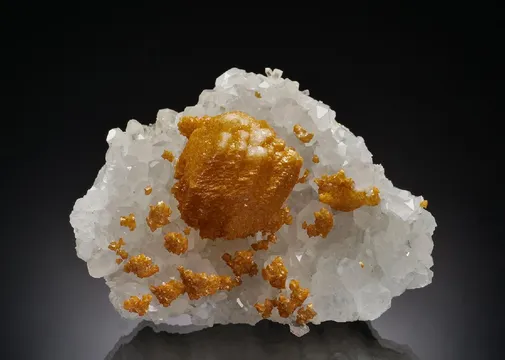
Calcite from Boldut is unusually varied and is one of the mine’s most collectible species: white laminar groups, lenticular flattened crystals, globular and spheroidal aggregates, pearly elongated growths, acute scalenohedra, radiating aggregates, and calcite coatings on quartz all occur in the documented material. The best-known modern classic pocket was the April 1999 discovery on the 61 level at about 350 m depth, where calcite formed late, very flattened lenticular crystals over complex chalcopyrite on compact quartz, and another specimen from that same find showed white laminar calcite with twinned chalcopyrite and small quartz crystals. Other strong pieces include yellowish-white calcite spheres on curved dolomite rhombs, sharp scalenohedral calcite with dolomite, sphalerite, galena, and chalcopyrite, and highly fluorescent calcite-dolomite combinations from 1993–2005 finds. At Boldut, top calcite is judged less by transparency than by form, contrast, intact delicate edges, and its relationship to chalcopyrite, pyrite, quartz, dolomite, or rhodochrosite.
Chalcopyrite gives many Boldut specimens their drama, occurring as bright brassy to slightly iridescent twinned disphenoidal crystals, interpenetrating twins, globular growths of small crystals, and metallic plates or clusters on quartz, calcite, sphalerite, and pyrite-bearing matrix. Fine Boldut chalcopyrite is not merely “ore”; the desirable crystals have sharp faces, defined edges, strong luster, and enough separation from white quartz or calcite to make the golden color stand out. Important documented pieces include the April 1999 61-level geode material, 1994 chalcopyrite with clear quartz and white calcite plates, 2003 interpenetrating twins with quartz, and 2005 globular chalcopyrite on quartz partly coated by white calcite. The usual faults are bruised metallic edges, overly massive chalcopyrite, or dull tarnish; the premium pieces are sharply crystallized, lustrous, balanced, and visually lifted by white carbonate or quartz.
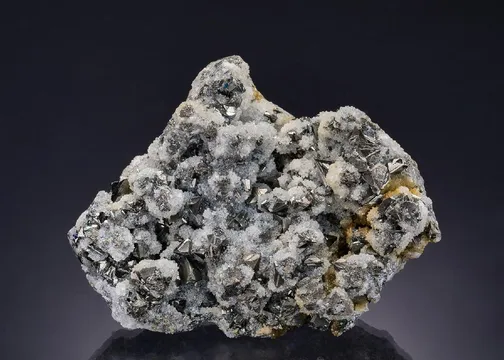
Sphalerite from Boldut is typically dark brown to black, commonly marmatitic in appearance, and it occurs as sharp lustrous crystals or twinned groups associated with quartz, calcite, pyrite, chalcopyrite, dolomite, galena, bournonite, zinkenite, realgar, and rhodochrosite. It often functions as a dark reflective base for brighter minerals, but good specimens show well-defined sphalerite geometry of their own rather than merely black massive sulfide. Notable documented examples include complex bright sphalerite growths with chalcopyrite from an April 2001 find, two twinned sphalerite crystals on fine quartz with small cubic pyrite from 2006, and sphalerite largely covered by chalcopyrite on a rich galena-quartz matrix. The better pieces have strong luster, visible twinning or crisp faces, and clean contrast with chalcopyrite or quartz; lower-grade examples become visually heavy when the sphalerite is too massive or obscured.
Pyrite at Boldut is abundant as small cubes, glittering druses, brassy accents, nodules, and occasional spheroidal or crown-like aggregates on quartz and carbonate matrix. It is most often a supporting species with quartz, calcite, sphalerite, chalcopyrite, dolomite, tetrahedrite-group minerals, bournonite, rhodochrosite, and barite, but some pieces are collectible in their own right when the pyrite forms bright cubic clusters or sculptural masses. Fabre documented a Boldut pyrite-and-quartz specimen as a crown of small bright cubic crystals covering a spheroidal mass on quartz, while other records show pyrite admixed with bournonite on milky quartz and pyrite cubes accenting rhodochrosite or calcite. Quality depends on brightness, intact crystal corners, and whether the pyrite adds sparkle and structure rather than a rusty or powdery distraction.
Dolomite from Boldut occurs as pale, tan, yellowish, reddish, or oxide-included rhombohedral crystals, curved rhombs, drusy coatings, and, in especially interesting cases, pseudomorphs after calcite. It is strongly associated with quartz and calcite and also appears with chalcostibite, pyrite, chalcopyrite, sphalerite, fluorite, galena, gypsum, tetrahedrite-group minerals, and rare sulfosalts. A particularly notable 1999 specimen showed light-yellow dolomite replacing calcite scalenohedra in multi-peaked formations, with sphalerite and chalcopyrite in the base; other documented pieces use reddish or tan dolomite to set off snow-white calcite spheres or yellowish-white calcite growths. The best dolomite pieces are crisp, lustrous, and texturally distinct from calcite; ordinary examples are just dull carbonate coatings without the contrast that makes Boldut combinations so desirable.
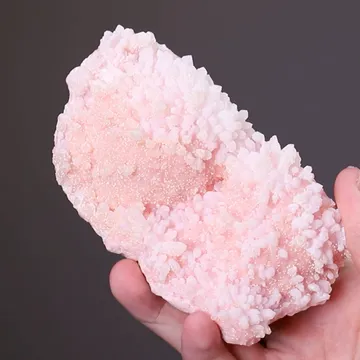
Rhodochrosite is part of the historical soul of Cavnic, whose broader mining area is cited as the type locality for the species, and Boldut supplied attractive pink examples within that tradition. Boldut rhodochrosite occurs as flattened rhombohedral crystals, lenticular curved rhombs, rosettes, botryoidal or coralloid microcrystal growths, spheroidal aggregates, saddle-shaped crystals, and crusts on quartz or mixed sulfide matrix. Documented pieces include deep-pink spheroidal rhombs on quartz from about 1986, rosette growths on quartz from 1973 and 1960–1970 material, calcite on intensely pink crystalline rhodochrosite from 1993, and rhodochrosite with quartz, sphalerite, pyrite, bournonite, siderite, and occasionally amethystine quartz. Good Boldut rhodochrosite is judged by color, freshness, luster, and recognizable crystal habit; the finest pieces avoid washed-out salmon tones and show the pink carbonate cleanly contrasted against quartz, calcite, or dark sulfides.
Galena from Boldut is less common as a showpiece species than quartz, calcite, or chalcopyrite, but it is an important part of the Pb-Zn-Cu ore assemblage and occurs with calcite, quartz, sphalerite, dolomite, chalcopyrite, pyrite, rhodochrosite, siderite, tetrahedrite-group minerals, chalcostibite, and zinkenite. Documented Boldut material includes sharp bright cubo-octahedral galena crystals with twinned sphalerite and small quartz from 1960–1970 production, as well as galena in mixed dolomite-tetrahedrite-chalcopyrite-quartz associations. The best specimens show separate, lustrous, sharp galena crystals rather than massive lead-gray ore; they gain particular value when the galena sits in balanced association with sphalerite, quartz, chalcopyrite, or carbonate rather than being hidden in the matrix.
Gypsum at Boldut is chiefly a later, secondary mineral and is far scarcer on the market than quartz-calcite-sulfide combinations, but it can be visually striking when preserved as transparent selenite blades or decimetric crystals. Romanian mineral-resource summaries explicitly note exceptional Cavnic-Boldut gypsum crystals, and documented Boldut gallery material includes colorless transparent selenite crystals to about 8.5 cm on light-brown siderite, collected around 1990, as well as larger gypsum specimens in the 17–18 cm range. Gypsum is soft and cleaves easily, so intact edges, transparency, and undamaged terminations are crucial; cloudy, bruised, or chalky pieces are far less desirable unless they preserve unusual associations or pseudomorph relationships.
Boldut tetrahedrite is usually best discussed as tetrahedrite-subgroup material on modern databases, because older specimen labels often predate current group-level refinements; in hand specimen it appears as steel-gray to black metallic tetrahedra with sharp triangular faces and bright luster. It occurs with quartz, calcite, pyrite, chalcostibite, rhodochrosite, chalcopyrite, dolomite, bournonite, zinkenite, galena, and sphalerite. Fabre-documented Boldut examples include a circa 1999 group of three sharp tetrahedrite crystals to 1.6 cm on intense pink rhodochrosite, and a 1992 specimen with tetrahedrite, calcite, and pyrite in which the tetrahedra contrasted strongly with unusual calcite forms and small pyrite pentagonal dodecahedra. The best pieces have clean, lustrous, sharply edged tetrahedra in open display; dark massive sulfosalt without crystal form is far less compelling.
Chalcostibite is one of Boldut’s most important rarity species, recorded as black prismatic plates to several millimeters and rated as good crystals or rich material for the species. It occurs most characteristically with quartz and dolomite, and also with tetrahedrite-group minerals, zinkenite, calcite, realgar, sphalerite, galena, and pyrite. The classic Boldut chalcostibite material from around 2001 consists of groups of small flat crystals—unusually sharp and bright for the species—on white quartz crystals with small dolomite rhombs; documented specimens show main crystals around 0.5–0.6 cm and pieces up to about 10.5 cm across. Because chalcostibite is easily mistaken for other dark sulfosalts, analytical confirmation or strong provenance matters, and the collector premium goes to specimens with visible metallic blades or rose-like groups rather than anonymous black smears.
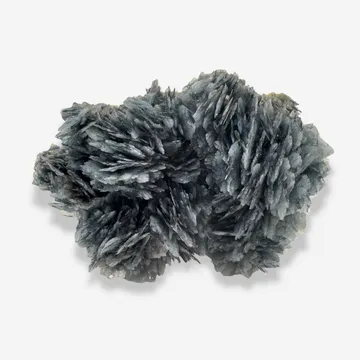
Barite, historically and on Mindat often spelled baryte, is a documented but less common Boldut species, fitting the late hydrothermal sulfate-carbonate character of the Cavnic system. In the Cavnic mining area it is known as transparent to translucent tabular or lamellar crystals, sometimes colorless, yellow, pale blue, or included by dark sulfide needles; at Boldut it is best treated as a scarce accessory species in quartz-carbonate-sulfide assemblages rather than a major production mineral. Good Boldut-labeled barite requires careful label scrutiny because excellent barites also came from nearby Cavnic-area workings such as Roata; the most desirable pieces have identifiable tabular crystals, clean association with quartz or dolomite, and strong provenance, while poorly localized “Cavnic” barites should not be upgraded to Boldut without evidence.
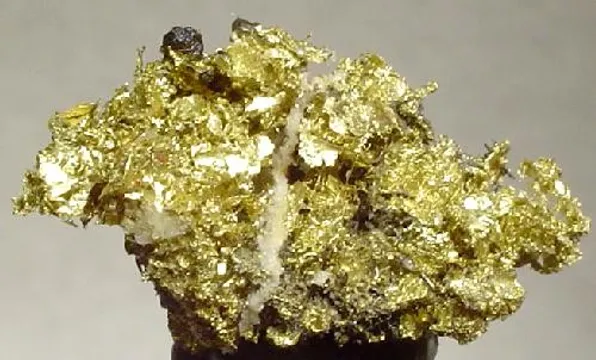
Other documented minerals from Boldut include aragonite, bournonite, fluorite, hübnerite, kutnohorite, marcasite, native gold, realgar, stibnite, zinkenite, manganese-bearing calcite, milky quartz, amethyst, and selenite. The rarities are significant: chalcostibite and zinkenite were important enough to receive early-2000s German-language reports, and zinkenite from Boldut is recorded with realgar, calcite, chalcostibite, sphalerite, chalcopyrite, tetrahedrite-group minerals, stibnite, galena, and quartz. Bournonite can occur as small cogwheel twins on milky quartz with pyrite, and native gold is reported from Boldut with quartz. Rhodochrosite carries the broader Cavnic type-locality heritage, though the formal type-locality wording should be read carefully on labels and databases because Cavnic-area names are often used at different levels of precision.
Boldut specimens are most vulnerable to mislabeling at the locality level. Old tags may say Cavnic, Kapnik, Kapnikbánya, Cavnic Mine, Boldut, Roata, or simply Maramureș; those names are related but not interchangeable. A specimen that says only “Cavnic” should not automatically be sold as Boldut unless an old label, dealer record, collection card, or recognizable documented pocket supports the attribution. Conversely, genuine Boldut labels are valuable because the mine produced specific post-1990s styles that are distinct enough for experienced collectors to recognize but not always safe to assign without documentation.
The most common condition problems are mechanical: bruised quartz points, chipped calcite blades, rubbed chalcopyrite edges, detached carbonate balls, cleaved gypsum, and dulled sulfide luster. Fine Boldut pieces often depend on delicate contrast, so over-cleaning can be as damaging aesthetically as a chip. Acid cleaning is particularly risky around calcite, dolomite, rhodochrosite, gypsum, and mixed sulfides; even if quartz survives, the specimen’s best surfaces may not. Mechanical cleaning around pyrite, chalcopyrite, sphalerite, and galena should be conservative.
No major, well-documented fake industry is associated specifically with Boldut, but the usual Romanian-classic cautions apply: repaired quartz sprays, reattached calcite or rhodochrosite groups, refreshed or oiled sulfide surfaces, and upgraded labels from vague “Cavnic” to more saleable “Boldut.” Chalcostibite, zinkenite, tetrahedrite-group minerals, and other dark sulfosalts should be treated carefully; without analysis or reputable provenance, identification based on appearance alone is weak.
Some Boldut calcites show fluorescence under longwave and/or shortwave UV, from minor to strong, and a few documented calcite-dolomite specimens are notably fluorescent. Fluorescence should be considered a bonus rather than a primary value driver unless the specimen is already visually strong in daylight. Gypsum and selenite require extra handling care and should be kept away from abrasion, excess humidity swings, and careless packing.
Market availability is moderate for quartz-calcite-chalcopyrite combinations and much lower for top rhodochrosite, sharp tetrahedrite, confirmed chalcostibite, fine gypsum, and old-provenance sulfide suites. Smaller attractive pieces still appear from collections, but the best cabinet examples from the 1990s–2000s pockets have largely moved into long-term holdings. A strong Boldut specimen should have locality precision, intact three-dimensional composition, and visible evidence of the mine’s distinctive quartz-carbonate-sulfide paragenesis.
In April 1999, miners opened the find that gave Boldut one of its modern calling cards: a large chalcopyrite geode with calcite and quartz on the 61 level, about 350 m down. The best specimens from that pocket did not look like ordinary brassy ore. Complex chalcopyrite crystals grew on compact quartz, and a later mineralizing pulse laid down curious, very flattened lenticular calcite crystals across the metallic base. One documented piece measured 12.8 x 8 x 4 cm, with a main chalcopyrite crystal 2.2 x 2.2 cm; another from the same event was a 14.5 x 10 x 6.5 cm plate of white laminar calcite with twinned chalcopyrite and small quartz. That pocket is why a good Boldut label can still make a chalcopyrite collector pause.
The chalcostibite story is quieter but just as important to species collectors. Around 2001, Boldut produced specimens with small black metallic plates of CuSbS2 on quartz and dolomite. Chalcostibite is not a mineral that often gives handsome cabinet specimens, and the Boldut material was repeatedly described by dealers and databases as unusually well-defined and bright for the species. Several pieces were analyzed, and some entered serious European collections. The best examples are not large in crystal size—millimeters matter here—but they are exactly the kind of locality-specific rarity that rewards magnification and a careful label.
Boldut’s post-mining afterlife has played out through collections and dealer updates. In 2022, a Mineralogical Record online report singled out a 13.5 cm Boldut specimen offered by Hummingbird Minerals: a plate of intergrown chalcopyrite crystals from which rose clumps of prismatic quartz, each little quartz crystal jacketed in white calcite except at the terminations. The asking price was $4,000, a figure that signaled what collectors had already learned: the mine was no longer feeding the market, and the best combinations from old production had become finite classics.