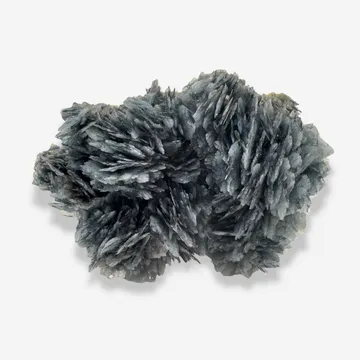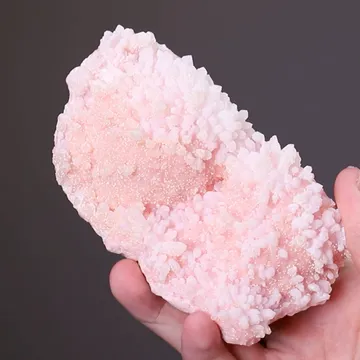
Roata Mine, Romania — Cavnic-area locality in Maramureș, with native gold in quartz/calcite, yellow/blue barite, and stibnite pockets, prized for gangue.
Key facts
Roata Mine is the south-eastern half of the classic Cavnic ore field in Maramureș, northern Romania, a locality that deserves more precise treatment than the broad old label “Cavnic” usually gives it. It belongs to the Baia Mare metallogenic district of the Eastern Carpathians, one of Europe’s great Neogene epithermal polymetallic provinces. The deposit is a vein system carrying Pb-Zn-Cu-Au-Ag mineralization, with the Roata sector developed in the same Cavnic system as Bolduț but with its own specimen identity: native gold in quartz and calcite, yellow and blue barite, stibnite-bearing combinations, arsenic sulfide pockets, and manganese minerals that link the locality to Cavnic’s wider rhodochrosite fame.
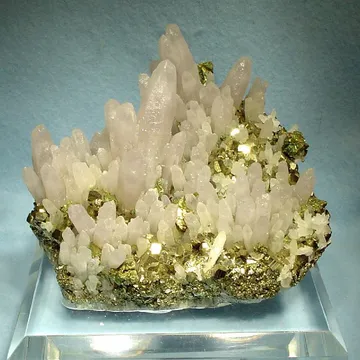
For collectors, Roata’s most important distinction is the combination of precious-metal mineralogy and highly displayable gangue. The best gold specimens are not large nuggets but delicate, high-character pieces: bright yellow to electrum-rich leaves, arborescent growths, and fine crystalline plates on quartz, calcite, and sulfide-bearing matrix. The best barites are sculptural rather than merely massive—thin tabular crystals, lamellar plates, and lustrous yellow to blue aggregates, sometimes with quartz, dolomite, rhodochrosite, stibnite, or dark sulfide inclusions. A fine Roata specimen has the look of a sealed epithermal cavity opened at just the right moment: glassy quartz, pale carbonate, metallic sulfides, and one strongly colored focal mineral holding the whole piece together.
Historically, Roata matters because it is part of one of Romania’s longest-lived mining landscapes. Cavnic mining is documented from the medieval period, intensified under Habsburg and later industrial management, continued through the twentieth century, and ended as an active mining district in the restructuring that closed the Baia Mare-area mines in the mid-2000s. Roata is also one of the rare Romanian localities where specimen mineralogy and archaeometallurgical research overlap: native gold from the Roata mine has been analyzed by XRF, micro-PIXE, and SEM-EDAX in studies of Transylvanian gold provenance.
Regional View
Country View
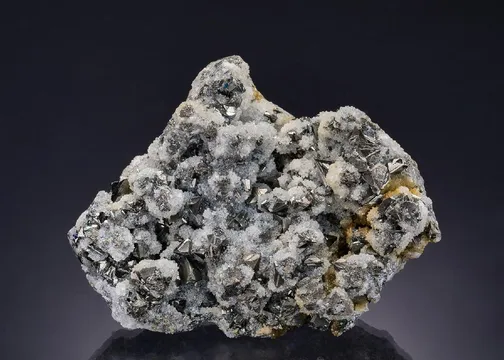
Roata specimens are often best understood by reading the matrix. Quartz is a constant framework; calcite, rhodochrosite, and dolomite mark later carbonate pulses; arsenopyrite, pyrite, galena, sphalerite, chalcopyrite, and stibnite record the sulfide-rich stages; and the show minerals—gold, barite, realgar, native arsenic, or manganese species—appear where open space and chemistry coincided. This is why excellent Roata pieces rarely feel generic: even small specimens tend to carry a paragenetic story in miniature.
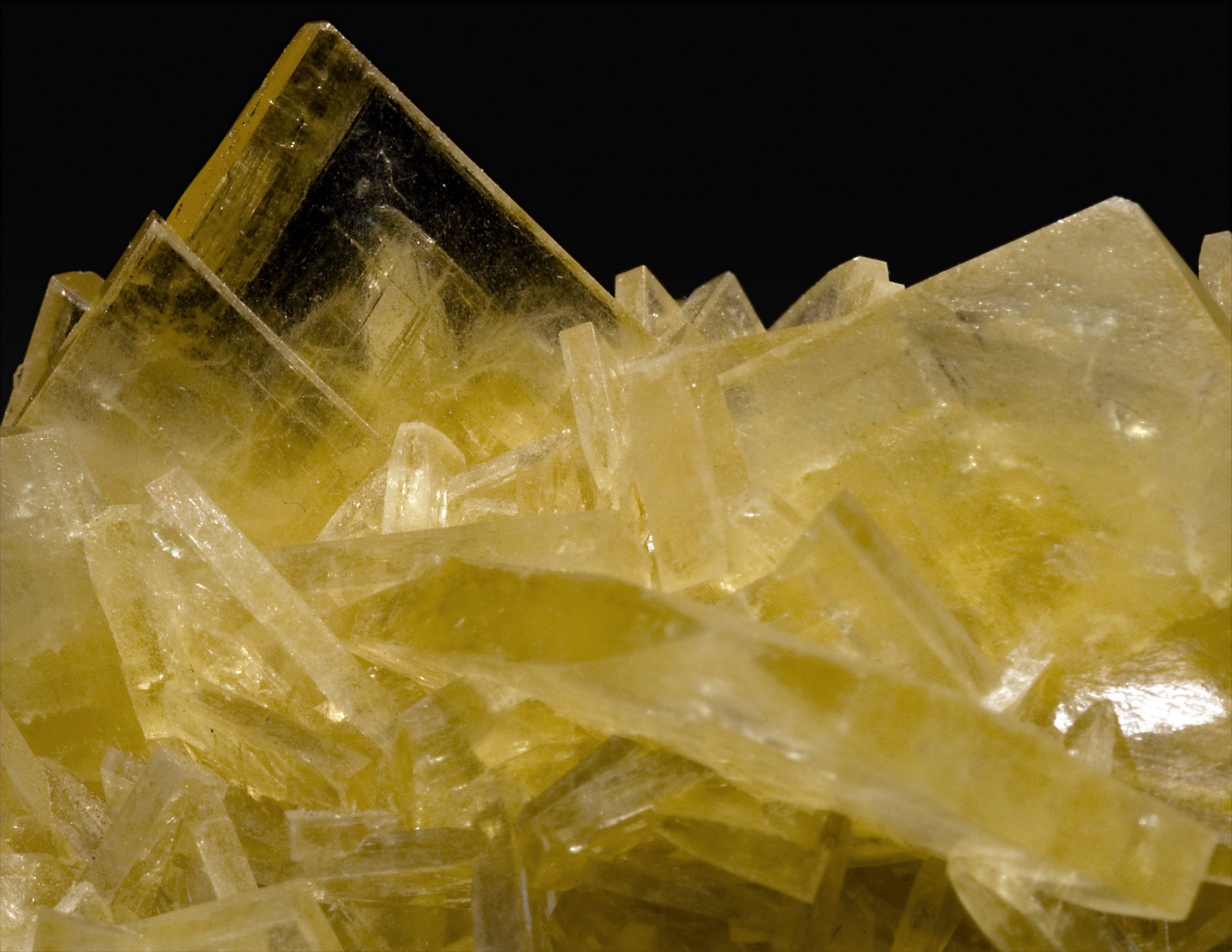
Photo: Fabre Minerals
Search for specimens: View all specimens from Roata Mine, Romania
Roata Mine is at Cavnic in Maramureș County, northern Romania, in the Gutâi Mountains and the Baia Mare mining district. The Mindat locality record places the mine at approximately 47.66065 N, 23.88188 E, close to the town of Cavnic; older and local labels may use Mina Roata, Roata, Cavnic, Kapnik, Kapnikbánya, or simply Maramureș. Serious collectors should keep all labels with Roata specimens because many old Romanian pieces entered the market before mine-level locality names were consistently recorded.
Geologically, Roata is part of the Cavnic epithermal polymetallic deposit, a fracture-controlled vein system hosted by Neogene volcanic rocks and Paleogene-Miocene sedimentary units intruded by Pannonian dioritic bodies. Published descriptions divide the Cavnic deposit into Cavnic-Bolduț in the north-west and Cavnic-Roata in the south-east. The mineralization occupies numerous parallel veins and fissure systems, with brecciation, banding, colloform textures, open-space crystal linings, and local silicification, argillization, and pyritization. At the deposit scale, the ore system is zoned: Au-Ag and silver-sulfosalt mineralization is more characteristic of upper levels, while base-metal sulfides become increasingly important downward.
The principal ore minerals at Cavnic are pyrite, sphalerite, galena, chalcopyrite, and arsenopyrite, with local gold, silver-rich phases, Sb-As sulfides, and telluride-bearing micro-inclusions. Roata is especially important to collectors for native gold, barite, realgar, native arsenic, rhodochrosite, rhodonite, and stibnite-bearing combinations. In the broader Cavnic paragenesis, published work has described multiple mineralization stages, including early Fe-W and Cu stages followed by Pb-Zn-Au and Pb-Zn-Au-Mn-Sb stages. The specimen-forming stages collectors prize are mostly those later open-space episodes in which quartz, carbonates, barite, sulfides, and native gold crystallized in cavities and breccia openings rather than as massive ore.
The mine was one of the major units of the Cavnic deposit, together with Bolduț. A 2022 mining-engineering study records known mineralization to about 450 m depth at Roata, and notes that Roata was opened down to around the +590 m elevation. The same source contrasts Roata with Bolduț because Roata lies above the base horizon, a fact that affects drainage and closure conditions. The Cavnic–Baia Sprie tunnel and the old Ferdinand gallery recur in modern accounts of water routing and mine closure, reminding us that the specimen locality was part of a much larger industrial network rather than an isolated pocket mine.
Mining at Cavnic is old. Local historical sources document mining organization in the medieval period and describe repeated cycles of closure and reopening. By the modern era the district passed through private, Austro-Hungarian, Romanian state, and post-socialist mining phases. Local development documents record that in 1899 a mining association sold a mine to Iacob Creewel of London and that it was subsequently acquired by a British company named Rota Aurra Mines Limited. In the late twentieth and early twenty-first centuries Cavnic belonged to the Romanian non-ferrous mining sector associated with REMIN Baia Mare; national restructuring led to the closure of Cavnic and other Baia Mare district mines around 2006-2007.
Collecting access today is not an active underground-mining situation. Roata is closed, and modern photographs show walled entrances, abandoned mine buildings, and dump collecting shortly after closure. Local accounts describe the Cavnic galleries worked until 2007 as being in conservation. The practical collector market is therefore dominated by old mine-run material, Romanian and Hungarian collections, European dealer stock, and specimens recycled from collections built during the 1960s through early 2000s. Dump material and site visits should be treated as controlled, hazardous, and property-sensitive; no specimen value justifies entering old workings or disturbing unstable mine infrastructure.
Several specific specimen finds are well enough documented to matter. Native gold from a 2000 find is represented by quartz and calcite matrix specimens with leaf and filigree gold, arsenopyrite, pyrite, and sometimes sphalerite. One photographed Mindat specimen from “filon 7-Oanța 1, pan 578, level 180 m” was collected in 2000 and described as quartz holding filigree crystalline leaf gold with arsenopyrite. Fabre Minerals records arborescent gold-on-quartz specimens from Roata dated 2000, and notes that the now-closed mine produced scarce collectible native gold. For barite, Fabre records important Roata pieces from 1960-1970, 1970-1980, and December 1995, including yellow tabular barite with quartz from level 230 and yellow barite with dark “plumosite” inclusions from the Uwe Niemeyer collection. A Northstar Minerals specimen, mined circa the 1970s to early 1980s, documents the Roata style of creamy to clear barite associated with gray-black bladed stibnite and oriented reddish realgar inclusions.
Gold from Roata is a true collector specialty rather than a bulk occurrence: the documented specimens are generally small, rich, and textural, showing leaf gold, serrated plates, arborescent growths, and fine crystalline filigree on quartz or calcite matrix, commonly with arsenopyrite and locally pyrite, sphalerite, or manganocalcite. The important specimen find around 2000-2001 produced analyzed material and pieces with leaf-sheets and small crystals rather than large free-standing nuggets; Fabre examples give arborescent growths on quartz with individual crystals around 1 mm, while EarthWonders records a small-cabinet specimen in which gold to 1.1 cm occurs over the display face of quartz with arsenopyrite, calcite remnants, and pyrite. Analytically, Roata native gold is often electrum-rich, with published Ag/(Au+Ag) ratios lower than those reported for Cavnic-Bolduț but still substantial, and micro-PIXE work has detected Te- and Sb-bearing signatures and silver telluride micro-inclusions in Roata gold. The best pieces are those with unmistakable natural leaf texture, multiple exposed gold areas, clean contrast against white quartz or calcite, and sulfide associations left intact; ordinary pieces are usually tiny blebs or poorly displayed films lost in quartz.
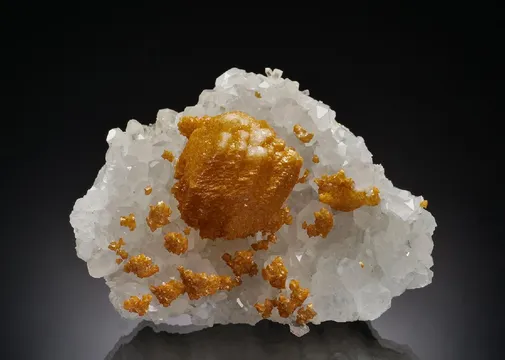
Barite from Roata is best known as tabular to lamellar crystals in yellow, blue, colorless to creamy, and dark-included habits, usually prized for translucency, thin bladed architecture, and association rather than sheer crystal size alone. Documented Roata pieces include bright transparent deep-yellow tabular crystals on quartz from level 230, with main crystals about 2.5 x 2 cm; very sharp yellow tabular-lamellar crystals with quartz and rhombohedral dolomite from 1970-1980; and yellow barite aggregates with dark gray inclusions described as “plumosite,” with main crystals recorded to 4.2 x 3.7 cm. The wider Cavnic specimen tradition also includes blue barite rosettes, transparent barite with rhodochrosite and dolomite, and unusual stibnite-included barite, and Roata material overlaps this aesthetic when barite grows as thin plates over dark sulfides or quartz. The most desirable Roata barites have clean edges, good luster, visible transparency, strong color, and meaningful associations such as quartz, dolomite, rhodochrosite, stibnite, or realgar inclusions; flat, bruised plates or massive baryte with no open-space crystal habit are much less compelling.
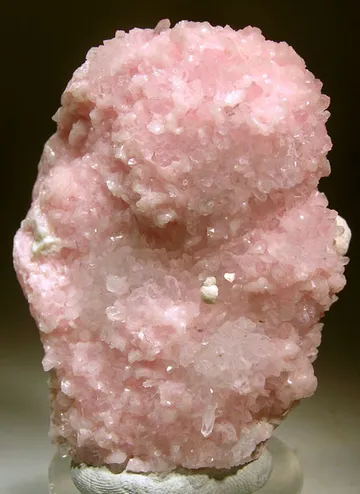
Roata’s documented mineral list extends well beyond gold and barite. Mindat records arsenopyrite, calcite, chalcopyrite, fluorite, galena, gypsum, helvine, native arsenic, electrum, orpiment, pyrite, quartz including milky quartz, realgar, rhodochrosite, rhodonite, sphalerite, stibnite, wurtzite, and a questioned occurrence of benleonardite. Realgar and native arsenic are visually distinctive Roata rarities, occurring as red crystals on dark to gray arsenic crusts and in small cavities; cinnabar with barite is also documented from a 1991 Roata specimen and is considered unusual for Maramureș. Rhodochrosite ties Roata into Cavnic’s type-locality heritage, even though the finest classic rhodochrosite specimens are usually labelled more broadly Cavnic or Bolduț. Rhodonite is significant in the Cavnic-Roata manganese paragenesis, and helvine is a notable Be-Mn silicate recorded from the Cavnic system, though Roata-attributed collector specimens of helvine are far scarcer than the better-known Cavnic/Bolduț examples.
The first authenticity issue with Roata specimens is locality precision. Many older labels say only “Cavnic,” “Kapnik,” “Kapnikbánya,” “Maramureș,” or “Romania,” and some high-quality specimens from Bolduț, Roata, the Cavnic Mine sensu lato, Baia Sprie, Herja, or Băiuț can be superficially similar. A Roata attribution is strongest when supported by an old dealer label, a collector label naming Roata, a documented find date, or a style consistent with known Roata material: gold-on-quartz from the 2000 find, yellow tabular barite from level 230, barite-stibnite-realgar associations, or arsenic sulfide pieces specifically labelled Roata.
No well-documented epidemic of Roata-specific fakes is part of the standard mineral-collecting literature. The more realistic problems are overbroad labels, optimistic mine attribution, repaired barite, and cleaned gold. Native gold specimens should be examined for natural attachment, uninterrupted quartz or calcite matrix around the gold, and the presence of normal associated sulfides such as arsenopyrite or pyrite. Brightness alone is not a guarantee of quality; some collectors prefer a natural patina, while overly acid-cleaned gold can lose the subtle contrast that makes Roata pieces attractive.
Barite condition is the chief practical concern. Thin tabular crystals chip along edges, cleave, and bruise easily; blue and yellow rosette or plate specimens should be inspected under low-angle light for cleaved terminations, rubbed high points, missing interior blades, and repaired clusters. Cabinet-size pieces can be impressive, but large Roata barites with completely intact thin blades are much scarcer than ordinary plates. Minor trimming on the back of old mine specimens is not necessarily a defect if the display face is natural and undamaged, but heavy sawing or glued restoration should be disclosed.
Realgar, orpiment, and native arsenic require sensible handling. Realgar is photosensitive and can alter in strong light, so Roata realgar-bearing pieces—especially barite with reddish inclusions or native arsenic crusts with red crystals—should be stored away from direct sun and intense display lighting. Arsenic sulfides and native arsenic are not dangerous in a closed case, but avoid abrasion, dust, licking, ultrasonic cleaning, or casual handling by children; wash hands after handling and keep fragments contained.
Market availability is intermittent. Roata gold is genuinely scarce as a collectible specimen occurrence, and attractive pieces usually move through established dealers, auctions, or older European collections. Barite appears more often, but the market separates ordinary Cavnic/Roata barite from the best old pieces with color, transparency, documented provenance, and sharp condition. Specimens with Uwe Niemeyer, Bill and Diana Dameron, Jan Buma, Wouter van Tichelen, Fabre Minerals, Crystal Classics, or other recognized provenance deserve preservation of every label and photo record, because locality precision and collection history are a major part of the value.
The strongest Roata story begins not with a showcase specimen but with emptiness. In August 2011, a visitor photographed miners’ helmets at Roata and noted that the scene “wasn’t staged.” They had simply been left behind. Other photographs from 2007 to 2013 show dump collecting after closure, a walled adit, abandoned buildings, and the square of the mine with the entrance sealed at the bottom of the forecourt. For a collector, those images change the way a Roata specimen looks: the yellow barite plate or leaf-gold thumbnail is not an abstract mineral object, but a survivor from a mine whose working life ended almost overnight in the wider collapse of Maramureș non-ferrous mining.
A darker episode came on 30 November 2006, just as the Cavnic mining world was approaching its end. At about 4:00 in the afternoon, in the Roata section of the Cavnic mine, a 37-year-old wagon worker named Mihai Cupcea was transporting ore in the Ferdinand gallery with a locomotive mechanic. According to the labor inspector quoted in the Romanian press, Cupcea should have been standing behind the last wagon but instead climbed onto the locomotive frame. He became ill, slipped, and the mechanic stopped as quickly as he could, but several wagons had already passed over the miner’s legs. The mine management reportedly notified the incident only the next morning at 8:00, about 16 hours later. It is a brutal reminder that Roata’s most beautiful specimens came from a working mine, not a harmless collecting trench.
Roata also has a surprisingly modern technological echo in the ruins of Logolda, the old gold-smelting installation near the Roata area of Cavnic. Local accounts place the ruins near the school and the Hotel Roata, on the left side of the road toward Sighet after the intersection with the Băiuț road. The site is described locally as having been built in the mid-1800s and as an early European installation to apply cyanide separation technology to gold ore. Today the place is no glittering industrial monument: local descriptions speak of remaining walls, much of them swallowed by forest. The contrast is memorable—one of the region’s most advanced nineteenth-century metallurgical ambitions reduced to masonry in the trees, while tiny gold leaves from the nearby mine sit in cabinets around the world.
The 2000 gold find has its own quieter drama. One documented Roata specimen was traced to filon 7-Oanța 1, pan 578, level 180 m: a quartz matrix held together by filigree crystalline leaf gold, with arsenopyrite crystals present. That specimen was described as recovered from a single find made in 2000. Other analyzed and dealer-documented pieces from the same period show why the find matters: Roata gold is not generally abundant as cabinet material, and the Cavnic district is better known to many collectors for rhodochrosite, barite, tetrahedrite, and sulfides. When the 2000 material appeared, it gave Roata a distinct identity within Cavnic—a gold locality producing delicate leaves and arborescences rather than simply another name under the broad Kapnik label.