






Boyacá Department, Colombia — world-famous emerald locality with hexagonal beryl in carbonate veins, historic mines (Muzo, Coscuez, Chivor), and prized collect…
Key facts
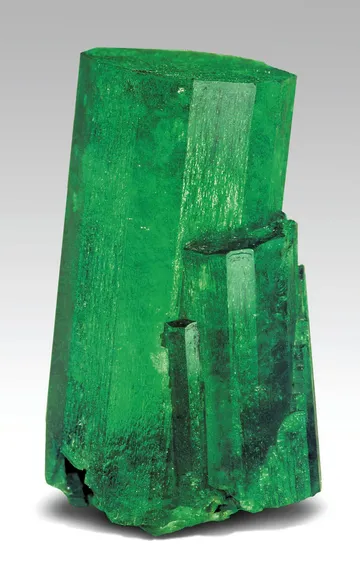
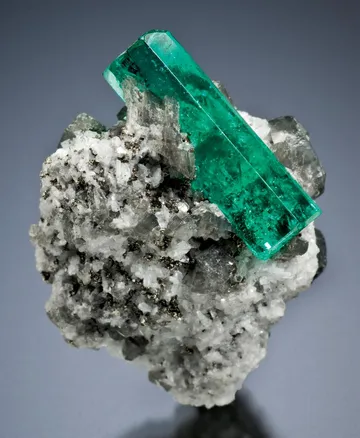
Boyacá is the green heart of Colombian mineral collecting: a department whose name, in the mineral world, immediately calls up Muzo, Coscuez, Chivor, Peñas Blancas, La Pita, Quípama, and the other legendary workings of the Eastern Cordillera. These are not pegmatite emerald deposits. Their fame rests on a far stranger and more elegant geological story: emeralds formed in carbonaceous Lower Cretaceous sedimentary rocks, in fault-controlled carbonate veins, breccias, and tension gashes opened by Andean tectonism and charged by hot saline fluids. The classic Boyacá specimen is not merely a green crystal; it is a geological contrast piece—hexagonal beryl in vivid emerald green, seated in white calcite or carbonate gangue, often with black shale and bright pyrite, and locally with rare parisite-(Ce), fluorite, albite, dolomite, quartz, or bitumen.
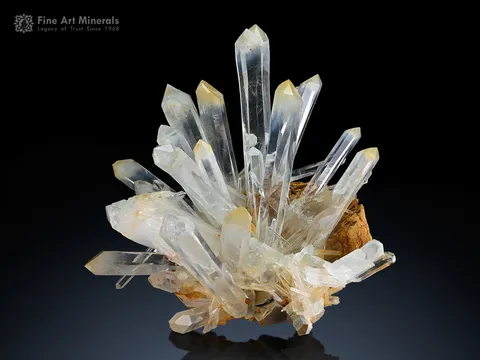
Collectors value Boyacá because it joins four different levels of importance in one locality field. It is a gem source of global rank; a specimen source capable of producing matrix pieces that belong in the same conversation as any great colored-mineral locality; a historic mining region worked before and after the Spanish conquest; and a mineralogical type-locality district through Muzo and parisite-(Ce). The best pieces have the calm authority of natural architecture: an undamaged emerald rising from carbonate like a cut gem that refused to leave its pocket, or a cluster of clear quartz from Cabiche with yellow to orange halloysite drawn into the tips like pigment in glass.
Regional View
Country View
The department spans both sides of Colombia’s emerald narrative. On the western flank are the Muzo–Coscuez–Quípama–Maripí–Peñas Blancas localities, where emeralds occur in black shale and carbonate veins of the western emerald belt and where trapiche emeralds are especially associated. On the eastern side, the Chivor area gives the other great Colombian emerald look: commonly bluish green, glassy, and prized for transparency, with albite, carbonate, pyrite, and shale telling the same hydrothermal story in a different structural setting.

Photo: Parent Géry / Wikimedia Commons

The Boyacá name also appears on a newer generation of non-emerald specimens. Cabiche, in Quípama municipality, reintroduced collectors to “mango” or “corona” quartz: clear to milky quartz crystals carrying bright yellow to orange fibrous inclusions concentrated in terminations, widely attributed in the collecting literature to halloysite. These quartz pieces are not emerald-mine side notes; they are one of the few modern Colombian specimen styles to become instantly recognizable on show tables.
Search for specimens: View all specimens from Boyacá Department, Colombia
Boyacá’s specimen localities are dominated by sediment-hosted hydrothermal emerald deposits in the Eastern Cordillera of Colombia. The productive rocks are Cretaceous marine shales, calcareous mudstones, limestones, and related sedimentary units that were folded, faulted, brecciated, and veined during later Andean deformation. In collector terms, that is why the matrix is so distinctive: black carbonaceous shale, white to cream calcite and dolomite, pyrite, albite, quartz, and locally fluorite or barite, rather than the feldspar-quartz-mica assemblage one expects from pegmatitic beryl localities.
The western emerald belt in Boyacá includes the Muzo district and its satellites—Coscuez, Quípama, La Pita, Cunas, Peñas Blancas, and related workings—where the Muzo name has long carried both locality meaning and trade prestige. Here emerald occurs in carbonate veins and breccias cutting black shale and calcareous rocks, with calcite, dolomite, pyrite, quartz, albite, fluorite, barite, and parisite-(Ce) documented in the broader assemblage. The prized matrix specimens from this side of Boyacá are often emerald in calcite with pyrite and black shale: high-contrast, compact, and unmistakably Colombian. Trapiche emeralds, showing a six-rayed pattern related to growth sectors and included carbonaceous material, are also especially tied to the western emerald zone, including Muzo and Peñas Blancas.
Coscuez lies close to Muzo but deserves independent attention. It has been worked for centuries and became a major modern source in its own right, at times rivaling or surpassing Muzo in production. The Coscuez assemblage overlaps strongly with Muzo: emeralds in calcite veins, with pyrite, quartz, dolomite, parisite, and rarer fluorite, apatite, albite, and barite. Historically, Coscuez emeralds have sometimes been absorbed into the broader “Muzo” commercial identity, a source of both romance and confusion for later labels.
Chivor, on the eastern side of the emerald region in Boyacá, gives a different classic. The mine area was known historically as Somondoco and is widely treated as the first major Colombian emerald source worked by the Spanish. Chivor emeralds are commonly described in the trade as more bluish green and often highly transparent compared with the warmer Muzo style, though individual stones and specimens vary. The mineralization is again sediment-hosted and structurally controlled, but the mine’s collector look frequently includes emerald with albite or carbonate, pyrite, shale, and associated hydrothermal minerals.
Mining history in Boyacá is layered and complicated. Indigenous exploitation and trade preceded Spanish conquest; Spanish activity began in the sixteenth century; colonial and republican mining passed through cycles of control, abandonment, rediscovery, leasing, private enterprise, state intervention, and modern corporate operation. José Ignacio París held a major nineteenth-century role at Muzo, and the rare-earth fluorocarbonate parisite-(Ce) was named for him. In the twentieth century, government agencies, private lessees, local emerald families, foreign investors, and later formal mining companies all shaped production. Today the largest emerald operations are not casual collecting localities. They are active mines with legal titles, security, underground workings, and controlled sale chains; access for collectors is by permission, not by hammering freely on dumps.
The modern specimen flow from Boyacá comes by several routes. Fine emerald-in-matrix pieces are usually recovered during mining and pass through miners, mine offices, Bogotá dealers, export networks, or specialized specimen dealers. Lower-grade material, fragments, and small crystals may move through local markets, but fine, undamaged matrix emeralds are scarce because cutting value constantly competes with specimen value. Cabiche quartz is different: the yellow-orange quartz pockets were shallow roadside or near-surface diggings in Quípama, rediscovered in 2017 and worked locally as collector demand grew. The earliest Cabiche pieces were robust, elongated crystals with color concentrated toward the tips; later finds produced brighter orange inclusions and, in summer 2018, delicate needle-quartz styles with yellow inclusions.
Quartz from Boyacá splits into two collector traditions: accessory quartz in the emerald-bearing carbonate veins of Muzo, Coscuez, Peñas Blancas, and related districts, and the much more specimen-driven halloysite-included quartz from Cabiche in Quípama. The Cabiche material is the modern standout: lustrous clear to milky crystals, commonly elongated or needle-like, carrying yellow to orange fibrous inclusions concentrated in terminations, producing the “mango” or “corona” look. Good pieces show bright color sealed within transparent quartz, sharp terminations, attractive crossing or clustered architecture, and minimal cleaning damage; ordinary pieces are cloudy, broken, iron-stained without definition, or lack the concentrated color zoning that makes the locality immediately recognizable.
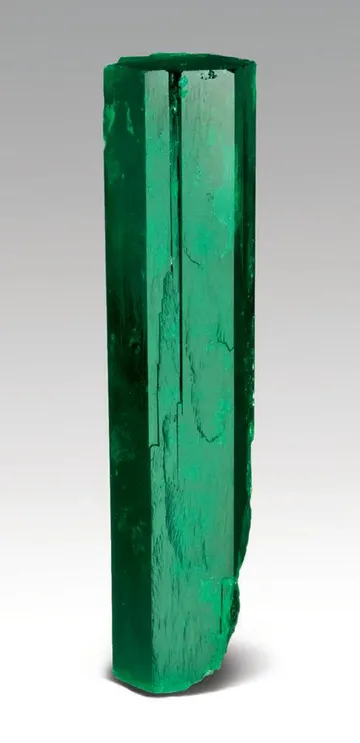
Emerald is the defining Boyacá mineral: hexagonal green beryl from sediment-hosted hydrothermal veins and breccias in the Muzo–Coscuez–Quípama–Peñas Blancas western belt and the Chivor eastern belt. Muzo and nearby western-belt specimens are most coveted when a saturated, gemmy crystal remains naturally seated in white calcite or carbonate with black shale and pyrite; Chivor pieces are admired for glassy, often bluish green crystals and a crisp hydrothermal matrix context. Sizes range from tiny matrix sparkles and etched fragments to centimeter-scale display crystals and rare large rough; the best specimens combine color, transparency, intact terminations, undisturbed attachment, and convincing paragenesis, while lesser pieces may be pale, fractured, over-cleaned, repaired, or essentially cutting rough set on matrix.
Beryl from Boyacá is overwhelmingly important as emerald, Be3Al2(Si6O18), colored chiefly by chromium and vanadium in a black-shale hydrothermal environment rather than by pegmatitic processes. Collectors sometimes use “beryl” on labels when the crystal is pale, weakly colored, partly altered, or when the specimen is being described at species level rather than gem-variety level, but the locality’s prestige rests on green emerald crystals from Muzo, Coscuez, Chivor, La Pita, Peñas Blancas, and related workings. Fine beryl specimens here are judged less by brute size than by intact hexagonal form, lively internal green, natural contact with calcite, albite, shale, or pyrite, and credible mine attribution; matrix pieces that preserve growth context are usually more desirable to mineral collectors than loose crystals of similar color.
Calcite is the principal stage on which many Boyacá emerald specimens perform. In the Muzo and Coscuez style it commonly appears as white to cream massive, cleavable, or crystallized carbonate gangue filling veins and cavities in black shale, carrying emerald, pyrite, dolomite, quartz, and rarer accessory minerals. As a collectible species, calcite from Boyacá is valued less for standalone crystal perfection than for matrix quality: sharp contrast, stable natural surfaces, visible pocket texture, and undisturbed emerald attachment. The finest emerald-on-calcite pieces show the calcite as part of the original vein architecture, not as a suspicious white pedestal; chalky, broken, acid-worn, or glue-packed calcite is a warning sign rather than a virtue.
Other documented Boyacá minerals give the district much of its mineralogical depth. Pyrite is a key companion and visual accent in emerald specimens, forming brassy grains, crystals, and aggregates in the carbonate veins. Dolomite, albite, fluorite, barite, apatite, muscovite or sericite, bitumen, graphite-rich shale, and halloysite all appear in the documented assemblages of the emerald and quartz localities. Parisite-(Ce), CaCe2(CO3)3F2, is the great rarity: Muzo and the Muzo Mine are listed as co-type localities for the species, and good brown to yellow-brown crystals from the district are prized not merely as accessories to emerald but as important rare-earth carbonate specimens in their own right. Euclase and pink fluorapatite from western Boyacá localities such as La Marina also widen the department’s appeal beyond emerald.
Boyacá emerald specimens require a stricter authenticity eye than almost any other green-mineral locality. The classic visual formula—green crystal on white calcite—has been imitated, repaired, and reconstructed for decades because the components are valuable, portable, and visually simple. A natural specimen should make geological sense: the emerald should enter the calcite, shale, or albite along a believable contact; the matrix should show continuous veining or pocket texture; and pyrite, shale, carbonate, and crystal orientation should not look staged. Red flags include rounded drilled-looking sockets, glue halos, calcite powder packed around a crystal base, repeated crystals set at implausible angles, glossy adhesive under UV or magnification, broken loose emeralds presented as “in matrix,” and romantic labels that say “Muzo” without mine history or old collection provenance.
Treatments also matter. Emeralds—especially cut stones, but sometimes crystals and repaired specimens—may have surface-reaching fractures filled with oil, wax, natural resin, or artificial resin to improve apparent clarity. For a specimen collector, this is not automatically disqualifying if disclosed, but it changes value and handling. Avoid ultrasonic cleaning, heat, solvents, prolonged strong light on filled fractures, and aggressive acids around carbonate matrix. Calcite reacts with acids and is easily cleaved or bruised; pyrite can oxidize if stored damp; shale matrix can flake; and emerald, while hard, is commonly fractured and vulnerable at terminations and attachment points.
Mislabeling is common. “Muzo” is sometimes used as a color term or prestige shorthand for western Boyacá emeralds, including Coscuez or other district material. Chivor, Coscuez, La Pita, Peñas Blancas, Quípama, and Muzo should not be treated as interchangeable names. Trapiche emeralds are another risk category: real Colombian trapiches are scarce, structurally subtle, and expensive; many low-cost “trapiche emeralds” in casual online commerce are assembled, dyed, polymer-filled, or simply unrelated material with a painted or molded six-rayed pattern.
Market availability is uneven. Small emerald-in-calcite specimens from Boyacá appear regularly, but truly fine matrix pieces with gem color, undamaged terminations, and credible provenance are always scarce and expensive because they compete directly with the cut-gem trade. Cabiche mango quartz is more available in the modern specimen market, but top pieces with bright internal color, intact clusters, and clean transparent terminations are much less common than ordinary yellow-stained or damaged quartz. Parisite-(Ce) from Muzo is a specialist rarity; old labels, analytical confirmation, and matrix context carry a large premium.
The most haunting Boyacá story belongs to Coscuez. During the colonial period, miners followed emerald-bearing veins underground with simple tunnels. One vein produced a magnificent emerald crystal described as 18 ounces, or about 550 carats, reportedly sent to a museum in Madrid. Then, in the mid-1600s, a large cave-in buried almost 300 Spaniards and Indigenous workers. Mining was abandoned soon afterward. Two centuries later, in 1850, operations broke back into the same tunnel and found the bones of the victims together with bamboo and metal tools. The vein became known among miners as the Dead Man’s Underpass; later it was called El Español—“The Spaniard.”
Chivor has its own lost-mine drama. The Spanish learned of the Somondoco emerald source in 1537, worked it in the sixteenth and seventeenth centuries, and then lost the exact knowledge of the workings after abandonment. For more than 200 years, the old mine lived partly as memory and manuscript. Francisco Daniel Restrepo Escobar, a Colombian mining engineer experienced in gold and silver districts, is credited with the rediscovery. Later accounts placed the rediscovery in different years, but surviving maps, reports, and notes point back to Restrepo’s search in the 1880s. The best image from that period is not a glittering emerald but paper: rough hand-sketched maps marking rivers, old mines, and promising places between the Río Somondoco and Río Guavio.
The twentieth-century Chivor story reads like a mining novel because some of the men involved wrote it that way—and because the real corporate record was just as dramatic. In 1919, an American group bought Chivor 1 and 2 for £46,000, equivalent at the time to about US $230,000. Within a few years, ownership passed into a web of American corporations. In the mid-1920s, George Graham Rice, an infamous stock promoter, began pushing shares of the Colombia Emerald Development Corporation through the Wall Street Iconoclast, a circular sent to a mailing list of 600,000 recipients. The promotion boasted of rich June 1926 production of 23,500 carats and claimed the property was worth $100,000,000, capable of returning $2,000,000 to $5,000,000 annually. The sober mining reality was less glamorous: half the touted 23,500 carats were worthless stones, the rest were estimated at only 50 cents per carat, and the company reported a $57,000 loss for 1926. One engineer later reduced the whole episode to a dry sentence: “I guess they made more money on the stock market than mining.”
Modern Chivor still gives miners the old problem of water. GIA’s 2017 field visit to El Manantial recorded maze-like tunnels more than 1.7 kilometers long. In one vertical shaft leading to a productive tunnel, water nearly filled the opening and had to be pumped after every five hours of mining; the pumping took two hours. The mine’s name, El Manantial—“the spring”—is not poetic exaggeration. In these mountains, emerald mining is often as much about moving water as moving rock.
Cabiche’s mango quartz story is quieter but dear to collectors because it happened in the specimen era. The yellow quartz workings were close to the surface, where tree roots followed fractures and entangled quartz clusters. When interest grew after the locality’s 2017 rediscovery, different styles emerged from nearby pockets. The first material from a pocket above the road produced robust elongated crystals with yellow inclusions concentrated at the terminations, but many were damaged by early cleaning. A spring 2018 find produced the brightest orange inclusions, followed in summer 2018 by delicate needle quartz with yellow color in the tips. The best pieces look as if the quartz grew around warm mineral light.
The human side of Boyacá mining remains immediate. Around Coscuez, women have entered a world once treated as male territory. AP documented miners such as Margot Avila, 45, using hammer and chisel underground; Yaneth Forero, 52, working small unregulated mines where dynamite still opens tunnels; Deisy Alexa Gallo hauling sacks of rock to be washed and sifted; and Janeth Paez, 45, standing in hot, oxygen-poor tunnels where power tools chip at boulders. Forero’s line is the kind of sentence that stays with anyone who has bought a Colombian emerald: “There are months or years in which I don’t even make $250.” Yet she kept working for the dream of a home “with tiles on the floors, a place that smells good and where no one can kick me out.”
_6.jpg)
