A collector's guide to Bou Nahas mine, Morocco: its geology, mining history and notable minerals, illustrated with the 89 specimens documented from this locality on EarthWonders.
Key facts
Bou Nahas is the specimen name collectors use for the Bounhas–Bou N’has copper mine in the Oumjrane mining area of Morocco’s Eastern Anti-Atlas, a desert polymetallic vein system about 50 km southeast of Alnif and north of the Oumjrane village area. It matters because it is not just another Moroccan copper locality: it is a modern, working copper deposit in Upper Ordovician sandstone–pelite country rock that has yielded a distinctive suite of collector specimens—barite, pyrite, quartz, marcasite, chalcopyrite, native copper, galena, sphalerite, malachite and azurite—formed across primary hydrothermal and later supergene events.
The mine’s geological interest is unusually strong for a specimen locality. The Bounhas mineralization is a structurally controlled, lenticular lode system, generally east–west in trend and dipping south, with ore textures described as brecciated, ribboned, disseminated and massive. The best collector pieces make that history visible: quartz and sulfides from the Cu–Ni–As stage; tabular or rosette barite from the late Pb–Zn–Ba stage; and supergene native copper, cuprite, malachite, azurite, paratacamite and the type-locality mineral bounahasite from oxidation-zone chemistry.
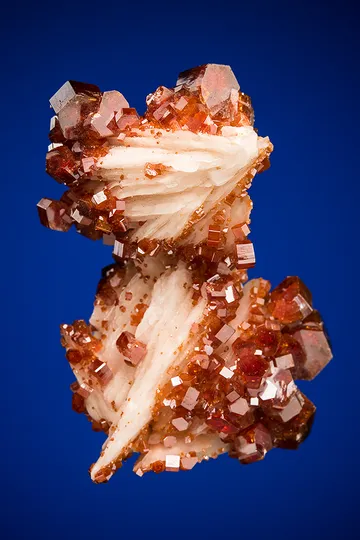
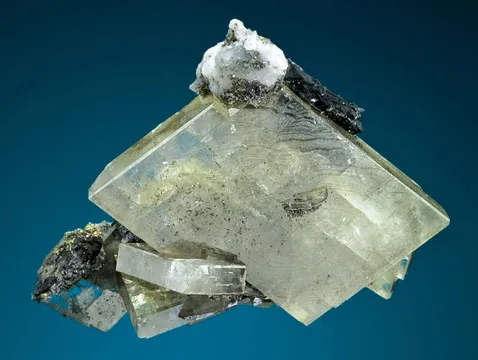
For collectors, Bou Nahas is best known for two quite different aesthetics. The first is the barite–sulfide look: sharp, thick, tabular to diamond-shaped barite crystals in yellow-brown, grey, white, blue or zoned colors, commonly dusted or edged with bright pyrite, marcasite and quartz. The second is the 2015 native copper find: small to miniature skeletal copper crystals and elongated spinel-law twins, often partly coated with cuprite red, malachite green or iridescent oxide films. In both groups, the finest pieces have a crisp “built” quality—crystals perched on open matrix rather than massive ore—and the associations are a major part of the locality’s character.
Regional View
Country View
Historically, the Oumjrane–Bou N’has area links old copper working, French-period exploitation, and the modern expansion of Moroccan copper mining. The district had earlier workings and was worked in the 20th century before a long pause; Managem’s Oumejrane copper project entered modern production in 2014 through its CMO subsidiary. The specimen story begins just before that modern production phase, when the reopening and development of the mine sent barite, pyrite, marcasite, quartz, chalcopyrite and later native copper into the collector market in a steady stream from 2011 onward.
Search for specimens: View all specimens from Bou Nahas mine, Morocco
Bou Nahas Mine is in the Oumjrane mining area, Alnif Cercle, Tinghir Province, Drâa-Tafilalet Region, Morocco, within the Eastern Anti-Atlas. Its recorded coordinates are approximately 30°39′53″ N, 5°06′48″ W. The deposit is also written Bou N’has, Bou N’hass, Bounhas or Bou’Nhass; “Bou N’has” is commonly translated in locality literature as “there where the copper is,” an apt name for the copper-bearing desert tract north of Oumjrane.
Geologically, Bou Nahas is a polymetallic hydrothermal vein deposit hosted in detrital Upper Ordovician rocks—alternating sandstone-quartzite bars and pelitic units assigned to the upper part of the Second Bani Group. The mineralized lodes are controlled by brittle faults and fractures, with the principal Bounhas structure described as lenticular, generally east–west to east-northeast–west-southwest, south-dipping, and locally steep. District-scale work places Bounhas with related Cu–Ni lodes such as Oumjrane North and Afilou N’Khou in the southwestern part of the Oumjrane–Boukerzia district.
The ore history is polyphase. The earliest hydrothermal episode is iron-rich and marked chiefly by pyrite in carbonate gangue, especially ankerite and siderite. The economically important Cu–Ni–As episode introduced chalcopyrite, gersdorffite and arsenopyrite, with quartz as the important gangue. A later Pb–Zn–Ba episode deposited galena and sphalerite in association with barite. Subsequent supergene alteration produced covellite, native copper, anglesite, malachite, azurite and iron oxides; later mineralogical work on the oxidation zone also documented paratacamite and the new copper chloride bounahasite.
The mine’s specimen pockets record these stages in miniature. Baryte specimens commonly show tabular crystals on quartz with pyrite and marcasite, while some pieces preserve casts and perimorphs after earlier barite generations. Chalcopyrite is abundant as ore but uncommon as fine freestanding crystals; the best specimens are from early mining and show bright golden tetrahedral crystals or botryoidal aggregates on quartz. Pyrite occurs as cubic, octahedral or mosaic coatings, as bright curved aggregates, and as pseudomorphic or perimorphic crusts after dissolved barite. Native copper was historically known mostly as arborescent, oxidized masses, but in early 2015 a small green-clay zone produced crystalline copper floaters, including skeletal elongated spinel-law twins that became the mine’s most celebrated copper specimens.
Mining in the Oumjrane area is old. Local accounts and collector literature refer to copper exploitation in medieval or earlier times, followed by French-period work in quarries and shafts. Later, mining stopped and the area became largely inactive. Modern development resumed around 2011 after exploration, and Managem records the start of copper production from the Oumejrane project in 2014. Corporate and industry sources describe Oumejrane as an underground cut-and-fill operation producing copper concentrate by flotation; one 2014 source lists the operator as CMO, Compagnie Minière d’Oumejrane, a Managem subsidiary.
Collecting access should be treated as access to an active mining operation, not as an open rockhounding locality. Serious collectors normally encounter Bou Nahas material through Moroccan miners, dealers and international show circuits, not by casual field collecting. Anyone attempting a visit would need current permission from land and mineral-rights holders and would have to observe mine safety requirements; underground workings, shafts, dumps and industrial activity are real hazards.
Barite is the signature display mineral of Bou Nahas and occurs in two main collector habits: sharp, thick tabular crystals, often in parallel or multi-terminated groups, and rosettes of thinner lamellar crystals, commonly on quartz. The classic colors are grey, brown, canary yellow and yellow-brown, but later finds also produced white and pale to vivid blue tabular crystals, sometimes with yellowish edges or phantom-like zoning; crystals are commonly in the 4–6 cm range, with some reaching about 10 cm, while exceptional rosette groups have been reported much larger. Associations with quartz, pyrite and marcasite are essential to the Bou Nahas look. The best specimens are not merely large barite: they show sharp transparent to translucent blades or thick “book-like” aggregates with bright sulfide contrast, clean zoning, undamaged terminations and an open architecture that reveals the polymetallic matrix.
Pyrite from Bou Nahas is far more interesting than ordinary brassy ore pyrite because it occurs in several highly recognizable specimen styles: bright cubic crystals with curved or polycrystalline faces, microcrystalline mosaics coating barite, pyrite crusts and perimorphs after tabular barite, and aggregates associated with quartz, marcasite and late barite. A notable 2013 zone produced sharp pyrite masses after tabular barite crystals that had dissolved away, and the summer 2020 material included white tabular barite partly or nearly completely mantled by minute cubic and octahedral pyrite. Good Bou Nahas pyrite is judged by brightness, sharpness of the microcrystal mosaic, clarity of the barite-cast geometry, and association; the ordinary pieces are simply brassy coatings, while the best show an architectural history of barite growth, pyrite overgrowth and partial dissolution.
Quartz at Bou Nahas is chiefly a gangue and matrix mineral tied to the Cu–Ni–As hydrothermal stage, and in specimens it serves as the pale crystalline framework for barite, marcasite, pyrite, chalcopyrite, galena and copper. It occurs as white to colorless crystals and microcrystalline coatings, locally overgrowing barite, bridging sulfide groups, or carrying metallic crystals in open cavities. The best quartz-bearing Bou Nahas specimens are those in which quartz sharpens the contrast rather than burying it: bright white quartz against yellow-brown or blue barite, quartz matrix carrying sharp marcasite twins, or quartz plates with isolated chalcopyrite or galena. Quartz-only pieces are not the locality’s strength; its value here is as the structural and visual stage on which the sulfides, barite and copper minerals sit.
Marcasite from Bou Nahas occurs as bright, sharp crystals and twinned aggregates, commonly on quartz and in association with barite and pyrite. Dealer and field descriptions emphasize very sharp twins, aerial groups, lustrous faces and edges, and barite associations, including lamellar “book-like” barite aggregates and tabular barite on quartz. The species is part of the mine’s best sulfide aesthetic: silvery to pale-brassy marcasite with glassy barite and sparkling pyrite, often in small cabinet to cabinet-size pieces. Top examples separate themselves by crisp marcasite form, fresh luster, open placement on quartz, and freedom from oxidation; dull, massive, or crumbly sulfide material is commoner and far less desirable.
Native copper is Bou Nahas’s most important rarity for species collectors because the early 2015 green-clay pocket produced Morocco’s first widely recognized high-quality crystallized native copper specimens. Before that find, Bou Nahas copper was known mainly as arborescent or spongy oxidized aggregates, often coated by malachite; the 2015 pocket yielded roughly 1,000 pieces, of which only about 100 had well-formed sharp crystals. Most good specimens were small, commonly up to 5 cm, with a few to about 10 cm; several loose elongated spinel-law twins reached about 7 cm. The most coveted examples are skeletal, elongated spinel-law twins with sharp edges, clean coppery surfaces or attractive cuprite-red, malachite-green or iridescent oxide coatings. Matrix pieces are scarcer than floaters, and unusually crisp twins with minimal bruising are the locality’s copper elite.
Chalcopyrite is the principal copper ore mineral at Bou Nahas, but fine crystallized chalcopyrite specimens are comparatively uncommon. When well formed, it appears as classic golden tetrahedral crystals, usually not exceeding about 1 cm, or as botryoidal to globular aggregates built of tiny, roughly millimetric chalcopyrite crystals; quartz is the most important collector association. The better chalcopyrite pieces mostly came from the early years of renewed mining around 2011–2012, including bright crystals on quartz and spheroidal aggregates. Good specimens need visible crystal form, fresh brassy color, and balanced quartz matrix; massive ore pieces, even if rich, do not have the same collector standing.
Other documented minerals from Bou Nahas include anglesite, ankerite, arsenopyrite, azurite, calcite, covellite, cuprite, galena, gersdorffite, malachite, paratacamite, siderite, sphalerite and tenorite. The standout rarity is bounahasite, Cu+Cu2+2(OH)3Cl2, for which Bou Nahas is the type locality. It was described from the oxidation zone as green, vitreous, pseudo-hexagonal micrometre-scale plates in loose clusters with native copper and paratacamite, making it a micromineral rather than a cabinet-specimen mineral. Galena and sphalerite deserve collector attention as well: recent specimens have shown cubo-octahedral galena with pyrite, quartz and bluish barite, and 2023 material included unusually large, sharp sphalerite crystals with marcasite and chalcopyrite for the locality.
Bou Nahas specimens are commonly authentic and recognizable when they carry the right assemblage—barite, quartz, pyrite, marcasite and chalcopyrite, or native copper with cuprite, malachite and occasional quartz—but the locality is easily blurred in the market with nearby Oumjrane-area material and with other Moroccan barite localities. Blue barite from Bou Nahas should not be confused with pale blue Ouichane/Sidi Lahcem barite from Nador Province; the habit and matrix are different. Bou Nahas barite is typically thicker, sharper and more diamond- or tabular-looking, often with pyrite, chalcopyrite, marcasite and quartz rather than hematite/limonite-style matrix.
The most locality-specific authenticity concern is “hoganite” attributed to Bou Nahas or the Oumjrane area. Mindat flags hoganite from this locality with uncertainty and notes that it is most likely a synthetic product formed when copper minerals are cleaned with vinegar. Treat any Bou Nahas specimen labeled hoganite as suspect unless supported by serious analytical documentation; the label may indicate cleaning residue rather than a natural mineral occurrence.
Condition matters strongly. Barite cleaves readily and Bou Nahas barite commonly has exposed edges, so look for bruised corners, snapped terminations and repaired lamellar groups. Pyrite perimorphs after barite can be visually spectacular but mechanically delicate where the original barite has partly dissolved. Marcasite should be inspected for dulling, powdering, sulfurous odor, and incipient pyrite-disease-like deterioration; stable, bright, dry-stored specimens are preferred. Native copper should be checked for artificial brightening, overly aggressive cleaning, glued repairs, and loss of natural cuprite or malachite coatings. The finest copper pieces often owe their charm to natural surface color, so cleaning can reduce rather than improve value.
Fluorescence is not a major selling feature of the standard Bou Nahas assemblage. Handling concerns are more practical: keep marcasite and pyrite dry and away from humidity swings, avoid acid cleaning, protect barite from shock and vibration, and store native copper where delicate spinel-law twins will not snag. Bounahasite is a micromineral associated with chloride-bearing supergene chemistry; it should be considered analytical and fragile rather than a hand-specimen display species.
Market availability remains good for barite, pyrite, quartz and mixed sulfide/barite specimens because the locality entered the trade in volume after reopening, with notable waves in 2011–2012, 2014–2015, 2017–2018, 2020, 2022 and 2023. Truly top native copper from the 2015 clay pocket is much scarcer, especially sharp elongated spinel-law twins, matrix pieces, and specimens with undamaged skeletal crystals. Galena and sphalerite from recent finds are less ubiquitous than barite and may be underappreciated when they show strong association and sharp crystal form.
Before Bou Nahas became familiar to show dealers and online collectors, the road to Oumjrane was part of the story. Collector accounts describe Oumjrane as a small Saharan desert settlement in the Anti-Atlas, surrounded by hamada—stony desert, with only minor sand dunes—and formerly difficult to reach because of poor road conditions. A later road improvement left about 20 km without asphalt, enough to keep the place feeling remote even as the mine began feeding specimens to Europe and North America.
The transformation was fast. A 2008 view showed old mining buildings and quarries at Bou N’has; by 2014, the same area had become a mining center with shafts, dumps and active work. That shift is one reason early Bou Nahas labels can be confusing: collectors may see Bou N’has, Bou Nahas, Bounhas, Oumjrane, Alnif, Er Rachidia, Tinghir or Drâa-Tafilalet on labels depending on the year, dealer and administrative convention.
The great native copper find reads like a classic modern pocket story. Until early 2015, Bou Nahas native copper was known mainly as arborescent, spongy masses—interesting, but often oxidized and partly hidden under malachite. Then miners opened a small green-clay zone and began recovering copper floaters. Around 1,000 specimens came out of the clay, but only about 100 contained the sharp, well-formed crystals that made the find famous. Most of the good pieces were small, up to about 5 cm, with only a few reaching about 10 cm. The prize crystals were skeletal, elongated spinel-law twins—some to about 7 cm—whose open copper frameworks invited comparison with celebrated crystallized copper from Rubtsovskoe in Russia and Itauz in Kazakhstan. The pocket was small, and by the time collectors understood its importance it had already been exhausted.
The barite story is quieter but longer-lived. In 2012 and again in 2014, collectors at Sainte-Marie-aux-Mines were noticing new Moroccan barites from more than one locality, and Bou Nahas material needed to be separated from the pale blue Nador barites then also entering the market. Bou Nahas pieces had their own identity: fat, sharp, yellow-brown crystals with sulfides, and later white or blue tabular crystals coated or interrupted by pyrite. In 2013, a particularly unusual zone yielded pyrite masses and shells after dissolved tabular barite, turning a common association into a record of chemical removal—the crystal shape remained, but the original barite had partly vanished.
The mine has continued to produce surprises. A 2020 find yielded white tabular barite partly coated by extremely bright cubic and octahedral pyrite microcrystals, including pieces in which the barite was nearly gone and a pyrite shell preserved the form. Finds from August–September 2022 added blue barite, galena, quartz and pyrite combinations, while 2023 material showed that sphalerite—previously not the showiest species at Bou Nahas—could occur in larger, sharper crystals than collectors had expected from the locality.