Bou Azzer Mine, Morocco — premier cobalt district producing arsenides, erythrite, and roselite; famed for dramatic color, rarity, and collector locality appeal.
Key facts
Bou Azzer is one of the essential names in cobalt mineral collecting: a working Moroccan cobalt-nickel-gold mining complex in the Central Anti-Atlas whose fame rests on an unusual marriage of ore geology and supergene color. The primary mineralization is a Co-Ni-Fe-As system in quartz-carbonate veins, breccias, and contact zones tied to the Bou Azzer–El Graara inlier, where Neoproterozoic serpentinite and associated Pan-African rocks were later mineralized by hydrothermal fluids. To the economic geologist it is a rare primary cobalt district; to the collector it is the place where metallic cobalt arsenides, vivid cobalt arsenates, and pink cobalt-bearing carbonates meet in specimens with a look found almost nowhere else.
The classic Bou Azzer specimen is instantly recognizable: black to silvery skutterudite or other arsenides in white calcite or dolomite, carrying blades and sprays of hot-magenta erythrite; rose-red roselite crystals on pink cobalt-bearing calcite; small but intensely colored arsenate rarities tucked into vugs; and, at its best, a hard contrast between metallic ore, pale carbonate, and saturated cobalt color. Fine pieces reward close inspection. Bou Azzer is not merely “a Moroccan locality” for pink minerals—it is a district where primary ore, oxidation chemistry, and collector aesthetics are visibly bound together.
Regional View
Country View
The locality name needs careful handling. “Bou Azzer” may refer to the mine proper, the mining center, or the broader Bou Azzer mining district, which includes named workings and sectors such as Bou Azzer East, Aghbar, Agoudal, Aït Ahmane, Ightem/Irhtem, Tamdrost, Taghouni, and others. Older labels often use spellings such as Bou Azer, Bou-Azzer, Bouazzar, Arhbar, or Arbhar. For serious collectors, that precision matters: an Aghbar roselite on cobaltian calcite, a Vein No. 7 erythrite, and an Aït Ahmane arsenide specimen all belong to the same celebrated cobalt province, but they do not tell the same specimen story.

Photo: Wikimedia Commons

Search for specimens: View all specimens from Bou Azzer Mine, Morocco
Bou Azzer is a hydrothermal vein-type cobalt deposit in the Central Anti-Atlas of southern Morocco, about 120 km south to southwest of Ouarzazate in modern mining literature. The deposit sits within the Bou Azzer–El Graara inlier, part of the Anti-Atlas Pan-African belt, and the cobalt-nickel-gold mineralization is associated with the El Graara Pan-African greenstone belt and ophiolitic rocks. The important collector geology is the same geology that made the mine economic: cobalt and nickel arsenides developed along contacts and fracture systems involving serpentinite, quartz diorite and related Precambrian rocks, with quartz-carbonate gangue filling veins, breccias, and open spaces.
The ore bodies are not a single simple vein. Published geological work describes the complex as extending for tens of kilometres and containing numerous ore-bearing quartz-carbonate veins. Mineralization occurs in several structural settings: veins within serpentinite, veins at contacts between serpentinite and other rocks, and mineralized faults. More recent work has emphasized arsenide bodies and calcite envelopes near the contact between serpentinite and Pan-African diorite, as well as arsenide replacements in brecciated serpentinite cemented by calcite. In collector terms, that setting explains why specimens so often combine metallic arsenides, white to pink carbonate, quartz, dolomite, talcose or serpentinized matrix, and supergene cobalt arsenates in tight association.
The primary ore mineralogy is dominated by Co-Ni-Fe arsenides and sulfarsenides. Skutterudite, safflorite, rammelsbergite, nickeline, löllingite, gersdorffite, cobaltite, arsenopyrite, chalcopyrite, and related phases recur throughout the literature. The oxidation of those arsenide-rich ores produced the district’s celebrated secondary suite: erythrite, roselite, anorthoroselite formerly known as roselite-beta, talmessite, annabergite, cobaltaustinite, cobaltarthurite, lavendulan, pharmacosiderite, picropharmacolite, sainfeldite, wendwilsonite, and many other arsenates. The district’s arid environment has helped preserve delicate secondary minerals that would not survive long in a wetter climate.
Mining history at Bou Azzer begins with a story that sounds almost too mineralogical to be true. In 1928, Jean Epinat encountered cobalt arsenate minerals being sold in traditional stalls in Marrakech’s Jemaa el-Fna square for domestic use, including as insecticide or rodenticide material. He recognized their significance and was led back to the Bou Azzer area, where cobalt-bearing veins cropped out at surface. Prospecting and artisanal extraction followed quickly, and industrial mining began in the early 1930s; Managem’s historical account places industrial-scale mining in 1934 under SMAG on central Bou Azzer deposits and at Ightem, while other Managem material notes the creation of CTT and the start of cobalt concentrate production in 1930.
The mine’s twentieth-century production history includes interruption during World War II, postwar resumption, a major 1969–1971 exploration program by Technoexport that identified Taghouni, Bou Azzer East, and Tamdrost, a later closure in 1983 after reserve depletion, and renewed activity from 1987 after CTT work led to the Méchoui deposit. CTT, the Compagnie de Tifnout Tighanimine, is now part of Managem and operates Bou Azzer as one of the group’s oldest mines. The mine supplies cobalt concentrate to the Guemassa hydrometallurgical complex near Marrakech; modern public reporting identifies Bou Azzer as one of the few primary cobalt mines in the world and a current source of cobalt for Managem’s cobalt cathode and derivative production.
Collectors should understand that Bou Azzer is an active industrial mining district, not a public rockhounding destination. Fine specimens historically emerged through mining, local miners, dealers, and occasional access to old dumps or abandoned workings, but present-day access is controlled by the operator and by safety, security, and legal constraints. Older field accounts describe self-collecting on dumps at abandoned mines such as Irhtem and Aït Ahmane as possible in the early 2000s, while also noting that mine management did not permit open specimen traffic. That should not be read as modern permission. Any current visit or collecting attempt requires local authorization, respect for mine rules, and caution around arsenic-bearing minerals and underground workings.
The most important specimen-producing contexts differ by species. Erythrite is especially associated in collector literature with Vein No. 7 at Bou Azzer and with quartz-rich vugs in Aït Ahmane material; Aghbar has produced smaller erythrite but is more famous for roselite and associated pink cobalt-bearing calcite. Aghbar roselite is a world-class standard: gemmy red to purplish crystals on dolomite or cobaltian calcite, sometimes with centimetric pink calcite crystals. Aït Ahmane is important for arsenide ore, gersdorffite and later discoveries in the F53 and F55 deposits. Bou Azzer East is important geologically and economically, but some field accounts note that oxidation conditions there were less favorable for good erythrite. Agoudal, Ightem/Irhtem, Tamdrost, and other workings add further complexity, especially for rare arsenates and cobalt-bearing carbonates.
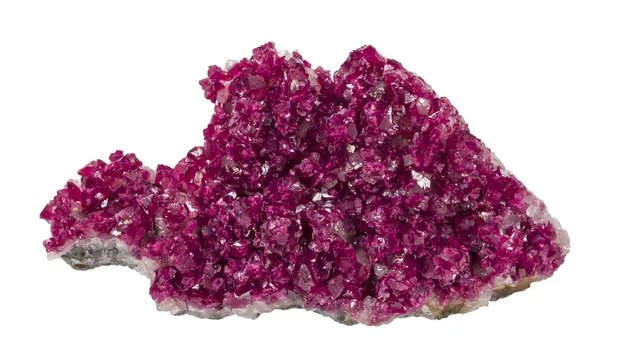
Bou Azzer erythrite is the species by which many collectors first learn the locality: saturated magenta to deep purple-red blades, acicular sprays, radial groups, and lustrous striated crystals developed from the oxidation of primary cobalt arsenides, especially skutterudite. The best material is not merely pink—it has sharp, translucent to gemmy crystal faces, a metallic internal glow, and enough relief from the matrix to read as individual crystals rather than a powdery coating. Documented specimen styles include blades to about 1.7 cm in photographed Wikimedia material, classic vug specimens with 1 cm striated crystals on quartz and skutterudite, and exceptional collector pieces said to reach several centimetres, with Vein No. 7 at Bou Azzer and Aït Ahmane quartz vugs especially important in the literature. Associations with skutterudite, quartz, calcite, roselite, alloclasite, talmessite, picropharmacolite, annabergite, and pharmacosiderite are characteristic; ordinary pieces are dull, friable, earthy, or partly altered, while fine Bou Azzer erythrite shows clean terminations, electric color, intact sprays, and a matrix that frames rather than buries the crystals.
At Bou Azzer, skutterudite is both an ore mineral and a collector mineral, occurring as bright metallic gray to silvery arsenide in massive aggregates, sharp cubo-octahedral to octahedral crystals, and crystals partly embedded in calcite or dolomite. It is one of the principal Co arsenides in the district and commonly provides the chemical parentage for the supergene cobalt arsenates that make the specimens colorful. Fine skutterudites from Bou Azzer are judged by luster, crystal definition, and separation from the enclosing carbonate; many crystals grew in tight calcite-filled openings and are difficult to expose without bruising, so undamaged, three-dimensional crystals on contrasting white carbonate are far better than massive ore fragments. Field and dealer records describe good crystals to centimetre scale, with exceptional crystals from Aghbar and Irhtem reported much larger, while typical collector pieces are more modest and valued for sharp faces, mirror luster, association with erythrite or calcite, and precise sublocality labels.
Calcite at Bou Azzer is not a background mineral in the usual sense; it is the visual stage on which much of the cobalt suite performs. Hydrothermal calcite occurs as white to colorless gangue with arsenides and as pink cobalt-bearing calcite ranging from pale rose to saturated raspberry-magenta, especially in Aghbar and related district material. Habits include rhombohedral crystals, scalenohedral crystals, drusy linings, and vug or seam fillings, with better examples showing vitreous luster, distinct crystal form, and strong contrast against skutterudite, dolomite, serpentinite, or other matrix. The finest collector calcites from Bou Azzer are those in which the carbonate is both beautiful and informative: pink calcite carrying red roselite, calcite enclosing or framing skutterudite, or calcite with enough Co color to identify the specimen instantly as Bou Azzer rather than a generic carbonate piece. Some documented cobalt-bearing calcites from Aghbar fluoresce under shortwave and weakly under longwave UV, but fluorescence should be treated as specimen-specific rather than assumed for every pink piece.
Bou Azzer roselite, especially from Aghbar, is among the world standards for the species: brilliant deep red, fuchsia, rose-red, to purplish crystals perched on white dolomite, pink cobalt-bearing calcite, or vuggy carbonate matrix. Most crystals are small by cabinet-mineral standards, commonly a few millimetres, but they can be strikingly gemmy and lustrous; documented dealer and photo records describe sharp crystals around 4–8 mm, with occasional larger crystals approaching 1 cm or a little more. The best specimens show isolated, well-formed monoclinic crystals or rich druses with intense color and transparency, not merely reddish crusts. Associations with cobaltian calcite, skutterudite, erythrite, quartz, talmessite/anorthoroselite, and other arsenates are typical of the district, but proper identification matters: roselite, anorthoroselite, wendwilsonite, and talmessite can be visually close in Bou Azzer material. A high-grade Bou Azzer roselite is bright, glassy, sharp, and well placed on a contrasting matrix; an ordinary one is tiny, matte, crowded, or unresolved without magnification.
Quartz at Bou Azzer is important less as a standalone trophy species than as a matrix and paragenetic witness in the cobalt veins. It occurs in quartz-carbonate gangue, vug linings, and pale crystalline cavities that host or accompany erythrite, skutterudite, roselite, alloclasite, chalcopyrite, native gold, bouazzerite, and other arsenate species. Collector pieces become significant when quartz provides contrast and structure: white quartz vugs holding striated magenta erythrite, quartz-feldspar-carbonate matrix with Mg-enriched erythrite, or quartz pockets carrying rare arsenates from Vein No. 7. Smoky quartz is also documented from the Bou Azzer Mine, but the market value of most Bou Azzer quartz is tied to the cobalt suite it supports. The best examples have clean, lustrous quartz crystals that act as a pedestal or protective cavity for delicate cobalt minerals; ordinary examples are massive vein quartz with little specimen character.
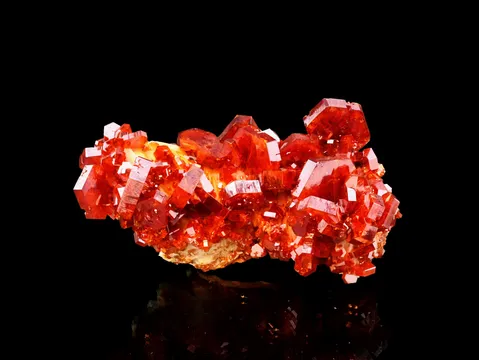
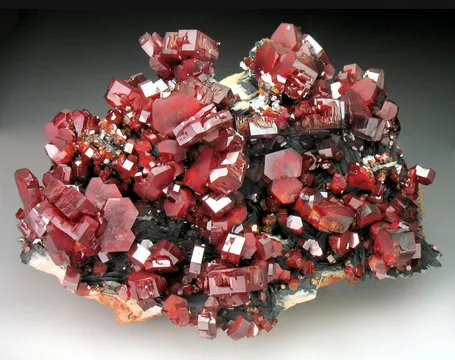
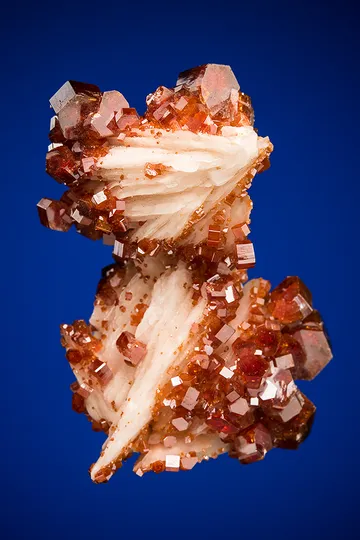
Vanadinite is not the headline Bou Azzer mineral in the way it is for Mibladen, Taouz, or other Moroccan lead districts, and Bou Azzer-attributed vanadinite should be approached with more caution than erythrite, skutterudite, roselite, or cobaltian calcite. Older dealer records do list “Minerals from Bou Azzer, Anti Atlas” alongside vanadinite offerings, and vanadinite is present in broader Moroccan mineral heritage discussions, but specific Bou Azzer vanadinite is far less central in the scientific and collector literature than the cobalt arsenides and arsenates. A credible Bou Azzer vanadinite specimen should therefore carry a precise old label, a convincing matrix and association, and preferably a sublocality; without that, misassignment to Bou Azzer from better-known Moroccan vanadinite fields is a real risk. Good pieces would be judged by the usual vanadinite standards—sharp hexagonal crystals, strong orange-red color, luster, and undamaged edges—but locality confidence is the decisive factor here.
Beyond these familiar collector minerals, Bou Azzer is a rare-mineral district of the first rank. The mine or district is tied to type-locality or type-material status for several arsenates, including irhtemite, nickelaustinite, wendwilsonite, bouazzerite, arhbarite, maghrebite, and nickeltalmessite, depending on whether one is speaking of the mine proper, named sublocalities, or the broader district. Bouazzerite, named for the locality, was described from Filon 7 as a pale apple-green bismuth-magnesium-cobalt-iron arsenate associated with quartz, chalcopyrite, native gold, erythrite, talmessite/anorthoroselite, Cr-bearing yukonite, alumopharmacosiderite, powellite, and a blue-green copper arsenate related to geminite. Other notable Bou Azzer species include safflorite, löllingite, rammelsbergite, nickeline, gersdorffite, cobaltite, arsenopyrite, native silver, allargentum, schachnerite, proustite, cobaltaustinite, cobaltarthurite, cobaltlotharmeyerite, karibibite, guanacoite, sainfeldite, lavendulan, pharmacosiderite, picropharmacolite, vladimirite, spherocobaltite, dolomite, talc, malachite, and conichalcite.
Bou Azzer specimens are often chemically serious minerals rather than decorative “crystals.” Many contain arsenic-bearing arsenides or arsenates, and some also contain nickel or cobalt compounds. They are safe enough for normal mineral-cabinet handling if treated sensibly, but they should not be cut, ground, acid-cleaned, soaked experimentally, used in elixirs, or left where children or pets can handle them. Wash hands after handling friable erythrite, arsenide ore, or powdery secondary minerals. Keep delicate arsenates in enclosed boxes or display cases to limit dust and abrasion.
Erythrite is the main condition trap. It is soft, splintery to fragile, and easily bruised; sprays can flatten, detach, or lose luster from rough handling. Some Bou Azzer erythrites are naturally coated or altered by later secondary minerals such as annabergite, pharmacosiderite, or picropharmacolite, and not every dull surface is damage—but the price difference between lively, intact, glassy magenta blades and rubbed, powdery material is large. When buying, inspect terminations, blade edges, and the contact between crystals and matrix. Broken sprays often leave obvious magenta scars.
Skutterudite has different issues. It is tougher-looking but commonly grew embedded in calcite or dolomite; extracted crystals may have bruised edges, polished-looking contact faces, or broken backs. Good skutterudite should show natural metallic crystal faces, not merely a sawn or chipped lump of ore. Because old labels may use “smaltite” or “smaltine,” older Bou Azzer skutterudite specimens can be historically interesting even when the mineral name has since been updated.
Roselite and anorthoroselite require identification discipline. Bou Azzer has multiple rose to red arsenates—roselite, anorthoroselite, wendwilsonite, talmessite, erythrite, and related phases—and visual identification can be unreliable on small crystals. Fine old specimens labeled “roselite-beta” may correspond to anorthoroselite under modern nomenclature. Talmessite and roselite-series material can be difficult even for experienced collectors without analytical confirmation. For high-value micromounts or rare-species labels, favor specimens with analytical history, reputable provenance, or published comparisons.
Cobalt-bearing calcite is widely loved and therefore widely simplified in the market. “Cobaltocalcite” is often used as a trade name for cobalt-bearing calcite rather than as an IMA species name. Bou Azzer material can be excellent, but pink calcite from other localities—especially Morocco generally and the Democratic Republic of Congo—may be sold under broad or incorrect names. A real Bou Azzer calcite should be evaluated by locality label, associations, crystal habit, and matrix, not color alone. Some Moroccan quartz geodes and decorative minerals are known to be artificially colored in the tourist trade; that is a broader Moroccan market problem, but it makes provenance especially important when bright pink or purple material is sold without a credible mineralogical context.
Vanadinite labeled Bou Azzer deserves particular scrutiny. Morocco produces enormous quantities of vanadinite from other famous districts, and Bou Azzer is not the standard Moroccan vanadinite locality. Unless the label is old, precise, and convincing, a Bou Azzer vanadinite attribution should be treated as less secure than a Bou Azzer erythrite, skutterudite, roselite, or cobalt-bearing calcite.
Market availability is uneven. Small to mid-range Bou Azzer erythrite and cobaltian calcite appear regularly, but top erythrite blades with size, luster, and pristine condition are genuinely scarce. Good Aghbar roselite remains highly desirable and is often priced more like a classic world-locality specimen than a common Moroccan mineral. Skutterudite is available as massive ore and as cabinet specimens, but sharp, undamaged, isolated crystals on contrasting calcite are much less common. Rare arsenates from Bou Azzer are usually micromount to thumbnail material and should be bought for documentation and analysis as much as beauty.
The origin story of Bou Azzer reads like a mineral collector’s fable told in a Marrakech square. In 1928, Jean Epinat was in Jemaa el-Fna when he noticed cobalt arsenate minerals being sold in the traditional market. Local people from the Bou Azzer area had long used the brightly colored cobalt minerals for practical domestic purposes, including as insecticides and rodenticides. Epinat recognized that these were not mere curiosities. He followed the trail back to the Anti-Atlas, where outcropping veins in the Bou Azzer boutonnière exposed oxides, arsenates, carbonates, and arsenides. Within only a few years, the mineral that had been sold in market stalls had become the foundation of one of Morocco’s most important mining operations.
The early industrial history moved quickly. Visual prospecting began around 1929, artisanal mining followed in the early 1930s, and industrial work was underway by 1934 on central Bou Azzer and Ightem. World War II interrupted operations, but by 1944 the mine had resumed with more industrial equipment. Later chapters were equally dramatic in exploration terms: the 1969–1971 Technoexport program identified Taghouni, Bou Azzer East, and Tamdrost; after a 1983 closure tied to depleted reserves, CTT geologists returned in 1987 and found the Méchoui deposit, helping bring the district back into production.
A collector’s field account from May 2001 captures a very different Bou Azzer: not the polished company history, but the difficult, semi-desert specimen hunt. The road approach led from Marrakech to Ouarzazate, then toward Tazenakht and Bou Azzer, through a region described as semi-desert with no lodging or restaurants at the mine area. Specimen seeking, the author wrote, often became “an unfruitful hunt.” Management did not allow open mineral traffic, daylight village inquiries were discouraged, and meetings with miners—if they happened at all—were arranged cautiously and privately. Yet the same account remembered the hospitality of Berber miners: couscous and mint tea shared in homes, even when good specimens were scarce.
That 2001 visit also records the frustrating asymmetry of Bou Azzer collecting. Erythrite, cobaltocalcite, and roselite were strongly in demand, but fine erythrite supply was “extremely poor” at the time. Aghbar, 15 km east of Bou Azzer, was a different matter: it was producing attractive roselite and wendwilsonite specimens, including the kind of rose-red crystals on carbonate matrix that now define the locality for many collectors. The same account notes the cruel practical problem of skutterudite: good crystals may occur, even exceptionally large ones, but they are difficult to remove from their enclosing matrix without damage.
Another distinctly modern Bou Azzer story concerns silver minerals from the Bouismas mine. Around 2010, the market saw a surprising group of spiky, silvery metallic specimens in white calcite. They were first said to be dyscrasite, but later study showed that many were mixtures of schachnerite and allargentum, with allargentum often dominant. Then an “exceptional find in 2010” produced stouter branching metallic crystals on actinolite that were presented simply as silver. For collectors, the episode is a reminder that Bou Azzer is not only a cobalt-color locality; it is an analytically demanding district where metallic species can fool even experienced eyes until proper work is done.
Dietrich, J. E., Meisser, N., Brugger, J., Ait Haddouch, L., Maacha, L., Kampf, A. R., Devouard, B., Sarp, H., Parodi, G. C., and Weiß, S. “Famous mineral localities: Bou Azzer, Morocco.” The Mineralogical Record, 38(5), 345–407, 2007. The major collector-oriented locality monograph, published as a 63-page feature and based on the important Lapis treatment of the district.
Ahmed, A. H., Arai, S., and Ikenne, M. “Mineralogy and paragenesis of the Co-Ni arsenide ores of Bou Azzer, Anti-Atlas, Morocco.” Economic Geology, 104, 249–266, 2009. A key ore-mineralogy paper on the primary arsenide assemblage and paragenesis.
Saintilan, N. J., Ikenne, M., Bernasconi, S. M., Toma, J., Creaser, R. A., Souhassou, M., Allaz, J. M., Karfal, A., Maacha, L., and Spangenberg, J. E. “The World’s Highest-Grade Cobalt Mineralization at Bou Azzer Associated With Gondwana Supercontinent Breakup, Serpentinite and Kellwasser Hydrocarbon Source Rocks.” American Journal of Science, 323, 2023. A modern open-access geochronology and genetic-model paper giving Late Devonian Re-Os ages for safflorite and interpreting the role of serpentinite, basinal brines, and hydrocarbon source rocks.
Tourneur, E., et al. “Formation of serpentinite-hosted, Fe-rich arsenide ores at the latest stage of mineralization of the Bou-Azzer mining district (Morocco).” Ore Geology Reviews, 2020. Focuses on Fe-rich arsenide ores in serpentinite-hosted settings and later-stage mineralization.
Souiri, M., et al. “Phase relations in Co-Ni-Fe-(±Au ±Ag) mineralizations of Bou Azzer-El Graara inlier, central Anti-Atlas, Morocco: Insights from mineral chemistry and fluid inclusions analysis.” Journal of African Earth Sciences, 2025. A recent treatment of phase relations, mineral chemistry, and fluid inclusions in the Bou Azzer–El Graara cobalt system.
“An overview of the Co-Ni-Fe arsenide ore zoning in the Bou Azzer mining district (Central Anti-Atlas, Morocco).” Journal of African Earth Sciences, 2025. Useful for the modern district-scale framework, including named deposits such as Taghouni, Filon 7/5, Bou Azzer East, Aghbar, Tamdrost, Agoudal, and Aït Ahmane.
Kunecki, P., Ciesielczuk, J., et al. “Mg-enriched erythrite from Bou Azzer, Anti-Atlas Mountains, Morocco: geochemical and spectroscopic characteristics.” Mineralogy and Petrology, 2018. Documents Mg-rich, oscillatory-zoned erythrite associated with skutterudite, roselite, alloclasite, quartz, and carbonate matrix.
Brugger, J., Meisser, N., Krivovichev, S., Armbruster, T., and Favreau, G. “Mineralogy and crystal structure of bouazzerite from Bou Azzer, Anti-Atlas, Morocco: Bi-As-Fe nanoclusters containing Fe3+ in trigonal prismatic coordination.” American Mineralogist, 92(10), 1630–1639, 2007. The formal description of bouazzerite from Filon 7 at the Bou Azzer mine.
Cesbron, F. P., Ginderow, D., Giraud, R., Pelisson, P., and Pillard, F. “La nickelaustinite Ca(Ni,Zn)(AsO4)(OH): nouvelle espèce minérale du district cobalto-nickélifère de Bou-Azzer, Maroc.” The Canadian Mineralogist, 25, 401–407, 1987. Formal publication for nickelaustinite from the Bou Azzer district.
Chukanov, N. V., et al. “Nickeltalmessite, a new member of the fairfieldite group, Bou Azzer, Morocco.” Geology of Ore Deposits, 52(7), 606–611, 2010. Describes nickeltalmessite from the Aït Ahmane mine dump in the Bou Azzer ore district.
Cesbron, F., Ginderow, D., and Giraud, R. “Irhtemite, a new mineral from the Irhtem and Bou Azzer ore deposits, Morocco.” American Mineralogist, 59, 208–212, 1974. A historic new-mineral description tied to the Bou Azzer–Irhtem cobalt deposits.
U.S. Geological Survey, “A preliminary evaluation of stream sediment sampling for the detection of cobalt mineralization in the Bou Azzer District, Morocco,” 1982. A practical exploration-geochemistry study showing how Co-Ni-As mineralization affects stream-sediment signatures in the district.
Managem, “Rapport sur le devoir de diligence du Cobalt 2025.” Current operator reporting on CTT, Bou Azzer, Guemassa, and responsible cobalt supply-chain due diligence.
“Dolomite (variety cobalt-bearing dolomite) from Bou Azzer Mines, Bou Azzer mining district, Morocco” — Fabre Minerals on Vimeo. Short specimen video showing sharp cobalt-bearing dolomite crystals on a metallic matrix probably including skutterudite.
“Enquête. Cobalt: la vérité sur les accusations qui frappent le site Bou-Azzer de Managem au Maroc” — Le360. News video and article filmed around the modern Bou Azzer cobalt operation, useful for seeing the present industrial setting.
“Vorwürfe gegen den BMW-Zulieferer und Betreiber der Kobalt-Mine Bou Azzer im Süden Marokkos” — Tagesschau. German news video concerning allegations around the modern cobalt supply chain connected to Bou Azzer.
Mindat: Bou Azzer Mine — The main locality database page for the mine proper, with mineral list, photos, sublocality context, and reference trail.
Mindat: Bou Azzer mining district — Essential for understanding how the mine relates to Aghbar, Aït Ahmane, Agoudal, Bou Azzer East, and other district sublocalities.
Wikimedia Commons: Minerals of Bou Azzer — Open image archive with licensed photographs of Bou Azzer specimens.
Wikimedia Commons: Erythritemaroc1.jpg — Didier Descouens photograph of a classic Bou Azzer erythrite specimen with locality and size data.
Wikimedia Commons: beta-roselite, skutterudite, calcite — Géry Parent photograph illustrating the roselite/anorthoroselite–skutterudite–calcite association.
Managem: Bou-Azzer mine — Operator overview of location, deposit type, mining method, processing, history, and modern role.
Managem: Cobalt — Current company summary of cobalt production, CTT, Bou Azzer, and Guemassa.
USGS: Morocco country minerals information — Current and recent production context for Morocco, including Bou Azzer cobalt output and CTT reporting.
Smart Minerals: The Bou Azzer Co-Ni Mining Complex — Older collector-field account with locality access notes, species comments, and early-2000s observations on erythrite, roselite, skutterudite, and cobaltocalcite.
Fabre Minerals: Morocco reference specimens — Dealer archive with well-photographed reference specimens from Aghbar, Agoudal, Bou Azzer, and other Moroccan localities.
Lithographie: Bou Azzer, Morocco — Publisher page for the major Mineralogical Record locality issue and summary of the district’s mineral diversity.
American Journal of Science: The World’s Highest-Grade Cobalt Mineralization at Bou Azzer — Open-access modern paper on age, fluid sources, serpentinite, and ore genesis.
Springer: Mg-enriched erythrite from Bou Azzer — Detailed mineralogical and spectroscopic study of unusual Mg-enriched Bou Azzer erythrite.
University of Adelaide record: Bouazzerite description — Bibliographic record for the formal bouazzerite paper in American Mineralogist.
Webmineral: Nickelaustinite — Data page summarizing the Bou Azzer type locality, chemistry, occurrence, and original Canadian Mineralogist reference.