






Benitoite Gem Mine, USA - California state gemstone locality famed for sapphire-blue benitoite crystals on natrolite, with rare paragenesis and collector value.
Key facts
The Benitoite Gem Mine—historically the Dallas Gem Mine, now commonly catalogued as the California State Gem Mine—is one of the few mineral localities in the world whose identity rests on a single, unmistakable specimen style: sapphire-blue, triangular benitoite crystals perched on white natrolite, commonly with glassy black to dark reddish-brown neptunite blades and tiny honey-brown joaquinite-group crystals. For serious collectors it is not merely the type locality for benitoite; it is the locality that made benitoite a collector’s gemstone, a state symbol, and a classic American mineral specimen.
Geologically, the mine lies in the New Idria district of the southern Diablo Range, in San Benito County, California, near the headwaters of the San Benito River. The deposit is a highly unusual vein system developed in altered Franciscan blueschist tectonic inclusions enclosed in serpentinite. The productive veins are dominated by natrolite, but the value of the locality lies in the earlier minerals lining the vein walls: benitoite, neptunite, joaquinite-group minerals, jonesite, apatite, albite, copper sulfides, and rare silica pseudomorphs after serandite. The best pieces preserve that paragenesis in miniature—crystals grown on the blueschist wall, later entombed by natrolite, and finally exposed by careful preparation.
Regional View
Country View
The mine’s early history has the flavor of a California gem rush in miniature. Discovered in 1907 by prospectors working in remote Coast Range country, the blue crystals were first thought to be sapphire, then spinel, before George D. Louderback of the University of California recognized the material as a new barium titanium silicate and named it benitoite after San Benito County. In 1985 benitoite was designated California’s official state gemstone, cementing the mine’s cultural importance far beyond the mineral-collecting world.
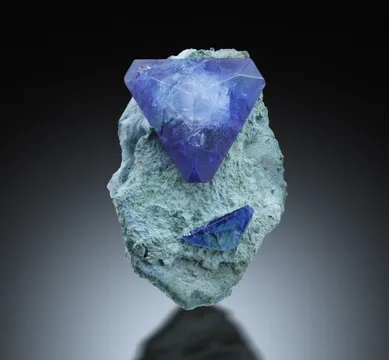
The look of a top Benitoite Gem Mine specimen is governed by contrast and survival. Benitoite crystals are usually flattened triangular or pseudo-hexagonal forms, colorless to deep blue, often with colorless cores and richer blue rims. Neptunite contributes sharp, lustrous, elongated prisms that may look black until strong light reveals their deep red-brown body color. Natrolite provides the pale matrix and the protective shroud that saved many crystals during weathering, mining, screening, and transport. Joaquinite, where present, appears as small yellow-brown to orange-brown crystals; even a few sharp individuals can transform a two-species benitoite-neptunite plate into a complete San Benito classic.

Search for specimens: View all specimens from Benitoite Gem Mine, USA
The Benitoite Gem Mine is a former gemstone and specimen mine in the SW¼NE¼ of section 25, T18S, R12E, Mount Diablo Meridian, about 1.2 km south-southwest of Santa Rita Peak. The mine area is remote, dry, and rugged, in serpentinite country near the headwaters of the San Benito River. Historically the property was private patented mining ground; modern references commonly identify it as the California State Gem Mine, while collectors continue to use Dallas Gem Mine, Benitoite Gem Mine, and Gem Mine almost interchangeably.
The deposit is not a conventional pegmatite, skarn, or simple hydrothermal vein locality. Its productive host is altered blueschist, part of the Franciscan assemblage, tectonically enclosed in highly sheared serpentinite of the New Idria district. The broader district was prospected and mined for mercury, chromium, gold, asbestos, gems, and mineral specimens, but the benitoite deposit is a very specific mineralogical accident within that larger serpentinite body. The serpentinite carried slices of blueschist, graywacke, greenstone, mica schist, and related oceanic rocks; only certain altered blueschist bodies developed the barium-titanium mineralization collectors prize.
At the mine itself, the productive material is a network of natrolite-filled veins and fracture zones cutting the altered blueschist. The veins are generally narrow, commonly less than 1 cm wide, and benitoite is localized rather than continuous. The best crystals formed on vein walls before natrolite sealed the open space. In many specimens, natrolite entirely encased the benitoite, neptunite, and joaquinite-group minerals; this makes preparation central to the locality’s specimen history. Many classic pieces were not “found” as display specimens in the field—they were recognized as promising natrolite-coated knobs or plates and later etched, trimmed, and cleaned to reveal the crystals beneath.
The mine was discovered in early 1907. James M. Couch, grubstaked by Roderick W. Dallas, is widely associated with the discovery, though the early literature records a dispute among those involved. What matters to collectors is what happened next: samples reached San Francisco, were examined by jeweler and dealer circles, and were ultimately brought to George D. Louderback at Berkeley. Louderback recognized the mineral as new to science, and the first scholarly descriptions followed quickly in 1907 and 1909. The Dallas Mining Company began active work in July 1907, driving open cuts and underground workings into the gem-bearing blueschist. Early miners recovered considerable gem rough, but specimen preservation was secondary. Because benitoite “knobs” under natrolite were often broken from the matrix mechanically, many early crystals lost context that would now be considered essential.
Commercial mining by the Dallas Mining Company continued until 1912, when the operation ceased to be economical; the equipment was auctioned in 1913, and the property received mineral patent papers in 1917. The Dallas family retained ownership until 1987. Between the early operating period and the late twentieth-century revival, the mine saw intermittent leasing, dump collecting, and small-scale recovery. Miller Hotchkiss worked the mine in the 1940s, Clarence Cole held a lease from 1952 until his death in 1967, and William “Bill” Forrest and Elvis “Buzz” Gray then took over the lease and later purchased the property from the Dallas family.
The Forrest and Gray period is central to modern collecting history. They first worked the open pit for mineral specimens, including neptunite and jonesite, and then began washing dump material in 1970. Their seasonal work took advantage of spring weather and available water from the San Benito River. By washing dump, colluvial, and eluvial material, they recovered loose gem rough as well as natrolite-protected mineral specimens that had survived weathering and movement. The protective natrolite mattered: it allowed delicate benitoite and neptunite crystals to arrive at the processing stage still intact.
Exploration and mining intensified in the late 1980s and 1990s. The deposit was studied by larger mining interests including Kennecott and AZCO, and by 1997 a new productive extension downslope of the historic open cut exposed mineralized lode material and additional gem-bearing colluvium and eluvium. A boulder excavated on May 1, 1997 became a benchmark image of the deposit: a large mass with natrolite covering a 40 cm by 70 cm area, its surface knobs indicating hidden benitoite and neptunite attached to the vein wall beneath.
Collector’s Edge Minerals, operating through Benitoite Mining, Inc., worked the property from 2000 to 2004. Their operation processed approximately 30,000 yards of material, including about 20,000 yards of old dump material, using washing, screening, jigging, hand picking, and later more efficient plant equipment. Material larger than 1.9 cm was inspected for potential specimens, while smaller heavy fractions were treated for gem recovery. A crucial practical detail of the operation was mud: sticky clay carried and hid gem material, forcing reprocessing and constant hand vigilance. The company also mined known in situ vein material, then rehabilitated the site.
Public access today is not access to the old mine workings. The mine site itself is closed to the public for safety, regulatory, and land-management reasons. Benitoite Mining Company currently offers reservation-only fee collecting at a separate screening field where mine material is brought for visitors to dig, wash, screen, and examine, with the four main target minerals identified as benitoite, neptunite, joaquinite, and natrolite. The modern experience is therefore a controlled pay-to-dig and sorting operation, not underground collecting and not open access to the historic cuts.
Production figures underline the locality’s rarity. By 1997, published estimates placed total lifetime faceted benitoite production at about 5,000 carats, including roughly 2,500 carats produced before Forrest and Gray began work in 1967, about 2,000 carats produced by them, and an estimated additional 500 carats entering the market through older rough, informal channels, and mineral specimens. Most faceted stones are small: the modern production breakdown cited for Forrest and Gray’s inventory indicated that 89% of stones were under 1 carat, 9% were 1 to 2 carats, and only 2% exceeded 2 carats. The famous 7.53 ct Smithsonian benitoite, recut from a 7.6 ct stone illustrated in Louderback’s 1909 report, is an exceptional survivor rather than a normal size.
Benitoite from the Benitoite Gem Mine is the definitive material for the species: euhedral, flattened triangular to pseudo-hexagonal crystals attached to blueschist vein walls and commonly preserved under white natrolite. Published work records crystals up to 5.6 cm across, though the usual size is closer to 1–1.5 cm, and good collector crystals around 2.5 cm are already large. Color ranges from colorless and pale blue to vivid sapphire-blue and blue-violet, often with colorless cores and blue rims; the finest pieces combine strong color, translucency or transparency, sharp faces, and a natural placement on white natrolite with neptunite or joaquinite. Ordinary examples are small, included, bruised, isolated, or over-etched; exceptional examples show crisp triangular crystals standing cleanly above the matrix, with enough natrolite retained to preserve the classic color contrast and enough associated minerals to prove the paragenesis.
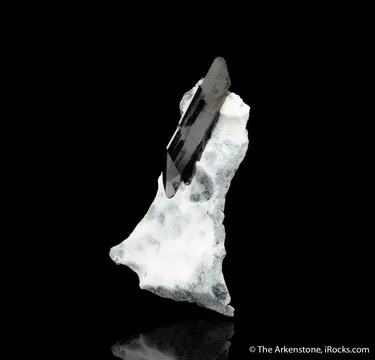
Neptunite from the Benitoite Gem Mine is the locality’s great supporting species and, on many specimens, its visual anchor: sharp, lustrous, prismatic crystals that appear black in ordinary light but are actually a very deep reddish brown. Crystals are typically much longer than wide, commonly attached by one end to the vein wall, and doubly terminated crystals attached along a prism face are not unusual; crystals to about 7.5 cm are known, while many good pieces fall below 2.5 cm. The best neptunites sit on white natrolite with blue benitoite, or form elegant sprays and isolated blades that escaped breakage during mining and preparation. Crossing twins, with a staurolite-like visual effect, are especially desirable. For collectors, luster, termination quality, freedom from contact damage, and association with benitoite or joaquinite matter more than sheer size.
Natrolite is the matrix, seal, and preservative of the Benitoite Gem Mine. It occurs as white to cream, opaque vein-filling material that coats the earlier benitoite, neptunite, joaquinite-group minerals, and other vein species, commonly filling the vein completely. Where cavities allowed faces to develop, the natrolite is not the slender spray familiar from many zeolite localities, but rather irregular, roof-shaped, coxcomb-like ridges and cleavable masses; crystals to about 2 cm have been reported. Good natrolite specimens from this mine are judged less as isolated zeolite specimens than as matrix specimens: the white surface should frame the blue benitoite and dark neptunite without swallowing them, and preparation should expose crystals cleanly while leaving enough natrolite to retain the mine’s unmistakable aesthetic.
Joaquinite-(Ce) is one of the great small-crystal rewards of the Benitoite Gem Mine and another species tied historically to this locality. It occurs as tiny yellow-brown, honey-brown, to orange-brown crystals, generally only a few millimeters across, with sharp equant to twinned forms set in or on natrolite with benitoite and neptunite. Because the crystals are small and easily overlooked, joaquinite often separates advanced locality pieces from merely pretty benitoite-neptunite combinations. A fine Benitoite Gem Mine joaquinite specimen need not be large; it needs clean, identifiable, lustrous crystals, ideally visible without destroying the balance of the plate. Pieces showing all three signature species—benitoite, neptunite, and joaquinite—on white natrolite are especially prized.
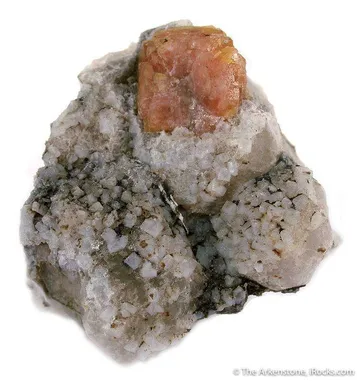
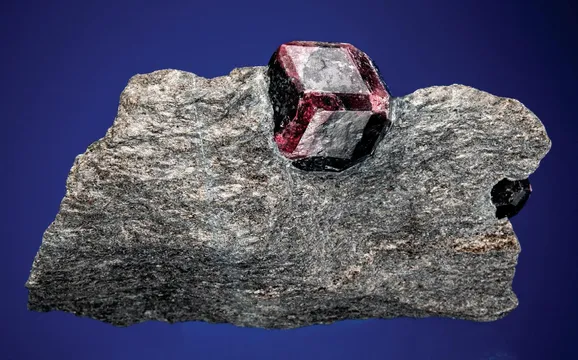
Andradite is documented from the California State Gem Mine locality, but it is not part of the classic benitoite-natrolite-neptunite vein aesthetic in the way benitoite, neptunite, natrolite, and joaquinite are. The andradite most plausibly encountered on labels from the immediate mine is dark melanite-type material associated with the serpentinite/blueschist environment rather than the yellow-green topazolite specimens better known from nearby San Benito County garnet occurrences. Collectors should evaluate such pieces as locality or district minerals rather than as display equals to the iconic benitoite plates. Good examples need clear provenance, visible garnet crystal form, and an honest locality distinction from nearby Yellow Cat or Junnila-area andradite occurrences.
Artinite under “Benitoite Gem Mine” labels deserves special caution. The classic artinite of the area is from the Artinite Pit near Picacho Peak in the New Idria district, several miles from the Gem Mine, where white radiating sprays and fibrous balls occur on serpentinite, locally with desautelsite and other alteration minerals. Published and collector discussions specifically warn that specimens labeled “near Gem Mine” or similar can be confused with the better-known benitoite locality. For a collector, the right approach is to treat artinite as a San Benito/New Idria district association unless a specimen has unusually strong documentation for the actual Gem Mine; attractive sprays, clean white color, and intact radiating aggregates matter, but precise locality wording matters even more.
Topazolite, the yellow to yellow-green variety of andradite, is a San Benito County collector mineral that can be confused in commerce with the Benitoite Gem Mine because nearby New Idria district occurrences are geographically and historically entangled with the famous benitoite locality. The best-documented topazolite-style andradite specimens are from the Yellow Cat Mine/Junnila-area garnet occurrence northwest of the Benitoite Gem Mine, where yellow-green to honey and orange andradite occurs in fractures in serpentinite with chlorite and accessory minerals. If a topazolite specimen is offered as “Benitoite Gem Mine,” its value depends heavily on whether that wording reflects a broad district label, a database grouping, or true mine provenance. Desirable pieces show lustrous, sharp dodecahedral to trapezohedral garnets with saturated yellow-green color, but locality precision is essential.
Other minerals documented from the Benitoite Gem Mine and its immediate literature include actinolite-tremolite, albite, analcime, apatite, calcite, chrysocolla, crossite/glaucophane, covellite, digenite, djurleite, feldspar, fresnoite, jonesite, quartz, serandite, silica pseudomorphs after serandite, and stilpnomelane. Jonesite is especially important: it was discovered by Francis Jones in 1957 and described as a new species from the mine in 1977, occurring as tiny colorless orthorhombic crystals, sometimes in sprays, to only a few millimeters. The joaquinite group gives the locality additional scientific weight, and the small copper sulfides—though rarely the visual subject of a specimen—help complete the paragenetic story preserved in the natrolite veins.
Benitoite Gem Mine specimens are among the most recognizable American classics, but they are also among the most preparation-dependent. Many were originally enclosed or partly enclosed in natrolite, and a large proportion of display specimens have been prepared by dissolving natrolite with hydrochloric acid. This is normal for the locality, not automatically a defect, but the quality of the preparation is crucial. Over-etched pieces can look raw, chalky, or unnatural; under-etched pieces may hide damaged crystals or leave unattractive residue. The best preparation exposes the benitoite and neptunite while preserving enough natrolite and matrix to keep the specimen geologically coherent.
Condition problems are common. Benitoite is brittle, crystals are often thin along the c-axis, and points and edges can chip easily. Neptunite prisms break, cleave, or lose terminations; because they are dark and lustrous, small repairs or losses may not be obvious until the specimen is examined under strong light and magnification. Natrolite matrix can be friable, porous, or acid-softened. Old specimens may show glue, reattached crystals, or trimming around the original natrolite knobs. A high-value specimen should be checked carefully for contacts, edge bruising, missing benitoite tips, snapped neptunite terminations, and unnatural placement of loose crystals.
Fluorescence is one of the locality’s pleasures and one of its useful diagnostic tools. Benitoite commonly fluoresces blue to blue-white under short-wave ultraviolet light, with colorless or pale cores often brighter than blue rims. Long-wave behavior can vary, and natrolite and associated phases may add their own responses. Fluorescence does not by itself prove authenticity, but a non-fluorescent “benitoite” on a supposed Dallas Gem Mine matrix deserves scrutiny. Use short-wave UV with eye protection, and avoid prolonged exposure of labels and old adhesives.
Authenticity issues fall into three main categories: synthetic or imitation gem benitoite, reconstructed or enhanced specimens, and locality mislabeling. Hydrothermal synthesis of benitoite has been reported in the scientific literature, and faceted blue stones can be confused visually with sapphire, spinel, tanzanite, or synthetic materials, but natural Benitoite Gem Mine stones are readily separated by standard gemological testing. For specimens, the greater practical risk is assembly or misleading locality attribution. Loose benitoite crystals can be glued onto natrolite or pale matrix; dark acicular minerals can be misread as neptunite; and nearby New Idria minerals such as artinite or topazolite-bearing andradite may be casually folded into “Benitoite Mine” or “near Gem Mine” labels. Old labels are valuable but not infallible—especially when they use vague regional wording.
Market availability is unusual: the species is famous, the mine is historically prolific for a rare mineral, and yet truly fine specimens remain scarce. Small benitoite crystals, etched matrix pieces, and pay-dig finds do appear regularly. Fine cabinet or miniature specimens with sharp blue benitoite, lustrous neptunite, white natrolite, and visible joaquinite are much less common and command strong prices. Large, gemmy benitoite crystals on matrix are rare; large faceted stones are rarer still. Most serious collectors eventually learn that a balanced 2–4 cm specimen with one excellent crystal and good contrast can be more desirable than a larger plate with many bruised, pale, or poorly exposed crystals.
The discovery story begins in rough country, not in a gem shop. In early 1907, James M. Couch was prospecting under the backing of Roderick W. Dallas. The men involved were looking at mineral prospects in the New Idria mountains, not hunting for a new state gemstone. They came upon blue crystals in a small, remote exposure and thought they might have found sapphire. That mistake is understandable: the best benitoite can be a clean, piercing blue, and the locality sat far from the normal channels of gem commerce. What followed was a tangle of claims over who first recognized, collected, or brought attention to the find. Louderback later wrote that those involved “happened upon the benitoite deposit and each claims to be responsible for the discovery,” a wonderfully human sentence for one of America’s great mineral discoveries.
The first stones did not immediately receive their rightful name. A piece brought to a San Francisco Bay Area lapidary was first dismissed by one expert as “volcanic glass.” The lapidary, recognizing that it was too soft for sapphire but still confronted by a strong blue gem, decided it must be spinel. The stone then reached George Eacret of Shreve & Co. in San Francisco, who used a dichroscope and saw that the material was doubly refractive. That observation sent the gem to George D. Louderback at the University of California, Berkeley. Louderback recognized it as a new mineral, visited the mine on July 19, 1907, and returned that October to study the geology. In August 1908 he came back again and took the first photographs used for his 1909 full treatment of the mineral and its occurrence.
Once the Dallas Mining Company formed, the remote blue-schist outcrop became a working mine almost overnight. Cabins and corrals were built, and equipment was hauled from Coalinga by horse and wagon over punishing roads. Active mining began in July 1907. The miners developed an open cut and underground workings, and the company’s early records described rough not in neat carat parcels but in homely containers—“quart jars” and “cigar boxes”—sent back to Dallas’s offices in Coalinga. For today’s collector, the heartbreaking detail is that many crystals were originally covered by natrolite and could have been exposed by acid, but the early operation was after gem rough. Knobs over hidden benitoite were broken off by hammer, chisel, or punch press, sacrificing specimens that modern collectors would consider irreplaceable.
The long quiet period after the Dallas operation closed produced its own lore. Between 1920 and 1940, the mine was not a steady commercial producer, but it remained magnetic to collectors and opportunists. Peter Bancroft and Edward Swoboda, later famous names in mineral circles, were among the adventurous teenagers who visited during the 1930s and collected thousands of specimens. The mine dumps became known in club circles as a place where patience might still turn up a prize. In a locality where the best crystals could hide under white natrolite or stubborn mud, “worked out” never meant empty.
The Forrest and Gray era revived the mine with a beautifully simple idea: wash the old material again. In 1970 they began processing dump material by pumping water uphill through a fire hose, working in spring when weather and river water made the job possible. They picked mineralized blueschist and loose benitoite by hand. That modest system recovered significant faceting rough, including material for a flawless 6.53 ct pear-shaped brilliant that became the center stone of a benitoite and diamond necklace. The necklace was stolen in Europe in 1974 and recovered in 1975, but the pendant was never found—a cinematic footnote in the history of a mineral more often measured in millimeters than in carats.
One of the most evocative modern mining moments came on May 1, 1997, when a remarkable benitoite-bearing boulder was excavated from a newly discovered extension of the deposit. Natrolite covered a 40 cm by 70 cm area of the boulder, and the surface knobs betrayed what lay beneath: benitoite and neptunite crystals attached to the vein wall, sealed by natrolite. Several gem-quality pieces were recovered from that material. For anyone who has prepared a Benitoite Gem Mine specimen, the image is familiar at any scale—a pale, lumpy surface promising blue and black crystals below, with success depending on judgment, patience, and luck.
The Collector’s Edge operation from 2000 to 2004 brought industrial discipline to a small and difficult deposit. About 30,000 yards of material were processed, including roughly 20,000 yards of old dumps. The plant could handle far more material than the older jig setup, but the mine fought back with mud. Sticky, gooey clay carried pebbles, crystals, and specimen fragments through the system as disguised balls, forcing reprocessing and constant hand picking. Organic debris plugged spray nozzles. Material larger than 1.9 cm was inspected for specimens, smaller heavy fractions went to jigs, and benitoite’s slight magnetism—caused by iron content—was used to help separate it from concentrate. It is hard to imagine a more practical contrast: a gemstone famous for brilliance and rarity, recovered from mud balls, spray nozzles, conveyor belts, and heavy-mineral concentrate.
_sur_natrolite_et_serpentine_(USA)_2.jpg)