






New Idria Mining District, USA — famous for benitoite with natrolite and neptunite/joaquinite, a distinctive serpentinite locality prized by collectors.
Key facts
New Idria is one of those rare districts where a specimen label can mean two different kinds of greatness. To the mining historian, it is a great Coast Range quicksilver camp: cinnabar in silica-carbonate rock, roasted for mercury from the nineteenth century into the early 1970s, with the New Idria mine ranking among the most important mercury producers in North America. To the mineral collector, it is a barium-titanium wonderland, the district that gave the world benitoite and the finest classic association of blue benitoite, black to red-black neptunite, white natrolite, honey-brown joaquinite-group minerals, and a scattering of rarities that still make micromounters and systematic collectors lean forward.
The geological setting is as distinctive as the specimens. The district sits in the southern Diablo Range of central California, where the New Idria serpentinite forms a large, fault-bounded ultramafic body. Blocks and slices of Franciscan rocks—blueschist, greenstone, jadeite-bearing rocks, eclogitic and amphibolitic tectonic blocks, and unusual Ti-rich metapyroxenite associations—were carried within and along this serpentinite mass. Later hydrothermal and metamorphic events opened fractures and small cavities where sodium-rich zeolitic minerals, barium-titanium silicates, titanium-bearing garnets, and mercury minerals developed in a peculiarly New Idria chemistry.
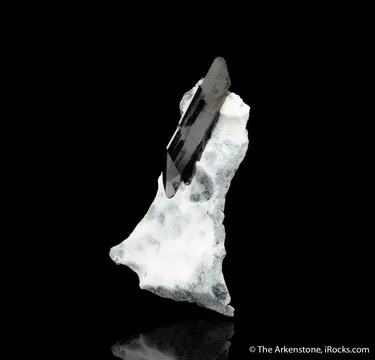
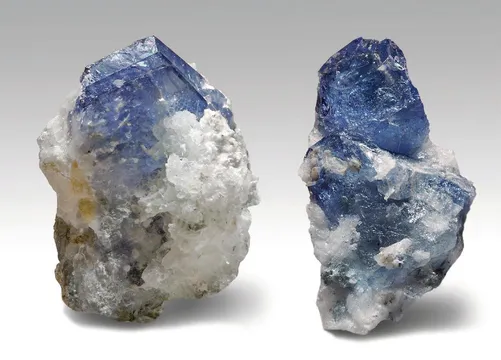
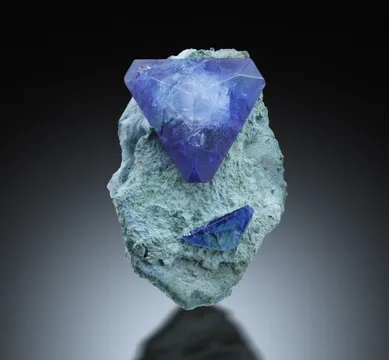
The district’s most famous specimens are immediately recognizable. From the Benitoite Gem Mine area, a fine piece shows triangular to pseudo-hexagonal blue benitoite crystals perched in or on chalky white natrolite, accompanied by lustrous, striated neptunite prisms that may look black at first glance but flash deep red-brown along thin edges or under strong light. The best classic plates are sculptural: blue points, black blades, snow-white zeolite, and dark blue-gray amphibole-rich schist in a compact, high-contrast composition. From the Junnila and related Clear Creek occurrences come rarer, more systematic pieces—fresnoite in yellow to burnt-yellow blocky crystals, strontiojoaquinite, analcime, and tiny barium-titanium assemblages that are less theatrical than benitoite-neptunite plates but much rarer in fine crystallized form.
Regional View
Country View
New Idria’s collector appeal is also unusually broad. Display collectors pursue the large aesthetic benitoite-neptunite-natrolite specimens from the Dallas/Benitoite/California State Gem Mine. Gem collectors follow the faceted benitoite tradition, especially stones with rich sapphire-blue body color and the lively dispersion that made the species famous from the beginning. Systematic collectors chase the district’s less obvious treasures: jonesite from the Benitoite Gem Mine, strontiojoaquinite from Mina Numero Uno and related deposits, the highly unusual mercury minerals of the Clear Creek claim, and the fine old artinite sprays from the Artinite Pit. Very few districts can support a cabinet of such different personalities while still feeling geologically coherent.

Photo: Wikimedia Commons

Photo: Wikimedia Commons
Search for specimens: View all specimens from New Idria Mining District, USA
The New Idria Mining District lies in San Benito and adjacent Fresno Counties in the southern Diablo Range, centered on and around the New Idria serpentinite and the Clear Creek–San Benito River headwaters region. The district is not a single mine or a single mineral occurrence, but a mineralized province with several very different collecting identities: the New Idria mercury mine and associated quicksilver workings near the abandoned town of Idria; the Clear Creek mercury deposits and their rare secondary mercury species; the Benitoite Gem Mine group near Santa Rita Peak; the Junnila, Mina Numero Uno, Victor, and Santa Rita Peak benitoite-related prospects; artinite occurrences in the Clear Creek area; and asbestos, chromite, jadeite, and Ti-rich metamorphic mineral localities within the broader serpentinite mass.
The mercury deposits are classic Coast Range silica-carbonate mercury deposits. Their ores formed where hydrothermal alteration converted serpentinite and adjacent sedimentary rocks into silica-carbonate rock, cut by faults, fractures, cracks, and veins. The principal ore mineral is cinnabar, with lesser metacinnabar and native mercury documented in the district. At the New Idria mine, ore was mined through a deep and extensive underground system, roasted in furnaces, and condensed as metallic mercury. The EPA’s Superfund profile records more than 30 miles of tunnels and 20 levels at the mine, with the Level 10 adit functioning as the principal haulage level. Historic calcines, waste rock, furnace remains, flooded workings, acid mine drainage, and mercury-contaminated drainage are now major environmental and access considerations rather than collecting opportunities.
The benitoite-neptunite deposits belong to a different but related geological story. Benitoite at New Idria is tied to altered blueschist bodies enclosed within serpentinite, especially at the Benitoite Gem Mine near the headwaters of the San Benito River. The mineralized rock consists of altered blueschist and associated mafic schist/greenstone lenses or blocks, cut by narrow vein systems and tension gashes. In the classic mine area, benitoite formed on vein walls with neptunite, joaquinite-group minerals, albite, apatite, jonesite, silica pseudomorphs after serandite, and minor copper sulfides; natrolite then infiltrated and coated or sealed much of the open space. This paragenesis is the key to both the beauty and the preparation of the specimens: many benitoite and neptunite crystals were originally hidden under white natrolite and became visible only after careful trimming, natural weathering, or acid removal of the zeolite.
At the Benitoite Gem Mine, the mineralized zone was small in absolute mining terms but world-class in specimen significance. Published mapping and later studies describe benitoite-bearing veins that commonly average less than a centimeter wide, with benitoite localized where veins narrow, terminate, or intersect favorable altered blueschist. Crystals from the main mine may reach several centimeters across, though typical crystals are much smaller. The commercial gem production has historically come overwhelmingly from this mine, formerly known as the Dallas mine and later widely called the Benitoite Gem Mine or California State Gem Mine. Other New Idria occurrences—Junnila, Mina Numero Uno, Victor, and Santa Rita Peak—are mineralogically important but generally produced smaller, more limited, or less gemmy benitoite.
The Junnila claim and nearby prospects are especially important for rare-species collectors. At Junnila, benitoite occurs in a narrow resistant zone of altered blueschist; the associated vein assemblage is more calcium-rich than the classic natrolite-dominated Benitoite Gem Mine assemblage, with thomsonite, pectolite, calcite, stevensite, neptunite, and joaquinite-group minerals reported locally. Junnila is also famous for later finds of yellow fresnoite, in some cases associated with analcime or quartz and strontiojoaquinite. The “Mother Lode Pocket” discovery of June 16, 1996, and later Scott Kleine-era collecting around the late 1990s and early 2000s are the names serious fresnoite collectors watch for, because they produced unusually rich, crystallized specimens for a species that is normally more a micromount than a display mineral.
Mina Numero Uno lies along upper Clear Creek northwest of the Benitoite Gem Mine and produced small benitoite, neptunite, and joaquinite-group minerals in albite-lined vugs and narrow fractures in blueschist boulders. Published descriptions note pale blue platy benitoite crystals up to several millimeters, with some rosette-like or tabular plates in narrow fractures. Mina Numero Uno is also the type locality for strontiojoaquinite, making it a major systematic locality even though its hand specimens are usually modest. The Victor claim, also in the Clear Creek area, is another key blueschist-hosted occurrence, known for its mineralogical complexity and for collectors’ and researchers’ studies of its small benitoite-neptunite-joaquinite-type assemblages.
Access today is mixed and should be approached conservatively. Much of the Clear Creek Management Area is BLM-managed public land, but the area includes private parcels, claims, environmental restrictions, naturally occurring asbestos concerns, and special permit requirements. Current BLM information for Clear Creek lists hobby gem and mineral collecting as a recreational activity, but also requires permits for the management area and a separate Serpentine Area of Critical Environmental Concern permit for entry into that ACEC, with limits on the number of entries. General BLM rockhounding rules also restrict collecting to noncommercial personal use, hand tools, modest surface disturbance, and weight limits, and prohibit collecting on active claims without the claimant’s permission. The abandoned New Idria mercury mine itself is a contaminated Superfund site with physical mine hazards and is not a casual collecting venue.
The Benitoite Mining Company, operating at the classic benitoite locality, has offered pay-to-dig opportunities, gravel washing, and mine-run material to collectors; availability, fees, weather windows, and access rules change and should be checked directly with the operator before planning travel. Historically, the mine has been worked seasonally because of weather, water availability, and road conditions. This is rugged country, and even modern access can involve long dirt-road approaches, heat, dust, clay, serpentine slopes, and poor communications. For serious collectors, the safest approach is to treat New Idria not as an open invitation to wander old workings, but as a district where documented old specimens, legal commercial digging, and carefully permitted BLM collecting each have their own rules.
Fresnoite from the New Idria district is a collector’s rarity rather than an abundant cabinet mineral, but the Junnila mine and related New Idria finds produced some of the most desirable crystallized examples known from California: lustrous yellow to canary-yellow, honey-yellow, or burnt-yellow blocky tetragonal crystals, commonly only millimeters across but locally reaching about 6 mm on quartz and around 1 cm or slightly more on the best analcime-bearing pieces. The standout material is tied to small, named finds such as the Mother Lode Pocket of June 16, 1996, and the later Scott Kleine collecting period, including the celebrated 4th of July Pocket; these specimens may show isolated yellow crystals perched dramatically on off-white analcime or quartz, a contrast that separates exceptional New Idria fresnoite from ordinary small yellow specks in matrix. Good pieces are sharp, colorful, freestanding, and visibly crystallized without magnification; merely representative pieces require a loupe and are valued chiefly for rarity and provenance.
New Idria neptunite is one of the great classic accessory species of the benitoite suite, especially from the Benitoite Gem Mine, where lustrous prismatic crystals grew on blueschist vein walls with benitoite and were commonly later coated or partly enclosed by natrolite. The crystals are typically black in hand-specimen lighting but may show deep red-brown translucency on edges or thin splinters; fine examples range from small sharp prisms to crystals a few centimeters long, with published and dealer-documented specimens around 18 mm to more than 4 cm on matrix. The most desirable pieces show undamaged, bright, well-striated neptunite standing proud of white natrolite, ideally with blue benitoite and joaquinite-group accents; ordinary examples are broken, mostly embedded, over-etched, or visually lost in dark amphibole-rich matrix.
Benitoite is the signature mineral of New Idria and the species that made the district famous: blue to colorless BaTiSi3O9 crystals in altered blueschist bodies enclosed by serpentinite, with commercial gem-quality production historically centered on the Benitoite Gem Mine. At the classic mine, benitoite occurs as euhedral triangular to pseudo-hexagonal crystals attached to vein walls, averaging roughly 1 to 1.5 cm in many described specimens and reaching several centimeters in the best crystals; published work records crystals up to 5.6 cm in diameter, while other district occurrences such as Junnila, Mina Numero Uno, Victor, and Santa Rita Peak are generally smaller or less gemmy. Fine specimens combine sharp saturated blue crystals, bright luster, attractive placement on white natrolite, and good associations with neptunite or joaquinite-group minerals; lesser pieces are pale, abraded, heavily included, fractured, or reduced to isolated grains in schist.
Artinite from New Idria is best known from the Artinite Pit in the Clear Creek–Picacho Peak area, where it forms delicate white to snow-white acicular sprays, silky radial balls, crusts, and sparkling fibrous aggregates on pale green serpentine or altered matrix. Specimens collected in the 1960s and 1970s, including pieces attributed to classic collections, are especially prized because the sprays are fragile, airy, and difficult to extract or transport without bruising. Good New Idria artinite is three-dimensional, clean white, bright, and composed of distinct radiating needles rather than compact chalky crust; association pieces may include hydromagnesite or desautelsite from the same Artinite Pit environment, but the collector’s eye should stay on crystal delicacy and preservation.
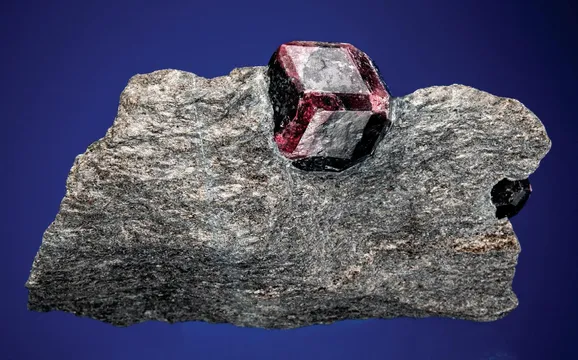
New Idria andradite is most important in the district’s titanium-rich metamorphic assemblages, where titaniferous andradite coexists with chlorite and diopside in isolated patches and tectonic blocks within the serpentinite. These garnets are not usually gemmy demantoid-style display crystals; they are more often green, brown, dark, or melanite-like grains and small crystals in metapyroxenite or related rock, valued for their chemistry, setting, and association with New Idria’s broader Ti-rich suite. The best collector pieces show identifiable, well-formed garnet in contrasting chlorite-diopside-serpentine matrix, while routine material can look like dark granular rock unless the label, locality, and mineralogical context are strong; chromian and uvarovitic andradite compositions have also been reported from serpentinite-related New Idria rocks, adding systematic interest to otherwise modest hand specimens.
Analcime at New Idria is most visible to collectors as a pale, off-white to white matrix and cavity mineral associated with the rare yellow fresnoite finds, especially in specimens from the Junnila-area New Idria material where fresnoite crystals stand on or among analcime. Unlike the bold natrolite of the Benitoite Gem Mine, New Idria analcime is usually a supporting species: it provides the clean geometric or granular light-colored stage that makes yellow fresnoite crystals readable. Fine analcime-bearing specimens from the district are judged by contrast, freshness, and the quality of the associated fresnoite rather than by analcime alone; the best pieces show crisp, undamaged fresnoite isolated on a light analcime surface, while ordinary examples are small, massive, or visually indistinct without the rare barium-titanium association.
Natrolite is the white architectural mineral of the classic Benitoite Gem Mine specimens, filling narrow veins and cavities in altered blueschist and commonly coating benitoite, neptunite, joaquinite-group minerals, and wall-rock fragments. Published descriptions of the mine emphasize that natrolite infiltrated the altered blueschist and closed many of the veins after earlier mineral growth, which is why so many specimens were historically prepared by dissolving or reducing natrolite to reveal the blue and black crystals beneath. Collectible New Idria natrolite is not usually sought as freestanding zeolite sprays; its value lies in its role as matrix, contrast, and paragenetic evidence. The best pieces retain enough clean white natrolite to frame the benitoite-neptunite association, while over-etched specimens can lose the soft white relief that makes the classic look unmistakable.
Beyond these headline species, New Idria is a systematic collector’s district of unusual depth. Benitoite itself is the type species from the district’s gem mine area; jonesite was described from the Benitoite Gem Mine; strontiojoaquinite has its type locality at Mina Numero Uno; and the Clear Creek mercury mine and claim produced an extraordinary suite of rare and type-locality mercury minerals, including clearcreekite, deanesmithite, edgarbaileyite, edoylerite, hanawaltite, szymańskiite, wattersite, vasilyevite, and aurivilliusite. The district also includes jadeite, albite, glaucophane- and crossite-group amphiboles, actinolite, clinozoisite, apatite, titanite, diopside, chlorite, serpentine minerals, hydromagnesite, desautelsite, chromite, uvarovitic garnet, cinnabar, metacinnabar, native mercury, montroydite, calomel, terlinguaite, mosesite, eglestonite, and many other species whose importance depends strongly on exact sublocality and analytical confirmation.
New Idria specimens demand careful locality reading. “New Idria District” on a label is useful but incomplete: a benitoite-neptunite-natrolite plate from the Benitoite Gem Mine, a fresnoite-analcime specimen from the Junnila material, a strontiojoaquinite from Mina Numero Uno, an artinite spray from the Artinite Pit, and an edoylerite micromount from the Clear Creek claim are all New Idria in a broad sense, but they are not interchangeable. Older labels may use Dallas Gem Mine, Benitoite Mine, Benitoite Gem Mine, Gem Mine, or California State Gem Mine for overlapping versions of the famous benitoite locality. Serious collectors should preserve all old labels and avoid “upgrading” a vague Clear Creek or New Idria label into a precise mine name without evidence.
The main authenticity problem is mislabelling and overbroad attribution rather than a well-known industry of New Idria fakes. Benitoite from elsewhere is usually small, pale, or noncommercial compared with the classic San Benito material, and some historical reports outside the district have been discredited or regarded as misidentifications. Conversely, not every blue mineral on white matrix from California is benitoite, and not every black prism with benitoite is necessarily from the Benitoite Gem Mine unless the specimen has strong provenance. For rare species such as fresnoite, strontiojoaquinite, jonesite, and the Clear Creek mercury minerals, visual identification alone can be inadequate; analytical support or a chain of ownership from a knowledgeable collector is a major value factor.
Preparation is a major part of the New Idria story. Many classic benitoite and neptunite specimens were etched with acid to remove natrolite, a long-established and locality-specific practice rather than a modern deception. The collector’s question is not simply “etched or natural,” but whether the preparation was skillful. Good preparation leaves crystals sharp, lustrous, and attractively exposed while retaining enough natrolite for contrast. Aggressive acid work can undercut crystals, round zeolite textures, leave chalky residues, or produce an unnaturally skeletal appearance. Loose benitoite crystals and fragments are common because the mineral breaks readily along pre-existing fractures and because early miners often broke crystals while trying to liberate them from natrolite.
Condition standards vary by species. Benitoite is expected to have some edge wear or internal fractures unless it is an exceptional crystal; vivid blue color, intact terminations, and crystal placement are more important than theoretical perfection. Neptunite is brittle and often chipped at tips and edges, so a complete glossy prism on matrix carries a premium. Fresnoite is uncommon in crystals large enough to display unaided; tiny but sharp, bright yellow crystals with verified Junnila provenance are desirable even when the specimen is small. Artinite is extremely delicate: collapsed sprays, dust, bruised needle tips, or flattened balls sharply reduce appeal.
Fluorescence is part of the district’s charm. Benitoite from the classic mine is famous for strong blue to bluish-white shortwave ultraviolet fluorescence, while colorless to pale material may show different responses under longwave. Fresnoite specimens from the New Idria finds have also been reported with bright yellow shortwave fluorescence. UV response should be used as supporting evidence, not as a sole identification test, because associated minerals, coatings, and preparation residues can complicate the view.
Handling considerations are real. Specimens from the Clear Creek and New Idria serpentinite region may be associated with naturally occurring asbestos minerals, mercury minerals, acid-generating sulfides, and old mine waste. Do not trim, saw, grind, or air-abrasively clean serpentinite or fibrous material without professional precautions. Cinnabar and native mercury specimens should be boxed, kept from children, not heated, and never cleaned in a way that creates dust or vapor. Old mine dumps, calcines, and underground workings in the New Idria mercury area are environmental hazards, not collecting conveniences.
Market availability is uneven. Benitoite-neptunite-natrolite specimens are always available in some quantity because the locality is famous and old collections continue to recycle, but top plates with saturated benitoite, strong neptunite, and balanced natrolite remain expensive. Loose gem benitoite is more available than fine matrix specimens but is usually small; stones above a few carats are exceptional. Fresnoite from the Junnila/New Idria finds appears sporadically and often sells quickly when crystals are large enough to see clearly. Artinite from the Artinite Pit is a classic old-time California specialty, not a constant supply item. Clear Creek mercury rarities are mostly micromount and systematic-cabinet minerals, with value driven by verification, rarity, and provenance rather than display size.
The benitoite story begins with a scene every field collector can picture: a tired prospector making camp near the headwaters of the San Benito River and waking to a white pocket glittering with blue crystals. James M. Couch, a Coalinga rancher and prospector grubstaked by R. W. Dallas, had gone into the hills south of the New Idria mines after hearing local stories. According to the later account preserved by Leza Junnila, morning light drew him to a rocky exposure on the north side of the canyon. There, in the weathered white material, “blue crystals were lying all over the ground.” Couch gathered material, returned to Coalinga, and soon made the long trip to Hollister to file a federal mining claim.
The identification did not come easily. Early material taken to Los Angeles was reportedly dismissed as volcanic glass and valueless. Other specimens passed through Fresno and San Francisco hands; some cut stones were thought to be sapphire. It took the eye and mineralogical discipline of George D. Louderback at the University of California to recognize that the blue mineral was new. In 1907, Louderback and W. C. Blasdale described benitoite as a new California gem mineral, a barium-titanium silicate with optical properties dramatic enough to make mineralogists immediately pay attention. The name honored San Benito County, the San Benito River, and the local geography that had produced the find.
Early mining was rough on specimens. The first workers did not yet understand the collector’s modern trick of removing natrolite patiently to reveal enclosed crystals. Instead, many natrolite-coated nodules were broken open, damaging untold numbers of benitoite crystals that would today be carefully prepared under magnification. In the first years the mine developed an open cut and underground workings, and numerous plates of gem-bearing rock were removed, but countless crystals were likely lost to hammer blows, trimming, and the simple fact that nobody yet knew how valuable intact matrix specimens would become.
The district has a strange afterlife of lost stones. During an idle period after early mining, travelers and collectors reportedly stopped along the old county road and carried away natrolite boulders studded with broken benitoite crystals for rock gardens. One of the most evocative tales concerns the Sawmill Creek rock garden of Frank Nunez’s grandmother. A forest fire burned her cabin, and the benitoite-studded rock garden was forgotten until the mineral had become valuable. By then the spot had been lost to brush and time. It is a perfect New Idria story: extraordinary material treated casually when it was abundant enough to be misunderstood, then turning almost mythical after the hills took it back.
The mine passed through many hands and moods. Dallas worked it from 1907 to 1912. Later operators reopened, leased, bulldozed, washed dumps, or searched old workings according to the economics and collecting culture of their day. In the early 1950s, M. F. Hotchkiss bulldozed old dumps looking for veined blueschist that could be treated with muriatic acid. C. L. Cole of Oakland displayed big benitoite plates in his rock-shop windows and sold stones to New Idria miners. Local families remembered weekend trips, school field visits, and children finding specimens in the bushes. The locality was never simply a remote mine; for generations of California collectors it became a place people hoped to visit at least once.
One of the great modern chapters came under Bill Forrest and E. “Buzz” Gray. Beginning in the late 1960s and early 1970s, they worked the mine and especially the dump, colluvium, and eluvium by washing material with water pumped uphill, then hand-picking mineralized blueschist and loose benitoite. This simple method proved remarkably effective because weathering had already freed many crystals from veins, and natrolite coatings had protected benitoite and neptunite during transport. The gem rough from this work was often high quality because broken crystals had separated naturally along old fractures, leaving gemmy tips and nodules.
A glamorous and almost cinematic object emerged from this era: a benitoite and diamond necklace with 52 faceted benitoites totaling about 33 carats, the largest stone 2.84 carats, cut and matched by Buzz Gray and designed by William McDonald of Fresno. A related pendant held a flawless 6.53-carat pear-shaped brilliant recovered from early 1970s production. The necklace was stolen in Europe in 1974 and recovered in 1975, but the pendant was never found. It remains one of the district’s most memorable losses, not because it was a pocket of ore or a scientific specimen, but because it translated New Idria’s mineralogical miracle into a jewel and then into a mystery.
On May 1, 1997, the mine produced another moment collectors still remember: a remarkable boulder from a newly discovered extension of the Benitoite Gem Mine. Its natrolite-covered surface measured about 40 by 70 cm, with knobs indicating benitoite and neptunite crystals attached to the vein wall underneath. Several gem-quality pieces were removed from the outside edge. The discovery mattered because it showed that even after decades of mining, washing, bulldozing, leasing, and collecting, the old deposit could still surprise those who understood its geology well enough to keep looking downslope and along the altered blueschist.
The fresnoite pockets belong to a quieter but no less intense collecting culture. The Junnila-area yellow crystals were not the blue-gem spectacle of the Benitoite Gem Mine, but for rare-species collectors they were electrifying. Labels tied to the Mother Lode Pocket of June 16, 1996, and later finds such as the 4th of July Pocket record the sort of small, specific discoveries that make a systematic locality legendary. A 1 cm yellow fresnoite on contrasting analcime may not impress a casual visitor the way a blue benitoite plate does, but to a collector who knows how rarely fresnoite forms sharp freestanding crystals, it is the kind of specimen that can define a species suite.
G. D. Louderback and W. C. Blasdale, “Benitoite, A New California Gem Mineral,” University of California Publications, Bulletin of the Department of Geology, Vol. 5, No. 9, pp. 149–153, 1907 — The original description of benitoite, the district’s defining mineral species.
R. Arnold, “Notes on the Occurrence of the Recently Described Gem Mineral, Benitoite,” Science, New Series, Vol. 27, No. 686, pp. 312–314, 1908 — Early description of benitoite with black neptunite in natrolite veins within glaucophane schist enclosed by serpentinite.
D. B. Sterrett, “Gems and Precious Stones,” Mineral Resources of the United States, U.S. Geological Survey, 1911; excerpted at Geology.com — A vivid early account of the discovery, geology, workings, and gem material at the benitoite mine.
E. B. Eckel and W. B. Myers, “Quicksilver deposits of the New Idria district, San Benito and Fresno counties, California,” California Journal of Mines and Geology, Vol. 42, pp. 81–124, 1946 — Foundational work on the district’s mercury geology and mine setting.
R. G. Coleman, “Jadeite deposits of the Clear Creek area, New Idria district, San Benito County, California,” Journal of Petrology, Vol. 2, pp. 209–247, 1961 — Classic study of jadeite-bearing tectonic inclusions in the New Idria serpentinite.
W. S. Wise and R. H. Gill, “Minerals of the Benitoite Gem Mine,” The Mineralogical Record, Vol. 8, pp. 442–452, 1977 — Key locality paper on the mineral assemblage of the Benitoite Gem Mine.
W. S. Wise and A. Pabst, “Jonesite: a new mineral from the Benitoite Gem Mine, San Benito County, California,” The Mineralogical Record, Vol. 8, pp. 453–456, 1977 — Type-mineral description for jonesite from the classic gem mine.
W. S. Wise, “Strontiojoaquinite and bario-orthojoaquinite: two new members of the joaquinite group,” American Mineralogist, Vol. 67, pp. 809–816, 1982 — Description including strontiojoaquinite, with Mina Numero Uno as the type locality.
W. S. Wise and W. P. Moller, “Geology and Mineralogy of the New Idria District, San Benito and Fresno Counties, California,” Rocks & Minerals, Vol. 70, No. 1/2, pp. 30–35, 1995 — Compact district-scale overview of the geology and mineral deposits.
B. M. Laurs, W. R. Rohtert, and M. Gray, “Benitoite from the New Idria District, San Benito County, California,” Gems & Gemology, Vol. 33, No. 3, pp. 166–187, 1997 — The essential modern gemological and geological paper on New Idria benitoite.
M. R. Van Baalen, “Migration of the Mendocino Triple Junction and the Origin of Titanium-Rich Mineral Suites at New Idria, California,” International Geology Review, Vol. 46, pp. 671–692, 2004 — Important interpretation of the district’s Ti-rich mineral suites, syenite, serpentinite, and metamorphic history.
G. E. Dunning, T. A. Hadley, J. Magnasco, A. G. Christy, and J. F. Cooper, “The Clear Creek mine, San Benito County, California: a unique mercury locality,” The Mineralogical Record, Vol. 36, No. 4, pp. 337–363, 2005 — Major reference on the Clear Creek mercury-mineral suite, including numerous rare and type-locality mercury species.
W. E. Wilson, “The 100-Year History of the Benitoite Gem Mine, San Benito County, California,” The Mineralogical Record, Vol. 39, No. 1, pp. 13–42, 2008 — The most complete published historical treatment of the Benitoite Gem Mine.
R. C. Erd, A. C. Roberts, M. Bonardi, A. J. Criddle, Y. Le Page, and E. J. Gabe, “Edoylerite, Hg32+Cr6+O4S2, a new mineral from the Clear Creek claim, San Benito County, California,” The Mineralogical Record, Vol. 24, pp. 471–475, 1993 — Type description for edoylerite, a rare yellow mercury chromate-sulfide alteration mineral from the Clear Creek claim.
A. C. Roberts, J. A. R. Stirling, A. J. Criddle, G. E. Dunning, and J. Spratt, “Aurivilliusite, Hg2+Hg1+O(I,Br,Cl), a new mineral species from the Clear Creek claim, San Benito County, California, USA,” Mineralogical Magazine, Vol. 68, pp. 241–245, 2004 — Description of an exceptionally rare mercury oxyhalide from the Clear Creek claim.
“Great Finds - Videos” — Benitoite Mining Company — Short mine-operator videos showing notable finds made by visitors and collectors at the benitoite dig.
“Mercury Production In California” — Travel Film Archive — A 1955 black-and-white film clip showing cinnabar mining and mercury production at New Idria.
“The Quicksilver Chronicles” — Ben Guez and Aleksandra Kulak — Documentary coverage of life in the nearly abandoned New Idria mercury-mining ghost town.
“What is Benitoite?” — Benitoite Mining Company — Mine-operator history page with embedded media and a locality narrative by Leza Junnila.
New Idria Mining District on Mindat — Broad mineral list, sublocalities, photographs, type-locality information, and locality hierarchy for the district.
Benitoite from the New Idria District — Gems & Gemology — Essential modern reference for benitoite geology, gemology, mines, claims, and production history.
Historical Reading List: Benitoite — GIA — Curated bibliography of early and modern benitoite literature, including discovery papers and later locality studies.
Migration of the Mendocino Triple Junction and the Origin of Titanium-Rich Mineral Suites at New Idria, California — Detailed geological interpretation of New Idria’s serpentinite, Ti-rich assemblages, syenite, and metamorphic evolution.
Jadeite deposits of the Clear Creek area — USGS Publications Warehouse — Coleman’s classic paper on jadeite-bearing tectonic inclusions within the New Idria serpentine body.
New Idria Mercury Mine Superfund profile — U.S. EPA — Current environmental, historical, and cleanup information for the abandoned New Idria mercury mine.
Clear Creek Management Area — Bureau of Land Management — Current access, permit, recreation, and safety information for the BLM-managed Clear Creek area.
BLM “Can I Keep This?” rockhounding guidance — General rules for recreational collecting on BLM-managed public lands.
The Clear Creek mine, San Benito County, California: a unique mercury locality — Australian National University research record — Citation and abstract for the key Mineralogical Record paper on the Clear Creek mercury-mineral suite.
Edoylerite type-mineral record — USGS Publications Warehouse — Concise USGS record for the new-mineral description of edoylerite from the Clear Creek claim.
Aurivilliusite new-mineral paper — RRUFF — Full paper for aurivilliusite, one of the extremely rare mercury oxyhalides from Clear Creek.
Artinite specimens from the Artinite Pit — Fabre Minerals archive — Useful visual reference for classic New Idria artinite habits and specimen style.
Fresnoite from the Junnila mine — Wikimedia Commons — Verified photograph and locality data for a 1998-find fresnoite specimen from New Idria.
Benitoite-neptunite-joaquinite-natrolite from the Dallas Gem Mine — Wikimedia Commons — High-resolution photograph of the classic New Idria benitoite-neptunite association.
Benitoite Mining Company — Current operator information for pay-to-dig opportunities, mine-run material, and visitor details at the benitoite locality.
_sur_natrolite_et_serpentine_(USA)_2.jpg)
