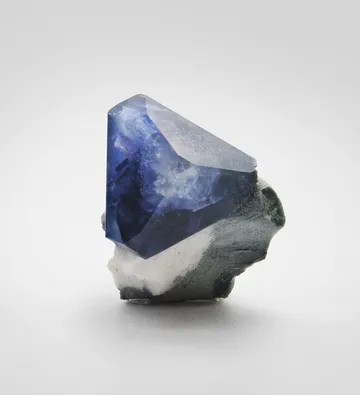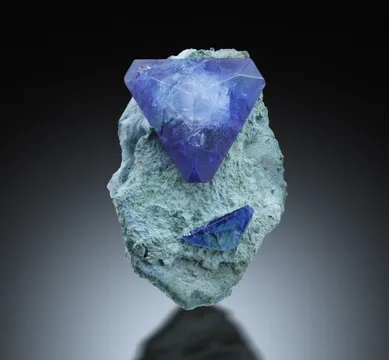
Benitoite - rare barium titanium cyclosilicate with sapphire-blue, sharp triangular crystals and vivid UV fluorescence; locality California State Gem Mine.
Key facts
Benitoite is a rare barium titanium cyclosilicate most famous for its intense sapphire-blue color, sharp triangular crystal habit, and brilliant shortwave UV fluorescence. The type and overwhelmingly best locality is the California State Gem Mine (formerly Dallas Gem Mine), where benitoite crystallized in natrolite-filled veins cutting serpentinite and glaucophane schist. Classic specimens show sharply formed trigonal/tabular crystals—often triangular in outline—ranging from icy pale to vivid royal blue, frequently perched with jet-black neptunite on pure white natrolite for striking contrast. The mineral’s uniqueness and beauty led to its designation as the California State Gem. While micromount occurrences are known elsewhere, virtually all world-class specimens derive from San Benito County, and top pieces—gemmy, vividly colored, on bright matrix—are among the most coveted modern classics in mineral collecting.
Discovered in 1907 and described by George D. Louderback shortly thereafter, benitoite quickly captured attention for its unmistakable triangular crystals, fine blue color, and exceptional fluorescence (electric blue under shortwave UV). The combination of a single, highly distinctive top locality, a compelling geologic story, and dramatic aesthetics has kept demand high for generations. Museum-defining clusters with multiple sharp, saturated crystals on snow-white natrolite are limited and have become increasingly scarce as historic pockets are long exhausted. Today, the California State Gem Mine operates primarily for controlled collecting, and fresh, truly elite display specimens are rare; as a result, prices for fine pieces remain strong. Collectors at all levels participate: micromounters pursue tiny but textbook crystals, while advanced collectors compete for large, vibrant, unrepaired clusters with great provenance.
While benitoite occurs in a handful of places worldwide, only a few localities produce collectible crystals, and just one—San Benito County, California—yields truly world-class specimens.
The type and premier source, this mine (formerly the Dallas Gem Mine) produces the finest benitoite on Earth. Crystals are typically sharp, lustrous trigonal plates from a few millimeters to several centimeters, in hues from pale cornflower to saturated royal blue, commonly on stark white natrolite. Jet-black neptunite and occasional joaquinite add elegant contrast. Aesthetics hinge on color saturation, crystal size and isolation, and the purity of white matrix. Historic pockets produced legendary clusters with multiple gemmy, undamaged crystals; intact large matrix pieces are now exceedingly rare. The mine is also known for its spectacular shortwave UV response—many specimens glow electric blue, making them superb under UV lights as well as in ambient display.
The broader district hosts several veins and occurrences genetically related to the famous mine. Material recovered from satellite zones, old dumps, and minor workings can yield attractive single crystals and small matrix pieces, often accompanied by neptunite and natrolite, albeit typically smaller or less vividly colored than the best from the main workings. For micromounters and locality specialists, San Benito County offers diversity—tiny but textbook crystals, unusual habits, and fluorescent “light shows” under shortwave UV. While major new finds are unlikely, careful collecting and reprocessing of historic material still turn up desirable smaller specimens.
Color and Saturation:
Crystal Form and Size:
Clarity and Luster:
Matrix and Associations:
Fluorescence:
Condition and Repairs:
Overall, the finest benitoites synthesize rich color, sharp form, excellent luster, a strong composition on white natrolite, and minimal damage. Such pieces are scarce and command top prices.
Reattachments:
Polishing or Grinding:
Matrix Alteration:
Color Enhancement:
As always, provenance and trusted sources are your best defenses. Ask directly about repairs; well-documented, minimal restoration is acceptable on significant pieces.
Handling:
Light and Temperature:
Cleaning:
Storage and Display:
With thoughtful handling, gentle cleaning, and sensible display, benitoite specimens retain their vivid color, lustrous faces, and brilliant fluorescence for generations.