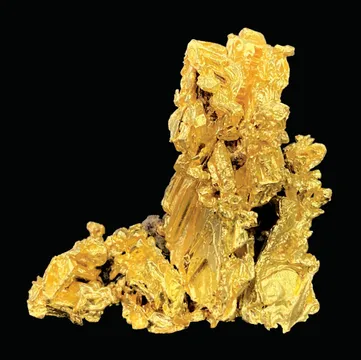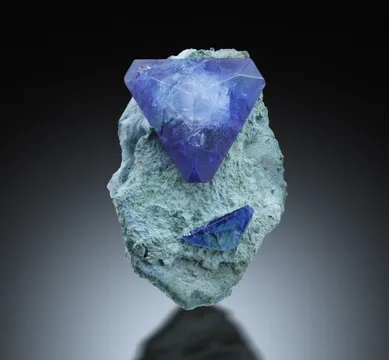
San Benito County, USA - classic type locality for benitoite, with electric-blue benitoite, black neptunite, and natrolite in blueschist; prized by collectors.
Key facts
San Benito County is one of the classic mineral names of North America because a remote patch of the Diablo Range, near the headwaters of the San Benito River, produced a mineral association that is almost impossible to confuse with any other locality: electric blue benitoite, jet-black neptunite, honey-brown joaquinite-(Ce), and white natrolite in altered blueschist enclosed by serpentinite. The locality collectors usually mean is the California State Gem Mine, historically the Dallas Gem Mine and later the Benitoite Gem Mine, in the New Idria district near Santa Rita Peak. It is the type locality for benitoite and one of the world’s few mineral localities where a single deposit simultaneously matters to crystallographers, gemologists, systematic mineral collectors, and aesthetic-specimen collectors.
The geological setting is as distinctive as the specimens. The benitoite-bearing bodies are blocks of Franciscan blueschist tectonically incorporated into the New Idria serpentinite mass. Later hydrothermal activity opened fractures and seams in the altered blueschist and filled them with natrolite and the celebrated barium-titanium silicate assemblage. The best pieces look almost designed for the cabinet: sharp triangular to tabular blue benitoite crystals, sometimes color-zoned from milky centers to saturated sapphire-blue rims, with glossy black prismatic neptunite standing out against white natrolite. Small brown joaquinite-(Ce) crystals, scattered sulfides, blue amphibole matrix, and occasional rare species add the locality’s systematic depth.
Regional View
Country View
San Benito County should not be reduced to benitoite alone. The broader New Idria–Clear Creek serpentinite terrain has yielded excellent artinite from the Artinite pit near Picacho Peak, green andradite/topazolite and melanite from New Idria-area occurrences, stibnite from the Stayton district, jadeite and serpentine-area minerals, and an unusually rich suite of rare barium-titanium silicates. Still, the county’s enduring collecting identity rests on the visual drama of the Dallas/California State Gem Mine suite and on the fact that good matrix benitoite is both a gemstone occurrence and a mineral-specimen classic.

Photo: Wikimedia Commons

Photo: Wikimedia Commons
Search for specimens: View all specimens from San Benito County, USA
The main specimen deposit is the California State Gem Mine on the historic Dallas claim, near Santa Rita Peak in the New Idria district of the Diablo Range. Older literature places the mine about 20 miles northwest of Coalinga and roughly 4,520 feet above sea level. The mine lies in difficult upland country near the Fresno County line, reached historically by long approaches through Coalinga, Panoche, Idria, and rough four-wheel-drive routes in the Clear Creek–New Idria serpentinite belt.
The deposit is a vein and fracture-filling gemstone occurrence in blueschist blocks enclosed by serpentinite. The host rocks belong to the Franciscan complex, and the blueschist bodies represent metamorphosed oceanic rocks tectonically incorporated into the ultramafic mass. Benitoite occurs in altered blueschist cut by veins, seams, and brecciated zones. The collecting minerals are not dispersed evenly through the country rock; they are concentrated in natrolite-filled fractures and related veinlets. Many natrolite veins are thin, commonly less than a few centimeters across, but the best zones produced open spaces and coated fracture walls carrying benitoite, neptunite, and joaquinite-(Ce).
Paragenetically, the locality is important because benitoite and neptunite are tied to a late metasomatic event that altered the blueschist and introduced or redistributed barium, titanium, lithium, iron, manganese, sodium, potassium, and rare-earth elements. The most familiar specimen texture is a white natrolite mass or crust that once encased earlier crystals. In many specimens the natrolite has been partly dissolved away, revealing benitoite and neptunite that were attached to the vein walls beneath. This natural protective coating explains why many crystals survived weathering and later dump processing better than one would expect from a fragile vein occurrence.
The mine was discovered in early 1907. J. M. Couch, a prospector grubstaked by R. W. Dallas, encountered bright blue stones in the rough New Idria country. Early identifications ranged from sapphire to spinel before George D. Louderback of the University of California recognized the material as a new mineral species and named it benitoite for the San Benito River, San Benito County, and the broader San Benito geographic setting. The black associated mineral was initially given the field name “carlosite” by some early observers, but was soon recognized as neptunite, a species first known from Greenland.
Dallas organized the Dallas Mining Company, built a camp, and worked the deposit by open cut and a short adit into the benitoite-bearing blueschist. The first productive period, from 1907 into the early 1910s, yielded many of the historic gems and specimens. By 1912 the market had weakened and the property was largely idle. Later activity was intermittent: leases, collectors working old dumps, small reopening attempts, bulldozer work, and low-volume gem recovery through the middle decades of the twentieth century.
Modern specimen history accelerated when Forrest and Gray worked the property from 1967 onward. They processed dump, eluvial, and colluvial material, and later used mechanized washing, screening, and gravity separation. Their work recovered numerous benitoite gems and many specimen pieces, especially because natrolite-coated nodules and vein fragments protected crystals during weathering and movement downslope. In spring 1997, a productive extension downslope from the historic pit revealed fresh mineralized lode material and abundant gem rough. One well-documented boulder from that extension had a natrolite-covered surface roughly 40 by 70 cm, with knobs indicating benitoite and neptunite crystals hidden beneath.
Collector’s Edge Minerals, through Benitoite Mining Inc., operated the property from 2000 to 2004, processed remaining dump and colluvial material, mined known in situ vein material, and rehabilitated the site before the property was sold in 2005 to Dave Schreiner. Environmental restrictions in the Clear Creek area, naturally occurring asbestos in the serpentinite terrain, private ownership, safety issues, and land-management rules now make the original mine itself off-limits to casual collecting. Current public collecting is not an underground or open-pit mine visit; Benitoite Mining Company runs a reservation-based screening operation near Coalinga using material hauled from the mine area. Visitors work through dumped ore and soil with screens, washing tables, and ultraviolet checking rather than entering the mine workings.
Other benitoite occurrences in the New Idria district include the Junnila claim, Mina Numero Uno, Victor claim, and Santa Rita Peak property. The Junnila claim, northwest of the main mine, produced a small amount of gem-quality material and crystals reported to a few centimeters, but never rivaled the Dallas/California State Gem Mine. Mina Numero Uno is especially noted for pink benitoite, while the Victor claim is scientifically important for its suite of benitoite-related barium-titanium minerals but is not a source of the great classic matrix specimens. The Artinite pit near Picacho Peak is a separate San Benito County classic, developed in serpentinite where white sprays and spherical aggregates of artinite occur with hydromagnesite and orange desautelsite.
San Benito County neptunite is the black architectural counterpoint to benitoite: lustrous monoclinic prisms, commonly sharply terminated and sometimes showing deep red internal flashes at the edges, set in white natrolite or altered blue amphibole schist. At the California State Gem Mine the crystals occur in the same natrolite vein system as benitoite and joaquinite-(Ce), and many were exposed only after natrolite was removed from vein fragments. Crystals of a few millimeters to several centimeters are well documented, with the most desirable pieces showing upright, undamaged, high-luster prisms in balanced contrast with one or more blue benitoite crystals; ordinary pieces are more matrix-heavy, partly embedded, or show bruised terminations from extraction or etching.
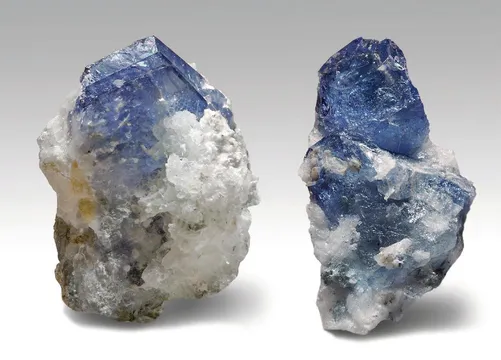
San Benito County benitoite is the defining material for the species: triangular to tabular ditrigonal-dipyramidal crystals in sapphire-blue, violet-blue, pale blue, colorless, white, and rarely pink tones, most famously on white natrolite with black neptunite. The best crystals show saturated blue edges or complete deep-blue bodies, high luster, sharp form, freedom from abrasion, and pleasing exposure on contrasting matrix; many crystals are color-zoned with milky or colorless centers and stronger blue toward the corners. Crystals around several millimeters are common in specimen material, 1–2 cm matrix crystals are highly collectible, and truly fine larger crystals or balanced benitoite-neptunite plates from the Dallas/California State Gem Mine are major American classics; Junnila and Mina Numero Uno material is important but generally much scarcer and more specialized in the specimen market.
At San Benito County, natrolite is the white stage on which the locality’s drama is built. In the benitoite veins it occurs as massive to granular white vein filling and crusts that enclosed benitoite, neptunite, and joaquinite-(Ce), often preserving crystals through weathering and mechanical handling. Collector specimens may retain natrolite as a snowy matrix, show partial acid removal around crystals, or consist of vein fragments with blue and black crystals still partly buried; better pieces keep enough natrolite for contrast and locality character without smothering the associated minerals. Completely stripped pieces may reveal hidden crystals, but they lose some of the visual and geological evidence that marks the classic Dallas/California State Gem Mine association.
Tourmaline is not a headline San Benito County mineral in the way benitoite, neptunite, natrolite, or artinite are, and collector labels from the county need to be read carefully because California’s famous gem tourmalines are overwhelmingly from southern California pegmatites rather than New Idria. The documented San Benito material is best treated as black tourmaline or schorl-type material from scattered historical references, including Stayton district and serpentine-schist country occurrences, rather than colorful pocket elbaite. Good San Benito tourmaline specimens, when credible, are locality pieces: black, massive to prismatic material valued for provenance and association with the county’s broader mining districts, not for the gem color, transparency, or pocket aesthetics expected from Pala or Mesa Grande.
San Benito County artinite is a separate classic from the benitoite mine suite, centered on the Artinite pit near Picacho Peak in the Clear Creek area. There, serpentinite breccia and altered surfaces produced white acicular crystals in hemispherical sprays, puffballs, and sparkling radiating groups, commonly on serpentine matrix and associated with tiny hydromagnesite aggregates and orange to orange-brown desautelsite. The best specimens show intact, bright, spherical or fanlike sprays across contrasting matrix; ordinary pieces are crushed, soiled, rubbed, or reduced to loose white crusts. The locality is especially prized because it has produced some of the most attractive artinite specimens known, with the desautelsite association adding both color and rarity.
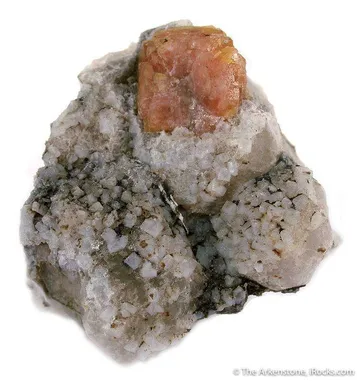
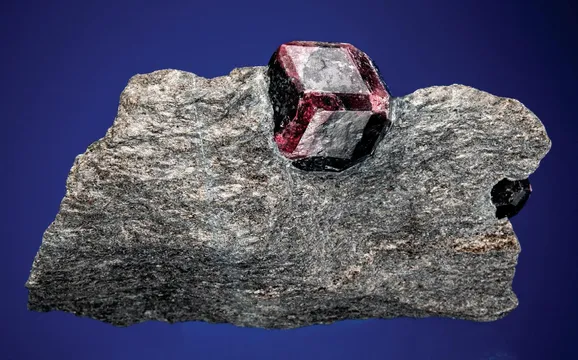
Andradite from San Benito County is a New Idria–serpentinite-area specialty rather than a benitoite showpiece. Historical and collector records document green garnet, topazolite, and melanite-style material from New Idria-area occurrences, including chromite-associated green crystals and specimens from localities such as the Yellow Cat Mine, Black Diamond One claim, and Green Fire Mine. The best examples are small but sharp, lustrous, and richly colored, with green andradite coating chromite or occurring with calc-silicate assemblages; more ordinary specimens are granular, dark, or weakly crystallized. For collectors, the appeal lies in the unusual ultramafic setting and the sharp contrast between bright garnet and dark matrix, not in large crystal size.
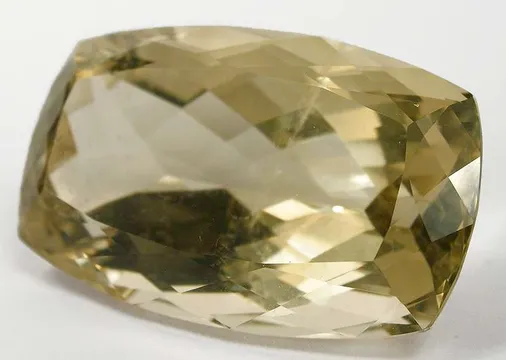
Kunzite requires special caution on a San Benito County page because the credible classic California kunzite story belongs to spodumene-bearing pegmatites of San Diego and Riverside Counties, not to the New Idria benitoite district. I found no well-documented San Benito County kunzite occurrence comparable to the county’s benitoite, artinite, and andradite localities, and any specimen sold or cataloged as San Benito County kunzite should be treated as a label problem until supported by an old collection label, analytical confirmation of spodumene, and a plausible locality history. In practical collecting terms, a San Benito County kunzite specimen would be a provenance curiosity rather than a recognized county classic; good material should not be judged by the standards of Pala kunzite unless the label actually belongs to a southern California pegmatite.
Beyond these species, San Benito County is especially important for type-locality and rare species collecting. Benitoite itself is a type-locality mineral from the California State Gem Mine. Joaquinite-(Ce), first found in minute honey-yellow to brown crystals with benitoite and neptunite in natrolite veins near the headwaters of the San Benito River, is another key locality species. The mine and nearby district occurrences also host or have been reported with bario-orthojoaquinite, strontiojoaquinite, jonesite, baotite, djurleite, digenite, chalcocite, albite, aegirine, crossite/glaucophane, anatase, and other rare or visually subtle minerals. The Victor claim adds further systematic interest with benitoite-related and barium-titanium species, including fresnoite and titantaramellite in the New Idria district assemblage.
The first authenticity issue with San Benito County material is locality specificity. “San Benito County” on a label usually points to the California State Gem Mine/Dallas Gem Mine suite, but the county contains other mineral localities, and the same few names—New Idria, Clear Creek, Santa Rita Peak, Picacho Peak, Coalinga area—are often mixed casually on dealer labels. Good labels should distinguish the California State Gem Mine from the Artinite pit, Junnila claim, Mina Numero Uno, Victor claim, Yellow Cat Mine, Green Fire Mine, or Stayton district when that information is known.
Benitoite specimens are commonly etched. This is not automatically a problem: much of the classic material was naturally or artificially freed from natrolite, and careful removal of natrolite can reveal superb crystals. The warning signs are over-etching, loss of natural context, dull or pitted crystal faces, etched scars on neptunite, and suspiciously isolated loose crystals glued to white matrix. A strong matrix specimen should have believable contact relationships: benitoite and neptunite attached to or emerging from natrolite and blueschist, not perched without geological logic.
Faceted benitoite should be tested rather than accepted on color alone. Its strong dichroism, high refractive indices, dispersion, and short-wave ultraviolet fluorescence separate it from sapphire, spinel, iolite, zircon, tanzanite, glass, and synthetic simulants. Heat-treated orange benitoite has been reported from colorless material, so unusual gem colors deserve disclosure. In mineral specimens, short-wave UV fluorescence is useful but not a complete authentication test; many benitoites fluoresce bright blue to blue-white, while zones and inclusions can complicate the response.
Condition matters sharply. Benitoite is brittle and commonly fractured or cloudy, and many crystals are partly embedded, cleaved, or abraded at edges. Neptunite terminations are easily nicked; black luster hides bruises in poor light, so rotate specimens under a point light. Natrolite matrix can be friable, stained, or acid-etched. Artinite from the Picacho Peak pit is delicate and should be kept dry, dust-free, and protected from rubbing; the finest sprays are easily crushed. Orange desautelsite on artinite specimens may darken or appear brownish with exposure and age.
Market availability is uneven. Small benitoite-on-natrolite pieces and etched thumbnails appear regularly, especially from screened mine material and older stocks. Balanced cabinet pieces with sharp blue benitoite and lustrous neptunite on attractive natrolite are far scarcer and command strong competition. Fine neptunite specimens without benitoite remain desirable, particularly if the prisms are large, sharp, and lustrous. Artinite from the Artinite pit appears intermittently from old collections. Credible San Benito County kunzite and high-quality tourmaline should be treated as unusual and should not be bought at a premium without exceptional documentation.
The discovery story begins with a prospector in difficult country, not with a gem dealer’s showcase. J. M. Couch was grubstaked by R. W. Dallas and was looking into prospects in the New Idria district when the famous blue crystals entered the story. Accounts differ over the exact division of credit among Couch, L. B. Hawkins, and T. E. Sanders, but the old controversy itself is part of the locality’s mythology. Louderback later recorded the dispute with the dry observation that the men “happened upon the benitoite deposit and each claims to be responsible for the discovery.” Oscar Couch, J. M. Couch’s eldest son, would later publish The Benitoite Story to argue that his father deserved sole credit.
The first stones did not announce themselves as a new mineral. They moved through the usual chain of practical guesses: sapphire because of the color, then perhaps spinel because the hardness did not fit sapphire, and even “volcanic glass” in one early dismissal. George Eacret of Shreve & Co. in San Francisco examined an early cut stone with a dichroscope and recognized that it was not behaving like an ordinary blue gem. Samples reached George D. Louderback at Berkeley, and the rough hillside prospect became a type locality.
The early Dallas camp had the raw look of a frontier gem rush. Dallas organized the Dallas Mining Company, issued stock, put up a cabin, and pushed workings into the benitoite-bearing outcrop. Historic photographs show miners at the portal, a short adit, and split vein material with black neptunite embedded in white natrolite. The irony is that the early miners were surrounded by extraordinary mineral specimens but were hunting chiefly for gemstones. They did not yet have the modern collector’s habit of preserving complete matrix pieces, and they did not understand how carefully natrolite could be removed to reveal hidden crystals. Much material was broken, blasted, or treated as gem rough first and mineral specimen second.
One of the most vivid later chapters belongs to the 1930s collectors. Peter Bancroft and Ed Swoboda visited the mine several times between 1935 and 1938, after receiving directions from their high-school teacher Frank Gulick, who had collected there in 1934. At that time the trip into the deposit was still a serious undertaking, and the old mine dumps were sufficiently rich that determined collectors could recover thousands of specimens. Their collecting became part of the specimen lineage of the locality, especially because later correction notes clarified that they had permission to visit, not the unauthorized status once implied in print.
The Forrest and Gray era changed the scale and method of recovery. Rather than only chasing obvious vein pockets, they worked weathered dump, colluvial, and eluvial material. A front-end loader fed rock and dirt over a grizzly; water jets washed the material through screens; fragments between roughly 3 and 25 mm passed into a gravity jig where heavy benitoite was trapped in trays and removed by hand. It was practical, muddy, seasonal work, dependent on spring weather and water from the headwaters of the San Benito River, but it recovered both gems and mineral specimens that would otherwise have remained hidden under white natrolite.
The gem record has its own drama. A piece of rough found in the late 1980s yielded a 10.47 ct faceted stone. Still finer rough recovered in the early 1990s was cut into a 15.42 ct gem, long cited as the largest faceted benitoite from the mine. Another famous object, a benitoite and diamond necklace with 52 benitoites totaling about 33 ct, was stolen in Europe in 1974. The necklace was recovered in 1975, but the pendant was not.
The 1997 extension reads like the kind of moment every locality specialist hopes for. By the end of the 1996 season, the older colluvial and eluvial reserves were largely exhausted. Then larger machinery exposed a productive area downslope from the historic pit. On May 1, 1997, a remarkable boulder of benitoite-bearing blueschist came out of the new extension. Its natrolite-coated surface covered roughly 40 by 70 cm, and the small knobs in that white crust betrayed the presence of benitoite and neptunite crystals beneath. Several gem-quality pieces were removed from the outside edge of the vein.
The modern public experience is a very different kind of story. The actual mine remains closed to the public for safety and environmental reasons, but the current operators haul material from the mine area to a screening field near Coalinga. Collectors work at tables and screens, then check suspect material under ultraviolet light. The romance is no longer a solitary prospecting camp in the mountains; it is a day of mud, screens, white natrolite fragments, glowing blue clues, and the occasional moment when a tiny triangular crystal justifies the whole trip.