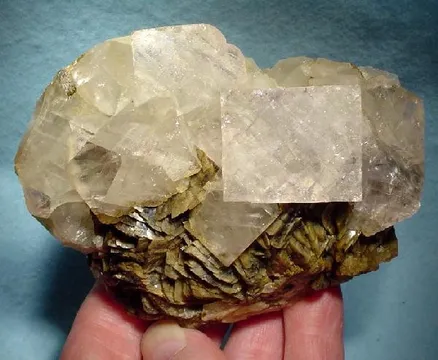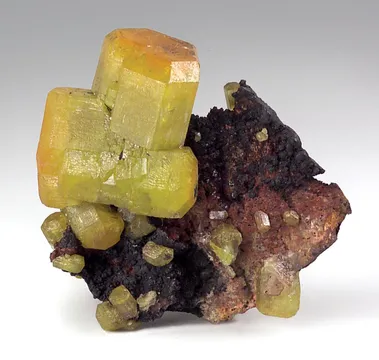
Beihilfe Mine, Germany — a defining Freiberg locality for cubic fluorite in blue to yellow, often with galena, sphalerite and barite; famed for the 1964 Blaue…
Key facts
The Beihilfe Mine at Halsbrücke is one of the defining collector localities of the Freiberg mining district in Saxony’s Eastern Ore Mountains: a classic hydrothermal vein mine where the late fluorite-barite lead-ore assemblage of the district reached unusual specimen quality. Its best pieces are not merely “German fluorite” in the broad market sense, but a very particular Halsbrücke style—cubic fluorite in vivid blue, golden yellow, violet, or color-zoned water-clear crystals, commonly with galena, sphalerite, chalcopyrite, barite, quartz, and calcite. For the serious collector, the name Beihilfe carries both geological and historical weight: it belongs to the great Freiberg Ag-Pb-Zn vein province, a mining landscape worked since the medieval silver era, revived for base metals and fluorspar, and finally closed in the late 1960s.
The deposit belongs to the Freiberg vein system, where mineralized fissures cut the gneissic basement of the Erzgebirge. At Halsbrücke the fluorite-barite lead-ore association—the fba-Formation of German literature—is especially important. In specimen terms that means a Pb-Zn-F-Ba assemblage: galena and sphalerite in a gangue of fluorite, barite, quartz, and subordinate carbonates, with pyrite, marcasite, chalcopyrite, and secondary lead minerals developed locally. The mine’s fame rests above all on postwar finds, especially the legendary 1964 “Blaue Druse,” a great blue-fluorite cavity encountered not long before the end of mining.
Regional View
Country View
Good Beihilfe pieces have a compact, old-European cabinet presence. The finest blue fluorites show deep ink-blue to night-blue color, sometimes as phantoms or zones inside otherwise clear cubes; the best yellow specimens have lustrous honey to golden cubes on quartz or with metallic sulfides. Galena adds sharp silver-gray cubo-octahedra or lustrous coatings, sphalerite may appear as honey-yellow to brown crystals or schalenblende, and barite ranges from white to water-clear tabular crystals. The most desirable examples combine color, luster, intact cubic edges, and credible old provenance, because many labels in circulation date from old German collections rather than modern collecting.

Photo: Dryhand58, Wikimedia Commons
Search for specimens: View all specimens from Beihilfe Mine, Germany
Beihilfe lies at Halsbrücke, north of Freiberg, in Mittelsachsen, Saxony. In older German labels it appears as Grube Beihilfe, Halsbrücke, Revier Freiberg, Erzgebirge, Sachsen, Deutschland. The mine is part of the northern Freiberg district, where the Halsbrücke subdistrict included the Beihilfe and Kurprinz mine fields. The principal Beihilfe workings named in district summaries include the Beihilfe-Richtschacht and Lorenz-Gegentrum-Schacht, with important veins including the Halsbrücker Spat, Daniel Spat, Lorenzspat, Pabst Spat, and Weisshaldner Stehender.
Geologically, the mine is best understood as a vein deposit in the Freiberg Ag-Pb-Zn system, not as an isolated fluorite occurrence. The regional host is the gneissic basement of the Eastern Erzgebirge, cut by numerous hydrothermal fissure veins. In the Freiberg classification, the Beihilfe collector assemblage belongs to the fluorite-barite lead-ore association, developed particularly strongly in the Halsbrücke area and characterized by fluorite, barite, quartz, galena, sphalerite, chalcopyrite, pyrite, and marcasite. This assemblage is why Beihilfe pieces so often show the collector-friendly contrast of bright cubic fluorite against dark metallic sulfides and white or clear gangue minerals.
The mine’s history is layered. Mining on the Halsbrücker Spat is recorded back to about 1600, while the Beihilfe mine itself was organized in the nineteenth century during renewed work on the deeper Halsbrücke veins. The Grube Beihilfe Erbstolln is associated with the 1861 reopening or consolidation of the deep workings on the Halsbrücker Spat. From 1874 until the 1900 shutdown, Beihilfe Kurprinz produced 7,171 kilograms of silver, an important figure for a district then struggling with falling silver prices. The broader Freiberg mining crisis deepened after the decline in the silver price in the 1870s; Saxon state involvement and mine consolidation followed, but Beihilfe Kurprinz was nevertheless shut down in 1900, and the Freiberg district as a whole was finally closed in 1913 before later twentieth-century revivals.
Modern specimen fame comes chiefly from the twentieth-century period. The Halsbrücke workings were brought back into operation in the mid-1930s and continued through the postwar years under the East German mining economy. The final chapter of Freiberg ore mining unfolded between 1968 and 1970, with Beihilfe’s last use commonly given as 1968 and the final district shipments following in 1969. This late working period is crucial for collectors: the celebrated Beihilfe fluorite, galena, sphalerite, barite, and quartz specimens known from cabinets and museum displays overwhelmingly belong to post-1945 production, not to the earliest centuries of mining.
The most famous single find is the “Blaue Druse,” discovered in 1964 on the 450-meter level of the Beihilfe mine. It yielded the dark-blue fluorite specimens that now define the locality for many collectors. These pieces are prized for deep blue color, internal zoning or phantoms, sharp to beveled cubic forms, and the occasional association with chalcopyrite or other sulfides. Terra mineralia in Freiberg displays a 20 cm Beihilfe fluorite and chalcopyrite specimen from this tradition, and the Krügerhaus literature records the find as one of the striking mineral episodes of the district.
Collectors also encounter material tied to Lorenz Gegentrum, close to and historically entangled with the Halsbrücke-Beihilfe system. The Lorenz Gegentrum dumps beside the road toward Falkenberg contain waste from the St. Lorenz Gegentrum Neuschacht and have long been searched by collectors. The material is important for Beihilfe-area secondary minerals: green to brown pyromorphite, fluorapatite pseudomorphs after pyromorphite—the old “Pseudoapatit”—mimetite, cerussite, brochantite, caledonite, langite, linarite, cuprite, hematite, barite, and fluorite are all recorded from the immediate Halsbrücke collecting context. For precise labels, however, Beihilfe Mine, Lorenz Gegentrum Mine, and neighboring Churprinz or Ferdinand Shaft material should not be casually merged; the district is compact, the assemblages overlap, and old labels are sometimes less exact than modern collectors would like.
Today Beihilfe is an abandoned mine locality, not an active collecting mine. Much of the accessible historical material comes from old collections, museum holdings, and the specimen market. Dumps and old mine ground in the Halsbrücke area have been heavily searched, altered, reclaimed, or are subject to property, safety, environmental, and heritage restrictions. Serious collectors should treat new “fresh find” Beihilfe labels cautiously unless the chain of custody is clear; the classic material is overwhelmingly old-stock.
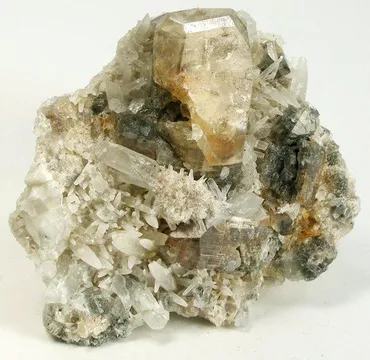
Fluorite is the signature Beihilfe species, occurring as cubic crystals in blue, yellow, violet, colorless, and color-zoned forms, commonly with quartz, galena, sphalerite, chalcopyrite, barite, calcite, marcasite, pyrite, dolomite, siderite, pyromorphite, and cerussite. The most celebrated pieces are the blue fluorites from the 1964 “Blaue Druse,” where water-clear to translucent cubes may carry ink-blue internal phantoms or deep night-blue body color; these are far scarcer in unfaded condition than ordinary pale blue-gray examples. Yellow Beihilfe fluorite is also highly collectible, especially when sharp, lustrous, and gemmy, with cubes from about thumbnail scale to several centimeters on edge; cabinet plates with golden cubes on quartz, chalcopyrite, or white to golden barite are among the locality’s most attractive display specimens. Good pieces have crisp cubic geometry, bright luster, strong but natural color, minimal bruising on cube corners, and convincing old provenance, while ordinary pieces tend to be pale, cleaved, etched, faded, or visually crowded by damaged sulfide matrix.
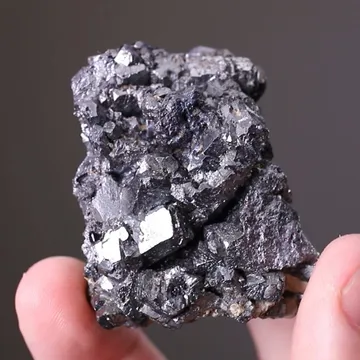
Galena from Beihilfe is a classic accessory and ore mineral rather than a mere matrix component, and the best examples show bright lead-gray crystals associated with fluorite, quartz, sphalerite, pyrite or marcasite, barite, and locally chalcopyrite. Freiberg galena is well known for octahedral to cubo-octahedral forms, and Beihilfe pieces are especially sought when the galena sits sharply on honey-yellow fluorite or contrasts cleanly with pale gangue; lustrous crystals on yellow fluorite are specifically regarded as among the most desirable Freiberg galena combinations. Specimen quality depends on metallic freshness, crystal definition, and composition: a sharp galena-fluorite association with intact fluorite edges is far more important than a heavy, massive lead ore piece, and schalenblende or sulfide-rich matrix can add historical character when it supports rather than overwhelms the display face.
Pyromorphite from the Beihilfe locality is a secondary lead mineral of the oxidized zone and the surrounding Halsbrücke dump assemblage, most often seen as green to brown crystals on quartz, barite, or iron-stained matrix rather than as the large, glossy barrel crystals familiar from Bad Ems. Mindat records Beihilfe pyromorphite with quartz, barite, calcite, and fluorite associations, while the nearby Lorenz Gegentrum material is especially known for pyromorphite and for fluorapatite pseudomorphs after pyromorphite, historically called “Pseudoapatit.” Good Beihilfe-area pyromorphite is valued for obvious crystal form, saturated green or pleasing brown color, and a reliable locality label separating Beihilfe Mine from Lorenz Gegentrum when possible; mediocre pieces are earthy, sparse, or so iron-stained that the crystals lose definition.
Chalcopyrite at Beihilfe is typically a bright brassy associate in the fluorite-barite lead-ore assemblage, adding metallic sparkle to fluorite, quartz, sphalerite, galena, barite, and marcasite-bearing pieces. It is rarely the dominant aesthetic species, but it is important in the best blue- and yellow-fluorite combinations: small brassy crystals or grains provide color contrast against deep blue fluorite from the Blaue Druse tradition and against golden-yellow fluorite on quartz. The most collectible Beihilfe chalcopyrite specimens are therefore combination pieces in which chalcopyrite is fresh, visible, and well placed, not tarnished to an indistinct brown film; when associated with marcasite, stability and oxidation products should be checked carefully because deteriorating iron sulfides can compromise an otherwise fine specimen.
Quartz is one of Beihilfe’s essential gangue minerals and appears as crystalline quartz, amethyst, smoky quartz, and chalcedonic material in the wider Halsbrücke assemblage. On fluorite specimens it commonly forms the pale, sparkling base that makes yellow or blue cubes stand out; older descriptions also single out “fliederfarbener Amethyst” and handsome quartz pieces with calcite overgrowths from Beihilfe. Good Beihilfe quartz is valued less as a standalone species than as architecture: clean quartz carpets, sharp drusy crystals, pale amethyst tones, or clear points that frame fluorite, barite, galena, sphalerite, and calcite can turn a mineralogical association into a balanced cabinet specimen. Ordinary examples are massive vein quartz with little crystal development, or quartz so iron-stained and sulfide-damaged that the fluorite or barite loses visual relief.
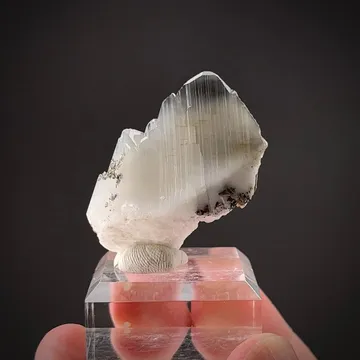
Barite is a major Beihilfe gangue mineral and one of the species for which the mine is historically respected, occurring as white, water-clear, tabular, prismatic, and locally shell-like “Kalkbaryt” material in association with fluorite, galena, sphalerite, quartz, chalcopyrite, pyrite, and marcasite. Older German accounts praise water-clear tabular barite from Beihilfe and note that the calc-baryte variety with shell-like structure can be penetrated by marcasite, a warning as well as an identifying feature. Fine Beihilfe barite specimens show bright, undamaged tablets or attractive white-to-clear groups, especially with blue or yellow fluorite and metallic sulfides; collectors should avoid pieces with active marcasite decay, crumbling baryte masses, or vague labels that may actually refer to Lorenz Gegentrum or another Halsbrücke working.
Other minerals documented from Beihilfe include sphalerite, pyrite, marcasite, calcite, manganese-bearing calcite, dolomite, siderite, sphärosiderite, cerussite, chalcanthite, melanterite, jarosite, gypsum, bournonite, and stolzite. Sphalerite is especially important to the locality’s character, ranging from honey-yellow crystals to darker material and schalenblende, often with fluorite, galena, and barite. Bournonite and stolzite are the more notable rarities on a Beihilfe label, while cerussite, pyromorphite, chalcanthite, melanterite, jarosite, and gypsum reflect oxidation and post-mining alteration of lead, copper, and iron sulfides. No Beihilfe species has the same type-locality status in collector literature as the famous Freiberg-district silver and sulfosalt minerals from other nearby mines, but Beihilfe remains one of the essential locality names for Saxon fluorite-barite-lead ore specimens.
The principal authenticity issue with Beihilfe is locality precision, not an established tradition of fabricated specimens. The Halsbrücke area contains closely related workings—Beihilfe, Lorenz Gegentrum, Churprinz/Kurprinz, Ferdinand Shaft, and others—and older German collection labels may use broad district wording. Yellow fluorite, barite, galena, and dolomite-bearing combinations can be difficult to assign with certainty if the label merely says Halsbrücke or Freiberg. Beihilfe labels are strongest when they include Grube Beihilfe, Halsbrücke, and preferably older collection or dealer documentation.
Blue Beihilfe fluorite needs special care. The dark-blue color of the Blaue Druse fluorites is documented as light-sensitive, and strongly colored examples that have been kept out of sunlight are significantly more desirable than faded gray-blue pieces. Store blue fluorite in a closed cabinet away from direct sun and intense display lighting. This is not simply conservative mineral care; for Beihilfe, color preservation is part of the specimen’s value.
Condition is a major market separator. Fluorite cubes from Beihilfe often show edge bruising, cleaves, or dulled corners; even modest damage is obvious on gemmy blue and yellow crystals. Galena can be chipped or oxidized, sphalerite can be fractured, and barite tablets are prone to bruised edges. Marcasite-bearing specimens deserve particular caution: older accounts note Beihilfe barite varieties penetrated by marcasite, and unstable marcasite can produce sulfate efflorescence, crumbling, and acidic decay. Keep suspect pieces dry, isolated, and regularly inspected.
Market availability is limited and highly quality-dependent. Ordinary Beihilfe fluorite and combination pieces appear periodically from old European collections, but fine blue fluorites from the 1964 Blaue Druse, strong golden-yellow fluorite plates, and sharp galena-on-fluorite combinations are scarce. Recent public market records show Beihilfe fluorites ranging from small miniatures to large decorative specimens priced from the low four figures into five figures when size, color, provenance, and condition align. Serious buyers should prioritize label history, natural-looking color zoning, and undamaged display faces over size alone.
The story every Beihilfe collector eventually hears begins underground in 1964, on the 450-meter level. The mine was already in its late chapter, with the great Freiberg ore field nearing the end of active production. Then miners at Beihilfe hit a cavity that collectors would remember simply as the “Blaue Druse”—the Blue Cavity. Accounts in the Krügerhaus literature describe the moment in the language of mining luck: after a couple of blasts, the Beihilfe miners made a “big shoot.” Out came blue fluorite, not the pale, forgettable kind, but dark, saturated, ink-blue cubic material that would become one of the most recognizable German fluorites of the twentieth century.
That find is now inseparable from the afterlife of the mine. Terra mineralia’s presentation of a 20 cm Beihilfe fluorite and chalcopyrite specimen emphasizes the same drama: the crystals came from a gigantic crystal cave discovered in 1964, shortly before closure, and only a few specimens still retain the strongest dark-blue color because the fluorite fades quickly in sunlight. In a collector’s cabinet, that turns the specimen into a kind of time capsule. A blue Beihilfe is not only a mineral from a famous pocket; it is evidence of careful custody across decades. The piece that still glows blue has survived not just mining, trimming, transport, and ownership changes, but also light itself.
The less glamorous story is written on the dumps. At Lorenz Gegentrum, beside the road toward Falkenberg, collectors repeatedly dug through the old waste from St. Lorenz Gegentrum Neuschacht. The attraction was not the big blue fluorite of the 450-meter level but the secondary mineral suite—green and brown pyromorphite, mimetite, cerussite, linarite, brochantite, langite, and the curious “Pseudoapatit,” a fluorapatite pseudomorph after pyromorphite. For locality specialists, this matters because it shows how the Halsbrücke area became two things at once: a source of cabinet-size classic fluorite-barite-lead ore from underground production, and a dump-collecting ground for small but distinctive secondary lead and copper minerals.