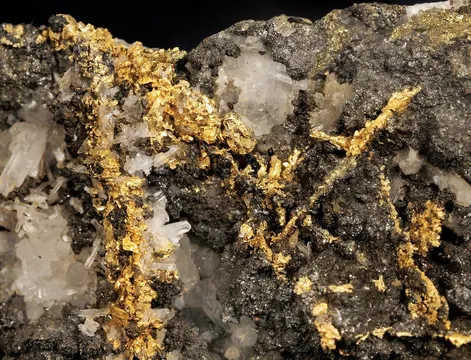
A collector's guide to Banská Štiavnica, Slovakia: its geology, mining history and notable minerals, illustrated with the 198 specimens documented from this locality on EarthWonders.
Key facts
Banská Štiavnica is one of Europe’s great old silver camps: a volcanic, deeply mined, historically layered mineral district where the specimens are inseparable from the town itself. The deposit sits in the central uplifted part of the Miocene Štiavnica stratovolcano of the Western Carpathians, where long epithermal fissure veins cut propylitized andesites, diorites, quartz-diorite porphyries and related intrusive rocks. In collector language, the name covers both the town locality and the old Schemnitz/Selmecbánya mining field, with famous vein systems such as Bieber, Terézia, Špitaler, Grüner, Rozália, and associated workings around Banská Štiavnica, Štiavnické Bane, Banky, and Hodruša-Hámre.
Mineralogically it is a classic Au-Ag-Pb-Zn-Cu epithermal district. The leading ore minerals are galena, sphalerite, chalcopyrite, pyrite, tetrahedrite-group minerals, Ag sulfosalts, acanthite, pyrargyrite, proustite, native gold and electrum, with a gangue suite dominated by quartz, amethyst, chalcedony, calcite, dolomite, barite, rhodochrosite, siderite, ankerite, kutnohorite, manganoan calcite and rhodonite. The best cabinet pieces have a particularly Central European look: lustrous bronze-to-gold iron/manganese-oxide-coated quartz, sceptre quartz, deep violet amethyst with colorless tips, pearly dolomite with black sphalerite and brassy chalcopyrite, creamy calcite rhombs, silver-black acanthite, and complex old ore specimens carrying galena, tetrahedrite, chalcopyrite, cinnabar or Ag sulfosalts.
Historically, Banská Štiavnica is far more than a specimen locality. It was a gold-silver mining town of medieval and early modern Europe, a UNESCO World Heritage mining landscape, and the home of a mining academy whose eighteenth-century teaching collections, engineering models and mineral instruction helped shape technical education in the Habsburg world. Its artificial reservoirs, the tajchy, were built not for scenery but to store water power for pumps, hoists, stamps and smelters; its mines forced innovations in drainage, explosives, pumping and ore dressing; and its old specimens traveled under German “Schemnitz” and Hungarian “Selmecbánya” labels into the great museum and private collections of Europe.
Regional View
Country View
For collectors, the district is strongest when the specimen still shows its paragenesis: quartz or carbonate first, then the dark metallic ore, then late barite or oxide coatings. Fine Schemnitz pieces are rarely about single perfect isolated crystals; they are about surface, association, and historic personality. A plate of tiny sceptre quartz coated in iridescent bronze oxide can be more typical, and more desirable, than a clearer but less local-looking quartz group. Likewise, a sphalerite-dolomite-chalcopyrite-galena association from Žigmund, Nová, Terézia or Bieber carries more locality character than a detached sulfide crystal without matrix.


Search for specimens: View all specimens from Banská Štiavnica, Slovakia
Banská Štiavnica is the principal historic center of the Štiavnica-Hodruša ore field, a large epithermal precious- and base-metal system in the Inner Western Carpathian volcanic belt. The ore field occupies the central part of the Štiavnica stratovolcano, a large polygenetic volcanic structure with subvolcanic granodiorite and quartz-diorite porphyry bodies. The mineralization is structurally controlled: long, steep fissure veins and vein-breccia zones were emplaced along fault systems related to uplift of the central horst and the evolution of the volcanic-intrusive complex.
The ore field is unusually large and vertically extensive for a European epithermal district. More than 120 veins are recorded in the broader Štiavnica-Hodruša field. Major veins such as Bieber, Grüner, Rozália and Terézia may run for several kilometers, with individual vein widths ranging from decimeters to several meters and locally broader mineralized zones. Scientific work on the district describes a zoned system: Au-Ag-Bi-Cu-base-metal assemblages toward the inner and deeper zones, Au-Ag-Pb-Zn-base-metal assemblages in intermediate positions, and more Au-Ag-quartz-dominant mineralization outward. In simple collecting terms, this is why the locality can produce both attractive quartz/amethyst specimens and dense sulfide-carbonate ore specimens from the same historic mining field.
The main epithermal gangue is quartz and carbonate. Quartz occurs as ordinary vein quartz, drusy quartz, sceptre quartz, amethyst, chalcedony and oxide-coated varieties; carbonates include calcite, dolomite, siderite, ankerite, rhodochrosite, kutnohorite and manganoan calcite. The ore minerals include galena, sphalerite, chalcopyrite, pyrite, marcasite, tetrahedrite-group minerals, acanthite, polybasite, pearceite, pyrargyrite, proustite, stephanite, bournonite, cinnabar, realgar, native gold and electrum, as well as an important suite of Ag-Cu-Pb-Bi-S sulfosalts in deeper parts of the system. Bieber and Rozália are especially important in the literature on Bi-bearing and chalcopyrite-rich deep-zone mineralization; Terézia and Špitaler are central names for Pb-Zn-Ag vein assemblages; Šobov and nearby secondary quartzite occurrences are important to the collector image of sceptre quartz.
Fluid-inclusion studies on quartz, sphalerite, barite and fluorite show the ore-forming system operated over a broad temperature and salinity range, with boiling and fluid mixing playing major roles in metal deposition. The recognized stages include an early hematite-quartz stage with Mn silicates and carbonates, a sphalerite-galena-chalcopyrite-pyrite stage, a rhodonite-carbonate-quartz stage, a galena-chalcopyrite stage carrying gold and Ag-Bi sulfosalts, and a later sulfosalt-barite stage with acanthite and other silver minerals. That sequence explains the collector associations: sphalerite commonly with galena, chalcopyrite, pyrite and dolomite; acanthite and silver sulfosalts in later, more silver-rich assemblages; and barite as a late open-space mineral.
Mining history here is deep enough that labels can be confusing. The same locality may appear as Banská Štiavnica, Schemnitz, Selmecbánya, Selmecz, Chemnitz or “Hungary” on older labels. The deposits were exploited for gold and silver from very early times; medieval mining developed into one of the great precious-metal centers of the Kingdom of Hungary, and later of the Habsburg monarchy. By the sixteenth to eighteenth centuries, the mines were technically sophisticated, economically crucial and increasingly deep, forcing large-scale drainage and water-power engineering. The eighteenth-century water-reservoir system of tajchy, connected by channels and tunnels, was a decisive response to the problem of flooding in deep workings.
Modern mining and collecting history overlaps strongly with state mining and museum collecting. Precious-metal mining in the traditional Ag-Au ores ended in the twentieth century, while base-metal operations in the district continued much later; the late socialist and early post-socialist period brought many of the modern carbonate-sulfide specimens onto the collector market. Specimens labeled Nová šachta, Žigmund šachta, Terézia adit, Bieber vein, Banky, Šobov, Štiavnické Bane or Hodruša-Hámre may all be encountered in collections and dealer stocks, and locality precision matters.
Collecting access today should be approached cautiously. Banská Štiavnica is a protected historic mining landscape, with active museums, tourist adits, old workings, private land, protected technical monuments and unsafe abandoned mine openings. Serious collectors should assume that underground access and dump collecting require permission and current local knowledge. The most responsible way to experience the locality is through the Slovak Mining Museum, the Kammerhof collections, the Open-Air Mining Museum with the Bartolomej adit, and official heritage routes; specimen collecting should be limited to legal, permitted surface opportunities and established trades from old collections.
Quartz is the visual signature of Banská Štiavnica: ordinary vein quartz is abundant, but the collector pieces that read immediately as Schemnitz are drusy plates and complex sceptre forms, commonly coated by thin bronze, golden or brown Fe-Mn oxides, sometimes with iridescence. Šobov-area material and small adits such as Zlatačka have supplied striking sceptre quartz, while the ore veins also produced quartz with chalcopyrite, galena, sphalerite, tetrahedrite-group minerals, dolomite, siderite, calcite and late oxides. Cabinet-size groups are known, but many of the best pieces are small cabinets and miniatures where the crystal repetition, lustrous oxide skin and intact terminations create the appeal; ordinary massive white vein quartz is common, whereas sharp, undamaged sceptres, upright sprays, doubly terminated crystals, and quartz carrying acanthite or rich sulfides are the pieces that carry the locality premium.
Calcite from Banská Štiavnica is a carbonate-stage classic, especially from twentieth-century workings such as Nová šachta, where 1970s–1980s material included large display specimens with pale, creamy to white rhombohedral crystals and curved or subtly phantomed forms. It occurs with quartz, siderite, dolomite, sphalerite, galena and chalcopyrite, and old pieces may show calcite perched on brown siderite rhombs or over drusy quartz. The best examples are not merely “calcite from a famous name,” but sharply crystallized, lustrous, undamaged carbonate groups with visible association and old labels; average pieces are dull, cleaved, bruised or so coated with iron oxides that the calcite habit is lost.
Amethyst is one of the most characteristic quartz varieties from Banská Štiavnica, represented in older European collections by dark violet groups, small sharp crystals and specimens with paler or colorless tips. It occurs in the same epithermal quartz-carbonate system as ordinary quartz and is documented around Banská Štiavnica and Štiavnické Bane, including amethyst with calcite and quartz associations. The most desirable pieces show saturated purple color without looking artificially uniform, clean terminations, attractive contrast with pale quartz or carbonate, and an old Schemnitz/Selmecbánya-style provenance; lesser examples are pale fragments, iron-stained masses or quartz groups with only a faint amethystine blush.
Chalcopyrite is central to the deeper and Cu-rich parts of the Banská Štiavnica system, especially in the Bieber and Rozália vein systems, where quartz-hematite-chalcopyrite ores and Ag-Cu-Pb-Bi sulfosalt assemblages have been studied in detail. Collector specimens show brassy chalcopyrite with dolomite, siderite, quartz, pyrite, galena, sphalerite, tetrahedrite-group minerals and, rarely, cinnabar or other accessories. Good pieces depend on luster, three-dimensional distribution and association: isolated chalcopyrite patches are common, but a balanced small cabinet with bright chalcopyrite crystals, pearly carbonate, black sphalerite and gray galena has far stronger locality character.
Sphalerite at Banská Štiavnica is both an ore mineral and a collector species, occurring in the productive Pb-Zn-Cu stages with galena, chalcopyrite, pyrite, dolomite, calcite, quartz and barite. Material from the district ranges from dark brown to black lustrous druses to honey, orange or more translucent “gem sphalerite” studied from the Banská Štiavnica area, including specimens associated with quartz-carbonate gangue and base-metal sulfides. The best pieces show bright, undamaged crystals rather than granular ore; a matrix of dolomite or quartz with galena and chalcopyrite is especially desirable because it expresses the classic epithermal paragenesis rather than just the species.
Galena is one of the principal ores of Banská Štiavnica, and its importance goes beyond PbS: silver, bismuth and sulfosalt chemistry in and around galena has been a major subject of study in the Bieber, Rozália and related vein systems. Collector galena occurs massive, cleavable, granular, and as crystals or crystal groups with sphalerite, chalcopyrite, pyrite, dolomite, quartz, calcite, tetrahedrite-group minerals and occasional cinnabar. The best pieces are sharp, bright, associated and historic; ordinary lumps of lead-gray ore are abundant by comparison, while specimens that preserve cubic galena surfaces with contrasting quartz or carbonate and an old Schemnitz label are far more collectible.
Acanthite, Ag2S, is the classic black silver sulfide of Banská Štiavnica and appears on many old labels as “argentite” or “Silberglanz,” especially under the historic Schemnitz name. In the paragenesis it belongs to later silver-rich stages with sulfosalts and barite, and collector pieces may show black metallic crystals, coatings or aggregates on quartz and other vein minerals. The finest examples have well-defined form, fresh metallic luster and documented old provenance; many lower-grade pieces are dull sooty coatings, silver-black masses or old “argentite” specimens that need modern interpretation as acanthite.
Dolomite from Banská Štiavnica is an important gangue and display mineral, particularly in sulfide-rich associations from places such as Žigmund šachta, Nová šachta, Terézia adit and Banky. It forms pale, pearly, saddle-like or rhombohedral crystals and druses with sphalerite, chalcopyrite, galena, pyrite, quartz, calcite and tetrahedrite-group minerals; the creamy carbonate against black sphalerite and brassy chalcopyrite is one of the locality’s most satisfying combinations. Good dolomite specimens are judged by sparkle, coverage, undamaged rhombs and contrast with ore minerals; dull brown carbonate crusts without crystal definition are much less desirable.
Barite is a late-stage gangue mineral in the Banská Štiavnica epithermal system, especially tied to the silver-sulfosalt-barite stage, and collector pieces include tabular to bladed crystals with dolomite, quartz, calcite, pyrite, sphalerite, galena and chalcopyrite. The color is commonly pale, creamy, grayish or brownish, and specimens can be attractive when thin blades rise cleanly from carbonate matrix. The best barites are open, sculptural and undamaged; because barite is soft and brittle, edge-wear and broken blades are common, so sharpness and intact terminations matter more here than size alone.
Pyrite is widespread through the Banská Štiavnica veins, occurring in early and later ore stages with quartz, sphalerite, galena, chalcopyrite, dolomite, calcite, marcasite and hematite. Collector pyrite appears as brassy crystals, small drusy aggregates, and accessory crystals scattered through carbonate-sulfide matrix rather than as the large standalone cubes familiar from some other localities. The best Banská Štiavnica pyrite is bright, stable-looking and compositionally interesting as part of a multi-species ore specimen; pyrite that is dull, oxidized, friable or intimately intergrown with unstable marcasite is less attractive and should be assessed for long-term stability.
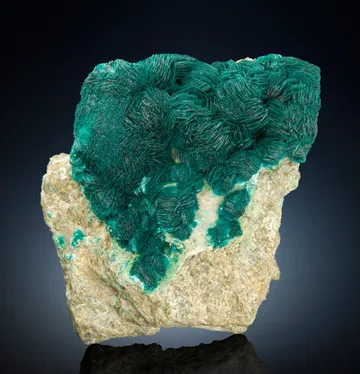
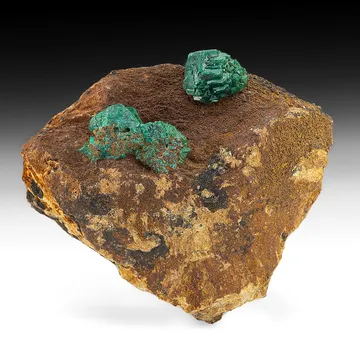
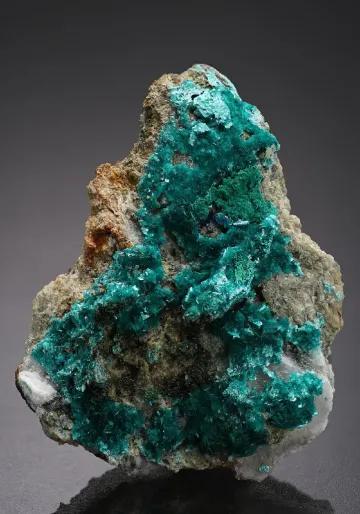
Euchroite deserves special caution under a Banská Štiavnica locality label. The famous Slovak euchroite occurrence is Ľubietová, especially the Svätodušná deposit, not the classic Banská Štiavnica Pb-Zn-Ag epithermal vein suite; museum, philatelic and mineralogical sources consistently separate Banská Štiavnica quartz-sulfide specimens from Ľubietová euchroite. A specimen sold or cataloged broadly as “Banská Štiavnica” may reflect a regional, trade, collection, or administrative shorthand rather than a true occurrence in the Banská Štiavnica veins. For collector purposes, any alleged Banská Štiavnica euchroite should be treated as a provenance problem first: verify old labels, matrix, analytical support and whether the piece is actually from Ľubietová, Poniky or another Slovak copper-arsenate locality.
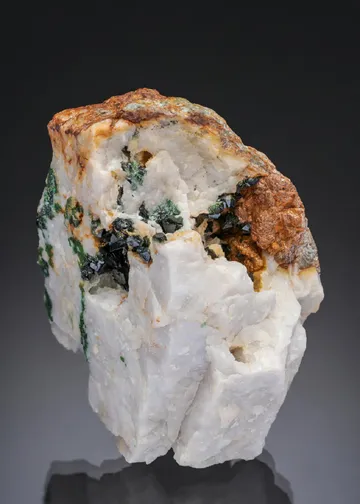
Beyond the headline species, Banská Štiavnica is documented for a remarkable suite of sulfides, sulfosalts, oxides, carbonates, sulfates, silicates and secondary minerals. Important species and groups include tetrahedrite-(Fe), tetrahedrite-(Zn), freibergite-subgroup minerals, polybasite, pearceite, pyrargyrite, proustite, stephanite, pyrostilpnite, bournonite, jamesonite, boulangerite or plumosite-style fibrous lead-antimony material, cinnabar, realgar, arsenopyrite, marcasite, pyrrhotite, bornite, chalcocite, covellite, hematite, goethite, cryptomelane, pyrolusite, rhodochrosite, kutnohorite, manganoan calcite, siderite, ankerite, fluorite, adularia, epidote, rhodonite, scheelite and a research-level suite of Ag-Cu-Pb-Bi-S minerals including matildite, wittichenite, schapbachite, ourayite, eskimoite and arcubisite reported from the Bieber vein system. In the broader Štiavnica Mountains and historic mining district, dillnite was originally described from Banská Belá, and hodrushite was described from the Rozália vein at Hodruša-Hámre; the old zeolite name leonhardite was historically tied to “near Schemnitz” but is now treated as dehydrated laumontite rather than a valid separate mineral species.
Banská Štiavnica is a label-sensitive locality. Older specimens may be labeled Schemnitz, Selmecbánya, Selmecz, Schemnitz in Hungary, or Czechoslovakia, and those labels can be entirely legitimate depending on the specimen’s age. “Theresia Gang” means Terézia vein, not Terézia shaft. Hodruša-Hámre, Štiavnické Bane, Banská Belá, Banky and Banská Štiavnica may also be mixed under broad district labels, so a collector should preserve every old label, even when spelling appears obsolete.
No major, well-documented modern fake industry is specifically associated with Banská Štiavnica specimens, but mislabeling is a real concern. Common problem cases include old “argentite” labels that should now be understood as acanthite, broad “Banská Štiavnica” labels on specimens actually from Hodruša-Hámre or Ľubietová, and attractive Slovak copper arsenates being conflated with Banská Štiavnica because of the town’s fame. Euchroite is the clearest warning sign: a true Ľubietová-type specimen is wonderful, but it should not be quietly folded into Banská Štiavnica without evidence.
Condition issues vary by species. Quartz and amethyst are durable, but the best oxide-coated sceptre quartz can lose visual quality if aggressively cleaned; the thin bronze Fe-Mn coating is often the whole point of the specimen. Calcite, dolomite and barite bruise readily, especially along crystal edges. Galena cleaves, dulls and can show handling rubs. Acanthite and silver sulfosalts are best kept dry, handled minimally and protected from abrasive cleaning. Proustite, pyrargyrite and other ruby-silver species from the district, when encountered, should be kept out of strong light. Marcasite-bearing specimens should be watched for pyrite/marcasite decay, especially if they have a sulfurous smell, powdering surfaces or expanding cracks.
Market availability is better than for many European classics but uneven. Modest Banská Štiavnica quartz, calcite, dolomite, pyrite and mixed sulfide specimens appear regularly from old collections and Central European dealers. Fine sceptre quartz, strong amethyst, good acanthite, sharp carbonate-sulfide combinations, rich cinnabar-on-galena pieces, and old museum-quality silver-sulfosalt specimens are much scarcer. The strongest value attaches to pieces with precise sublocality, old Schemnitz/Selmecbánya labels, documented publication history, or unmistakable locality aesthetics.
Field collecting should be conservative. The district is a UNESCO mining landscape with old adits, shafts, protected monuments, museum-managed underground spaces, private land and dangerous abandoned workings. Underground collecting without authorization is not appropriate and can be life-threatening. Serious collectors visiting Banská Štiavnica should prioritize the Slovak Mining Museum, the Open-Air Mining Museum, Kammerhof displays, and documented purchases from reputable local sources.
The oldest Banská Štiavnica story is told with lizards. The local legend says a shepherd named Sebenitz saw two lizards crawl from beneath a rock on Glanzenberg, one dusted with gold and the other with silver. The place where they appeared became the place where miners opened the mountain. Like all origin legends, it condenses geology into an image a child could remember: two quick animals, a glitter of metal, a shepherd looking closely enough to notice what the mountain was showing him.
The real early history is no less evocative. The hill of Glanzenberg, above the old town, was not simply scenic ground; it was an ore hill. Surface and near-surface workings followed rich oxidized outcrops before mining drove downward into the veins. Old accounts place major workings on Terézia, Špitaler, Bieber and Grüner, and the pattern of the town still reflects the old relationship between ore, slope, water and streets. In the best specimens, that same vertical story survives in miniature: quartz and carbonates from open cavities, dark sulfides from productive ore stages, and late oxides from the long afterlife of the veins.
The eighteenth-century crisis was water. As the mines deepened, drainage adits were no longer enough, and the district faced the old miner’s enemy: groundwater rising faster than men or horses could remove it. Banská Štiavnica’s answer was not one machine but a landscape-scale machine. Reservoirs were built high in the hills, connected by collecting ditches, channels and tunnels, and released as power for pumps, hoists, stamps and metallurgical works. The tajchy look today like mountain lakes, but their beauty is deceptive: they were industrial batteries, storing rain and snowmelt so that silver mines could keep breathing.
Into this world came the Hell family of engineers and Samuel Mikovíny. Matej Kornel Hell built water-powered pumping machinery when flooded workings threatened the mines. Jozef Karol Hell later developed new pumping machines, including air- and water-column concepts that were advanced for their time. Mikovíny, mathematician, surveyor and cartographer, helped rationalize the water-management system that tied the reservoirs to the mines. For a collector holding a Banská Štiavnica calcite or acanthite, this matters: many specimens exist because those machines, reservoirs and drainage works kept the ore zones accessible.
Banská Štiavnica also became a school. By the eighteenth century, the mines were not merely extracting ore; they were teaching Europe how to mine, survey, assay, pump and smelt. The Mining Academy grew from this need for trained specialists. Students learned ores and rocks not abstractly but from collections, mines and smelters around them. That educational tradition is one reason Banská Štiavnica specimens are so well represented in old European collections. A Schemnitz label is often not just a locality tag; it may be a trace of the old mining schools, dealers, museum exchanges and teaching cabinets that carried the district’s minerals across the continent.
The locality also has a modern museum story with a painful chapter. In March 2023, a fire in Banská Štiavnica damaged parts of the Slovak Mining Museum’s geological collections housed in the Berggericht building on Námestie svätej Trojice. Reports from the museum noted serious losses in the systematic mineralogical exhibition, including important Slovak specimens. For collectors, it was a reminder that old locality material is finite. A specimen that survives with its label, its association and its history intact is not just an object of trade; it is part of a fragile record.