Comprehensive guide to devilline from Špania Dolina
Key facts
Devilline from Špania Dolina is one of the great old European copper-mineral classics: a locality name, a historical synonym, and a collecting style all fused into one specimen. The village was long known in German as Herrengrund and in Hungarian as Úrvölgy, and devilline from here was for decades traded and labeled as “herrengrundite” or “urvölgyite.” Those names are obsolete today, but on an old handwritten label they are often the first hint that a specimen belongs to the classic Central European tradition rather than to a modern oxidized-copper occurrence.
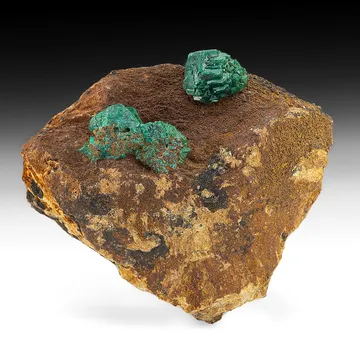
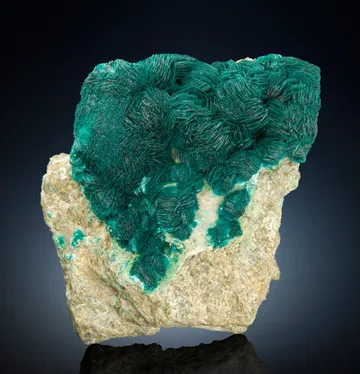
The appeal is immediate. The best Špania Dolina devillines are bluish green to deep green, with thin pseudohexagonal plates gathered into rosettes, rounded sprays, domed clusters, and mica-like foliated crystal groups. The color can look almost turquoise blue in richer, fresher examples, and on a pale arkose, quartz-carbonate, or gypsum-bearing matrix the contrast is exceptional. Old pieces with rosettes approaching the centimeter scale are the material that made the locality famous; smaller but sharp rosettes in protected vugs are still highly desirable when the crystals are clean, lustrous, and unmistakably platy rather than merely powdery crusts.

Photo: Wikimedia Commons
The mineral belongs to the oxidation story of an old copper district. Špania Dolina and the nearby Piesky and Richtárová occurrences sit in the Staré Hory–Špania Dolina ore belt of central Slovakia, a district worked for copper and silver through many centuries. Primary copper mineralization includes tetrahedrite-tennantite and chalcopyrite in hydrothermal quartz-carbonate-siderite systems; devilline formed later in the supergene environment as copper-bearing sulfides and sulfosalts oxidized in the presence of sulfate-rich waters and calcium-bearing gangue or wall rock.
For collectors, the locality is distinctive because it combines beauty, rarity, nomenclatural history, and mining history. Many copper secondaries are judged mostly by color; Špania Dolina devilline is judged by architecture. Good examples show discrete rosettes, radial plate bundles, or sharply bladed aggregates with enough relief to read as crystals under a hand lens. The strongest specimens also carry old labels, sometimes with “Herrengrund,” “Urvölgy,” “Hungary,” “Czechoslovakia,” or “herrengrundite,” reflecting the political and mineralogical history of the district.
Špania Dolina lies in the Banská Bystrica District of central Slovakia, in the historic Staré Hory Mountains mining region north of Banská Bystrica. In older specimen labels and literature it may appear as Herrengrund, Herren-Grund, Urvölgy, Úrvölgy, Neusohl district, Hungary, Czechoslovakia, or Slovakia, depending on the age and language of the source. Those older names are not red flags by themselves; in fact, for devilline they are often desirable evidence of a specimen’s age.
The deposit is best understood as a hydrothermal copper-silver district with veins, veinlets, stockwork, and disseminated ore in crystalline, Permian, and Lower Triassic rocks. The Piesky part of the district is especially important mineralogically: copper ores there occur in a quartz-siderite-sulfide stockwork and as impregnations hosted mainly by Permian sandstones and conglomerates. Tetrahedrite-tennantite was the principal copper-silver ore phase in the district, accompanied by chalcopyrite and, locally, bornite, arsenopyrite, pyrite, galena, cobaltite, sphalerite, siderite, Fe-dolomite, barite, quartz, and calcite. In weathered zones and mine waste, this primary assemblage broke down to a rich suite of secondary copper minerals.
Devilline is part of that secondary assemblage and is recorded from the Špania Dolina deposit, Piesky, and the Piesky adit area. At the main Špania Dolina occurrence it is classically associated with azurite, malachite, gypsum or selenite, aragonite, and langite. The wider district is also known for brochantite, antlerite, posnjakite, chalcophyllite, clinoclase, olivenite, pseudomalachite, cornwallite, tyrolite, libethenite, and many other supergene phases, but not every species occurs on every devilline specimen.
Mining history at Špania Dolina is unusually deep. Archaeological evidence places copper mining in the region back into prehistory, with stone mining tools reported from the broad Špania Dolina–Staré Hory area. Medieval and early modern mining made the district famous, and from 1494 to 1546 the Thurzo-Fugger enterprise controlled the mining district and built one of the major copper mining, processing, and export operations of its time in Europe. Mining continued long after the great early modern period; the old ore bodies were largely exhausted by the late 18th century, but mining persisted until closure in 1888. In the 20th century, old dump material and nearby Piesky material were again processed, with a flotation plant opened in 1964.
The modern locality is not an operating specimen mine. It is a protected historical mining landscape with preserved miners’ houses, the Church of the Transfiguration, the miners’ clapper tower, old shafts and adits, a mining educational trail, the Copper Museum, and a restored mining tunnel connection associated with Piesky. The old dumps around Piesky have long attracted mineral collectors, but access, ownership, conservation rules, and safety conditions can change. Serious collectors should treat the field locality as a heritage site: collect only where explicitly allowed, avoid underground workings, do not disturb monuments or trail infrastructure, and remember that the best devillines on the market are overwhelmingly old collection pieces rather than casual modern finds.
Notable devilline finds fall into two broad historical groups. The great classic specimens date to the 19th-century Herrengrund finds, including material that entered old European collections under the name herrengrundite. A later wave of specimens and photographs documents smaller but still fine rosettes, including examples found or recorded in the modern collecting era. The best pieces from both periods share the same essential quality: distinct green to bluish-green rosettes of platy crystals with enough relief, luster, and isolation to stand out from the oxidized matrix.
Špania Dolina devilline is a hydrated calcium copper sulfate with the formula CaCu4(SO4)2(OH)6·3H2O. It is monoclinic, soft, and visually delicate, but the locality’s best specimens have a surprisingly sculptural look because the crystals gather into thick, radial aggregates rather than lying only as flat crusts.
The defining habit is the thin pseudohexagonal plate. Individual plates may be minute, but when they stack and radiate they form rosettes, sub-spherical aggregates, sprays, and domed clusters. On high-grade specimens, the crystals overlap like tiny green mica books or sheaves, giving the surface a ribbed, foliated texture. Some pieces show rows of sharp plates a few millimeters across; others display rounded rosettes to about 0.5–1 cm, the size range that makes the locality world-class for the species. Museum-quality examples with robust crystal groups larger than that are exceptional.
Color ranges from green through bluish green to rich turquoise-leaning blue-green. The most collectible pieces are neither dull grass-green crusts nor shapeless stains, but lustrous, saturated rosettes with a strong blue component and visible crystal edges. Darker emerald-green examples can be excellent when the luster is high and the aggregates are sharply radial. Pale, powdery, or chalky turquoise coatings are more common and should be valued as matrix color unless they include distinct crystal groups.
Matrix varies. Classic specimens may occur on pale tan to cream arkosic or quartz-carbonate matrix, sometimes with gypsum, selenite, aragonite, malachite, azurite, or langite nearby. This pale matrix is part of the locality’s visual identity: it frames the copper-green devilline and helps separate individual rosettes from the rock. On some old pieces, devilline appears as rich coatings with hundreds of small plates across the display face. On others, only a few protected vugs carry the best crystals.
Typical specimen sizes range from thumbnails and miniatures to small cabinet pieces. Documented collector examples include miniatures around 4–6 cm across with rosettes from a few millimeters to about 1 cm. A specimen need not be large to be important; a small matrix with sharply isolated, lustrous rosettes can be far better than a larger piece covered with indistinct green crust.
The key quality factors are:
The most common authenticity issue is not fakery but nomenclature. “Herrengrundite” and “urvölgyite” are obsolete names for devilline, not separate valid species. On old labels, those names are historically significant; on modern labels, they should be understood as synonyms. A specimen sold as herrengrundite should be cataloged as devilline, with the old name preserved in the label history.
Locality labeling requires care. Špania Dolina, Piesky, and Richtárová are related but not identical occurrences in the broader ore belt. Richtárová devilline can be more acicular or needle-like in habit, while classic Špania Dolina material is especially known for platy rosettes. A label simply reading “Herrengrund” may refer to the historic Špania Dolina district broadly, and older dealers sometimes used the term loosely. For a serious collection, preserve all label variants rather than “correcting” them away; the old wording may be the only surviving evidence of provenance.
No treatment is normally expected for this species. The practical concerns are trimming, repair, misidentification, and overconfident locality claims. Devilline can be confused visually with langite, brochantite, posnjakite, serpierite-like copper sulfates, or other green-blue secondary copper minerals when crystals are small. For valuable pieces, especially old Herrengrund-labeled examples, confirmation by Raman, XRD, or another nondestructive analytical method is prudent if the habit is ambiguous.
Condition is a major value driver. Devilline is soft and platy; rosette edges can be rubbed, crushed, or dulled by old wrapping, cabinet abrasion, or careless cleaning. Avoid washing friable specimens, avoid ultrasonic cleaning, and do not assume that a green crust will tolerate water. Keep specimens dry and stable. Hydrated copper sulfates should not be exposed to heat, prolonged direct sun, or damp storage; even if devilline is more stable than some efflorescent mine salts, associated minerals such as gypsum, chalcanthite-like sulfates, or friable alteration products may be vulnerable.
Rarity is strongly grade-dependent. Small or crusty devilline from the district appears occasionally, and modest specimens may surface from old European collections or online sales. Fine classic Špania Dolina rosettes with historic labels are rare. Top miniatures and small cabinet pieces can command strong prices because they compete not only within devilline but within the broader market for historic European copper species. Recent dealer records show a wide spread: modest small specimens offered at relatively accessible prices, choice miniatures sold or listed in the high hundreds to several thousands of dollars, and exceptional pedigree pieces priced higher still.
Buy the crystal habit first and the label second, but never ignore the label. A rich, sharp, bluish-green rosette specimen with an old Herrengrund or herrengrundite label is the ideal. A vague green coating with a famous locality name is not the same thing.
Long before collectors admired devilline rosettes under fiber-optic lights, Špania Dolina was famous for a different green-blue copper magic. The old mine waters were rich enough in copper sulfate that iron placed in them became coated with metallic copper. To early visitors the process looked like transmutation: iron apparently turning into copper in the darkness of the Herrengrund mines. The chemistry is straightforward today, but in the 17th and 18th centuries it had the theatrical power of alchemy.
That phenomenon gave rise to the celebrated Herrengrund cups. These small copper vessels, often gilded and decorated, were made from cement copper precipitated from mine water onto iron. They were souvenirs, scientific curiosities, and cabinet pieces for learned travelers. A beaker in the Metropolitan Museum of Art carries an inscription that translates as: “Before I was hard iron; the clear pure water changed me into copper within a few hours in Herrengrund.” The line captures the whole romance of the place: a mining village where water seemed to rewrite the identity of metal.
The cups traveled far beyond the Slovak mountains. Some were bought as souvenirs by visitors; others entered Kunstkammer collections as proof that nature still had tricks that looked like alchemy. Their form is often deliberately theatrical. One Met example has a gilded lip and a tiny silver miner seated on a column in the bowl, so that when wine filled the cup, the figure’s reflection shimmered in the golden liquid. The object was not merely a drinking vessel; it was a staged demonstration of mining, chemistry, wealth, and wonder.
The same reputation drew notable European observers. Edward Browne visited Herrengrund in the 17th century and wrote about the richness of the ore, reporting that from “an hundred ponds of Ore” miners ordinarily obtained “twenty ponds of Copper.” Whether read as early travel writing or mining reportage, the remark shows why Herrengrund mattered: this was not just a picturesque village, but a copper district important enough to be described, sampled, and discussed among the scientific circles of its day.
Montesquieu, traveling through Europe between 1728 and 1731, made a detour into Hungary to examine mines, and Špania Dolina belongs to the same world of mining landscapes that fascinated Enlightenment travelers. By then, Herrengrund was already a place where metallurgy, natural philosophy, and collecting overlapped. The same district that produced copper for commerce and cups for curiosity would later give mineralogy one of its most beloved copper sulfates.
There is a pleasing symmetry in that history. Devilline itself was not the original economic prize; it is a late, delicate oxidation product, a mineral born after the sulfide ores had met air, water, and time. Yet the collector’s specimen and the Herrengrund cup both come from the same transformation story. In one, copper moves from mine water onto iron and becomes a souvenir vessel. In the other, copper moves through the oxidized zone and crystallizes as green-blue rosettes on matrix. Both are small objects, both are beautiful, and both preserve the chemistry of Špania Dolina in a form meant to be held, studied, and remembered.