






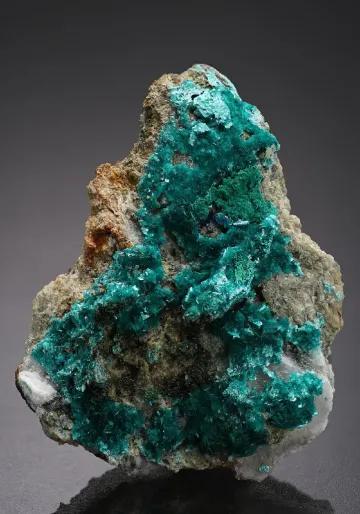
Špania Dolina, Slovakia — historic copper-silver locality famed for devilline rosettes and azurite/malachite in oxidation zones, a European copper source.
Key facts
Špania Dolina is one of the great old copper localities of Europe: a mountain village north of Banská Bystrica whose specimens carry the older labels Herrengrund, Herren-Grund, Úrvölgy, Urvölgy, Neusohl district, Hungary, Czechoslovakia, and finally Slovakia. For collectors, the locality is not a single simple mine but a historic copper-silver ore district centered on Špania Dolina and its satellite workings and dumps at Piesky, Richtárová, and the Ludovika shaft area. The ore field sits in the Staré Hory Mountains of the Central Western Carpathians, where copper-silver mineralization was worked in Permian siliciclastic rocks, Lower Triassic cover rocks, and associated quartz-carbonate-sulfide bodies. The primary ore that matters most to the specimen story is tetrahedrite-tennantite, accompanied by chalcopyrite and a supporting cast of bornite, pyrite, arsenopyrite, galena, cobaltite, sphalerite, siderite, dolomite, barite, quartz, calcite, and locally celestine and aragonite.
The deposit’s fame among mineral collectors rests on what weathering did to those ores. Piesky in particular developed a rich oxidation zone of copper carbonates, sulfates, arsenates, and phosphates, with azurite, malachite, brochantite, antlerite, langite, posnjakite, chalcophyllite, olivenite, pseudomalachite-group minerals, and devilline. Špania Dolina is inseparable from devilline’s collecting history: the blue-green to green platy rosettes long sold as herrengrundite or urvölgyite remain classic, instantly recognizable, and far more evocative than most small secondary copper species. The best specimens show sharp, velvety to pearly rosettes and crusts of devilline against pale quartz-carbonate or altered dump matrix, often with malachite, azurite, langite, or gypsum providing colour contrast. The aragonites, when good, are a different pleasure: white to translucent, often twinned or skeletal crystals in fractures and cavities, especially from the Ludovika area, associated with tetrahedrite, chalcopyrite, calcite, and carbonate gangue.
Regional View
Country View
The locality also matters because its mining history reaches far beyond specimen mineralogy. Prehistoric copper working is indicated by stone mining tools from the area, medieval and early-modern mining made Banská Bystrica rich, and the Thurzo-Fugger enterprise turned central Slovak copper into a commodity of European importance. Špania Dolina’s “cementation waters” even produced the famous Herrengrund copper vessels—objects made from copper precipitated onto iron and then worked into cups, bowls, and boxes—so that this village occupies the rare intersection of ore geology, mineral collecting, mining engineering, art history, and early modern chemistry.


Search for specimens: View all specimens from Špania Dolina, Slovakia
Špania Dolina lies in the Banská Bystrica District of central Slovakia, in the Staré Hory Mountains north of Banská Bystrica. The collecting locality name is best read broadly: old labels may refer simply to Herrengrund or Špania Dolina, while modern mineralogical references commonly distinguish the Špania Dolina deposit from Piesky, Richtárová, and individual mine areas such as the Ludovika shaft. Piesky is about 1.2 km north of the village and is the key modern reference point for many supergene copper minerals; Ludovika is especially familiar to collectors for celestine and aragonite-bearing material; Richtárová, just outside the administrative village core, is historically important in the wider Špania Dolina ore belt and appears often on labels for devilline-group material.
Geologically, Piesky is a hydrothermal copper-silver deposit hosted mainly by Permian arkoses, sandstones, conglomerates, and greywackes, overlain locally by Triassic sandstones, limestones, and dolomites. The ore occurs as veinlets, impregnations, stockwork, and massive aggregates in quartz-carbonate veins and mineralized sedimentary rocks. Tetrahedrite-tennantite is the dominant ore phase at Piesky and was the most important copper-silver source for the district, with chalcopyrite a frequent associate and bornite, arsenopyrite, pyrite, galena, cobaltite, and sphalerite present as accessories. Published work on the Piesky ores records tetrahedrite-tennantite masses reaching about 10 cm, often altered to yellowish-green amorphous Cu-Sb-Fe products and to diverse supergene minerals.
The oxidized zone at Piesky is the engine of the locality’s specimen reputation. Weathering of tetrahedrite-tennantite and chalcopyrite supplied copper, antimony, arsenic, iron, zinc, and other metals; host-rock gypsum and evaporitic intercalations supplied sulfate and calcium; surface-derived carbon and biological input helped form copper carbonates and phosphates. Modern isotope and geochemical work has dated the Piesky oxidation zone to roughly the latest Pliocene–earliest Pleistocene, around 2.5 million years old, and has emphasized that the site is one of only a few central Slovak copper localities with an unusually rich preserved oxidation zone. For the collector, that geochemical story translates into azurite and malachite in cavities, copper sulfates such as brochantite, antlerite, devilline, langite, and posnjakite on fractured matrix, and rarer arsenates and phosphates in small but mineralogically rewarding associations.
The mining history is very old. Archaeological finds of stone hammers in the region are associated with prehistoric copper working, and medieval mining was already significant before the best-documented early-modern phase. The settlement was granted privileges in the 13th century to encourage German mining families and entrepreneurs, and by the late 15th century the mines required capital on a scale that local owners could no longer easily provide. Ján Thurzo and the Fugger banking family formed the great Banská Bystrica copper enterprise in the 1490s, consolidating the region’s copper production and linking Špania Dolina ore to European trade. In 1494 Thurzo began sinking the main shaft later known as the Ferdinand shaft; it reached about 250 m and served both extraction and drainage. Later workings included the Maximilian and Maria shafts and the deep Ludovika shaft, recorded at about 440 m.
Water management was one of the district’s technical triumphs. A system of wooden troughs, ditches, leats, and collecting channels brought water from the Low Tatra side toward the Špania Dolina shafts to power mine machinery, replacing older horse-driven systems. Published local histories describe the system as roughly 36 km long, while forestry and heritage descriptions of the wider watercourse network give about 42 km including connected catchments and branches. Either figure conveys the same reality: this was not a village-scale trickle but a deliberately engineered landscape feature built to keep deep mining alive.
Mining declined after the richest ores had been exhausted. The Fugger administration ended in 1546, after which state mining administration took over, and later centuries worked poorer ore left behind by the great earlier campaigns. The mines finally closed as a traditional ore-mining operation in 1888, though the broader district saw 20th-century exploration, dump reworking, and limited extraction. Old dumps at Piesky, Richtárová, and Špania Dolina were investigated and reprocessed; a treatment plant at Špania Dolina processed local ore and, at times, material from other Slovak deposits. In specimen terms, this history matters because many collectible pieces came not from fresh underground pockets collected in situ but from historic dumps, reworked dump profiles, and oxidized fragments exposed by old and modern disturbance.
Collectors should approach Špania Dolina today as a historic mining and heritage landscape, not as an open digging free-for-all. The village is a protected architectural and mining-history destination with marked trails, museum interpretation, old shafts, adits, dumps, and unstable ground. Surface collecting has been reported historically on dumps such as Ludovika and Piesky, and student and collector field trips have recovered azurite, malachite, celestine, and related secondary copper minerals; nevertheless, legality, land ownership, conservation status, and safety must be checked before any collecting. Underground access without authorization is inappropriate and dangerous, and the most responsible collecting is limited, surface-based, permission-aware, and respectful of the mining monuments.
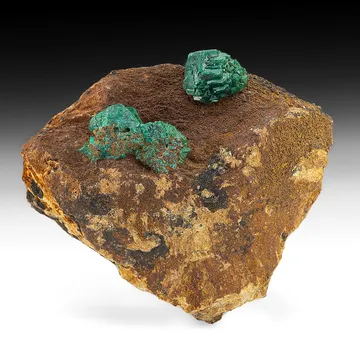
Notable specimen finds include the classic 19th-century devilline/herrengrundite material, the celestine-bearing Ludovika dump material, the aragonite-bearing fractures and cavities in sandstones with dolomitic cement, and the important azurite discovery at Piesky in 2016–2017. The 2016 Piesky azurite find produced several hundred exceptional Slovak specimens, commonly deep blue rosettes and spheres with malachite, and is considered one of the best Central European azurite events of modern collecting. Although azurite is not the featured species on this page, that find is important context: it shows that the old dumps and oxidation-zone remnants at Špania Dolina are not merely historical curiosities but can still yield specimen-quality supergene copper minerals when the right material is exposed.
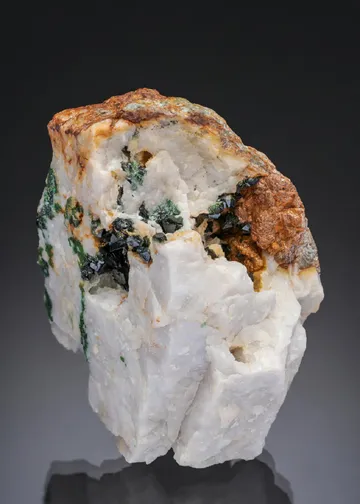
Devilline from Špania Dolina is the signature collector mineral of the district: green to bluish-green CaCu4(SO4)2(OH)6 · 3H2O in thin pseudohexagonal plates, platy crusts, rosettes, and hemispherical aggregates on pale quartz-carbonate or altered dump matrix. The classic specimens were historically traded as herrengrundite or urvölgyite after the German and Hungarian names of the village, and the finest pieces are prized precisely because they combine that old-label romance with excellent mineralogical character. Good Špania Dolina devilline is not just a green stain; it shows discrete platy rosettes, lustrous leafy surfaces, and saturated blue-green colour, commonly with malachite, azurite, langite, gypsum or other sulfate associations. The best cabinet pieces are rich across the display face, with rosettes large enough to resolve by hand lens or macro photography and matrix that has not crumbled, soaked, or shed; ordinary pieces are powdery crusts or thin, low-contrast coatings in which the devilline is visually overwhelmed by altered rock.
Aragonite from Špania Dolina is most strongly associated with fractures and cavities in the Ludovika area, where it occurs with tetrahedrite, chalcopyrite, calcite, siderite, quartz, and carbonate gangue in the copper-silver ore assemblage. Collector descriptions emphasize attractive six-sided twinned and triplet crystals from cracks in sandstones with dolomitic cement, as well as pale white to colourless or translucent aragonite on sulfide-bearing matrix. The usual pieces are small and association-driven rather than large freestanding “flos ferri” showpieces; what makes a good Špania Dolina aragonite specimen is sharp crystal habit, clear association with the district’s ore minerals, and an old or precise Ludovika label. Specimens that preserve aragonite beside tetrahedrite or chalcopyrite are more locality-characteristic than loose white carbonate sprays, because they show the mineral in the copper deposit’s own textural setting rather than as an anonymous carbonate accessory.
Beyond devilline and aragonite, the Špania Dolina district has documented azurite, malachite, brochantite, antlerite, langite, posnjakite, celestine, chalcophyllite, olivenite, pseudomalachite, libethenite, clinoclase, cornwallite-pseudomalachite series material, tangdanite, cuprite, tenorite, chrysocolla, aurichalcite, siderite, tetrahedrite-tennantite, chalcopyrite, bornite, pyrite, barite, calcite, quartz, gypsum, and several rarer supergene products. The locality is especially important historically for the names herrengrundite and urvölgyite, now treated as synonyms or historical usages connected with devilline rather than valid separate species. Rarity hunters should also note the reported occurrences of camérolaite, tripuhyite, barium-pharmacosiderite, bieberite, and other small secondary phases from Piesky and related dump material, though many of these require analytical confirmation and are not visually collectible in the same way as devilline, azurite, celestine, or aragonite.
Špania Dolina specimens are label-sensitive. Older labels reading Herrengrund, Herren-Grund, Urvölgy, Úrvölgy, Neusohl, Besztercebánya district, Hungary, or Czechoslovakia may be perfectly legitimate and can add historical value, especially for devilline/herrengrundite material. Conversely, vague “Slovakia” copper-secondary labels should not automatically be upgraded to Špania Dolina without supporting provenance; central Slovakia has several famous copper oxidation localities, including Ľubietová, Poniky, and Staré Hory-area sites, and the secondary assemblages can overlap.
The most common identification issue is confusing fine-grained blue-green copper sulfates. Devilline, langite, posnjakite, brochantite, and related hydrated copper sulfates may occur as crusts, rosettes, needles, plates, or powdery coatings on similar matrix. Visual identification is safest when the specimen matches known habit and association: Špania Dolina devilline is classically platy to pseudohexagonal and rosette-like, whereas some Richtárová devilline is more acicular, and langite commonly appears as brighter blue to blue-green microcrystals or crusts. If a specimen is being sold as a rare sulfate species rather than simply as “copper secondary minerals,” analysis or a trustworthy old collection pedigree matters.
Condition is a serious issue. Many Špania Dolina pieces are dump specimens from oxidized, fractured, porous matrix; they can shed grains, develop loose powder, or carry soft efflorescent sulfates. Devilline itself is soft and should be protected from abrasion, soaking, ultrasonic cleaning, and aggressive chemical treatment. Avoid prolonged wetting: hydrated copper sulfates and associated gypsum-rich material can deteriorate or change surface character if repeatedly wetted and dried. Dusting should be minimal and done with a soft brush or air bulb only after checking that the crystals are firmly attached.
Aragonite specimens from Ludovika and related areas are carbonate specimens and should not be cleaned in acid. Even weak acids will etch or destroy aragonite and calcite, and may also destabilize iron-stained matrix. Pale carbonate crystals on dark sulfide matrix can look tempting to “brighten,” but overcleaning often removes the very surface and association that make a Špania Dolina specimen meaningful.
No famous large-scale fake industry is documented for Špania Dolina, but mislabelling is plausible because old Central European labels can be confusing and because similar copper secondaries occur at nearby localities. Be cautious with unnaturally bright loose coatings on otherwise unrelated matrix, with modern labels that call Špania Dolina the type locality for devilline without nuance, and with specimens described as “herrengrundite” as though it were a valid species. The name is historically desirable, but the mineral is devilline.
Market availability is uneven. Small devilline specimens from the district appear regularly enough that a patient collector can obtain one, but excellent old rosette pieces with rich coverage, good colour, and credible provenance are genuinely scarce and command a premium. Aragonite is less famous internationally but attractive locality pieces with tetrahedrite, chalcopyrite, or Ludovika attribution are worth saving. The 2016–2017 Piesky azurites remain sought after in Slovak and Central European collecting circles, and high-quality examples are much less common than the locality’s long mining history might suggest.
The most famous story from Špania Dolina is not a single pocket, but a chemical “miracle.” Mine waters rich in dissolved copper flowed through the old workings, and when iron objects were left in them, copper plated out in their place. To early modern visitors it looked like transmutation: iron had become copper. The miners and metalworkers of Herrengrund turned the phenomenon into objects—cups, bowls, boxes, trick vessels—often gilded, sometimes set with silver ore, and inscribed with verses about their impossible birth. One recorded motto survives in English as: “Copper I am, but Iron was of old, Silver I carry, cover’d am with Gold.” That line captures the whole Špania Dolina legend: chemistry, mining, theatre, and salesmanship, all in one object small enough to hold in the hand.
Edward Brown, the English physician and traveler, visited the central Slovak mining region in the 17th century and described the cementation waters with the astonishment of a learned man encountering a phenomenon that still felt half alchemical. Later, princely and scholarly visitors repeated the experience. In 1764, Prince Leopold, brother of the future Emperor Joseph II, recorded seeing iron placed in the cementation water; after weeks of immersion, the form of the iron remained, but the material appeared transformed into copper. By modern chemistry the mechanism is a straightforward redox reaction, but that explanation does not diminish the wonder. For a collector, it is a reminder that the same oxidizing copper-rich environment that grew devilline, azurite, malachite, and other secondary minerals also shaped one of Europe’s great mining curiosities.
The engineering story is equally vivid. As the mines deepened, horses were no longer enough. Water had to be brought across the mountains to power machinery, and the solution was a long wooden-and-earth watercourse that gathered water from the Low Tatra side and carried it toward the shafts. Local accounts describe about 36 km of troughs, leats, and ditches; broader heritage accounts of the connected system give about 42 km. The water drove wheels that replaced horse gins and helped keep the Ferdinand, Maximilian, Maria, and Ludovika workings productive. It is easy to stand in the village today, see wooden miners’ houses and quiet forested slopes, and miss the scale of that hidden infrastructure. The old specimen labels say “Herrengrund,” but behind that name was a full industrial landscape.
There is also a modern collector’s story at Piesky. In 2016, a rich azurite find was uncovered in the old copper deposit, partly associated with malachite. Hundreds of unusually fine Slovak azurite specimens were recovered during 2016 and 2017, including deep blue rosettes and spherical aggregates on green malachite. In a district already famous for medieval mining and 19th-century devilline, the find proved that Špania Dolina could still surprise collectors in the 21st century.
2(OH)6*3(H2O)_(26017491022).jpg)
