Ľubietová, Slovakia — old copper locality and Libethenite’s type locality; famed for euchroite, pseudomalachite, malachite, and classic European specimens.
Key facts
Ľubietová is one of the great old copper-mineral localities of central Europe: a former royal mining town whose surrounding ore fields produced not only copper, silver, and iron ores, but also a classic supergene suite that has been studied and collected for two centuries. For mineral collectors, the name matters first because of type-locality status. Libethenite was named from Libethen, the old German name for Ľubietová, and the district is also the original home of euchroite and mrázekite. The specimens that made the locality famous are products of oxidation in small but exceptionally mineralogically fertile Cu-bearing deposits: Podlipa, Svätodušná, and Kolba. Podlipa is the phosphate locality, celebrated for libethenite, pseudomalachite, malachite, and the pseudomalachite polymorphs reichenbachite and ludjibaite; Svätodušná is the arsenate locality, where emerald-green euchroite, olivenite, clinoclase, strashimirite, parnauite, cornubite, tyrolite, and related species reflect the arsenic-rich primary assemblage.
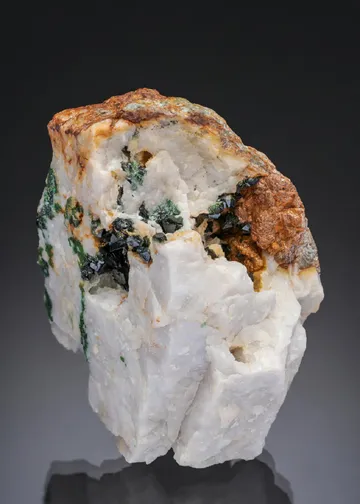
The collector look is unmistakably old European. The best Ľubietová pieces are not flashy in the modern pocket-mining sense; they are compact, intense, and mineralogically eloquent. Libethenite tends to appear as dark olive-green to grass-green pseudo-octahedral or short-prismatic crystals in quartz cavities, on corroded quartz, or with pseudomalachite and malachite crusts. Euchroite, at its best, shows glassy emerald-green crystals on iron-stained matrix from Svätodušná, sometimes large enough to command a cabinet by itself. Pseudomalachite occurs as darker green to bluish-green botryoidal, reniform, fibrous, stalactitic, and crustiform masses, with the finest old pieces showing richly textured surfaces rather than simple paint-like coatings. Quartz is the quiet framework of the locality: milky vein quartz, vugs, druses, corroded cavities, and boxwork-like matrices that gave the copper phosphates and arsenates protected places to crystallize.
Regional View
Country View
The deposits lie in the Western Carpathian setting of central Slovakia, near Banská Bystrica, within the Veporic unit. Podlipa, the most specimen-famous of the fields, sits east of the village on the southern slope of Vysoká above Zelená dolina. The geological contrast between the ore fields is important to collectors because it explains why a label reading “Ľubietová” is not quite enough. A libethenite or pseudomalachite should generally point toward Podlipa and especially the Rainer/Ladislav workings; a good euchroite should usually point toward Svätodušná.


Search for specimens: View all specimens from Ľubietová, Slovakia
Ľubietová is best understood as a small district rather than a single pocket locality. The three principal copper-bearing deposits are Podlipa, Svätodušná, and Kolba. Podlipa lies roughly 1 to 1.5 km east of the village, on the southern slopes of Vysoká, and is the best documented and most collected deposit. Svätodušná and Kolba lie farther east in the Peklo valley system; Kolba, whose name is traditionally connected with cobalt-bearing ores, carries a more pronounced Co-Ni-Cu-Ag signature. The district also has old iron-ore workings and associated slag localities, but those are peripheral to the classic collector suite.
The deposit style is hydrothermal copper mineralization expressed as veins, veinlets, disseminations, and impregnations in Permian metasedimentary rocks and associated crystalline basement rocks of the Veporic unit. At Podlipa, the host rocks include Permian greywackes, arkosic schists, arcoses, shales, and conglomeratic rocks of the Ľubietová group or Predajná Formation. The best-known ore is disseminated and veinlet chalcopyrite in quartz-bearing rock, accompanied by minerals of the tetrahedrite-tennantite series and smaller amounts of pyrite and other accessory sulfides and sulfosalts. Published work on the primary Podlipa ores has recorded chalcopyrite and tennantite as the most abundant sulphides in studied dump material, with cobaltite-gersdorffite, pyrite, siegenite, and cassiterite common but volumetrically minor, and tetrahedrite, kupčíkite, possible matildite, cinnabar, unidentified Ag-S phases, and native gold much scarcer.
The oxidation and cementation zones are the collector engine of the locality. Historical mining appears to have favored these upper enriched zones, where native copper, cuprite, malachite, libethenite, pseudomalachite, and other secondary phases were accessible. At Podlipa, the phosphorus budget generated the copper phosphates: libethenite, pseudomalachite, mrázekite, ludjibaite, reichenbachite, and associated species. At Svätodušná, arsenic in the primary assemblage produced the famous arsenate suite, especially euchroite and olivenite, with rarities including clinoclase, strashimirite, parnauite, cornubite, tyrolite, and others. This split between Podlipa phosphates and Svätodušná arsenates is one of the most useful rules for reading old Ľubietová labels.
The mining history is unusually deep. Archaeological interpretations point to copper extraction in the Bronze Age, when native copper from the upper parts of the ore bodies could have been obtained without true deep mining. The first written reference connected with the area appears in 1340 as “aqua Lybtina,” and Ľubietová was elevated to a free royal mining town in 1379. German mining settlers expanded earlier work, and the district reached its greatest importance in the 15th and 16th centuries, before war, ownership changes, and declining ore fortunes reduced the mines’ significance. The Thurzó-Fugger enterprise of the early 16th century invested in the district but did not obtain the hoped-for results at Ľubietová. Copper mining persisted intermittently; a revival began around 1810 and lasted more than forty years, but copper extraction effectively ended in 1863. Later episodes included exploration in the 1950s and drilling or assessment work in the 1960s and 1970s, along with modern environmental studies of the dump fields and mine drainage.
Podlipa was extensively opened. Historical descriptions record at least 18 adits over elevations from roughly 570 to 700 m, while later summaries and visitor information describe up to 23 galleries and mining fields at the height of mining. Important names for specimen labels include Dreifaltigkeit, Mária Empfängnis or Zahlweiner-Mária Empfängnis, Ján, Rainer, Ladislav, Horný Ladislav, Dolný Ladislav, Jakob, Andreas, and related workings. The Rainer mining field and the Ladislav workings are especially important for collectors because they are repeatedly tied to libethenite, pseudomalachite, malachite, mrázekite, and related Podlipa supergene minerals. A modern geological field stop description records large abandoned mine dumps at Podlipa and emphasizes the locality’s type-mineral status; older topographic mineralogical accounts describe libethenite particularly in the upper parts of the Podlipa dumps, on fractures, on rock surfaces, and on corroded quartz.
Collecting access today is not the same as historical availability. The old adits, dumps, and shafts remain physically present, and some tunnels have been entered by visitors, but publicly available visitor guidance states that mineral collecting is prohibited. The hazards are also real: old workings include unstable adits, collapses, and deep vertical chimneys in the forest. For the collector market, this means legitimate supply is mainly old collections, estate material, exchanged specimens, and previously collected pieces rather than fresh public collecting. Old labels are part of the value here; “Libethen,” “Libetbánya,” “Hungary,” and “Czechoslovakia” can be correct historical label language for classic specimens.
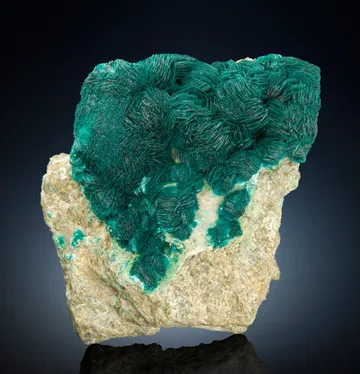
Euchroite is the signature mineral of the arsenate side of Ľubietová, especially Svätodušná, where it occurs in limonitized, quartz-rich mica schist and related oxidized material with olivenite and other copper arsenates. Classic descriptions emphasize its emerald-green color, bright lustre on flat crystal faces, and habits ranging from rhombic domes with parallel striations to thicker tabular or short-prismatic crystals; locality summaries record typical crystals around 1.5–2 cm, while the village’s own mineral account notes exceptionally attractive crystals up to about 4 cm. Fine pieces show individual, well-formed, glassy crystals standing free enough to display symmetry, preferably on contrasting iron-stained matrix or with smaller euchroite druse; ordinary pieces are more commonly thin coatings, incomplete crystals, or green arsenate aggregates where the diagnostic crystal form is lost.
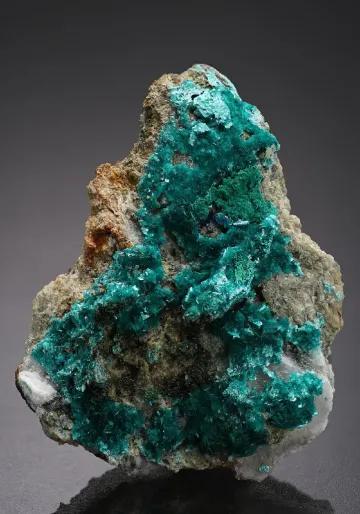
Libethenite is the name-bearing Ľubietová classic, first described from the locality in 1823 and named after Libethen, the old German name of the village; the most important collector material is from the Podlipa deposit and its Rainer/Ladislav sector. At Podlipa it occurs chiefly in the upper parts of the dumps and oxidized workings, on fractures, rock surfaces, corroded quartz, and quartz cavities, commonly with pseudomalachite, malachite, limonite, Fe-Mn oxides, and related copper phosphates. Older descriptions gave typical crystals near 1 mm and rare examples to 2–3 mm, while later work on type-locality material documented pseudo-octahedral to short-prismatic crystals up to 9.5 mm, rare hemispherical radial aggregates up to 11 mm, and uncommon acicular crystals up to 5 mm. The best specimens are sharply crystallized, vitreous, olive- to emerald-green, and set in protected cavities or on pale quartz where the form can be read; average examples are darker crusts, small sparkling druses, or crystals partly smothered by later pseudomalachite or malachite.
Pseudomalachite from Ľubietová is chiefly a Podlipa mineral, though it is also recorded from Svätodušná, and its classic forms are coatings, radial-fibrous aggregates, reniform and botryoidal crusts, earthy masses, cryptocrystalline crusts, and locally bluish-green stalactitic material historically called lunnite. It is commonly intergrown or intimately associated with malachite, brochantite, libethenite, Fe-Mn oxides, and the rarer polymorphs reichenbachite and ludjibaite; this makes precise visual identification difficult on mixed green crusts. Collector-quality pieces are judged less by crystal size than by texture, richness, color, and surface preservation: silky, lustrous, botryoidal or stalactitic crusts with depth and undamaged relief are far better than thin, dull smears. A small 2016–2017 discovery of relatively pure, coarser, gem-quality pseudomalachite from the Ľubietová area produced roughly 200 g of rough and a limited number of cabochons, an unusual lapidary footnote for a locality otherwise prized for cabinet mineral specimens.
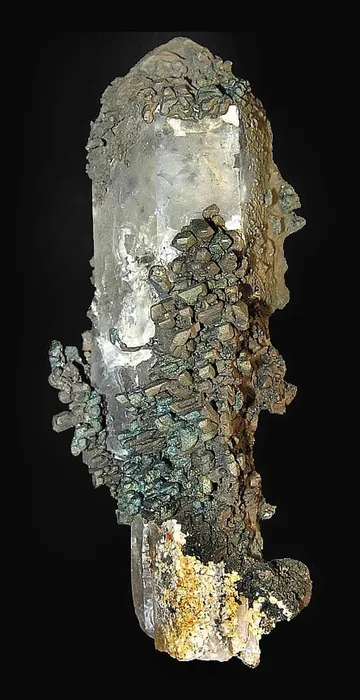
Quartz at Ľubietová is the principal gangue and specimen matrix rather than the headline species, but it is crucial to how the classics present. At Podlipa it forms milky-white vein material with carbonate and sulfide inclusions, massive quartz, corroded quartz surfaces, vugs, boxwork-like cavities, and occasional crystal druses that host libethenite, pseudomalachite, malachite, chalcopyrite, tetrahedrite-tennantite minerals, and Fe-Mn oxides. Good quartz-bearing specimens from the locality are those in which the quartz provides architecture: open cavities lined with green phosphate crystals, pale contrast behind dark libethenite, or porous limonitic quartz preserving the oxidation-zone story. Plain milky vein quartz is common and only becomes collectible when it carries well-developed copper minerals, old provenance, or an unusually attractive druse.
Other documented minerals from the Ľubietová district make the locality much richer than a four-species checklist. Type-locality and historically important species include mrázekite, a pale-blue bismuth copper phosphate from Podlipa’s Rainer mining field named for Zdeněk Mrázek, and euchroite and libethenite as classic 1823 species tied to the district. Podlipa also yields or has yielded malachite, azurite, brochantite, chrysocolla mixtures, langite, kintoreite, native copper, cuprite, goethite, gypsum, ludjibaite, reichenbachite, and rare primary phases identified in modern studies. Svätodušná is the arsenate stronghold, with olivenite, clinoclase, cornubite, cornwallite, parnauite, strashimirite, tyrolite, pharmacosiderite, scorodite, and related species, while Kolba adds the Co-Ni flavor through cobaltite, gersdorffite, erythrite, skutterudite, arsenopyrite, and associated carbonate-sulfide mineralization.
The main authenticity issue with Ľubietová specimens is not usually artificial enhancement; it is locality precision and species identification. Labels may read Libethen, Libetbánya, Hungary, Czechoslovakia, Slovakia, Podlipa, Reinera, Rainer, Ladislav, Svätodušná, or simply Ľubietová. Those names are not interchangeable for serious collecting. A libethenite from “Libethen” is plausible and desirable, but a specimen specifically tied to Podlipa or Rainer is stronger. A euchroite labelled Podlipa deserves scrutiny, because the classic euchroite association is Svätodušná. Conversely, a libethenite or mrázekite label pointing to Svätodušná should be treated cautiously unless there is unusually good documentation.
Mixed green copper minerals are another recurring problem. Pseudomalachite, malachite, chrysocolla-like mixtures, brochantite, and libethenite can be visually confused, and older literature used a thicket of historical names such as ehlite, lunnite, phosphorochalcite, prasin, and “phosphate copper” for material now understood differently. Some old “chrysocolla” from the locality may be mixtures with pseudomalachite, malachite, and brochantite. For higher-value pieces, especially dark green crusts sold as pseudomalachite or tiny crystals sold as libethenite, old labels are helpful but analytical confirmation or a trusted prior collection history is better.
Condition is central. Libethenite crystals are small, brittle-looking, and often perched in cavities or on rough quartz; even excellent specimens may show incomplete crystal edges under magnification. Fine euchroite is vulnerable because isolated crystals stand proud of the matrix, and broken terminations are common enough that a truly sharp, equant, lustrous crystal is a premium feature. Pseudomalachite crusts may bruise, dull, or lose botryoidal high points. Much matrix is iron-stained, porous, limonitic, or crumbly, so avoid unnecessary washing, ultrasonic cleaning, acids, and aggressive mechanical trimming. Arsenate-bearing specimens from Svätodušná, especially euchroite and olivenite associations, should be handled with normal mineral-collection hygiene: keep dust out of the air, do not grind or saw casually, and wash hands after handling.
Market availability is steady but selective. Small libethenite specimens from old European collections appear from time to time, while large, aesthetic, richly crystallized type-locality examples remain strongly contested. Good euchroite is scarcer and more expensive, especially pieces with a prominent crystal rather than mere druse or coatings. Pseudomalachite is available in a wider range, but attractive, undamaged, old, well-provenanced Ľubietová examples are still far from common. Modern public collecting should not be considered a legitimate source; buy from documented collections, dealers who understand the old locality names, and sellers willing to show the matrix, close-up crystal surfaces, and all labels.
One of the small pleasures of Ľubietová is that its mineral names preserve the political map of an older Europe. A cabinet specimen may carry “Libethen” in a fine nineteenth-century hand, “Libetbánya” on a Hungarian-era label, “Czechoslovakia” on a twentieth-century dealer tag, and “Slovakia” in a modern catalogue. The mineral libethenite itself is a label made permanent: August Breithaupt named it in 1823 for Libethen, and collectors have been reading that old name ever since. When a classic libethenite has a convincing early label, the paper is not an accessory; it is part of the specimen.
Podlipa still reads like a mined landscape. The old descriptions do not describe a neat single shaft but a hillside opened again and again: Dreifaltigkeit at the lower levels, Mária Empfängnis, Ján, Rainer, Ladislav, Andreas, Jakob, and other adits and fields distributed across the slope. A later locality account describes at least 23 adits and mining fields, with old workings ranging from the lower Dreifaltigkeit adit up toward the higher Ladislav levels. The names are not romantic inventions. They are the coordinates of collector memory: Rainer for mrázekite and phosphate rarities, Ladislav for native copper and later searchers, Jakob for langite, and the Ján adits in Zelená voda for accessible but partly collapsed old workings.
The human story of mrázekite is particularly poignant. The mineral was found at Podlipa in the Rainer mining field by the young Czech mineralogist Zdeněk Mrázek and described as a new species in 1992, after his death. The crystals are not large in the theatrical sense—pale-blue acicular or tabular crystals to about 5 mm—but their color and rarity make them unforgettable under the microscope. In a district dominated by green copper minerals, the appearance of a blue bismuth copper phosphate in the old Podlipa workings was a reminder that even a heavily collected European locality could still produce a new mineral species in the late twentieth century.
The 2016–2017 gem pseudomalachite episode is a modern coda to an old collecting district. Pseudomalachite at Ľubietová had long been known as crusts on quartz and limonite, material for specimens and occasional local lapidary use. Then a small amount of unusually pure, coarser pseudomalachite was recovered from the Ľubietová area. After separation from host rock, only about 200 g of rough remained. From that, researchers polished 15 high-quality cabochons ranging from 13.33 × 10.74 mm to 20.61 × 15.56 mm, plus a few dozen lower-quality stones. The cabochons looked greenish blue in daylight and green in incandescent light—an unexpected gemological face for a locality most collectors know through tiny libethenite crystals and old mine labels.
The old workings also have a more sobering modern story. Visitor accounts and regional tourism pages note that some adits can still be entered, but the same descriptions warn of unstable old tunnels and deep vertical chimneys hidden in the surrounding forest. Ľubietová is not a casual rock pile; it is a centuries-old mining landscape. The surviving specimens are best appreciated with that in mind: every fine crystal grew in a zone that miners first pursued for ore, later collectors pursued for beauty, and modern geologists now study for the behavior of copper, arsenic, antimony, iron, manganese, and mine drainage in an abandoned mining environment.