Balcoll Mine, Spain — historic epithermal locality yielding native silver with calcite gangue and acanthite; prized for skeletal, dendritic formations.
Key facts
Balcoll is the small Spanish silver mine that punches far above its size. It lies near Falset, in the Priorat mining basin of southern Catalonia, among the historic Bellmunt–El Molar–Falset vein deposits. Unlike the better-known neighboring Priorat mines, whose collector fame rests largely on galena, cerussite, siderite, dolomite and classic lead-zinc assemblages, Balcoll is remembered for native silver: bright, wiry to dendritic aggregates on white calcite and carbonate gangue, commonly with black acanthite. The geology is a compact but elegant epithermal story. Hydrothermal veins cut the Paleozoic basement—principally Carboniferous slate with quartzitic and pelitic laminae, affected regionally by the Carboniferous–Permian intrusive and contact-metamorphic history of the Catalan Coastal Ranges. Modern petrographic work describes the ore as an epigenetic, intermediate-sulfidation vein system in which silver and silver sulfides occupy pore spaces among earlier carbonates and intergrow with calcite.
The mine’s historical importance is equally strong. Silver extraction around Falset is documented from the 14th century, and the modern Balcoll concession appears to have rediscovered an older silver-working ground. At the beginning of the 20th century, the mine drew serious financial attention after a silver-rich vein was exposed in the number 2 shaft area. The best collector specimens, however, are modern recoveries from old mine material: skeletal silver crystals, filaments, herringbone sprays and arborescent growths liberated from carbonate blocks on the dumps. Good pieces have a distinctive Balcoll look—silvery-white to lightly bronzed metal crawling over or through massive snow-white calcite, punctuated by matte to lustrous black acanthite. The finest examples are airy and sculptural, not merely metallic smears in carbonate.
Regional View
Country View
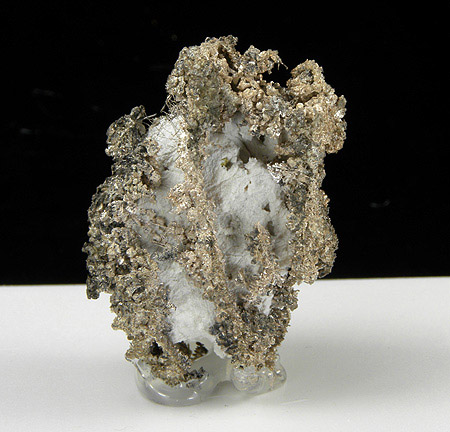
Photo: Wikimedia Commons
The specimen photographs that circulated internationally in the late 2000s made Balcoll familiar to many collectors who had never handled a Catalan silver. They show a miniature scale that is typical for the locality but visually forceful: dozens of small, bright, elongated silver crystals standing out against pale calcite. Balcoll’s appeal is not the huge rope silver of Kongsberg or the dramatic curls of Batopilas; it is the close-textured, crystallographically interesting native silver of a small Iberian vein, with a history that runs from medieval counts and Sardinian miners to 20th-century concession papers and late-20th-century dump discoveries.
Search for specimens: View all specimens from Balcoll Mine, Spain
Balcoll is situated between Falset and Bellmunt del Priorat in Tarragona, Catalonia, within the Priorat mining basin. The broader district is built on a Paleozoic basement of Carboniferous slates, sandstones and quartzites, intruded during the Carboniferous–Permian by granitoids and porphyry dikes. These intrusions and the later fracture pattern of the Hercynian basement provided the structural and thermal framework for the ore veins. The Balcoll mineralization is best described as hydrothermal vein mineralization along fractures, epigenetic in relation to the host rock, and comparable in style to the low-temperature vein systems of the Catalan Coastal Ranges. Recent academic work places it in an intermediate-sulfidation epithermal setting, with silver transported in sulfur complexes and precipitated during pressure decrease and/or mixing of hydrothermal and meteoric fluids.
The host rock at Balcoll is a dark Carboniferous slate with millimetric alternations of quartzitic and pelitic levels. Petrographic study records quartz, biotite, K-feldspar and kaolinite as principal components, with minor galena and pyrite and rarer titanium oxides, rutile, ilmenite and monazite-family rare-earth phosphate-silicate phases in the country rock. The vein material is carbonate-rich. Dolomite-ankerite is the dominant gangue, with calcite filling intercrystalline porosity and intergrown with silver; quartz occurs in several generations, including an early vein-opening quartz, a later pore-filling quartz and a final silicification episode. Barite, chamosite and adularia are also part of the Balcoll vein assemblage as documented in modern work.
The underground layout is small but quite complex for such a modest mine. A recent reconstruction from old mine plans identifies three shafts with horizontal exploration and exploitation galleries at several levels. In that model, shaft number 1 is 22 metres deep, shaft number 2 is 59 metres deep, and shaft number 3 is 92 metres deep. The mine exploited three silver-bearing veins: two roughly N-S, subvertical veins about 60 and 70 metres long, and a third E-W vein interpreted as subhorizontal and about 165 metres long. Surface dump material studied from the mine is mostly country rock, with roughly a fifth vein material; among the vein pieces, carbonates dominate.
Historically, silver working in the Falset area is documented from 1324 onward, under the Counts of the Mountains of Prades and the lords of the Barony of Entença. In the 14th century, the silver industry was sufficiently important that Pere de Prades ordered the accommodation of 100 skilled Sardinian mining masters from Iglesias, Sardinia, at Falset in 1344. The medieval silver mining appears to have faded by the end of the 14th century, after which the mine disappears from the documentary record until the early 20th century.
The modern Balcoll concession was granted to Pedro, or Pere, Coll i Rigau in 1904. Coll initially held a lead-mining concession, but the site’s true significance was its silver. In late 1905 and early 1906, work to reopen and examine the partially blocked number 2 shaft exposed a silver-rich vein associated with carbonates. Contemporary descriptions cited by later writers give the vein an irregular thickness of roughly 20 to 50 centimetres, a steadier width of about 3.5 metres, and a length of nearly 50 metres. Analyses of eight samples reportedly ranged from 3 to 30 percent silver, averaging 12.427 percent—figures that explain why the find drew immediate attention.
On May 12, 1906, Coll signed an option agreement with the Banque de Paris et des Pays-Bas for exploitation of the silver mine. The bank placed an engineer, recorded by Joan Abella as Mr. Otinie, in charge of the work and sank a shaft parallel to the number 2 shaft to about 31 metres. Chambers were opened along the vein, especially between about 5 and 10 metres depth. This was the short-lived period in which important crystallized silver specimens were reportedly recovered, including pieces that entered major Catalan collections such as the Joaquim Folch i Girona collection. In 1907, however, the bank declined to exercise the purchase option. The reasons given in the literature include the apparent exhaustion of the rich silver shoot with depth, persistent water problems in the lower workings, poor economics for dewatering, transport costs, and the unfavorable international silver market.
The mine is not an underground collecting locality today. Published field descriptions note that the workings are inaccessible and partly flooded, with the lower works of shaft number 2 commonly inundated. Shaft number 2 is fenced, shaft number 3 retains remnants of surface installations including a chimney and accessory building, and the underground chambers have even served as a water reserve for cultivation on the property. The ground has been described as private, associated with Joan Abella i Creus in recent academic work. Any collecting should therefore be assumed to require explicit permission, and serious collectors should treat all underground entry as off limits unless formally authorized and professionally managed.
The notable specimen finds are principally dump recoveries from old material, especially around the number 2 shaft. Joan Abella began studying the mine in 1993 and later reported recovering numerous silver specimens from exterior material after years of historical and field work. Dealer and museum records point to important recoveries around 1998–1999 and again around 2004–2006, with some pieces liberated from calcite/dolomite blocks. These finds are the source of most Balcoll silver specimens on the modern market: miniature to small-cabinet examples, typically native silver with acanthite on calcite, with occasional larger and very rich pieces.
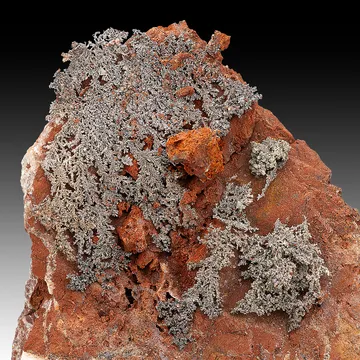
Native silver is the signature mineral of Balcoll and occurs as brilliant white to lightly bronzed, elongated skeletal crystals, filiform aggregates, dendrites, arborescent sprays, “herringbone” growths and rarer laminar or fissure-grown plates in carbonate gangue. The silver is commonly associated with massive white calcite and dolomite-ankerite, and it may be partly coated or accompanied by darker acanthite; modern microscopic work shows silver filling intercrystalline porosity in dolomite and intergrown with calcite. Most collector specimens are thumbnails to miniatures and small cabinets, but published dealer records include pieces around 5 to 8 cm across, uncommon larger examples exceeding 15 cm, and one very rich piece over 20 cm associated with the Jordi Povill collection. What separates a good Balcoll silver from an ordinary one is definition and openness: crisp skeletal or dendritic crystals, bright untarnished metal, visible three-dimensional growth, strong contrast against white calcite, and honest provenance to the late-20th-century dump recoveries or early 1900s mine material rather than a featureless acid-etched metallic patch.
Calcite at Balcoll is not a showy cabinet species in the usual sense; it is the crucial white to colorless carbonate stage that gives the silver specimens their contrast and structure. In the vein, calcite occurs as centimetric, generally anhedral material filling porosity among earlier dolomite-ankerite and locally intergrown with native silver, and most marketed Balcoll classics show silver on, in, or etched from massive white calcite. Several dealer records describe the calcite matrix as having been acidified to expose the silver, an accepted but important point for collectors because naturally open fissure pieces are less common and more desirable when the silver is already exposed without etching. Shortwave UV fluorescence has also been reported for calcite on some Balcoll silver-acanthite pieces, usually as a secondary interest rather than the reason to acquire the specimen.
Beyond silver and calcite, Balcoll is mineralogically richer than its small size suggests. Acanthite is the most important associate, occurring as dark coatings, small aggregates, deformed octahedral to cubo-octahedral crystals and silver-sulfide masses; well-formed acanthite crystals are considered rare for the locality. The documented assemblage also includes dolomite, ankerite, quartz, galena, pyrite, chalcopyrite, sphalerite, marcasite, siderite, goethite, chlorargyrite, pyrargyrite, stephanite, xanthoconite, native bismuth, arsenopyrite, nickeline, breithauptite, gersdorffite, millerite, molybdenite, pyrrhotite, annabergite, népouite, aurichalcite, linarite, mottramite, fluorite, orthoclase and synchysite-(Ce). Recent petrographic work is especially notable for recording sternbergite, argentopentlandite, barite, chamosite and adularia as newly described from the Balcoll mineralization in that study.
Balcoll silver is a locality where provenance matters. Most modern specimens trace to old dump material recovered during the late 1990s and early 2000s, particularly from the number 2 shaft area, with dealer labels often recording Pou 2, Falset, Priorat, Tarragona, Catalonia. Pieces with older Spanish or Catalan collection labels—Jordi Povill, J.M. Manchion, Joaquim Folch-associated material, or well-documented Fabre/Rosell/MTI provenance—carry extra weight because Balcoll is a small locality and better pieces are now hard to replace.
The main treatment issue is acid preparation. Many Balcoll silvers were enclosed or partly enclosed in massive calcite or dolomite-calcite gangue and were exposed with hydrochloric acid. That is not necessarily deceptive; it is a common preparation style for the locality and is openly stated on some dealer records. Still, collectors should distinguish between naturally open fissure plates and acid-liberated silver. Acid-prepared pieces may show etched, softened or recessed white carbonate, undercut metal, and silver standing proud from a dissolved matrix. A well-prepared Balcoll piece retains crisp silver growth and enough matrix to show context; an over-etched one can look unnaturally “floating,” fragile or visually thin.
Authenticity questions around wire silver deserve a precise warning. Balcoll acanthite has been used in discussions and demonstrations of anthropogenic silver growth from silver sulfides, and artificial wire silver is a known problem in the broader silver-specimen market. That does not make Balcoll silver generally suspect, but it means Balcoll pieces should be judged by locality-consistent morphology, old labels, matrix, associated acanthite and calcite, and preparation history. Be cautious of loose “Spanish wire silver” without matrix, implausibly fresh wires on unrelated gangue, or specimens lacking any credible chain of ownership.
Condition is usually the limiting factor. Native silver is soft, easily bent and vulnerable to abrasion; Balcoll’s best forms are made of small skeletal, dendritic and filiform aggregates that can be crushed or rubbed down. Acanthite coatings and crystals are brittle and may detach from the silver or carbonate. Silver may naturally tarnish to gray, bronze or black, and attempts to brighten it with dips or polish can destroy the surface, remove desirable patina, loosen acanthite and leave an overcleaned appearance. Handle Balcoll silver by the matrix, avoid repeated touching of the metal, store it dry, and keep it away from sulfur-bearing storage materials.
Market availability is limited. Balcoll specimens appeared in meaningful numbers after the 1998–1999 dump recoveries and the early- to mid-2000s finds, but recent offerings tend to be individual resale pieces rather than fresh production. Ordinary miniatures with modest silver and calcite appear occasionally; rich, bright, highly sculptural examples with strong acanthite contrast and old provenance are significantly scarcer. Larger pieces are genuinely uncommon and should be assessed carefully for preparation, repairs, stability and whether the silver is aesthetically distributed rather than merely heavy.
Balcoll’s story begins not with a modern headframe but with a medieval silver rush in the hills around Falset. In 1324 the County of Prades was created, and within its lands silver mining became a source of first-rank wealth. The work expanded during the reign of Pere IV “the Ceremonious,” from 1336 to 1387. The most vivid detail comes from 1344, when Pere de Prades ordered accommodation in Falset for 100 master miners from Iglesias, Sardinia. They were not casual laborers; they were imported specialists from one of the great Mediterranean silver-mining traditions, brought to Catalonia because the local silver needed skilled hands.
The medieval mining economy had its own ritual. The miner carried the ore—the “mena”—to the house of ores in Falset castle. There he deposited his production in a cabinet to which only he held the key. It waited there until he met with the administrator and the assayer, who valued his share of the business. For a collector holding a Balcoll silver today, that detail gives the specimen a second life: the same hills that yielded dendritic silver to modern collectors once fed a castle-based accounting system of ore, keys and assays.
Then the mine vanished from history for centuries. The silver of Balcoll seems to have slept through roughly five hundred years of neglect, until a very different kind of figure arrived: Pere Coll i Rigau. Coll was born on March 7, 1854 at Torre Ponça, near Torroella de Montgrí. At twelve he entered a notary’s office; in 1867 he left Barcelona by schooner for Cuba. In Havana he eventually built a match factory and made a fortune, returning to Catalonia at forty-four. He was also, famously, a man of stubborn legal and political energy. Before Balcoll, he fought a feudal right in Torroella de Montgrí—a medieval burden on land transactions—and the count renounced the rights publicly on September 21, 1901.
On December 9, 1903, Coll applied for 61 mining claims under the name Balcoll in the Les Pinyanes area of Falset. When the engineer Narciso de Mir demarcated the ground on March 7–8, 1904, only 35 claims could be granted because 26 overlapped earlier concessions. The plan was drawn on March 18, and the title to the Balcoll mine was granted on May 27, 1904. A demasía, or leftover irregular ground between concessions, followed in 1905. The concession was formally for lead ore, but Balcoll was never one of the great galena producers of the Priorat. Coll’s real quarry was the old silver.
The rediscovery came in late 1905 and early 1906, when work began to clear and examine shaft number 2, partly blocked and perhaps untouched for centuries. At only about six metres below the shaft mouth, workers encountered a handsome silver vein in carbonate. The dimensions were enough to excite any operator: irregularly 20 to 50 centimetres thick, about 3.5 metres wide, and nearly 50 metres long. Eight samples were analyzed; the reported silver contents ranged from 3 to 30 percent and averaged 12.427 percent. Joan Abella later calculated the contained silver at around 80 tonnes, a figure that explains why the find could set imaginations racing.
One story, transmitted orally by the great collector Joaquim Folch, is impossible to prove but too memorable to ignore. The first shipment of Balcoll ore was said to have gone by train to France with so much silver that news of it halted the silver quotation on the Paris exchange for fear of a sudden price drop. Abella was careful to say he could neither confirm nor deny it, but the story captures the atmosphere around Balcoll in 1906: a tiny Catalan mine suddenly spoken of in the same breath as Paris finance.
The finance arrived quickly. On May 12, 1906, Pere Coll i Rigau and the Banque de Paris et des Pays-Bas signed an option contract before the notary Joaquim Martí i Gironés. The price was 100,000 French francs. The bank had the right to excavate, test and examine the ground and minerals, and it installed an engineer, Mr. Otinie, to direct the work. A new shaft was sunk parallel to shaft number 2 to a depth of 31 metres, and exploitation chambers were opened along the silver vein, especially between 5 and 10 metres depth. This is the period to which the finest old crystallized silvers are tied.
The end came with the same abruptness as the discovery. The rich shoot apparently faded as work deepened. Water was a constant enemy; the lower workings of shaft number 2 lay below the local water table and flooded easily. Dewatering would have cut heavily into profit. Transport was another burden: ore had to go by cart to the Falset-Marçà station, then by train to Tarragona, then by ship toward France and onward to the smelter. Meanwhile the world silver market was under pressure from great North American production, including the famous Comstock Lode and the rising Cobalt district of Ontario. On June 17, 1907, the Banque de Paris et des Pays-Bas declined the purchase option. Balcoll’s modern silver boom had lasted barely a year.
The collector chapter began much later. By the late 20th century, the existence of fine silver at Balcoll had become almost legendary. Joan Abella began studying the mine in 1993, combining archival research with patient field recognition. From 1998 onward he recovered, always from exterior material, a series of crystallized silver specimens that he considered among the finest found in contemporary Spain. Some later specimens came from calcite/dolomite blocks on the dumps; when carefully treated, those blocks revealed wires, elongated skeletal crystals and herringbone aggregates of native silver. For collectors, that is the modern miracle of Balcoll: not a newly blasted pocket, but old mine stone reluctantly giving back silver after a century in the dumps.