Almadén Mine, Spain - premier mercury locality known for blood-red cinnabar crystals, historic mercury ore deposits, and iconic matrix specimens.
Key facts
Almadén is the mercury locality against which all others are measured. For collectors, its importance is not simply that it produced cinnabar; it is that it produced cinnabar from the largest and most historically consequential mercury orebody on Earth, in a geological setting so distinctive that “Almadén-type” mercury mineralization has long been used as a deposit model. The mine sits in the Almadén syncline of Ciudad Real, Castile-La Mancha, where Lower Silurian Criadero Quartzite on the steep southern limb of the structure carries cinnabar-rich beds cut and complicated by Variscan deformation and by the basaltic, explosive-volcanic “Roca Frailesca.” The ore is overwhelmingly mercury: cinnabar, native mercury, metacinnabar, pyrite and quartz, with dolomite, calcite, baryte and secondary mercury compounds adding the mineralogical embroidery that collectors notice on better pieces.
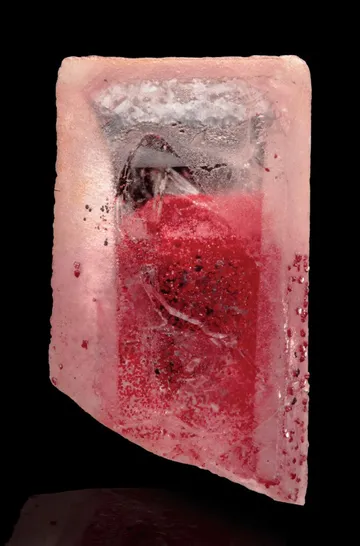
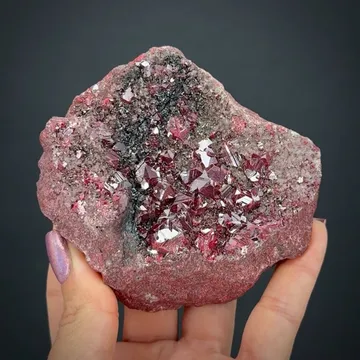
The classic specimens are compact but unforgettable: blood-red to cherry-red cinnabar crystals and crystalline crusts in dark quartzite, gray quartz, white calcite, or pale dolomite, often with a wet adamantine to submetallic sparkle. The best Almadén pieces are not usually giant single crystals; they are balanced, old-time matrix specimens with sharp rhombohedral or tabular cinnabar crystals, translucency at the edges, and the unmistakable contrast of bright red HgS against black or white gangue. Some pieces carry minute globules of native mercury, a locality association that turns a mineral specimen into a miniature lesson in ore chemistry.
Regional View
Country View
The mine’s collecting identity is inseparable from its history. Almadén’s mercury fed ancient pigment trade, medieval and early-modern metallurgy, and, after Bartolomé de Medina’s 1555 patio process, the silver economy of Spanish America. Modern geological studies place the ore in three mineralized levels of the Criadero Quartzite, and production is commonly given at roughly seven million flasks, or more than 240,000 tonnes of mercury metal. That figure is why even a small labeled Almadén cinnabar carries unusual historical weight: it represents a locality that supplied about a third of the mercury used by humanity.

Photo: Wikimedia Commons / Rob Lavinsky, iRocks.com
Search for specimens: View all specimens from Almadén Mine, Spain
Almadén Mine lies at Almadén, in the province of Ciudad Real, Castile-La Mancha, southwestern central Spain. The mine is part of the Almadén mercury district, a compact but extraordinary cluster of Hg deposits developed in Paleozoic rocks of the Almadén syncline. The main ore host at the mine is the Criadero Quartzite, a Lower Silurian quartzite unit exposed on the southern, nearly vertical limb of the syncline and striking roughly east-west through the mine area. The orebody is stratabound rather than a conventional open-space vein deposit: cinnabar impregnates the quartzite and fills joints and fractures within particular beds, with local remobilization along structures.
The classic mine geology is organized around three principal mineralized beds within the Criadero Quartzite. The lower ore level is traditionally called the San Pedro or San Diego bed, hosted in the lower quartzite interval. The two upper ore levels are the San Francisco and San Nicolás beds, situated in the upper part of the Criadero Quartzite. Geological descriptions distinguish between cinnabar impregnating the rock’s primary porosity, especially in the San Pedro bed, and cinnabar sealing later fissures and joints, more common in the San Francisco and San Nicolás beds. In the district as a whole, a second mineralization style consists of cinnabar filling veins and replacing volcanic rocks, especially in carbonatized volcanic bodies; this stockwork style is better represented by other Almadén-district deposits such as Las Cuevas and Nueva Concepción, but it is essential context for understanding the district’s specimen assemblage.
The “Roca Frailesca” is one of the signatures of Almadén geology. It is a peculiar basaltic diatreme or explosive volcanic tuff-breccia unit, with ultramafic fragments, black slate and quartzite clasts, and strong carbonate-sericite alteration. Its relationship to the ore has been central to arguments over Almadén’s genesis. Older models emphasized preconcentration of mercury in the Paleozoic marine basin; later interpretations give greater weight to intraplate mafic magmatism, deep crustal fractures, volatile release, and submarine hydrothermal activity. For the collector, the practical result is a mineral assemblage that is narrow in economic metals but rich in textural variety: red cinnabar as disseminations, crystal crusts, veins and replacements; gray to colorless quartz; white calcite and dolomite; baryte in uncommon but important associations; pyrite and other sulfides in small amounts; native mercury in droplets or inclusions; and a suite of rare secondary mercury minerals in the wider district and in calcines.
Mining followed the three-dimensional complexity imposed by folding and faulting. The deposit was worked along a maximum strike length of about 500 m and to depths of roughly 600 m. The mine infrastructure eventually included major shafts such as San Teodoro and San Joaquín, along with auxiliary ventilation shafts including San Miguel, San Aquilino and Robbins. San Teodoro was for a long period the principal shaft, eventually reaching the nineteenth level; San Joaquín, begun in the early 1970s and reaching the twenty-seventh level, later became the main shaft for deeper western workings. Geological work divided the deposit into zones from east to west known as Rama Mina, de los Masivos, and Rama Sur. The richest San Pedro ore was associated with the Rama Mina zone, while the richest San Francisco and San Nicolás mineralization was concentrated in de los Masivos and Rama Sur.
The mine’s history is unusually long. Cinnabar from the area was known in antiquity, prized first for vermilion pigment and later for mercury metal. Under Islamic rule the place acquired the name Almadén, derived from Arabic words meaning the mine or mineral place. In the early modern period the deposit became a strategic asset of the Spanish Crown. Control of mercury meant control of silver amalgamation, and mercury from Almadén became one of the silent engines of New World silver production after the mid-sixteenth century. Administration passed through royal, leased and state structures, including the long and notorious involvement of the Fugger bankers, later state administration, and, in the modern era, Minas de Almadén y Arrayanes S.A. The company MAYASA was created in 1982 and later became part of SEPI, Spain’s state industrial holding group.
Modern mercury mining at Almadén ended at the beginning of the twenty-first century. Official Spanish environmental accounts record that cinnabar extraction ceased in 2001, metallurgical activity ceased in 2003, and commercial sale of remaining mercury ended before 15 March 2011 under European Union mercury restrictions. The mine and metallurgical complex were subsequently transformed into the Parque Minero de Almadén. Today the site is a protected industrial-heritage and World Heritage landscape rather than an active collecting ground. Serious collectors should assume that new collecting from the mine workings or park is not a practical or lawful source of specimens; the market is fed by older mine production, historic Spanish and European collections, dealer stock, and occasional deaccessioned or recycled material with old labels.
Most attractive collector specimens trace to historic underground workings rather than to modern surface collecting. Dealer and collection records repeatedly identify the San Teodoro shaft as a source for notable pieces, particularly cinnabar with calcite, quartz, dolomite, baryte, and native mercury. The Folch Collection preserved San Teodoro specimens from 1923, the early 1970s and around 1979–1980, including vug specimens with cinnabar and dolomite, cinnabar with honey-colored baryte on black quartzite, and bright crystals on quartz. More recent documented collector specimens describe Almadén crystals from the 1960s and 1970s with main cinnabar crystals around 0.6 to 1.2 cm; exceptional examples are valued for sharpness, transparency, intense red color, high luster, matrix contrast, and intact old provenance.
Cinnabar from Almadén Mine is the locality’s defining collector mineral and occurs as massive ore, granular to crystalline crusts, fissure fillings, and sharp rhombohedral to tabular crystals in cavities and on quartzite matrix. The color ranges from dark wine-red and cochineal red in massive ore to vivid cherry-red and blood-red in the best crystals, with fine pieces showing high luster, edge translucency, and strong contrast against black quartzite, gray quartz, white calcite, or pale dolomite. Most collectable crystals are small by world standards—commonly a few millimetres, with notable cabinet pieces carrying crystals around 0.5–1.2 cm—but the locality’s finest specimens compensate with color, historical stature, and association with native mercury droplets. San Teodoro shaft labels are especially desirable, and good pieces are separated from ordinary ore by crystal definition, brightness, undamaged faces, attractive matrix, and credible old provenance rather than by sheer size.
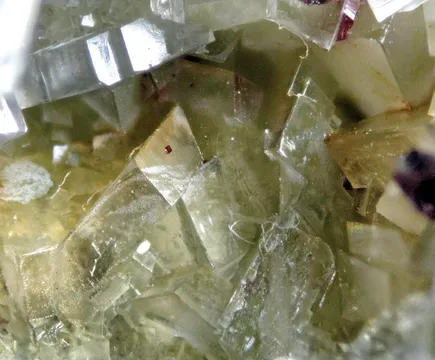
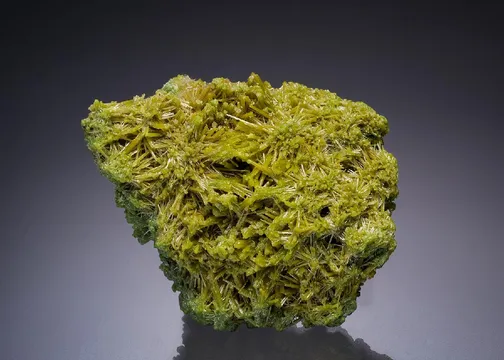
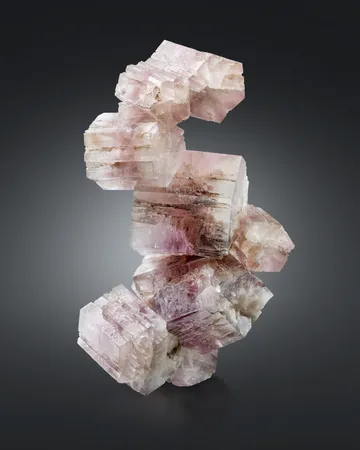
Other minerals documented from Almadén Mine and its immediate sublocalities include native mercury, metacinnabar, pyrite, quartz, dolomite, calcite, baryte, ankerite, siderite, sphalerite, chalcopyrite, galena, jarosite, gypsum, dickite, kaolinite, pyrophyllite, rectorite, graphite, greenockite, marcasite, millerite, pyrrhotite, ilmenite, titanite and zircon. Calomel is the most historically resonant secondary mercury chloride associated with the heritage setting of Almadén, but collectors should treat old “calomel” labels cautiously unless supported by analysis; one well-documented Folch Collection example originally labeled as calomelanos in a geode proved analytically to be dolomite. Among the true rarities, gianellaite and schuetteite are particularly interesting mercury-bearing secondary minerals recorded from Almadén material, and the broader Almadén district adds further rare Hg, Ni, Co and Cu species from related deposits such as El Entredicho and Las Cuevas.
The first collecting issue with Almadén is provenance. “Almadén” is sometimes used broadly for the mine, the town, the district, or even for Spanish cinnabar of uncertain origin, and it is easily confused in casual labeling with New Almaden in California. Mine-level labels, shaft names such as San Teodoro, old dealer cards, Folch, Sanabria, Gaspar Sintes, Bosch, Smithsonian or similar collection history, and a consistent chain of ownership matter. A small but well-labeled San Teodoro cinnabar may be more desirable than a larger unlabeled red ore piece sold only as “Spain.”
No sophisticated Almadén-specific fake-crystal industry is widely documented in the mineral literature, but mislabeling, over-broad district attribution, and mistaken secondary-mineral identifications are real concerns. Calomel, dolomite, baryte, calcite, and yellowish secondary coatings deserve special care because old labels may preserve historical names or assumptions rather than analytical identifications. Decorative “cinnabar” carvings, beads and boxes are another unrelated source of confusion: many are lacquer, resin, dyed material, or reconstituted decorative products and should not be compared to natural HgS mineral specimens from Almadén.
Condition matters greatly. Cinnabar is relatively soft and dense, and its luster can be dulled by abrasion, careless cleaning, dust, or handling. Fine Almadén crystals are commonly small, so a single bruised edge or rubbed face can noticeably reduce quality. Matrix pieces may include crumbly quartzite, calcite or dolomite coatings, and fragile tiny mercury droplets; avoid washing, ultrasonic cleaning, acids, heat, polishing, or aggressive brushing. Bright, isolated crystals should be protected from contact with foam that can snag, from loose perky boxes that allow rattling, and from high-heat lighting.
Almadén specimens should be treated as toxic mineral specimens. Cinnabar is mercury sulfide, and some pieces carry native mercury droplets or mercury-rich secondary compounds; the greatest practical risks for collectors are dust, abrasion, ingestion, and mercury vapor from native mercury or contaminated material in enclosed spaces. Handle minimally, wash hands afterward, keep specimens out of reach of children, do not wear or carve them, do not store them with food or jewelry, and keep mercury-bearing pieces in stable, sealed display boxes or cabinets. Avoid heating, drilling, grinding or trimming, and never try to “brighten” a specimen with chemicals.
Market availability is uneven. Massive cinnabar ore from Almadén is obtainable, but fine crystallized specimens with vivid red color, matrix, native mercury association, and old labels are much scarcer. The mine’s closure and protected status mean that essentially all legitimate supply is old stock. Desirable cabinet pieces are Spanish classics, and top examples are valued as much for locality significance and label quality as for aesthetics.
In the ancient world, Almadén’s red mineral was a pigment before it was a commodity of global finance. Cinnabar from this part of Spain was ground into vermilion, a color vivid enough to travel through Roman memory and medieval trade. The later story of mercury metal is darker and larger: once mercury became essential to silver amalgamation, the red ore under Almadén was no longer merely beautiful. It became strategic.
The hinge year was 1555, when Bartolomé de Medina’s patio process made mercury indispensable to the refining of silver ores in the Spanish Americas. A small town in La Mancha was suddenly tied to Potosí, Zacatecas and the imperial treasury. Almadén’s ore no longer ended at a furnace mouth in Spain; it became a reagent in an intercontinental system. The collector holding a cinnabar crystal from Almadén is holding the mineralogical beginning of a chain that helped move silver across oceans.
The most vivid human record comes from the age of forced labor. In 1566, after production demands rose and free labor was not enough, convicts began to be sent to the mine. By 1593 the complaints were serious enough that the Crown sent Mateo Alemán, later famous as the author of Guzmán de Alfarache, as a royal investigator. He arrived not as a novelist but as a judge-visitor, charged with interviewing prisoners, guards and officials and discovering what was really happening in the mercury works.
The details of the inquiry are unnerving because they are so exact. The forzados were not simply abandoned animals; the system accounted for them in rations and garments. Each man received meat, bread and wine, and annual clothing that could include a doublet, breeches, stockings, shirts, shoes and a hood. There was an infirmary and even an apothecary. On paper, that sounds almost orderly. Underground and at the furnaces, it was a different arithmetic: nearly a quarter of the convicts sent between 1566 and 1593 died before their release dates, with mercury poisoning a principal cause.
One task described in later accounts of the investigation has the starkness of punishment stripped to motion. Four men could be required to bail 300 buckets of water without rest. If they failed, they could be whipped. Sickness did not necessarily save them from the quota. It is a scene far from the sparkling red crystals in a collector’s case: men counting buckets in the dark so the mine could stay dry enough for the ore to be cut.
Alemán’s investigation also collided with power. The mine was tied to the Fugger bankers, who were deeply enmeshed in Crown finance. Accounts of the episode describe resistance from Fugger representatives and a sudden order from the Council of Orders telling Alemán to stop his work “without delay.” The report survived as an uncomfortable document: part administrative inquiry, part testimony, part human inventory of a mine whose metal mattered too much to the state.
The eighteenth century added its own grim chapter. A major fire in 1755 shaped both the physical and penal history of the mine, and forced labor continued in one form or another for more than two centuries before the mine sentence was abolished by Royal Order of 22 May 1799. The following year the prison population was transferred to Ceuta. By then, the mine had already accumulated layers of memory: Roman pigment, Islamic naming, royal monopoly, German finance, convict labor, technical innovation, and the slow professionalization of mining.
Almadén also became a place of mining science and medicine. The Real Hospital de Mineros de San Rafael stands as a reminder that mercury’s dangers were not abstract. José Parés y Franqués, a physician associated with the mines in the late eighteenth century, wrote on occupational illness among mercury miners, making Almadén part of the early history of industrial health as well as mineral extraction. The same place that gave collectors luminous cinnabar also forced physicians, engineers and administrators to confront tremor, salivation, weakness, and the neurological effects of mercury exposure.
In 1941, just after the Spanish Civil War, Almadén reached a record production of about 82,000 flasks of mercury. That number belongs to the industrial history of the mine, but it is also a collector’s warning against romanticizing the locality. The beautiful red crystals came from an operation of enormous scale, depth and consequence. By the time mining ended in the twenty-first century and the Parque Minero de Almadén opened the preserved workings to visitors, the mine had become something rare: a world-class mineral locality, an industrial monument, and a moral archive in the same underground space.
Mindat locality record: Almadén Mine, Almadén, Ciudad Real, Castile-La Mancha, Spain — Collector-oriented locality page with coordinates, sublocalities, references, mineral list, and documented occurrences for the mine.
Mindat occurrence record: Cinnabar from Almadén Mine — Species-specific occurrence page listing cinnabar as very common at the mine and documenting associated minerals from photo data, including native mercury, quartz, dolomite, calcite, pyrite, metacinnabar, baryte and jarosite.
Mindat occurrence record: Gianellaite from Almadén Mine — Specific record for the rare mercury-bearing mineral gianellaite at Almadén Mine, tied to the 2019 Mineralogical Record article.
Crawford, J.W. (1988), “Famous mineral localities: The Almadén mines, Ciudad Real, Spain,” The Mineralogical Record, 19(5), 297–302 — A classic collector-facing article cited in later Almadén bibliographies and locality records.
Sainz de Baranda Graf, B. and Menor Salvan, C. (2019), “The Almadén Mining District, Ciudad Real, Spain,” The Mineralogical Record, 50(1), 11–76 — Major modern collector-mineralogical treatment of the district; the issue was recognized by Friends of Mineralogy as a 2019 best-article award winner.
Saupé, F. (1990), “Geology of the Almaden mercury deposit, Province of Ciudad Real, Spain,” Economic Geology, 85(3), 482–510 — Fundamental geological paper on the deposit and its ore setting.
Hernández, A. et al. (1999), “The Almadén mercury mining district, Spain,” Mineralium Deposita, 34, 539–548 — Important district-scale synthesis covering the ore deposits and their mining context.
Higueras, P. et al. (2013), “Intraplate mafic magmatism, degasification, and deposition of mercury: The giant Almadén mercury deposit (Spain) revisited,” Ore Geology Reviews, 51, 93–102 — Modern genetic interpretation emphasizing mafic magmatism and mercury deposition.
Palero-Fernández, F.J. et al. (2015), “Geological context and plumbotectonic evolution of the giant Almadén Mercury Deposit,” Ore Geology Reviews, 64, 71–88 — Detailed tectonic and isotopic study of Almadén in the context of the Variscan basement.
Palero, F. and Lorenzo, S., “Mercury mineralization in the region of Almadén,” IGME Geosites chapter — Accessible geological field-style description of the Criadero Quartzite, Roca Frailesca, ore beds, shafts and district mineralization styles.
“To What Extent Are the Type Localities of Minerals Part of Geological Heritage? A Global Review and the Case of Spain as an Example,” Heritage, 2025 — Recent geoheritage discussion noting Spanish mineral type-locality heritage, including calomel in the Almadén Mining Park setting.
Mindat reference page for Sainz de Baranda Graf and Menor Salvan (2019) — Useful index showing which Almadén-district localities and mineral occurrences Mindat ties to the 2019 Mineralogical Record article.
“Parque Minero de Almadén (Ciudad Real) [Vídeo 360]” — Turismo Castilla-La Mancha — 360-degree tourism video presenting the preserved mining park and heritage setting.
“Parque Minero de Almadén” — Castilla-La Mancha Media — Short 2013 regional television report on the mining park after its transformation from an active mine to a visitor site.
“Las minas de Almadén” — CMM Play — Two-minute feature on the Parque Minero and underground route through one of the world’s oldest mercury mines.
“Almadén, mucho más que una mina” — Castilla-La Mancha Media / CMM Play — Longer 2025 regional program visiting the town, mining park and UNESCO-recognized heritage landscape.
“Cinnabar Ore with Mercury Beads” — U.S. Geological Survey — Media record illustrating Almadén cinnabar ore with locally abundant elemental mercury beads.
UNESCO World Heritage Centre: Heritage of Mercury. Almadén and Idrija — Official World Heritage listing explaining Almadén’s global significance in mercury extraction and industrial heritage.
IUGS Geological Heritage Site: The giant mercury deposit of the Almadén syncline — Concise geological and heritage summary with coordinates, production figures and key references.
Spanish Ministry for Ecological Transition: Papel de España en relación con el mercurio — Official Spanish account of mercury regulation, Almadén’s closure timeline, MAYASA and post-mining environmental management.
Parque Minero de Almadén official website — Current visitor and heritage information for the protected mine complex, museums and interpretive facilities.
Parque Minero de Almadén: Almadén Mine — Official overview of the underground mine visit, San Andrés baritel, forced gallery and preserved mine works.
MAYASA: Parque Minero de Almadén — Company-operated historical overview of the mine, production milestones, MAYASA and the mining park.
IGME IELIG: CI003 Mineralización de mercurio de Almadén y cuarcita armoricana de la Virgen del Castillo — Spanish geological-interest inventory page for the Almadén mercury mineralization and related geosite setting.
Universidad de Salamanca: Minas de Almadén — Teaching-collection page useful for hand-specimen context, deposit type and microscopy-oriented notes.
Wikimedia Commons: Category, Minerals of Almaden — Openly licensed photographs of Almadén minerals, including cinnabar, cinnabar with mercury, and historical images.
File: Cinnabar-162614.jpg — Wikimedia Commons — Openly licensed Rob Lavinsky photograph of a classic Almadén cinnabar specimen with a sharp 1.0 cm crystal.
File: Cinnabar from Almaden, Spain 1811.jpg — Wikimedia Commons — Public-domain James Sowerby engraving of an early nineteenth-century Almadén cinnabar specimen.
Fabre Minerals: Folch Collection Almadén cinnabar specimens — Dealer-archive examples documenting San Teodoro shaft specimens, old Folch labels, associations and crystal sizes.
Fabre Minerals: Spain reference specimens, Almadén cinnabar — Useful market and provenance reference for high-quality Almadén cinnabar with calcite, quartz and native mercury.
Cervantes Virtual / CVC Rinconete: Mateo Alemán y el secreto de los galeotes — Readable account of Mateo Alemán’s 1593 investigation into forced labor at the mercury mine.
UNESCO nomination dossier for Heritage of Mercury. Almadén and Idrija — Detailed historical and heritage dossier, including mining infrastructure, labor history and the transformation of the mine into a heritage site.