Aït Ahmane, Morocco — eastern Bou Azzer locality famed for nickel-rich ore, striking gersdorffite octahedra on calcite, and native-silver pockets prized by col…
Key facts
Aït Ahmane is the eastern, nickel-rich end of the Bou Azzer mining district, the famous cobalt-nickel-iron arsenide belt of Morocco’s central Anti-Atlas. For collectors it is not just another Bou Azzer sublocality: it is the place that made modern gersdorffite collecting. The mine group is developed in and around the Bou Azzer–El Graara Neoproterozoic ophiolite, where serpentinized ultrabasic rocks, gabbro, quartz diorite, and fault-controlled carbonate gangue provided both the chemistry and the openings for arsenide mineralization. The best specimens show the locality at its most dramatic: steel-gray to brilliant metallic gersdorffite octahedra perched on white calcite or quartz, sharp black copper-sulfide plates of djurleite-chalcocite from the later auxiliary-shaft finds, and bright native silver crystals exposed from calcite-rich matrix.
Historically, Aït Ahmane first entered the collector literature through gersdorffite from Filon 51, described in 1968 from specimens collected in 1965. Those early specimens were already exceptional because the crystals were not merely granular ore but large, clean, octahedral groups freed from white calcite. Later collecting and mining added a second chapter: the 2011–2012 gersdorffite finds that placed very lustrous, sharp octahedra on the international market; the 2014–2015 djurleite-chalcocite discovery, regarded as a major occurrence for a species usually seen as dull massive material; the unusual 2018 pale-lilac calcite pocket from an auxiliary shaft; and the 2020 silver find with cubic and cuboctahedral crystals on acid-etched calcite and löllingite.
Regional View
Country View
Geologically, Aït Ahmane is a compact lesson in why Bou Azzer is unique. Many Bou Azzer ores occupy fault contacts between serpentinite and more competent rocks, but Aït Ahmane also includes serpentinite-hosted Fe-rich arsenide lenses such as F55 and F56. These orebodies can grade outward from massive arsenide cores through disseminated ore into carbonated and talc-rich serpentinite. In the polished section they are scientific material; in the case they are collector specimens when the same mineralizing system produced open cavities, clean carbonate gangue, and crystal faces.

Photo: Wikimedia Commons
The aesthetic contrast is one of the locality’s signatures. A good Aït Ahmane gersdorffite is not a blackish lump: it is an architectural metallic crystal, commonly octahedral, standing out from pale gangue. A good Aït Ahmane silver is not a wire-silver tangle in the Kongsberg sense; it is a scatter or airy group of tiny, unusually sharp cubes and cuboctahedra, often accompanied by löllingite and calcite. A good Aït Ahmane djurleite is not merely rare by name; it has broad, bladed, pseudohexagonal faces that make the specimen instantly recognizable across a room.
Search for specimens: View all specimens from Aït Ahmane, Morocco
Aït Ahmane is a group of mines in the Bou Azzer mining district, near Agdz in Zagora Province, Drâa-Tafilalet Region. The mine group lies around 30.48° N, 6.58° W, roughly east of the classic Bou Azzer central workings and within the broader Anti-Atlas ophiolite belt. In older specimen labels it may appear as Ait Ahmane, Aït-Ahmane, Ait Hamane, Bou Azer, Tazenakht, Ouarzazate Province, or Souss-Massa-Draâ, reflecting both transliteration and Moroccan administrative changes. For modern cataloguing, the useful collector-level wording is Aït Ahmane, Bou Azzer mining district, Zagora Province, Drâa-Tafilalet Region, Morocco.
The deposit belongs to the Bou Azzer class of hydrothermal Co-Ni-Fe arsenide mineralization spatially tied to serpentinite. Regionally, the Bou Azzer district follows the Anti-Atlas structural trend and is famous because cobalt has been mined here as a primary arsenide ore rather than merely as a by-product of copper or nickel. At Aït Ahmane the ores occur as contact-type bodies along serpentinite contacts and as serpentinite-hosted lenses within weak zones in the ultramafic rocks. The gangue is chiefly calcite, dolomite, quartz, talc, chlorite, and related alteration minerals, with magnetite, hematite, chromite relics, and later arsenates developed in oxidized zones.
Several named veins and ore bodies matter to collectors. Filon 51 is the classic gersdorffite locality. The 1968 description placed the gersdorffite in a white calcite matrix, locally greenish from powdery annabergite in cleavage cracks, and noted that crystals up to about 4 cm on an edge could be recovered from the calcite. Modern geological summaries identify F51 as a nickel-rich contact-type orebody along serpentinite and gabbro, with nickeline, rammelsbergite, and gersdorffite as principal minerals. That mineralogical context explains why Aït Ahmane gersdorffite is commonly associated with nickel arsenides and green secondary nickel arsenates rather than with the more cobalt-dominant red-pink assemblages that collectors associate with other Bou Azzer sublocalities.
F53 is described in recent geological work as the most important Aït Ahmane deposit. It is a contact-type orebody on the serpentinite margin, with Co-Ni-Fe arsenides and sulfarsenides in quartz-calcite lenses along a major tectonic contact. Mineralogical work on the F53 deposit records nickel and cobalt monoarsenides, Co-Ni-Fe diarsenides, skutterudite-group minerals, and sulfoarsenides dominated by gersdorffite. The same broader Aït Ahmane area also produced the notable late copper and silver assemblages that reached the collector market as djurleite-chalcocite plates and silver on calcite with löllingite.
F55 and F56 are important scientifically because they exemplify serpentinite-hosted Fe-rich arsenide ores. Unlike simple open-space veins, these are lens-like bodies within serpentinite, with massive cores made largely of zoned spindle-like löllingite and outer disseminated zones with rosette-like löllingite. The surrounding serpentinite is carbonated and may grade outward into talc-rich material. For the collector, this geology helps explain the abundance of löllingite as ore and association, and why many Aït Ahmane specimens have a dense, metallic arsenide component embedded in or emerging through pale carbonate.
Mining in the Bou Azzer district began after the 1928 recognition of economically important cobalt mineralization and the subsequent formation of CTT, Compagnie de Tifnout Tighanimine. Managem’s published history places the start of cobalt-concentrate production at Bou Azzer in 1930 through CTT, with modern hydrometallurgical cobalt production added later at Guemassa. Today Bou Azzer remains an industrial mining district under Managem/CTT, and Aït Ahmane should be regarded as an active or controlled mining area rather than an open collecting locality. Some old workings and dumps have been documented at individual Aït Ahmane veins, but serious collecting access is permission-only and should be arranged through the operator or legitimate local channels. Unpermitted underground entry is not only unsafe but irresponsible in a district with active arsenide mining, old stopes, and potentially arsenic-rich dust.
Specimen production has arrived in pulses. The old Filon 51 material established the locality’s gersdorffite reputation in the 1960s. A later wave, notably around 2011–2012, supplied brilliant, sharp octahedral gersdorffite groups on calcite and quartz, often sold as recent or new finds. The 2014–2015 auxiliary-shaft copper-sulfide pocket produced djurleite-chalcocite intergrowths with unusually large, sharp, black tabular crystals, some on calcite. A unique or at least very limited 2018 calcite find from the auxiliary shaft yielded pale lilac scalenohedral groups. In December 2020, Aït Ahmane produced a distinctive silver suite: isolated bright cubic and cuboctahedral crystals, and locally dendritic groups, on acid-etched calcite with löllingite, including specimens where a mercury-rich silver generation forms rougher yellowish overgrowths.
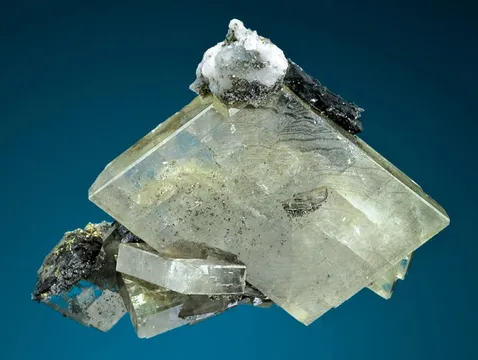
Gersdorffite is the signature Aït Ahmane mineral, especially from Filon 51 and the later 2011–2012 finds. The classic crystals are steel-gray to bright silvery metallic octahedra, commonly sharp and sometimes grouped in airy aggregates on white calcite or quartz; the 1968 study described brittle steel-gray gersdorffite in white calcite locally stained green by powdery annabergite, with exceptional crystal groups reaching about 4 cm on an edge, while market specimens from the later finds more commonly show sharp individual crystals around 1 cm, with selected groups carrying larger faces and strong luster. Good pieces are judged by true crystal form, clean octahedral geometry, freedom from cleaving or bruising at the vertices, bright metallic faces, and contrast against pale matrix; ordinary pieces are darker, massive, embedded, chipped, or too calcite-covered to show the sculptural octahedra that made Aït Ahmane famous.
Calcite at Aït Ahmane is both the principal display gangue and, in a few finds, a collectible species in its own right. In the arsenide veins it occurs as white to colorless carbonate enclosing or supporting gersdorffite, löllingite, silver, and djurleite-chalcocite; many silver specimens from the 2020 find were acid-etched to expose the bright metal, and those calcites are reported to fluoresce under both long- and short-wave ultraviolet light. The most distinctive standalone calcite find came from an auxiliary shaft in July 2018: pale lilac, translucent to transparent scalenohedral groups with parallel growth, good luster, and a reported unique pocket character for Aït Ahmane. Collectors should prize calcite here when it is unrepaired, lustrous, visibly crystalline, and naturally integrated with the arsenide or silver assemblage; heavily etched, chalky, or purely massive calcite has far less locality-specific value unless it preserves exceptional associated minerals.
Native silver from Aït Ahmane is best known from the December 2020 find, where it occurs as tiny but remarkably sharp cubic, cuboctahedral, and locally dendritic crystals on calcite-rich matrix with löllingite. The crystals are usually measured in millimeters rather than centimeters, with many fine examples showing 1–3 mm crystals, but their appeal lies in the unusually defined faces and bright luster rather than size. Some specimens show two generations: crisp bright silver cubes partly coated by rougher yellowish mercury-rich silver, described on the market as an amalgam variety. The strongest pieces have isolated crystals standing cleanly above acid-etched calcite, confirmed löllingite association, minimal tarnish, and no distracting etching scars; ordinary pieces are sparse, flat, gray, or too dominated by altered carbonate to read as silver specimens.
Djurleite from Aït Ahmane, especially the 2014–2015 auxiliary-shaft material, is one of the locality’s modern rarities. It occurs as black to dark steel-gray djurleite-chalcocite intergrowths, with djurleite reported as the dominant phase in tested specimens, forming sharp tabular to pseudohexagonal plates and bladed aggregates, commonly on calcite. Documented specimens include miniature-size pieces with crystals around 0.7–1.6 cm, and show reports noted thin-tabular crystals reaching roughly 2.4 cm vertically, exceptional dimensions and form for a species commonly represented by massive copper-sulfide ore. The best examples have complete bladed crystals, rolling metallic to submetallic luster, visible pseudohexagonal outlines, and open composition; lesser pieces are massive, dull, chemically ambiguous chalcocite-djurleite mixtures with little crystal definition.
Löllingite is abundant in the Aït Ahmane arsenide system but only selectively collectible. In serpentinite-hosted Fe-rich orebodies such as F55 and F56 it forms massive ore composed of zoned spindle-like crystals in the core and rosette-like aggregates in disseminated margins; in collector specimens it more often appears as small metallic crystals or epigenetic growths associated with silver, calcite, quartz, and locally sphalerite or talc. Veins 52, 54, 59, and 61 are all documented Aït Ahmane löllingite localities, and the 2020 silver specimens commonly use löllingite as a dark metallic support or coating on etched calcite. Good löllingite specimens from here need more than a formula on a label: they should show distinct crystal faces, attractive rosettes or sprays, or a meaningful association with silver or calcite; massive gray arsenide fragments are scientifically legitimate but visually ordinary.
Beyond these five collector species, Aït Ahmane has a rich arsenide and arsenate suite. Filon 51 alone is documented for annabergite, anorthoroselite, cobaltaustinite, erythrite, nickeline, nickelskutterudite, rammelsbergite, maucherite, native gold, native sulphur, népouite, talc, talmessite, nickel-bearing talmessite, retgersite, spherocobaltite, vladimirite, and the type-locality mineral nickeltalmessite, Ca2Ni(AsO4)2 · 2H2O. Filon 52 adds a strong secondary-arsenate micro suite including arseniosiderite, ferrilotharmeyerite, cobaltlotharmeyerite, nickellotharmeyerite, nickelaustinite, mansfieldite, karibibite, and talmessite-group minerals. Filon 59 is notable for adamite and copper-bearing adamite, arsenolite, cobaltkoritnigite, parasymplesite, powellite, opal, skutterudite, and probable guérinite. Vein 53 has been cited for luzonite and for a studied silver-copper sulfosalt of formula (Ag4.38Cu2.62)AsS5, described from a single known specimen in a white carbonate cavity. Most of these are micromount or analytical minerals rather than cabinet specimens, but they explain why Aït Ahmane remains attractive to specialists long after the showy gersdorffite and djurleite pockets were dispersed.
Aït Ahmane specimens demand careful labels. Older labels may say Ait Ahmane, Aït-Ahmane, Ait Hamane, Bou Azer, Tazenakht, Ouarzazate, or Souss-Massa-Draâ; those are not automatically wrong, but a modern collection record should preserve the old label wording while adding the current locality hierarchy. The most useful refinements are Filon 51 for classic gersdorffite and nickeltalmessite, auxiliary shaft for the 2014–2015 djurleite-chalcocite and 2018 calcite material when documented, and the 2020 Aït Ahmane silver find when the silver-calcite-löllingite association is present.
The most important identification issue is djurleite versus chalcocite. The Aït Ahmane copper-sulfide pocket has circulated under both names, and some specimens are explicitly described as djurleite-chalcocite intergrowths. Because the two phases are visually difficult to separate and may intergrow, high-value pieces should be accompanied by analytical confirmation or sold with conservative wording. A label reading simply “djurleite” is acceptable only if the source is reliable or testing has been done; otherwise “djurleite-chalcocite intergrowth” is more honest.
The 2020 silver suite raises a second point: many specimens were acid-etched from calcite matrix. This is not necessarily a deception if disclosed, and in fact etching is part of how many of the sharp silver crystals were revealed. The collector’s concern is whether the etching left chalky carbonate, undercut metal, or unstable residues. Examine silver crystals under magnification for looseness at the base, dull gray tarnish, and any rough yellowish overgrowths that may represent mercury-rich silver rather than damage. Such amalgam-bearing specimens are interesting, but the association should be recorded clearly.
Gersdorffite condition is all about edges and faces. The best Aït Ahmane octahedra have crisp ridges, triangular growth markings, and bright, fresh metallic faces. Because gersdorffite has perfect cubic cleavage, contacts and cleaved corners are common, especially on larger crystals that were freed from calcite. A single bruised vertex may be acceptable on a major crystal; broad cleaved backs, rubbed luster, or acid damage to the surrounding calcite reduce desirability sharply. Green annabergite dust in calcite cleavages is part of the classic association, but powdery nickel and cobalt arsenates should be handled with care and kept away from food, children, and unnecessary abrasion.
Löllingite and other arsenides from Aït Ahmane should be treated as arsenic-bearing minerals. Normal display is safe, but cutting, grinding, ultrasonic cleaning, or aggressive acid work is inappropriate for finished specimens and potentially hazardous. Keep labels precise, store friable arsenate-rich pieces in boxes, wash hands after handling, and do not allow loose powder to accumulate in drawers.
Market availability is uneven. Aït Ahmane gersdorffite appears regularly enough that patient collectors can choose, but truly bright, damage-free, well-positioned octahedral groups remain premium specimens. Silver from the 2020 find is scarcer and tends to sell on sharpness and documentation rather than size. Djurleite-chalcocite pieces from the 2014–2015 discovery are genuinely limited; the best bladed examples were dispersed through major dealers and quickly entered advanced collections and museums. Nickeltalmessite, vladimirite, talmessite-group minerals, and other secondary arsenates are chiefly a micromount and systematic-specialist market.
The origin story of Bou Azzer has the quality of a mineral fable, and Aït Ahmane sits inside that larger tale. In 1928, Jean Epinat, a French industrialist visiting Marrakech, noticed cobalt arsenate minerals being sold in the stalls of Jemaa El-Fna for domestic use. Local inhabitants used such minerals as insecticides and rat poison. Epinat asked to be taken to their source, and the trail led to the Bou Azzer depression, where mineralized veins cropped out at the surface. Within a few years the economic value of the cobalt arsenide ores had drawn formal mining into the district.
The first great Aït Ahmane collector story is Filon 51. In 1965, gersdorffite specimens were collected there that were important enough for F. Guilbert, P. Picot, and H.-J. Schubnel to publish a short mineralogical note in 1968. They described a setting of nickeliferous veins linked to the serpentinite margin and noted that, although gersdorffite had already been reported in the paragenesis, crystals of such size had not previously been found there. The memorable detail is the extraction: brittle steel-gray gersdorffite packed in white calcite, the calcite tinged green where powdery annabergite sat in cleavage cracks, and from that white carbonate matrix “exceptional groups of crystals” could be freed. One illustrated group had crystals reaching about 4 cm on an edge.
A field visit recorded by the Natural History Museum of Los Angeles County gives a more human-scale view of the district. The party heard a geology lecture by Mr. Karfal, then toured the Bou Azzer plant, seeing grinders, turbines, and water-fed shaking tables close enough to watch the ore separate by density. The description is wonderfully mechanical: ore crushed in grinders with steel ball bearings, then sorted through stages where denser particles fell off one part of the table and lighter grains traveled farther with the water. Later the group went out to search for minerals. At Aït Ahmane the collecting was not romantic abundance but expert patience: only the very experienced mineral hunters, “like Jean-Pierre,” found anything. The reward, even when the crystals were tiny, was the view and the sense of working in one of the world’s strangest arsenide districts.
The modern djurleite discovery has its own show-floor drama. The material was mined carefully over roughly seven months in the Aït Ahmane area between late 2014 and May 2015, reportedly not from the same shafts that produced the famous gersdorffites. When the best examples appeared at Tucson in 2017, collectors saw something unexpected for djurleite: sharp, bladed, black copper-sulfide crystals with real sculptural presence. Mineralogical Record commentary from the period stressed both the rarity of the species in such crystals and the labeling uncertainty, because some pieces had circulated as chalcocite while repeated testing by the dealer source indicated djurleite predominated. That ambiguity has become part of the material’s history rather than a footnote.
The December 2020 silver find is quieter but equally distinctive. The crystals are small, commonly only a few millimeters, yet they have a precision of form unusual for silver: cubes and cuboctahedra with bright faces sitting on etched calcite, with löllingite as the dark metallic counterpoint. Some specimens add a second generation, a rougher yellowish mercury-rich silver that partially mantles the clean earlier cubes. In a district famous for cobalt and nickel arsenides, these little silver crystals are a reminder that Bou Azzer’s late-stage mineralization could still produce completely different aesthetics from one pocket to the next.