






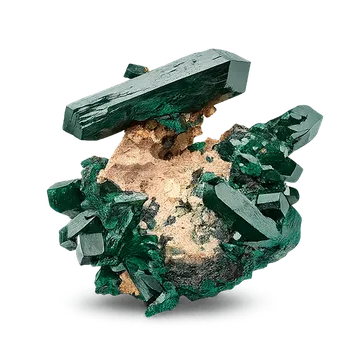
Altyn-Tyube dioptase, Kazakhstan - the type locality famed for emerald-green crystals, intense glow, and copper-oxide associations prized by collectors.
Key facts
Altyn‑Tyube is the ancestral name every dioptase collector eventually learns. Before Tsumeb, before the Congo localities, before the mineral became a show-case standard for “impossible” green, there was this small limestone hill on the Kazakh Steppe: the type locality of dioptase and the source of the “copper emeralds” that startled European mineralogists in the late eighteenth century.
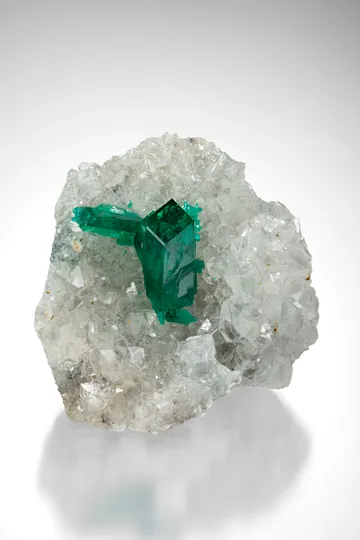
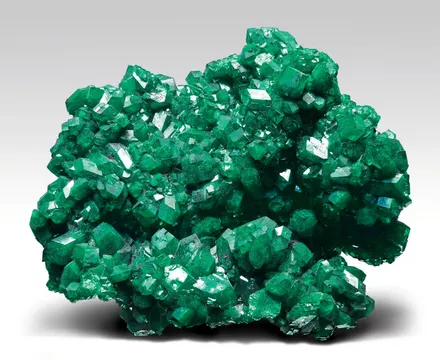
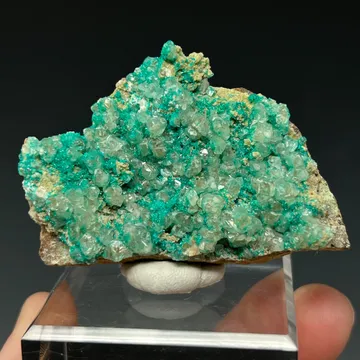
Its finest specimens are instantly recognizable: dense emerald-green to slightly blue-green dioptase crystals, usually small but brilliant, sparkling from pale calcite or limestone matrix. The best pieces have a hard glassy luster and an internal glow that makes the crystals look deeper than they are. Altyn‑Tyube is not a locality of broad mineral diversity; its power lies in repetition and intensity—green crystals in seams, vugs, calcite-lined openings, and limestone cavities, often in enough abundance to create jewel-like carpets.

Photo: Wikimedia Commons
Mineralogically, Altyn‑Tyube is a carbonate-hosted copper occurrence. Dioptase formed as a secondary copper silicate in oxidized copper-bearing ground where carbonate buffering, silica availability, and copper-rich fluids could meet in just the right balance. The matrix of collector specimens is most commonly limestone and calcite; malachite and cuprite may appear, while sulfide minerals such as chalcopyrite, bornite, chalcocite, pyrite, galena, and sphalerite belong more to the deposit’s broader ore mineralogy than to the usual display face of a cabinet specimen.
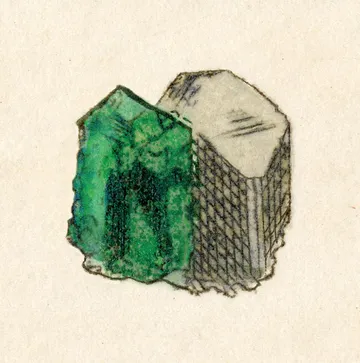
Historically, this is one of the great named mineral localities of Eurasia. René Just Haüy named dioptase in 1797 after studying material from Altyn‑Tyube, and the locality’s older labels can appear under a thicket of spellings: Altyn‑Tube, Altyntyube, Altyn‑Tübe, Altye‑Tebe, Altin Tioubé, and others. Collectors should also recognize the old regional label “Kirghiz Steppe,” a historical geographic term often attached to nineteenth- and early twentieth-century specimens from the deposit.
What serious collectors look for is straightforward but unforgiving: rich, natural emerald-green color; sharp trigonal crystals; bright vitreous luster; minimal bruising; attractive contrast against calcite or pale limestone; and, above all, locality confidence. Fine old Altyn‑Tyube specimens carry a historical weight that goes beyond size. A thumbnail with undamaged crystals and an old label can be more meaningful than a larger but battered recent piece.

Photo: Wikimedia Commons
Search for specimens: View all dioptase specimens from Altyn‑Tyube dioptase deposit, Kazakhstan
Altyn‑Tyube lies in the Bukhar‑Zhyrau District of the Karaganda Region, Kazakhstan, on the open Kazakh Steppe east of Karaganda. The locality is a small limestone knoll rather than a large industrial copper camp, and its importance to collectors has long exceeded its importance as an ore producer. Modern coordinates given for the Mindat locality are approximately 49° 48′ 59″ N, 73° 59′ 42″ E.
The name is usually translated as “Golden Hill.” Historical literature also places the occurrence near the Altyn‑Ssu or Altyn‑Syu, “Golden Stream” or “Golden Water,” a name that matters to label readers because Altyn Syu has sometimes appeared incorrectly as a dioptase locality. The lake or water feature may be part of the travel story, but dioptase is from the Altyn‑Tyube deposit itself.
The deposit is carbonate-hosted. Dioptase occurs in cavities, seams, and fissures in limestone, commonly with calcite. Some modern and older descriptions mention silicified limestone and copper mineralization related to nearby igneous activity, but the collector’s visual reality is simpler: green dioptase crystals in pale, buff, brownish, or white carbonate matrix, often in vuggy openings or calcite-lined pockets.
The broader mineral list recorded for the deposit includes bornite, calcite, chalcocite, chalcopyrite, cuprite, dioptase, epidote, galena, malachite, native copper, pseudomalachite, pyrite, quartz, and sphalerite. In specimen terms, calcite is the classic association; malachite is a familiar accessory; cuprite is less common but historically relevant; and the sulfides document the copper system rather than the usual display association.
Mining history reaches unusually deep here. Recent historical work in The Mineralogical Record presents Altyn‑Tyube as a deposit recognized and worked in antiquity, with green pigment use in the Neolithic and copper mining during the Bronze Age. By the late eighteenth century, green crystals from the locality had reached European scientific circles under the spell of emerald. Haüy’s 1797 recognition of the species gave dioptase its name and made Altyn‑Tyube the formal type locality.
For most collectors, production history falls into three broad periods. First are the classic old specimens: scarce, often with older Russian, French, German, British, or “Kirghiz Steppe” labels. Second is the post-Soviet wave, when Kazakh dioptase became much more visible in Western markets during the 1990s. Third is the modern specimen-mining period, including material collected in the 2010s and later from small-scale work at the locality.
Access is difficult even now. The locality sits away from main roads, across steppe tracks that may be nearly invisible. A widely circulated 2013 field account describes reaching Karaganda by train, then driving roughly 18 kilometers off-road from the nearest prepared road to the mine. In good weather, that final off-road section may take about an hour; in winter snow, it has reportedly taken a full 18 hours. This is not a casual collecting stop, and present-day collecting should be treated as permission-only, guided, and subject to local law and mine control.
Notable finds range from cabinet pieces richly covered in small crystals to very large dioptase-bearing masses. Mindat records an Altyn‑Tyube dioptase specimen associated with the Konstantin Buslovich collection measuring 85 x 50 x 45 cm and weighing 90 kg, a reminder that the locality can produce far more than thumbnails, even though undamaged aesthetic display pieces remain much scarcer than masses of green-bearing rock.
Altyn‑Tyube dioptase is typically seen as short prismatic to rhombohedral trigonal crystals, often with sharply reflective faces and steep terminations. The crystals can occur as scattered individuals, small groups, dense crusts, or carpets on carbonate matrix. The finest examples have bright, glassy luster and enough translucency for light to enter the crystal and return as a saturated emerald flash.
Color is the locality’s signature. Good crystals are intense emerald green to blue-green, sometimes appearing darker in photographs than in hand. The best pieces avoid the dull, blackish, bruised look that damaged dioptase can acquire along broken faces; instead they show living green across intact terminations and prism faces.
Typical crystal sizes on attractive specimens are small: a few millimeters is common, 5–8 mm crystals make a pleasing miniature or cabinet piece, and 1 cm crystals are desirable. Specimens with crystals above 1 cm become more competitive, especially if the crystals are undamaged and well isolated. Reports and dealer descriptions mention larger crystals, and crystals to several centimeters are possible in exceptional Altyn‑Tyube material, but size alone is not the point; a sharp, gemmy 6 mm crystal can be more attractive than a battered larger one.
The matrix is usually limestone and calcite. Calcite may appear as translucent rhombs, scalenohedral crystals, drusy linings, or massive white to buff carbonate. The most attractive combination pieces show green dioptase crisply set against pale calcite, sometimes with small patches of malachite. The carbonate host is important diagnostically: overconfident “quartz matrix” labels deserve scrutiny, because much Altyn‑Tyube material that appears pale and crystalline is actually calcite or calcite-rich limestone.
Quality is judged by crystal integrity first. Dioptase has perfect cleavage and is brittle; Altyn‑Tyube crystals often formed in tight seams and vugs, so edge contacts, missing tips, and rubbed peripheries are common. A truly fine specimen has the green density collectors want without the usual penalty of battered exposed edges. Next comes contrast and composition: separated, sparkling crystals on calcite can be more desirable than a uniformly green crust if the individual crystals read clearly. Finally comes provenance: older labels, documented collections, and reliable modern mine-source information add real value.
Compared with Tsumeb material, Altyn‑Tyube specimens are generally more historically resonant and often more carbonate-seam-like in habit, with smaller crystals. Compared with Congo material, they usually lack the same broad range of associated secondary copper silicates. Altyn‑Tyube is a purist’s locality: dioptase, calcite, limestone, history, and green fire.
Altyn‑Tyube dioptase is not rare in the sense of being unobtainable, but fine, undamaged, well-documented specimens are much scarcer than ordinary pieces. The market includes both classic old material and modern production. Recent auction and dealer records show thumbnails, miniatures, and large cabinet pieces trading across a wide range, with condition and aesthetics producing major price swings. Large size alone is not enough; dense bruising, cleaved crystal tips, and flat composition can hold back a specimen that is otherwise impressive.
Condition is the chief issue. Dioptase is brittle and cleaves readily, and Altyn‑Tyube specimens commonly come from vugs, seams, and carbonate cavities where the crystals were naturally crowded or exposed during extraction. Look closely at edges and high points. A few peripheral contacts may be acceptable, especially on dense matrix pieces, but missing terminations across the display face sharply reduce desirability. Use a loupe, and rotate the specimen under a single strong light; bruises often reveal themselves as dull, dark, non-reflective spots among otherwise glassy faces.
Repairs and reattachments are possible with any fragile dioptase specimen. Check for glue halos at the crystal base, mismatched crystal orientation, unnatural isolation of a single crystal on an otherwise barren patch of matrix, and fluorescence from adhesive under UV light. Calcite-rich matrices may also be acid-cleaned or etched. Careful cleaning is normal in mineral preparation, but over-etched calcite can look sugary, undercut, or unnaturally foamy around crystal bases.
True color treatment is not a normal concern for dioptase. Its green is intrinsic to copper in the mineral structure, and heating or irradiation would be more likely to damage a specimen than improve it. The more realistic problems are mislocality, repair, assembly, aggressive cleaning, and exaggerated photography.
Mislocality is a serious collector concern. Tsumeb, Congo, Namibia’s Kaokoveld, and Altyn‑Tyube can all produce attractive dioptase, and orphaned labels invite speculation. Altyn‑Tyube pieces should make sense as carbonate-hosted Kazakh material: green dioptase on limestone or calcite, with malachite or cuprite possible. Very white, sharply rhombohedral calcite habits that resemble Tsumeb material should be questioned if labeled Altyn‑Tyube. Conversely, the presence of calcite alone does not prove Tsumeb; Altyn‑Tyube is fundamentally a calcite-and-limestone locality.
Labels reading “Altyn Syu,” “Altyn Su,” or “Golden Water” should be treated cautiously. That name belongs to the nearby water feature and has appeared in travel and label lore, but the dioptase locality is Altyn‑Tyube. Older regional labels such as “Kirghiz Steppe,” “Siberia,” or “Russia” can be historically understandable rather than wrong, but they need interpretation in modern geographic terms.
Storage is simple but important. Keep specimens dry, stable, and protected from knocks. Do not clean dioptase with acids; the calcite matrix is vulnerable, and crystal bases may be loosened. Avoid ultrasonic cleaning. A soft brush and compressed air are usually safer than chemical intervention. For display, Altyn‑Tyube dioptase benefits from focused light, but avoid heat buildup in small enclosed cases.
The founding story of Altyn‑Tyube is the sort of mineralogical misidentification that changed a species list. Late eighteenth-century copper miners found brilliant green crystals in the limestone workings and thought the dream had arrived: emerald. The crystals were rich enough in color to justify the excitement, but the illusion collapsed under mineralogical scrutiny. Emerald is hard; dioptase is only Mohs 5 and cleaves readily. Haüy recognized the material as a new species in 1797, naming it for the visible internal cleavage—literally, the sense of seeing through.
The modern journey to Altyn‑Tyube still feels like a test of seriousness. Jolyon Ralph’s 2013 visit began far from the mine, with a flight to Almaty and a ten-hour train ride to Karaganda. From there the trip left the ordinary map behind. The last 18 kilometers were not a road in the usual sense but a drive across steppe tracks, sometimes barely visible, sometimes bypassed entirely because of waterlogged ground. In summer the off-road stretch took about an hour, plus breaks. In winter, Ralph was told, the same 18 kilometers had once taken 18 hours through snow.
The vehicle was a Russian UAZ‑452 4x4 minivan, the beloved “Bukhanka,” or loaf of bread. Its design had been produced almost unchanged for decades. The back had bare fold-down benches and only one real comfort: a padded roof. On steppe tracks, that padded roof became less a luxury than a survival feature.
The route passed Altyn Syu, “Golden Water,” the little lake whose name has confused mineral labels. It is part of the landscape, not the source of the dioptase. There the local party stopped, and Sergei Golomolzin’s friends stripped off and jumped in. Back on the track, Sergei’s son shouted “Gribi”—mushrooms—and the van stopped again. In less than five minutes, the group filled two large plastic carrier bags. The steppe was not empty: Ralph noted ibex, marmots, wild horses, birds of prey, and four eagles on a rock, only one of which stayed as the vehicle approached.
At the mine, the remoteness gave way to a surprisingly settled underground world. The workings were permanently occupied, and the crew had built an underground living area with bunks, kitchen, and storage. There was well water good enough to drink—the only place Ralph visited in Kazakhstan where the tap water felt safe to him—and even an underground sauna. Guests stayed not in the miners’ quarters but in a newer guesthouse with electric lighting, a clean carpeted room, open views, a telescope, and, improbably, a trapdoor leading down into the dioptase mine.
Down the ladders, the reason for the journey appeared in the wall: green crystals in place. Mine ventilation, though the workings looked basic, was taken seriously. The scene had the roughness of small-scale specimen mining but not the carelessness outsiders sometimes imagine. At the bottom, traces of dioptase were visible in situ; elsewhere, Ralph saw tiny green crystals in mud and rocks coated with green crystals lying about the workings.
One detail from that trip has become locality folklore: piles of dioptase-bearing rock set aside as building material. Not museum-grade pieces, not fine trimmed miniatures, but still rock richer in dioptase than many collectors will ever find for themselves. The plan was to use some of it in an extension of the living quarters—walls made with dioptase-rich stone at the type locality of dioptase.
The mine dogs added another steppe note. They fed themselves by hunting and sometimes returned with “gifts” of mice and other small animals. One accompanied the group on a walk up a nearby hill where mobile phone signal could be found. On that walk, an adder appeared and then disappeared quickly, apparently as eager to avoid the humans as they were to avoid it.
As evening came, the decision was whether to return or stay. They stayed. Hunters and trappers also used the mine as a base for marmot hunting, and that evening the group ate fresh Russian meat dumplings. Ralph’s caption captured the moment perfectly: asking “What meat is this?” was not the best question.
Night at Altyn‑Tyube brought another kind of specimen: the sky. Eighteen kilometers from the nearest road, with no lights visible in any direction, the stars were strong enough to turn the camp into a natural observatory. Ralph had not brought a tripod, then remembered the telescope in the guesthouse. Its tripod fit his camera. One night photograph caught a meteor running from the upper left corner. The next morning, after a 6 a.m. departure, the steppe sunrise closed the visit, and the guard dog said goodbye.
.jpg)
