






A collector's guide to Aghbar Mine, Morocco: its geology, mining history and notable minerals, illustrated with the 83 specimens documented from this locality on EarthWonders.
Key facts
Aghbar is one of the collector landmarks of the Bou Azzer cobalt-nickel-arsenic district in Morocco’s Central Anti-Atlas, a place where specimen beauty and ore-deposit mineralogy meet unusually well. The mine sits in the Bou Azzer–El Graâra inlier, where cobalt-nickel arsenide mineralization is tied to serpentinite bodies and their contacts with volcanic and volcano-sedimentary rocks. For collectors, that setting matters because the primary ore—skutterudite, safflorite-löllingite series minerals, rammelsbergite, nickeline and related Co-Ni-Fe arsenides—fed a rich supergene arsenate suite. The result is Aghbar’s signature palette: intense pink to red cobalt-bearing calcite, purple-red erythrite, rose-red roselite, pink to mauve roselite-wendwilsonite series crystals, cobalt arsenates, nickel arsenates, and rare micro-species that make the mine far more than a pretty carbonate locality.
Historically, Aghbar belongs to the early story of Bou Azzer cobalt mining. The broader district was recognized for cobalt in the late 1920s and became one of the world’s classic primary cobalt-producing provinces. Aghbar itself has been treated in the literature as one of the important deposits of the district, with mining of the Aghbar orebody reported in twentieth-century accounts and later scientific work using Aghbar material to study phase relations in Ni-Co-Fe arsenide ores. The mine’s name also entered mineralogical nomenclature through arhbarite, named for the Arhbar/Aghbar mine.
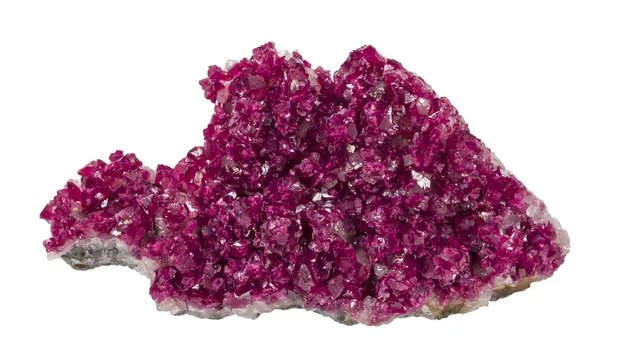
Visually, the best Aghbar specimens are unmistakable. Cobalt-bearing calcite can be baby pink, raspberry, fuchsia, or neon magenta, commonly as tight druses, seam linings, squat rhombohedral to pseudocubic crystals, and sparkling translucent crusts on matrix. Roselite and wendwilsonite add darker rose, mauve, or purple-red accents, often as tiny but brilliant monoclinic crystals scattered over calcite or tucked into vugs. Erythrite, when well crystallized, brings velvety to lustrous magenta sprays and blades on altered cobalt ore. The finest pieces are not merely bright; they combine saturated color, sharp crystal definition, clean contrast between arsenate and carbonate, and enough matrix to show their origin in a real cobalt-arsenide vein system.
Regional View
Country View
Aghbar’s best-known collector specimens generally come from the oxidized and carbonate-rich parts of the cobalt system rather than from massive ore alone. The mine’s aesthetic identity is therefore double: it is an industrial cobalt locality and, at the same time, a small-crystal connoisseur locality where the most valuable pieces are often miniatures and small cabinets with superb surface quality.

Photo: Wikimedia Commons

Photo: Wikimedia Commons
Search for specimens: View all specimens from Aghbar Mine, Morocco
Aghbar Mine is recorded at Aghbar in the Tansifte Caïdat, Agdz Cercle, Zagora Province, Drâa-Tafilalet Region, Morocco, within the Bou Azzer mining district of the Central Anti-Atlas. Older labels commonly give “Arhbar,” “Ahrbar,” “Bou Azer,” “Bou Azzer,” “Tazenakht,” or “Ouarzazate Province,” reflecting both spelling variations and changing administrative geography. A precise Aghbar label is important because Bou Azzer is not a single specimen hole but a long-lived mining district with numerous deposits and workings.
The deposit is part of the Bou Azzer–El Graâra cobalt-nickel-arsenic belt, associated with a Neoproterozoic ophiolitic sequence and serpentinite bodies. At Aghbar, recent geological and structural work describes cobalt-arsenic-rich mineralization hosted mainly by Cryogenian serpentinites and by contacts with overlying Ediacaran volcanic and volcano-sedimentary units. Mineralized quartz-carbonate veins and replacement bodies are localized along fault zones and lithological contacts, especially where serpentinite has been brecciated, carbonated, silicified, and chemically prepared to receive ore-forming fluids.
The Aghbar ore system is not a simple single-stage vein. Canadian Mineralogist work on forty Aghbar samples distinguished vein-type nickel ores, serpentinite-hosted Co-Fe ores, and late copper-bearing ores. The early nickel-rich stage includes nickeline, rammelsbergite, and Ni-rich skutterudite, interpreted as forming at comparatively high temperature under increasing arsenic fugacity. A later Co-Fe arsenide stage includes safflorite, löllingite, skutterudite and sulfarsenides in altered serpentinite, and a still later overprint introduced copper-bearing sulfides and related minerals along fractures and structural weaknesses. That complex paragenesis is exactly why Aghbar can yield metallic ore specimens, cobalt-rich carbonates, and delicate secondary arsenates from the same broader mine environment.
For industrial mining, Aghbar belongs to the wider Bou Azzer operation historically associated with CTT, now within the Managem group. Bou Azzer’s cobalt activity began in the late 1920s and early 1930s, with industrial-scale mining beginning in the 1930s and later interruptions, resumptions, and exploration campaigns. Published historical summaries report that the main Aghbar mining period ended around 1970 as reserves and grades declined, while modern sources still treat Aghbar and nearby deposits as part of the active or studied Bou Azzer system. In practical collecting terms, the point is straightforward: this is a mine locality, not an open rockhounding destination.
Specimens reach collectors through mine production, miner-to-dealer channels, old collections, and commercial lots that have filtered out of Morocco over many years. The very best Aghbar pieces are typically linked to pockets, seams, or vugs rather than to bulk ore. Calcite-rich openings produced pink cobalt-bearing calcite druses, sometimes with roselite or roselite-wendwilsonite crystals. Altered skutterudite and related cobalt arsenides produced vugs and fracture fillings with erythrite. The open pit at Aghbar is also mineralogically important for the rare arsenate maghrebite, described from weathering of a Variscan hydrothermal Co-Ni-As-(Cu-U-Mo) vein and associated with quartz, erythrite, arseniosiderite, wendwilsonite and cabalzarite.
Access today should be assumed restricted. Bou Azzer is an operating mining district with industrial infrastructure, private and corporate control, safety issues, and arsenic-bearing ore and secondary minerals. Serious collectors should acquire Aghbar specimens through reputable dealers, old collections, documented Moroccan sources, and properly labelled material rather than attempting field collecting.
At Aghbar, calcite is the collector’s stage on which much of the mine’s cobalt color performs: ordinary white to colorless calcite occurs in the quartz-carbonate gangue, but the coveted material is cobalt-bearing calcite in saturated pink, raspberry, fuchsia and neon magenta tones. It occurs as drusy seam and vug linings, tight crusts of squat crystals, pseudocubic-looking crystals to about a centimeter in noted specimens, and sparkling plates that may carry roselite or roselite-wendwilsonite series crystals. Good Aghbar calcite is judged by natural color saturation, translucency, glassy luster, fresh undamaged druse surfaces, and contrast with white calcite or darker ore matrix; ordinary pieces are flatter, chalkier, bruised on the pocket edge, or lack the punch of color that made Aghbar famous.
Aghbar is one of the essential localities for wendwilsonite, the magnesium analogue of roselite, and it is especially challenging because the roselite-wendwilsonite series can be visually deceptive: pink, rose-red, mauve or pale red crystals may require analysis to separate confidently from Mg-rich roselite or intermediate compositions. Aghbar specimens are typically small-crystal pieces, with lustrous crystals or drusy aggregates on calcite, cobalt-bearing calcite, talmessite, erythrite, skutterudite or other arsenate-bearing matrix; notable examples include tiny bright crystals in vugs and roselite-wendwilsonite series druses associated with cobalt-bearing calcite. The best pieces show discrete, well-formed, lustrous crystals with credible analysis or trustworthy provenance, because color alone is not a reliable guide here.
Roselite is Aghbar’s classic arsenate prize, appearing as deep rose-red, magenta, mauve-red or fuchsia crystals on calcite, cobalt-bearing calcite, dolomite and altered arsenide matrix. Dealer, museum and photo records document sharp crystals commonly in the millimeter range, with fine examples showing isolated, translucent to transparent crystals, curved or complex faces, occasional doubly terminated crystals, and strong contrast against pale or pink calcite; well-known Aghbar specimens include pieces found around 1979 and later analyzed Mg-rich roselite from 2014. The finest Aghbar roselites are not judged by size alone—crystals to several millimeters can be superb—but by glassy luster, saturated red-purple color, sharp termination, clean exposure, and a convincing Aghbar matrix association.
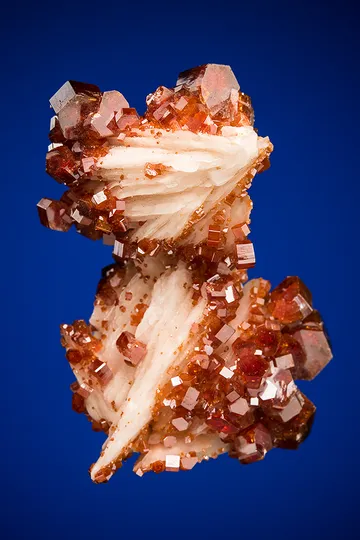
Aghbar erythrite forms from the oxidation of cobalt-bearing arsenide ore and is most desirable as magenta to purple-red blades, sprays, tufts, puffball-like aggregates and crystal groups in vugs or on altered skutterudite-rich matrix. Documented Aghbar pieces range from thumbnail micromount material with millimeter crystals to small-cabinet specimens bearing crystals reported to 1 cm, 2 cm, and in one old family-collected example as long as 2.5 cm; associations include skutterudite, quartz, cobaltkoritnigite, talmessite and other secondary arsenates. The best examples have upright, lustrous, undamaged sprays or blades with intense color and a clear ore context, while lesser pieces are powdery, matted, rubbed, or visually attractive but poorly localized to the broader Bou Azzer district.
At Aghbar, cobalt is the metal that defines the deposit, but collectors should understand that the mine is famous for cobalt-bearing minerals rather than for common aesthetic native cobalt specimens. The primary cobalt is chiefly locked in arsenide and sulfarsenide ore assemblages—skutterudite, safflorite-löllingite series phases, and related Co-Ni-Fe arsenides—while the showy collector minerals are cobalt-colored secondary species such as erythrite, roselite, wendwilsonite-series material, cobaltaustinite, cobaltkoritnigite, cobaltlotharmeyerite and cobalt-bearing calcite. A good Aghbar “cobalt” specimen is therefore normally valued as a cobalt-ore or cobalt-mineral association: metallic arsenide matrix with colorful secondary growths, strong locality documentation, and enough visible paragenesis to connect the specimen to the mine’s cobalt system.
Other documented Aghbar minerals include annabergite, anorthoroselite, aragonite, arseniosiderite, arsenolite, aurichalcite, austinite, cobalt-bearing austinite, beyerite, brannerite, cabalzarite, chalcanthite, chalcopyrite, clinosafflorite, cobaltaustinite, cobaltkoritnigite, cobaltlotharmeyerite, conichalcite, cornwallite, cobalt-bearing dolomite, goethite, hematite, heterogenite, hörnesite, köttigite, lavendulan, löllingite, maghrebite, malachite, mansfieldite, mcguinnessite, native copper, native sulphur, pharmacolite, pharmacoalumite, picropharmacolite, powellite, quartz, sainfeldite, scorodite, serpierite, skutterudite, spherocobaltite, takovite, talc, talmessite, cobalt-bearing talmessite, nickel-bearing talmessite, tyrolite and zálesíite. Arhbarite is the mine’s named type-locality mineral, and maghrebite is tied to the Aghbar open pit; both underscore why Aghbar matters to micro-mineral collectors as much as to lovers of bright cobalt color.
The first authenticity issue with Aghbar is not usually treatment but locality precision. “Bou Azzer,” “Bou Azer,” and “Morocco” labels are common, and older labels may be perfectly legitimate, but Aghbar material carries a premium when the mine is named and the association fits the locality: pink cobalt-bearing calcite with roselite or roselite-wendwilsonite series crystals, erythrite on cobalt arsenide ore, or arsenate microminerals on carbonate-rich matrix. Be cautious with specimens sold as Aghbar merely because they are pink. Cobalt-bearing calcite also occurs elsewhere in the Bou Azzer district and at famous non-Moroccan localities such as Katanga; the best Aghbar labels are supported by old collection provenance, dealer history, specimen style, or analytical work.
Roselite and wendwilsonite are a special identification problem. They form a chemical series and may be impossible to distinguish by eye, especially where Mg-rich roselite, wendwilsonite and intermediate roselite-wendwilsonite material occur in the same visual range. Specimens confidently sold as wendwilsonite or Mg-rich roselite deserve analytical support. The same caution applies to small cobalt and copper arsenates such as cobaltaustinite, cobaltlotharmeyerite, cobaltkoritnigite, talmessite, cabalzarite and arhbarite; many are micromount species requiring SEM-EDS, Raman, XRD, or prior published determination.
Condition is central to value. Cobalt-bearing calcite from Aghbar can have bruised druse edges where plates were removed from pocket walls, and some surfaces are naturally uneven or partly etched. Look for undamaged display faces, sharp terminations, and fresh luster rather than just color. Erythrite is soft, delicate and easily abraded; bladed sprays and puffball aggregates should be handled as fragile arsenate specimens. Avoid ultrasonic cleaning, acids, aggressive brushing, or soaking. Dusting should be minimal and gentle.
Because many Aghbar minerals contain arsenic and cobalt, handling should be conservative: do not cut, grind, lick, or wash powdered residues into food-preparation areas; wash hands after handling; keep friable arsenate specimens away from children and pets; and store delicate erythrite and micromineral specimens in boxes that prevent abrasion. Fluorescence is not the main reason collectors seek Aghbar material; color in cobalt-bearing calcite and cobalt arsenates is the essential feature.
Market availability varies sharply by species and quality. Pink cobalt-bearing calcite and roselite-calcite pieces appear regularly enough that collectors can be selective, but truly vivid, lustrous, undamaged Aghbar examples with sharp roselite or exceptional color command strong prices. Fine erythrite from Aghbar is much scarcer, especially older small-cabinet pieces with centimeter-scale sprays. Analytical wendwilsonite, arhbarite, maghrebite-related material and other rare arsenates are specialist material and should be bought for documentation as much as for aesthetics.
The origin story of Bou Azzer cobalt has the improbable flavor of a mineral-show anecdote, except that it belongs to mining history. In 1928, in Marrakech’s Jama Lfna square, a visiting geologist reportedly recognized erythrite—the cobalt arsenate “bloom” mineral—as something more than a colorful curiosity. That recognition led back to the cobalt-bearing ground of the Bou Azzer–El Graâra inlier. Within a few years, visual prospecting had catalogued the main outcropping occurrences, artisanal mining followed, and by the mid-1930s industrial mining was underway. For collectors, the detail is irresistible: a district now known for roselite, erythrite, skutterudite, pink calcite and rare arsenates entered modern mining history through the same kind of vivid cobalt color that still catches a collector’s eye across a show table.
A much more intimate Aghbar story survives in a specimen record rather than in corporate history. A 10 x 6 x 5 cm erythrite specimen in the Gallo family collection was described as having “typical shaped” crystals on cobalt ore, the longest crystal measuring 2.5 x 0.7 cm. The note says it was extracted by the collector’s father in the 1960s from Aghbar Mine, in the Bou Azzer cobalt mine. That single object says a great deal about old Aghbar: not bulk flats of modern pink druse, but serious cobalt-ore specimens with fragile, elongated erythrite crystals growing directly from the oxidized arsenide system. Pieces of that vintage, with family provenance and crystals in the centimeter range, sit in a different collecting category from the attractive but commoner small drusy fragments.
Aghbar also has a quieter scientific story in the rare-mineral world. Arhbarite was first described as a copper arsenate from Arhbar, with the original grains so small that early crystallographic work was limited. Later reinvestigation changed the ideal formula to Cu2Mg(AsO4)(OH)3 and placed the mineral on firmer structural footing. The story is typical of the mine’s micromineralogy: a few tiny blue aggregates on dolomite, nearly invisible to the casual collector, became important enough to carry the mine’s name into the mineral species list.

.JPG)