79 Mine, Arizona — classic oxidized Pb-Zn-Cu-Ag locality near Hayden, famed for pastel smithsonite, blue hemimorphite, wulfenite, and aurichalcite; highly coll…
Key facts
The 79 Mine is one of Arizona’s classic oxidized base-metal specimen localities: a small, complex Pb-Zn-Cu-Ag mine in the Dripping Spring Mountains near Hayden, yet a disproportionately important name in fine-mineral collections. Its reputation rests on what commercial mining largely left behind. The mine exploited replacement and vein-replacement ore bodies in thin-bedded Paleozoic carbonate and shale, cut by rhyolite porphyry dikes and broken by faults; later weathering of galena-, sphalerite-, pyrite- and chalcopyrite-bearing ore created a remarkably colorful oxidized suite. For collectors, that means cuprian green smithsonite, robin’s-egg to pale blue hemimorphite, powder-blue aurichalcite, glassy yellow to orange wulfenite, teal rosasite, and rarer late-stage secondary minerals in small but highly aesthetic pockets.
The look of the best 79 Mine specimens is unmistakable. The mine’s finest cabinet pieces are not massive ore chunks but pastel, cavity-grown assemblages: apple-green botryoidal smithsonite with sparkling hemimorphite in the recesses; blue-green aurichalcite sprays scattered like frost over pale hemimorphite; paper-thin square wulfenite plates hovering in protected vugs; and, in recent collecting, lustrous blue chrysocolla from deep in the workings. The palette is softer than Bisbee and less brassy than many Arizona wulfenite localities, but its best pieces have a delicacy and compositional balance that make the locality instantly recognizable.
Regional View
Country View
Historically, the 79 Mine also matters because it bridges two worlds: Arizona’s early 20th-century metal mining and the later, more surgical era of specimen recovery. Commercial operators drove shafts, levels, raises and stopes for lead, zinc, copper and silver; collectors later learned that the low-grade oxidized ground, especially around old stopes and bypassed cavities, held the specimens. That transition is central to the mine’s story. Much of the material now prized on the market was found not in the main ore shoots during production, but during later collecting by people who understood the mine’s oxidized zones and were willing to work slowly in hot, dusty, fragile ground.
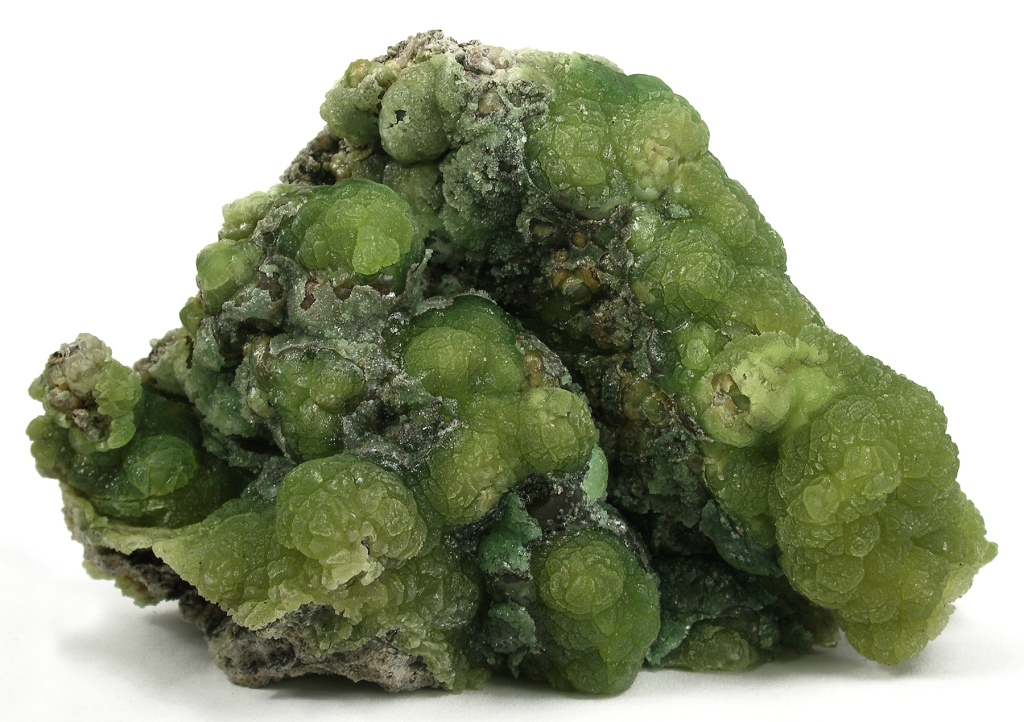
Photo: Wikimedia Commons

Photo: Wikimedia Commons
Search for specimens: View all specimens from 79 Mine, USA
The 79 Mine, also known historically as the Seventy-Nine Mine, 79th Mine, Seventy-Nine property and McHur prospect, lies in the Banner Mining District of Gila County, Arizona, in the Dripping Spring Mountains northwest of Hayden and west of the old Chilito area. The locality was discovered in 1879 by Mike and Pat O’Brien and took its name from that discovery year. When the claim was made, the county geography was not yet what collectors see on modern labels: Gila County was created in 1881, so older historical references may place the ground differently.
Geologically, the deposit is best understood as a replacement-type Pb-Zn-Cu system controlled by bedding, fracturing, faulting and intrusive contacts. The ore zones occur in thin calcareous shale, impure limestone and related carbonate beds of the Naco Formation, with nearby Escabrosa Limestone and older units in the district stratigraphy. Rhyolite porphyry dikes cut the sedimentary package, and mineralization developed both as bedded replacements in shattered, alternating limestone and shale and as small discontinuous vein-replacements in fractured and brecciated parts of the dike system. Reported structural controls include high-angle faults trending roughly northeast and north-south faults; the deposit is tabular, with a northeast strike and southerly dip, and ore was developed down several levels.
The commercial ore assemblage was not the pastel collector suite. The mine’s primary and hypogene value lay in galena, sphalerite, pyrite, chalcopyrite and quartz, later overprinted by deep oxidation and supergene alteration. Six bedded zones were mined, and the important collector minerals formed in the oxidized, gossanous and transitional ground rather than in the solid sulfide ore. This is why old production reports can describe a lead-zinc-copper mine while modern collectors think immediately of smithsonite, hemimorphite, aurichalcite and wulfenite.
Serious mining began in 1919, when the Continental Commission Company worked the Discovery ore body and shipped lead carbonate ore. Before a road reached the mine, ore was packed by burro to the railroad at Hayden Junction; a road built in the early 1920s allowed trucking to rail shipment and onward smelting. The Seventy-Nine Mining Company operated around 1922 at about 50 tons per day, but ownership litigation and metal prices repeatedly interrupted work. The property was sold at public auction in 1926, reopened in 1928 by the Seventy-Nine Lead-Copper Company, and by 1929 had become an important Arizona lead producer. Production declined again in the early 1930s, a 60-ton concentrator was built in the later 1930s, and Shattuck-Denn Mining Corporation reopened the mine in 1940, developed lower levels, and mined sulfide ore until 1949. Callahan Zinc-Lead Company acquired the property in 1950, and later production was limited.
The working history left an extensive underground layout. Published summaries describe a principal inclined shaft, multiple levels, winzes and more than 9,000 feet of underground workings; modern specimen accounts describe over 3,000 meters of drifts, raises and shafts. The ore body dimensions are often given in the range of about 335 meters in length and roughly 12 meters in width or thickness, with mineralization reaching approximately 152 meters below surface. Water below the deeper levels and the economics of pumping and metal prices limited later exploration.
For the collector, the important map of the mine is not just numbered levels but named specimen ground. The second level has yielded hemimorphite, cerussite and wulfenite, generally more modestly in recent work. The third-level Hemimorphite Stope produced major blue botryoidal hemimorphite, including a large zone discovered in 2020 and later extensions found in 2024 and 2025. The fourth-level Aurichalcite Stope is a key producer of aurichalcite sprays in hemimorphite- and calcite-lined cavities, and it recently yielded exceptional deep-blue chrysocolla. The fourth-level Wulfenite Stope is famous but difficult: hot, humid, unstable, and unforgiving to thin wulfenite plates. The Smithsonite Stope and nearby sublevel ground have produced sought-after green smithsonite and associated aurichalcite, calcite, hemimorphite and rosasite.
Access today is not public collecting. The mine is on active private claims and has been maintained and worked for specimens by current owners and invited, experienced collectors. Modern accounts note locked gates, rough roads, safety controls, dust hazards and the need for respiratory protection underground, especially because lead-bearing dust can be generated when old oxidized ore and limonitic ground are disturbed. Specimen recovery is careful underground work, not casual surface rockhounding; the best pieces are often in tight, low-ceilinged stopes or fragile cavities where a careless hammer blow can turn a cabinet specimen into a box of crumbs.
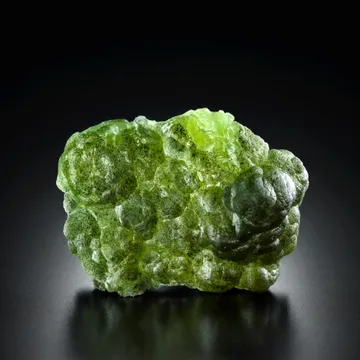
Smithsonite from the 79 Mine is prized above all in its cuprian green forms: apple-green to deeper bluish green botryoidal, stalactitic and rounded aggregates, sometimes with banding, drusy second-generation growth in crevices, or white smithsonite coatings that can obscure the color before cleaning. Much ordinary 79 Mine smithsonite is grey, white or brown, but the best specimens came from oxidized zones such as the lower fourth-level “chrysocolla room,” the Smithsonite Stope and later sublevel pockets, commonly with hemimorphite, aurichalcite, calcite and tiny rosasite. Fine examples range from small thumbnails and miniatures to cabinet pieces over 10 cm, with the strongest specimens showing rich green color, rounded three-dimensional relief, clean surfaces, contrasting white calcite or blue-green aurichalcite, and intact pocket form rather than broken botryoidal crust.
Hemimorphite is one of the most abundant and widespread collector minerals in the 79 Mine workings, occurring as sparkling crystal linings in vugs, colorless to grey druses, pale blue crusts, botryoidal masses, balls and occasional “donut” forms. Individual crystals larger than a few millimeters are uncommon, but blue botryoidal material from the third-level Hemimorphite Stope can make strong miniatures and small cabinet specimens, especially from the 2020 discovery and later 2024–2025 extensions. The best 79 Mine hemimorphite has robin’s-egg to soft sky-blue color, glossy rounded surfaces or crisp sparkling crystals, and lively associations with smithsonite, calcite, aurichalcite or hematite-stained matrix; ordinary pieces are dull, grey-white, chalky, or visually flat once removed from the dramatic lighting of the mine.
Aurichalcite is the mineral that gave the 79 Mine a world-class reputation among connoisseurs: pale blue to intense blue-green acicular sprays, velvety tufts and puffballs, typically perched on hemimorphite, calcite, limonite or green smithsonite in oxidized cavities. Major aurichalcite finds were noted as early as the 1970s, and later collecting on the fourth-level Aurichalcite Stope and in the Smithsonite Stope produced specimens from small thumbnail sprays to fine miniatures and cabinet combinations around 15 cm. The best examples show isolated, upright sprays with saturated color, no matting or abrasion, sparkling hemimorphite or calcite contrast, and undamaged terminations; ordinary pieces are thin blue crusts, rubbed tufts, or aurichalcite lost in visually busy limonite.
Wulfenite from the 79 Mine occurs chiefly as thin, square, tabular crystals in yellow to orange shades, often in protected vugs with hemimorphite, rosasite, chrysocolla, mottramite or calcite. Older reports note transparent yellow crystals reaching unusually large sizes for the locality, but most collectible specimens are thumbnails to miniatures, and the mine’s current reputation is built on delicate plates, “windowpane” crystals, thicker orange beveled tabs, and very rare cross-zoned crystals from a pocket style now important enough to have drawn modern analytical interest. Top pieces need intact edges, glassy transparency, bright color, clean isolation and undamaged transport history; 79 Mine wulfenite is notoriously fragile, and even good crystals are frequently chipped, incomplete, or detached from hard iron-rich matrix.
Calcite at the 79 Mine is a supporting actor rather than the headline species, but it can make a specimen: colorless to white crystals, small disk-like aggregates, sparkling druses and occasional flower-like growths occur with hemimorphite, aurichalcite, smithsonite and wulfenite in the oxidized cavities. Collectors prize calcite here when it provides contrast—white or glassy accents on green smithsonite, bright microcrystals sprinkled over blue aurichalcite, or sculptural “flower” forms on hemimorphite—rather than as isolated calcite specimens. The best pieces are clean, well-positioned associations where calcite sharpens the color palette; ordinary material is simply colorless gangue, cleavage, or vug lining with little independent visual impact.
Rosasite from the 79 Mine is a small-scale but attractive copper-zinc accessory, typically forming teal to blue-green micro-botryoidal beads, hemispheres or hairlike clustered aggregates on hemimorphite, smithsonite or oxidized matrix. It is especially effective in combination specimens from the Smithsonite Stope and related sublevel ground, where tiny rosasite hemispheres may sit on white smithsonite coatings over green smithsonite or appear with aurichalcite, calcite and hemimorphite. Good rosasite pieces from the mine are about color, texture and association rather than size: bright teal beads on a clean contrasting surface are far more desirable than dark, indistinct crusts; the finest examples hold up under magnification and add an extra coppery-blue punctuation to classic 79 Mine pastel assemblages.
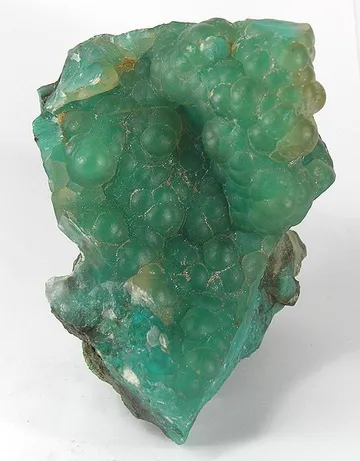
Chrysocolla was long present at the 79 Mine mostly as blue-green crack filling or a colorful substrate beneath more celebrated species, but recent collecting changed its status at the locality. A mid-2024 cavity in the fourth-level Aurichalcite Stope yielded deep-blue, lustrous botryoidal chrysocolla, including stalactitic forms and pieces described as possible pseudomorphs after aurichalcite, with many flats distributed to collectors. The best chrysocolla from this find is saturated blue, glossy, rounded and sculptural, with enough form to stand on its own rather than merely acting as background; lesser material remains the familiar massive or seam-filling chrysocolla that adds color but not strong specimen architecture.
Beyond the headline suite, the 79 Mine is a unusually rich oxidized micro-mineral locality with a long reported list including anglesite, cerussite, malachite, azurite, brochantite, descloizite, mottramite, vanadinite, pyromorphite, mimetite, caledonite, linarite, tsumebite, ktenasite, ramsbeckite, murdochite, plattnerite, willemite, hydrozincite, sauconite, goethite, hematite, jarosite and many others. Its modern scientific distinction is liudongshengite, Zn4Cr2(OH)12(CO3)·3H2O, a pinkish hydrotalcite-supergroup mineral first described from the 79 Mine and notable as a natural Zn-Cr carbonate. Some species reported from deeper levels have not been readily verifiable in recent collecting because the fifth, sixth and seventh levels have been inaccessible for years, so old labels for unusual 79 Mine micros deserve careful scrutiny.
The most common authenticity problem with 79 Mine material is not an established trade in deliberate fakes, but confusion among visually similar secondary zinc and copper minerals. Pale blue hemimorphite, blue-green aurichalcite, cuprian smithsonite, chrysocolla and rosasite can be miscalled when labels are vague or when specimens are traded without magnification. Botryoidal blue hemimorphite and green smithsonite are especially easy to confuse in casual photographs; acid reaction can help distinguish carbonate smithsonite from silicate hemimorphite, but acid testing should never be done on a finished specimen unless a tiny inconspicuous sacrificial point is available and the collector fully understands the risk.
Preparation history matters. Some green smithsonite pockets produced pieces with a thin white smithsonite coating, and recent collectors have documented removal of that coating with hydrochloric acid. That is a legitimate cleaning practice when disclosed and done carefully, but it means buyers should look for acid-burned surfaces, dulled luster, or residual white film in protected crevices. Acid will also attack calcite and other carbonates, so associated calcite may be etched or lost on overcleaned pieces.
Condition is critical because many 79 Mine specimens are inherently fragile. Aurichalcite sprays mat and crush easily; wulfenite plates are thin enough to chip on extraction, packing, ladder climbs or shipping; hemimorphite botryoids can bruise; chrysocolla surfaces can scuff; and iron-rich matrices may shed dust or small grains. A 79 Mine wulfenite with complete edges and no repairs is far scarcer than the species count alone suggests. For aurichalcite, look under magnification for broken needles, compressed tufts and unnatural “fuzzy” surfaces caused by handling.
Labels deserve attention. Older specimens may say “Seventy-Nine Mine,” “79 Mine,” “79th Mine,” “McHur prospect,” “near Hayden,” or “Banner District,” all of which can be legitimate depending on the label style and era. However, because Arizona has many famous wulfenite and secondary copper-zinc localities, generic labels such as “Hayden, Arizona” or “Gila County” should not be upgraded to the 79 Mine without strong provenance. Conversely, specimens from the mine collected during the 1970s, 1990s, early 2000s and post-2017 specimen operations may look different from one another; locality confidence improves when a label also names a collector, pocket, level, or stope.
Market availability is better than many closed classics because recent private collecting has produced new material, especially hemimorphite, aurichalcite, smithsonite, wulfenite and chrysocolla. Even so, the hierarchy is steep. Small association pieces and modest blue hemimorphite remain obtainable; fine green cuprian smithsonite, undamaged aurichalcite sprays on attractive matrix, crisp orange or windowpane wulfenite, and the rare cross-zoned wulfenites are much scarcer. Museum-quality 79 Mine specimens tend to move through specialist dealers, older Arizona collections, and private exchanges rather than ordinary bulk mineral channels.
The mine’s origin story is as western as the name suggests. Mike and Pat O’Brien discovered the deposit in 1879, and the property simply carried that year forward as its identity. Before roads made the place practical, ore moved out by burro to the railway at Hayden Junction. It is easy to forget, when looking at a polished green smithsonite miniature under LED lights, that the same mine once depended on men, animals, desert tracks and the economics of getting lead carbonate ore to a smelter.
In the early 1920s, the mine began to take on an industrial shape. The Continental Commission Company worked the Discovery ore body; later, the Seventy-Nine Mining Company operated at roughly 50 tons of ore per day. Litigation, falling metal prices, and ownership changes repeatedly interrupted the rhythm. The mine was sold at public auction in 1926 to satisfy a $16,000 judgment, then reopened in 1928. In 1929, during one of its stronger years, the property became a leading Arizona lead producer and an important silver producer, a reminder that the delicate collector minerals were only incidental to the mine’s original purpose.
The practical work of mining left vivid numbers. The inclined shaft was deepened to 450 feet; later development reached seven levels; and the lower mine eventually met water below the seventh level, roughly 500 feet beneath the surface, where lack of pumping capacity hindered deeper work. By the time later collectors entered the scene, they were moving through a complicated industrial skeleton: old stopes, raises, ladders, haulage levels, dust, heat, humidity, broken ground and oxidized pockets the metal miners had largely ignored.
A modern collecting account from David K. Joyce and Daniel D. Joyce captures the mine in its specimen era. In 2017, 1879 Minerals LLC formed under the current ownership group and began refurbishing the underground workings. Collecting became an invited-guest activity, not public access. The description is unromantic in the best way: rough road, locked gates, trail cameras, low-ceilinged stopes, masks for lead-bearing dust, helmets, gloves, knee pads, hammer drills, wrapping material, and a full change of clothes for anyone emerging “covered in fine dirt from head to toe.”
One 2018 aurichalcite episode shows why the mine keeps drawing serious collectors back. On his first visit, David K. Joyce worked in the fourth-level Aurichalcite Stope and found mostly poor material. At one end of the upper stope, he followed a vein-like structure lined with sparkling hemimorphite on limonite, still seeing little of consequence. Then a single intense blue, thick-bladed aurichalcite spray appeared among the smaller hemimorphite. He removed it intact on matrix—a rare piece from that exact spot, and possibly unique.
Another aurichalcite story has the sting of underground timing. Joyce and Ray McDougall worked overhead in the back of the Smithsonite Stope, extending an aurichalcite zone in the roof. They recovered a few decent pieces, exhausted themselves with hammer-and-chisel work above shoulder height, packed up, and started the climb out. Resting on the fourth level, they heard Cody Schwenk coming up the ladder. He emerged with a spectacular aurichalcite specimen from the same spot they had just abandoned, found by pushing the pocket only a few more inches.
The smithsonite discoveries have their own drama because most 79 Mine smithsonite is not exceptional. Grey, brown and white material is common enough, while fine green cuprian pieces are what collectors hope for. In April 2024, Joyce was working in the Smithsonite Stope on the fourth-level sublevel when his chisel opened a new large pocket of deep green smithsonite. Several excellent specimens came out; after he told Cody Schwenk, the two returned and recovered the remaining pieces. Some had a thin white smithsonite coating that masked the green and came away with a short acid dip, revealing the color beneath. One cleaned example was later displayed at the Alfie Norville Gem and Mineral Museum in Tucson.
Hemimorphite gave a more generous kind of find. In 2020, a large blue zone opened in the old third-level Hemimorphite Stope, producing many flats of robin’s-egg blue botryoidal specimens. The zone did not end with the first discovery. In 2024 and 2025, collectors continued to find extensions, including one impressive area recovered by Chad Nordhal of Colorado and later work by Cody, David and Daniel Joyce that produced more blue botryoidal hemimorphite with smithsonite, calcite and hemimorphite crystals. The best of those pieces show the mine at its gentlest: rounded blue forms on pale matrix, no pyrite glitter, no harsh contrast—just soft zinc-silicate color from a hard underground place.
The wulfenite stories are harsher. The fourth-level Wulfenite Stope is described as hot, humid and unpleasant, with loose rock underfoot and rockfall concerns overhead. The crystals themselves are part of the difficulty: thin, glassy, square plates attached to hard matrix. A specimen may survive the chisel work and still break during packing, the climb to surface, or the drive home. One photographed wulfenite in a vug on rosasite, about 2 cm on edge, did not survive extraction. That is an unusually honest note in the specimen literature, and every 79 Mine wulfenite collector should remember it.
The rarest recent wulfenite episode belongs to the so-called Cross Pocket. A very limited number of wulfenite crystals showed distinctive cross-shaped zoning, with a dark cross beginning at the center and extending along the crystal axes. Modern researchers have considered the zoning unusual enough to investigate by scanning electron microscopy and energy-dispersive spectroscopy. For collectors, the appeal is immediate: a familiar Arizona wulfenite form carrying a graphic internal mark that has not been documented as a common global style.
Then came chrysocolla. For years it had been a background mineral at the 79 Mine, a crack filling or colorful substrate rather than a headline. In mid-2024, a seam in the fourth-level Aurichalcite Stope opened into a cavity of deep-blue lustrous botryoidal chrysocolla, some of it stalactitic and some possibly replacing aurichalcite. Don Bouchelle discovered the seam, and he and Cody Schwenk, with help from others, excavated it. Many flats entered the collector community, instantly broadening what a modern 79 Mine suite could look like.